
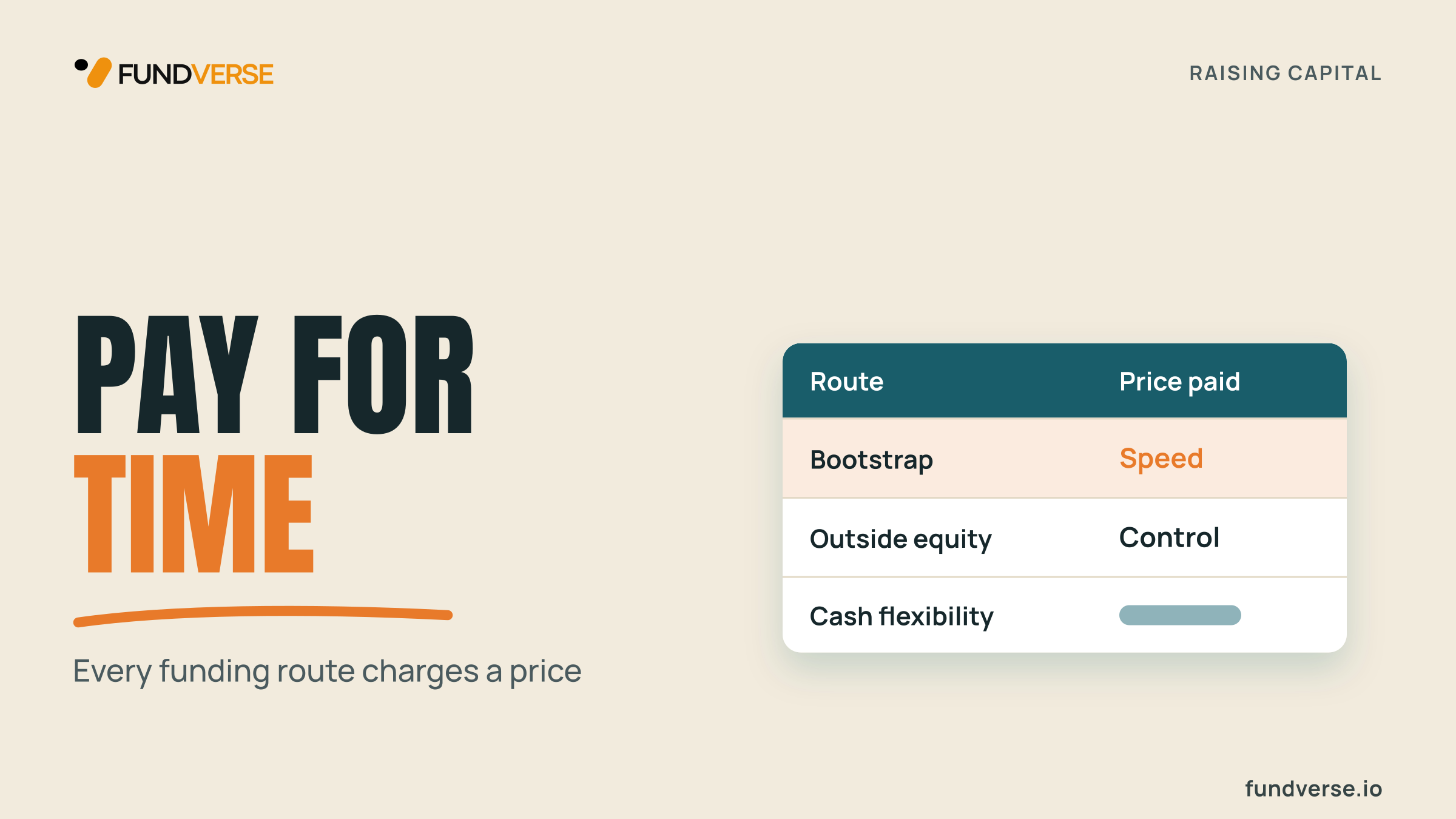

Bootstrapping and outside funding are two ways of buying time, each at a different price. The right choice depends on what your market punishes and what you are willing to trade.
Founders announce how they are funded the way some people announce their diets. One camp says it never took a dollar from anyone and answers only to customers. The other says you cannot build anything important without serious backing, and that the first camp is playing small. Both speak with the confidence of people who found something that worked for them and concluded it must work for everyone.
Both are asking the wrong question. Nobody is choosing a philosophy. A founder is choosing how to pay for time: the months it takes to find customers, fix the product, hire the first people and survive the early mistakes. Every funding route buys some of that time, and every route charges for it. The sensible way to choose is to look at the price tag, and then at how much time your particular market actually allows.
Everything has a price
Bootstrapping looks free because no investor writes a check. It is not free. It costs speed, because growth is limited to what the business can fund from its own sales and the founder's savings. It costs personal risk, because the founder's income, credit and sometimes family stability sit underneath the company. And it costs optionality: a competitor with a large balance sheet can hire faster, discount harder and stay in the market through a bad year that would end you.
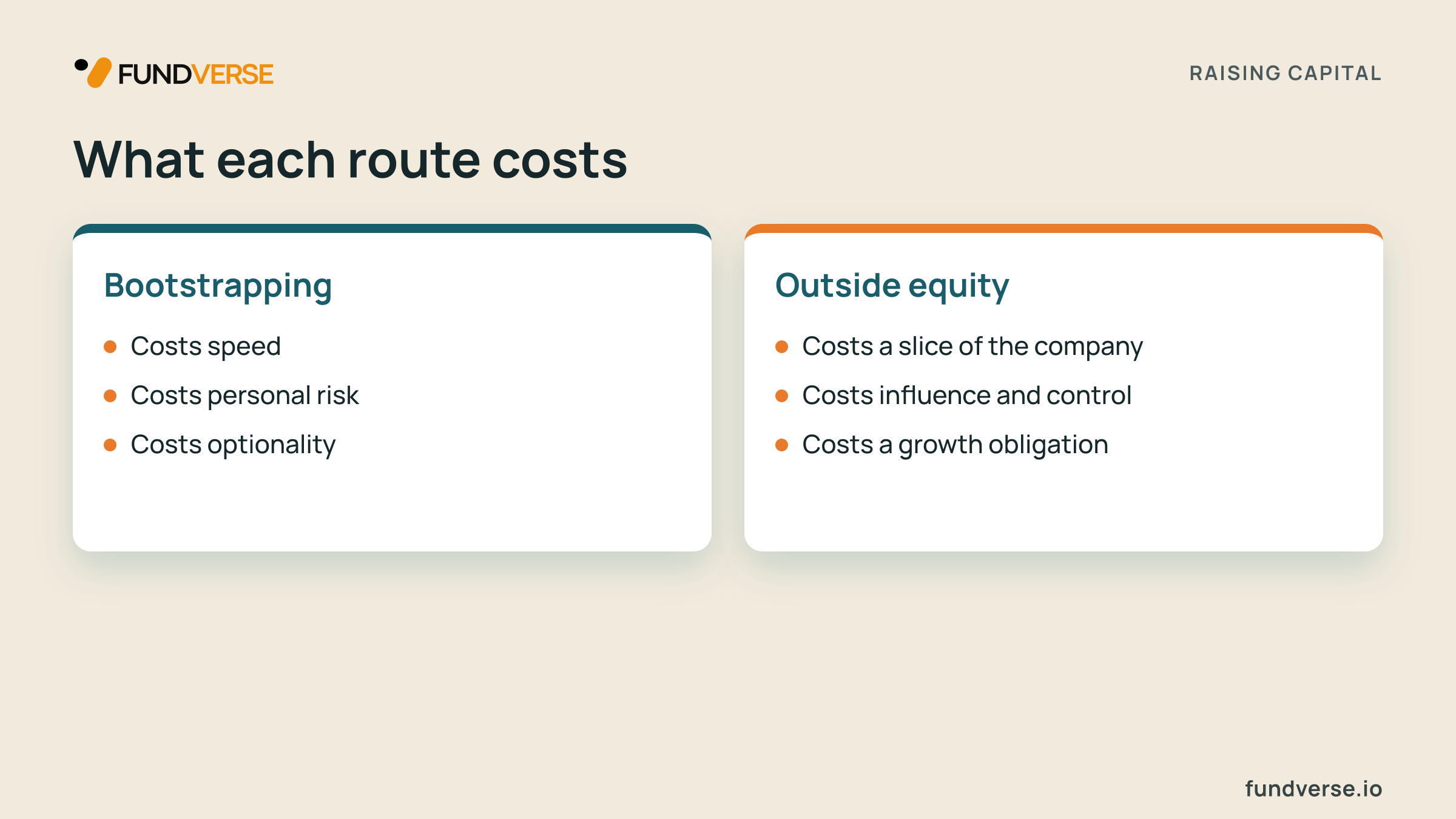
Outside equity looks expensive because the founder gives up a slice of the company, and that is real. But it is only part of the bill. Investors also buy influence: board seats, consent rights over later financings, a say in whether and when to sell. Most of all they buy an obligation. Venture-style investors need a few outcomes large enough to return an entire fund, so your business is expected to aim at a size that may or may not suit it. The check arrives with a growth plan attached, and the plan is rarely negotiable in spirit even when it is negotiable in detail. The sharpest version of this price is that selling a fifth of a company is really selling a share of every future decision.
So the trade is cash, control or speed, and you cannot have all three. A founder who keeps control and cash by growing slowly pays in speed. A founder who wants speed and keeps cash flexible pays in control. Any honest comparison starts there.
Money changes behavior
The more interesting difference between the routes is what they do to the people running the company. Where money comes from shapes which decisions feel natural and which feel reckless.
Customer-funded companies learn a discipline early. Every cost has to be justified by revenue that already exists or is very close. Pricing gets tested immediately, because a price customers refuse becomes a payroll problem next month. Features get built when someone will pay for them. The result is often unglamorous and frequently resilient, because the loop between what the company does and whether it eats is short and unforgiving.
Investor-funded companies learn a different one. The money arrives before the evidence, so the company may make bets customers have not yet endorsed: hiring ahead of demand, entering a second market, running at a loss to buy share. That freedom is the point of the capital. The pressure is its other side. The company is now measured against a trajectory, and a business growing at a respectable rate can look like a failure if the plan assumed something much faster.
The same business, two routes
Take a hypothetical software company selling scheduling and invoicing tools to independent clinics. Assume that in year one it reaches modest recurring revenue from a handful of clinics, with healthy gross margins and two founders drawing small salaries.
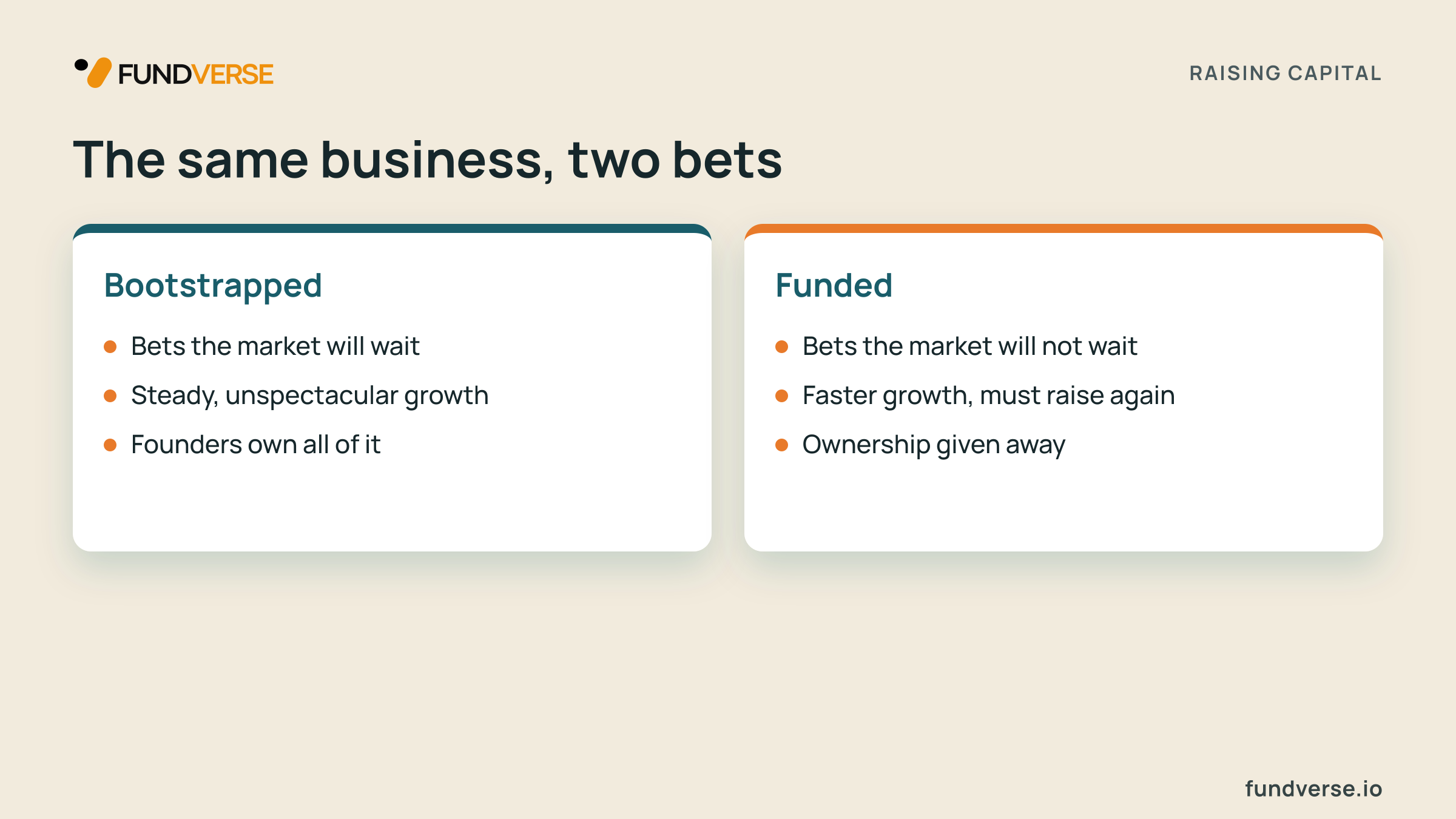
On the bootstrapped route, the founders keep the team at two plus one contractor. They sell to clinics one at a time, in person, because that channel works and costs almost nothing. Each customer pays upfront for the first quarter, so cash arrives before the cost of serving them. They turn down a request for a custom integration because no one will pay for it. By year three the company is profitable and growing at a steady, unspectacular rate, and the founders own all of it. If a larger player copies the product and markets aggressively, they may lose some share, but they have no investors to disappoint and no burn to feed.
On the funded route, the same company raises a seed round in year one. The plan now shows national expansion, a sales team and an integration partnership with a payments provider. Hiring runs ahead of revenue, so each month the company spends more than it collects and the gap comes out of the investors' money. Growth is faster, the company reaches clinics in several regions, and a competitor finds it harder to catch up. But the clock is running: the company must raise again before the cash runs out, and its next round depends on showing growth that justifies a higher price. If the clinics turn out to be slow, loyal, low-spending customers, a business that would have been a comfortable company for its founders becomes a problem for everyone, because the math of a venture return needed a much larger outcome.
Neither version is wrong. They are different bets. The bootstrapped one bets that the market will wait. The funded one bets that it will not, and that being early to scale is worth more than the ownership given away. The only real question is which bet describes the actual market.
Market structure beats temperament
Founders often choose a route by temperament: I prefer independence, or I want to move fast. Temperament matters, but the market usually matters more, and it does not care about your preferences.
Some markets reward whoever scales first and punish everyone else. Marketplaces, networks, platforms with strong switching costs and anything where the largest player gets cheaper and better as it grows tend to be winner-take-most. Capital-heavy businesses are similar in a different way: a manufacturing plant, a fleet, a lender that needs a balance sheet to lend against, or an energy project cannot begin on savings and early sales, because the product does not exist until the money has been spent. In these markets, bootstrapping is not a principled stance. It is a decision to arrive late, or not at all.
Other markets are quite different. Service-led businesses, niche software, specialist distributors, local brands and companies selling to customers who buy steadily rarely have a land grab. The market will still be there next year, and the advantage of scaling quickly is small. Cash-generative models, where customers pay before the company spends, can fund their own growth for a long time. Venture capital is often a mistake here, because the investor needs an outcome the market structure cannot supply.
Many businesses fit neither description. They are too small or too slow for venture capital and too capital-hungry for pure bootstrapping: a food processor that needs equipment, a logistics company that needs vehicles, a clinic chain that needs premises, a software company selling to slow-paying institutions. These are good businesses, though a good business is not necessarily an investable business, and the either-or framing leaves them nowhere to go. For them the answer is usually in the middle.
The middle routes nobody brags about
Nobody celebrates a well-structured equipment loan, which is why the middle gets ignored in the public conversation. For a large share of real companies, though, it is where the decision actually lives.
Revenue-based finance gives a company capital in exchange for a fixed share of future revenue until a set total is repaid. Because repayment flexes with income, a slow month costs less, and the founder gives up no ownership. It suits steady sales and good gross margins. It is usually more expensive than a bank loan and takes a bite out of cash flow every month, so it works poorly when margins are thin.
Small bank and asset-backed loans are unfashionable and underrated. If the business owns or can pledge something a lender can value, such as equipment, inventory or receivables, debt can fund growth without diluting anyone. The catch is that a bank loan is priced on collateral quality rather than business quality, which is worth understanding before you apply. In many emerging markets, collateral rules, high interest rates and personal guarantees make this route harder, and founders there often combine it with other sources.
Grants and development finance can fund work with a public benefit, such as health, agriculture, clean energy or financial inclusion, without any claim on ownership. They are slow, competitive and come with reporting demands, and a grant maker's priorities can pull a company off course. Still, for the right business in the right sector, a grant can pay for expensive early work that no commercial investor wants to fund yet. Blended structures, where grant money absorbs early risk so commercial capital will follow, are becoming more common; see the shift toward blended finance and revenue-based grants.
Customer prepayments may be the cleverest form of funding because they barely feel like funding. Annual contracts paid upfront, deposits on custom work, pre-orders and paid pilots all put the customer's cash to work before the company has spent its own. It is bootstrapping with a lever, and it tests demand at the same time, which is why the cheapest way to test a business idea is to get paid first.
Angel money sits between the extremes. Angels write smaller checks, often have operating experience, and are frequently more flexible about outcome size than a fund that needs a very large return. They are not always gentler, and some behave like small venture funds, but a founder who wants a modest injection and a sounding board often finds more room here than in an institutional round. For founders in markets where venture funds are few, a mix of angels, grants, lenders and customer cash is not a fallback. It is the normal way capital gets assembled, as the piece on alternative funding routes for founders in emerging markets explains.
The strongest case against this view
The best objection is that this underrates the cultural and psychological differences. Treating funding as a pricing decision sounds rational, but founders are not calculators. A founder who takes venture money signs up for constant fundraising, board management and growth pressure, which may be a different job from the one they wanted. A founder who bootstraps may build habits that make a company durable and are hard to acquire later. If identity shapes behavior, then identity is part of the price, and perhaps it deserves a larger role than I am giving it.
Most of that is right. Preferences are legitimate inputs: if you would rather own all of a small company than a fraction of a large one, that is a defensible choice and no one should pressure you out of it. My objection is to starting there. Identity tells you what you want, and says nothing about what your market will allow. A founder who bootstraps because it is who they are, and then enters a winner-take-most market, has chosen a story over a strategy. Start with the market, then let preferences decide among the options it leaves open.
Five questions that decide it
These turn the philosophy into a decision. They are not a scorecard, and no formula will hand you an answer, but together they show which way the evidence leans.
- Time to first revenue. How long before a real customer pays? If the answer is weeks, bootstrapping is plausible. If it is years, because you must build a plant, get a license or complete a long sales cycle, someone has to fund the gap.
- Gross margin. What is left after the direct cost of serving each customer? High margins let sales fund growth. Thin margins mean growth eats cash, which points toward outside capital or asset-backed debt.
- The cost of falling behind. If a competitor doubles your size in a year, what happens to you? If you merely lose some share, time is cheap. If you lose the market, time is expensive and speed is worth paying for.
- Personal runway. How many months can you live on savings if the company pays you nothing? A founder with a short runway who bootstraps is borrowing from their own household at a very high rate. What founders should pay themselves matters more than most plans admit.
- What the money would specifically buy. Name the purchase: two engineers, a machine, six months of inventory, a regulatory approval. If you cannot say what it buys and what that changes, you are not ready to raise it. Asking what the money would change goes deeper.
Notice what the test does. It does not say raise or do not raise. It asks you to look at the gap between where you are and where the market requires you to be, then to find the cheapest capital that closes it. Sometimes that is a prepayment from your first five customers. Sometimes it is a loan against receivables. Occasionally it is a venture round, with the full price understood. Often it is a combination.
If you decide outside capital is part of the answer, a prepared data room and a well-matched list of investors save months of effort. Fundverse helps founders organize their materials and reach capital providers whose appetite fits their stage and structure.
The question to carry out
Imagine your best competitor doubling in size over the next twelve months while you grow at the pace your own sales can fund. Would you still be in business, and would the loss be something you could live with? If your honest answer is yes, you probably have more time than you think, and the cheapest money is the money your customers hand you. If the answer is no, ask what you are really protecting by keeping the cap table clean, and whether you would rather own all of something that arrives too late.
Frequently asked questions
Topics
bootstrapping vs external funding
bootstrapping a startup
early-stage funding options
revenue-based financing
venture capital vs bootstrapping
startup funding decision
alternatives to venture capital
customer prepayments
Raising or investing?
Find the right people on the other side of the table, and run the round in one place.