
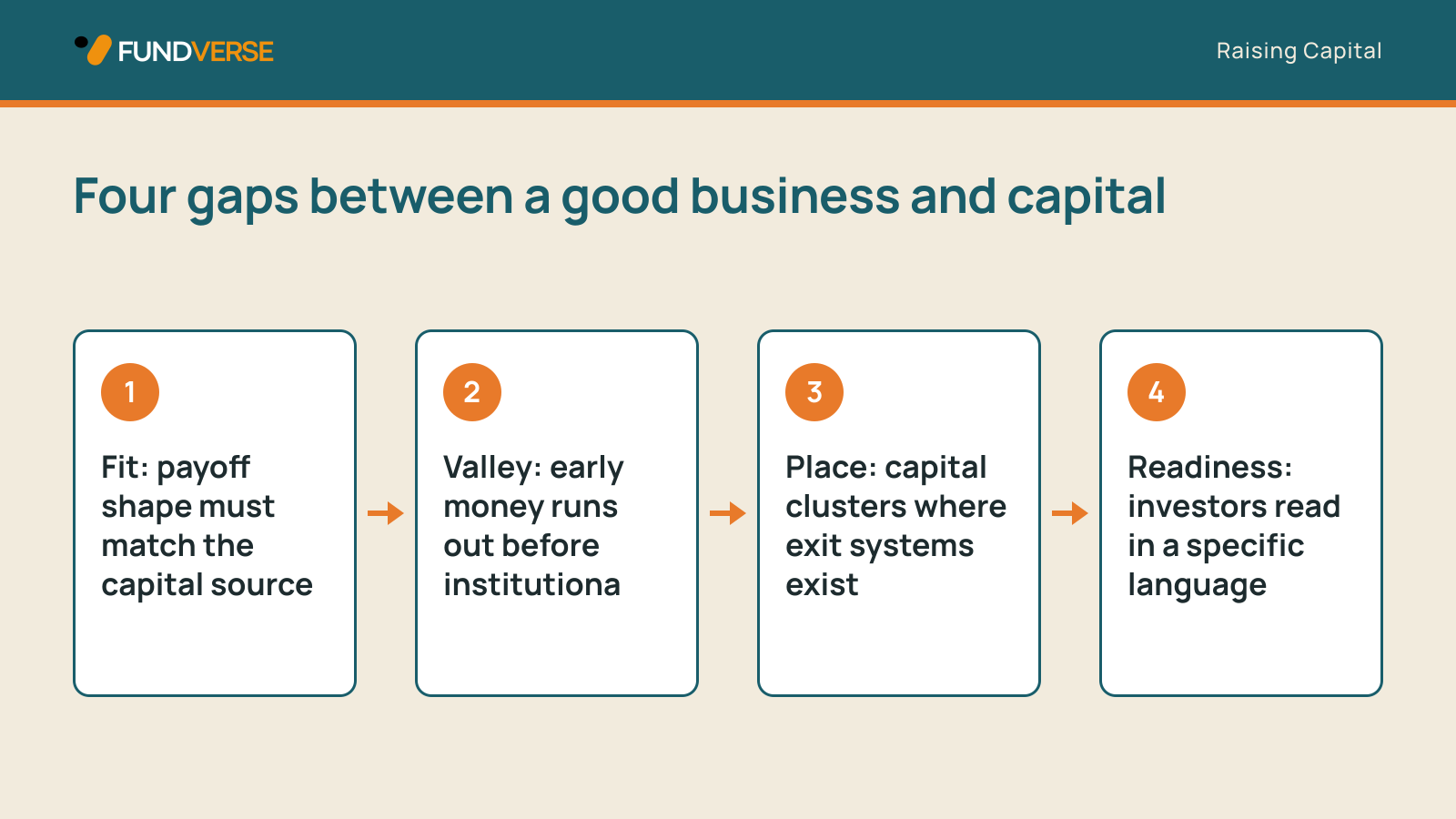

A profitable, well-run company can still be unfundable. The reason is rarely quality. It is fit, and four structural gaps decide whether a good business ever meets capital that suits it.
Picture two companies pitching the same investor on the same afternoon. The first is a regional distributor of building materials: twelve years old, profitable every year, loyal contractors, a founder who knows most customers by name. The second is a software company that has never made a profit, loses money on each new customer for the first year and is growing at triple digits. Most investors in the room will lean toward the second, which looks perverse until you notice they are not deciding which business is better.
They are asking whether a business can produce the returns that their particular pool of money needs. Investability is not a trait a company carries around like a credit score. It is the fit between the shape of a business's payoff and the requirements of a specific source of capital, plus enough evidence and permission for the money to move. When a good business cannot raise, one of those pieces is usually missing, and the reasons are more structural than most rejection emails admit.
Investable is a matching problem
Start with venture capital, because it sets the terms of the startup funding conversation even for companies that will never touch it. A venture fund is a portfolio of bets, and the arithmetic of the portfolio dictates what each bet must look like. Take a hypothetical $50 million fund that owns about 10% of a company at exit after several rounds of dilution. For that single company to return the entire fund, it would need to be worth roughly $500 million. Since most investments in a venture portfolio fail or stall, a few have to be far larger than that to make the fund work. A fund cannot rationally back a business whose realistic best case is an excellent $40 million company, however well run.
Nobody is being unkind there. The distributor is a strong candidate for a bank loan, asset finance, a minority stake from a patient family office, or simply retained earnings. Its economics are steady cash flows rather than a lottery ticket, a shape that suits debt and patient equity far better than venture. Trouble starts when founders and investors misread the match, or when the right kind of capital does not exist nearby. Our guide to choosing between equity, debt and blended capital covers the instruments. The four gaps below explain why the match so often fails to happen even when it exists.
The valley between two kinds of money
Founders call the stretch between friends-and-family money and a first institutional round the valley of death. Early money comes from people betting on you: relatives, friends, a handful of angels. It is small, quick and relationship-driven, enough to fund a prototype and a first few customers. Institutional money comes from funds and lenders betting on evidence such as retention, margins and a repeatable way of selling. The valley opens because the evidence institutions want usually costs more than the early money provides.
Consider a business that raised $150,000 from people who believe in it. That might buy eighteen months for a small team. A seed fund wants a repeatable sales motion, which can take longer than eighteen months and more than $150,000 to demonstrate. The angels who could write a second check are not set up to lead a larger round, and the funds who could lead it do not want to be first to bear the risk that the motion does not repeat. Each side behaves sensibly, and the company sits between them, burning cash on a clock. Institutions have fixed costs too: diligence on a $300,000 check takes much the same legal and analyst time as on a $3 million one, which is why small checks often look uneconomic to them. The practical consequence is that money raised before the valley should buy the specific proof the next investor will ask for, rather than breadth, features or a bigger team.
Capital has a postcode
Money clusters, and for reasons beyond fashion. A fund in San Francisco, London or Singapore wants co-investors who will join the next round, advisers who can open doors, experienced executives to hire and, above all, a believable route to an exit through acquirers or public markets. Those ingredients are dense in a few cities and thin elsewhere. An investor looking at a company in a smaller market is judging not only the company but the surrounding system it needs in order to produce a return.
Distance adds friction. Investors who sit on boards and monitor closely find that harder across time zones and currencies. A business that earns in a local currency but must deliver returns in dollars carries exchange-rate risk the founder never chose and cannot control. Sometimes the geographic bias is rational and sometimes it is plain habit: investors go where they already know someone, and their existing portfolio becomes the evidence that the place is safe. Both can be true at once, which is why the bias is so stubborn. A founder's most useful response is to ask which missing pieces of that system they can supply themselves, such as a credible list of likely acquirers, a dollar-linked revenue stream or a regional co-investor, rather than to argue that their city deserves better.
Readiness is a language, not talent
Investment readiness is often discussed as a character test. It is closer to a language barrier. Investors read businesses through a particular grammar: unit economics, cohort retention, a cap table that adds up, financials that reconcile with bank statements, projections whose assumptions can be challenged. A founder who built a solid company on intuition, cash discipline and customer relationships may be fluent in running the business and unable to render it in that grammar. Nothing about the business is weaker. The investor simply cannot see it.
Networks widen the gap. Founders inside established ecosystems pick up the dialect from peers who have raised, from advisers, from the warm intro who explains what the partner will ask. Founders outside those circles receive the rejection email without the translation, so some capital flows to people who present well rather than people who operate well. Closing the gap is rarely glamorous: a model that ties to real accounts, a clean cap table, a data room that answers questions before they are asked. It is translation work, and it can be learned.
Rules that make caution rational
Much of the world's investable capital sits inside institutions with legal duties, mandates and regulators: pension funds, insurers, banks. A trustee who allocates to a small private company in an unfamiliar market and loses money must explain the decision. One who allocates to a large listed index and loses money has a defense ready. Allocation limits on private markets, capital requirements that can make unsecured lending to small firms costly to hold, and know-your-customer and anti-money-laundering checks that cost the same whether a deal is large or small all push money toward bigger, collateralized, familiar transactions.
Securities rules add to it. In many jurisdictions, laws restrict who may invest in private companies, which protects ordinary savers and also shrinks the pool of early-stage money. Exchange controls and approval processes slow cross-border capital. Each rule has a defensible purpose, but the cumulative effect is a system where an individual decision-maker is punished more for a bad yes than for a missed good one. Risk aversion, seen this way, is less a personality flaw in investors than a product of how they are held accountable.
If you are working out which investors fit the shape of your business, and how to present it in their language, Fundverse's investor matching and data rooms are built for that groundwork.
Start by naming your payoff shape
Put together, the four gaps say something encouraging: being uninvestable to venture capital is often a statement about payoff shape, not a verdict on the business. So the first move is to decide honestly what shape yours is. If the best case is a durable, cash-generative company, look first at lenders, revenue-based structures, development finance and patient investors, and use equity sparingly. If you truly have venture-scale potential, accept what comes with it: dilution, growth pressure and an exit horizon. Then write down what the next investor will need to see to cross the valley, and price your early round against that. The startup valuation calculator can give a rough starting range for those conversations.
The valley, the postcode effect and the rulebook are market failures, and no amount of founder polish fully repairs them. A rejection should not be read as a ruling on the quality of your work when these mechanisms explain it just as well; the structural side is explored further in our piece on why promising businesses struggle to access capital. Waiting for the system to fix itself is not a strategy either. The founders who raise in thin markets tend to be those who stopped asking whether their business was good enough and started asking whose money has a shape that fits theirs.
What to watch next is whether the middle of the market fills in: regional funds writing smaller checks, revenue-based and blended structures that suit steady businesses, and tools that standardize how company data is shared with funders. As those spread, investable may stop meaning venture-shaped and start meaning well matched, which would be a better definition for most of the businesses that actually exist.
Frequently asked questions
Topics
investable business
raising capital
venture capital
payoff shape
funding gap
startup funding
investor expectations
investment readiness
Raising or investing?
Find the right people on the other side of the table, and run the round in one place.