
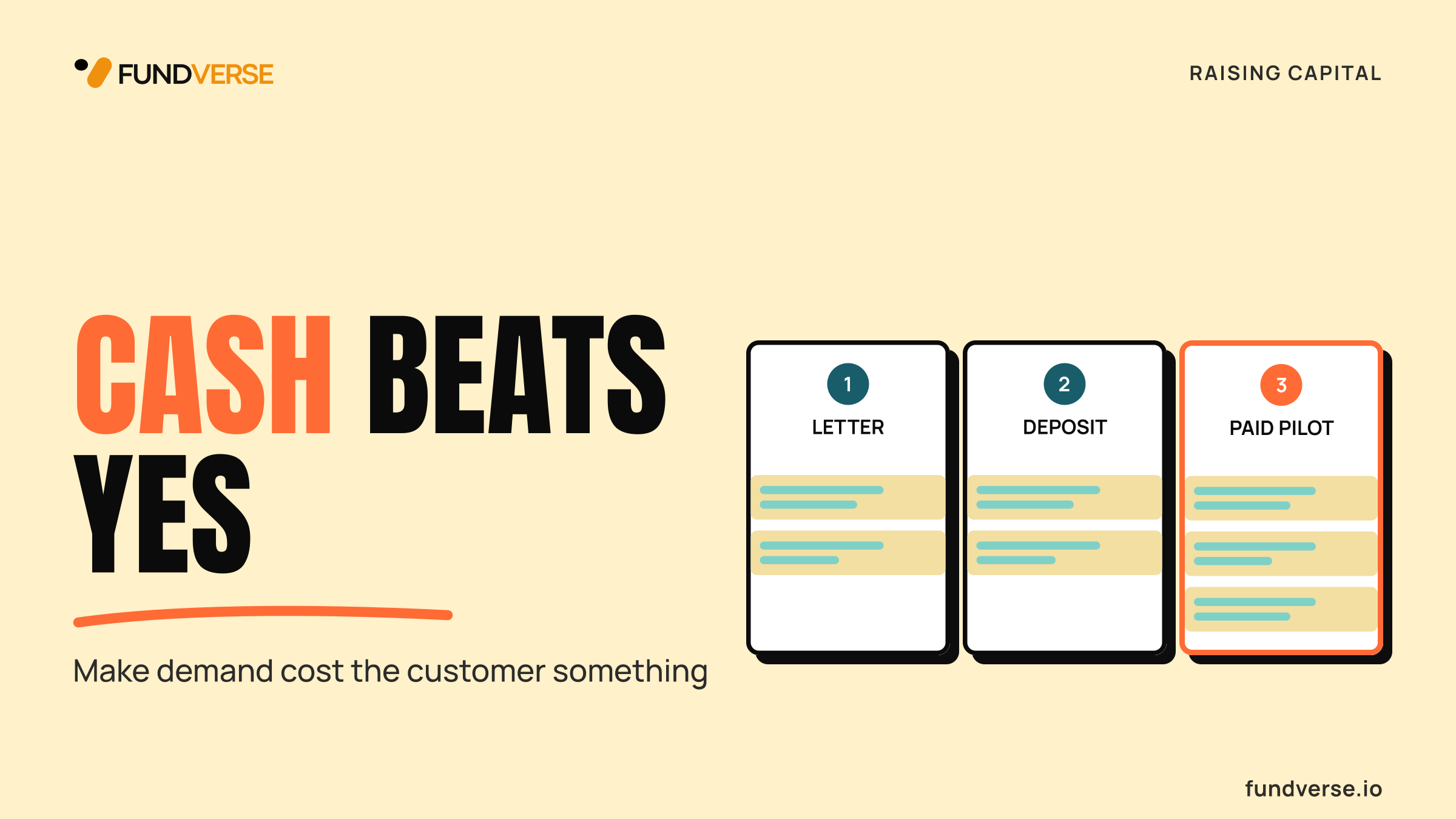

Surveys, compliments and waitlists measure politeness. A deposit, a paid pilot or a signed commitment measures demand. Here is how to design a small test, set a loss limit and read the result honestly.
Imagine two founders who each spend a month asking people about the same idea, say a service that handles import paperwork for small retailers. The first collects forty enthusiastic conversations, a survey in which most respondents say they would use it, and a waitlist of several hundred emails. The second collects three signed one-page agreements, each with a small deposit. Ask which founder knows more about demand and most people answer correctly. Ask which one feels more confident, and it is usually the first.
That gap between confidence and evidence is where savings get lost. Enthusiasm is cheap to produce and expensive to act on. This guide is about replacing it with a signal that costs the other party something real, and about designing the test so that failing it costs you little. It applies to an individual founder, a small company exploring a new line, or a project developer wondering whether anyone will take the output of a plant that does not exist yet.
Why politeness passes for demand
When you ask someone whether they would use your product, they are not forecasting their own behavior. They are being pleasant to a person who is visibly hoping for a yes. Saying yes costs nothing, and saying no creates an awkward moment, so answers skew positive and the founder, who wants them positive, reads them generously.
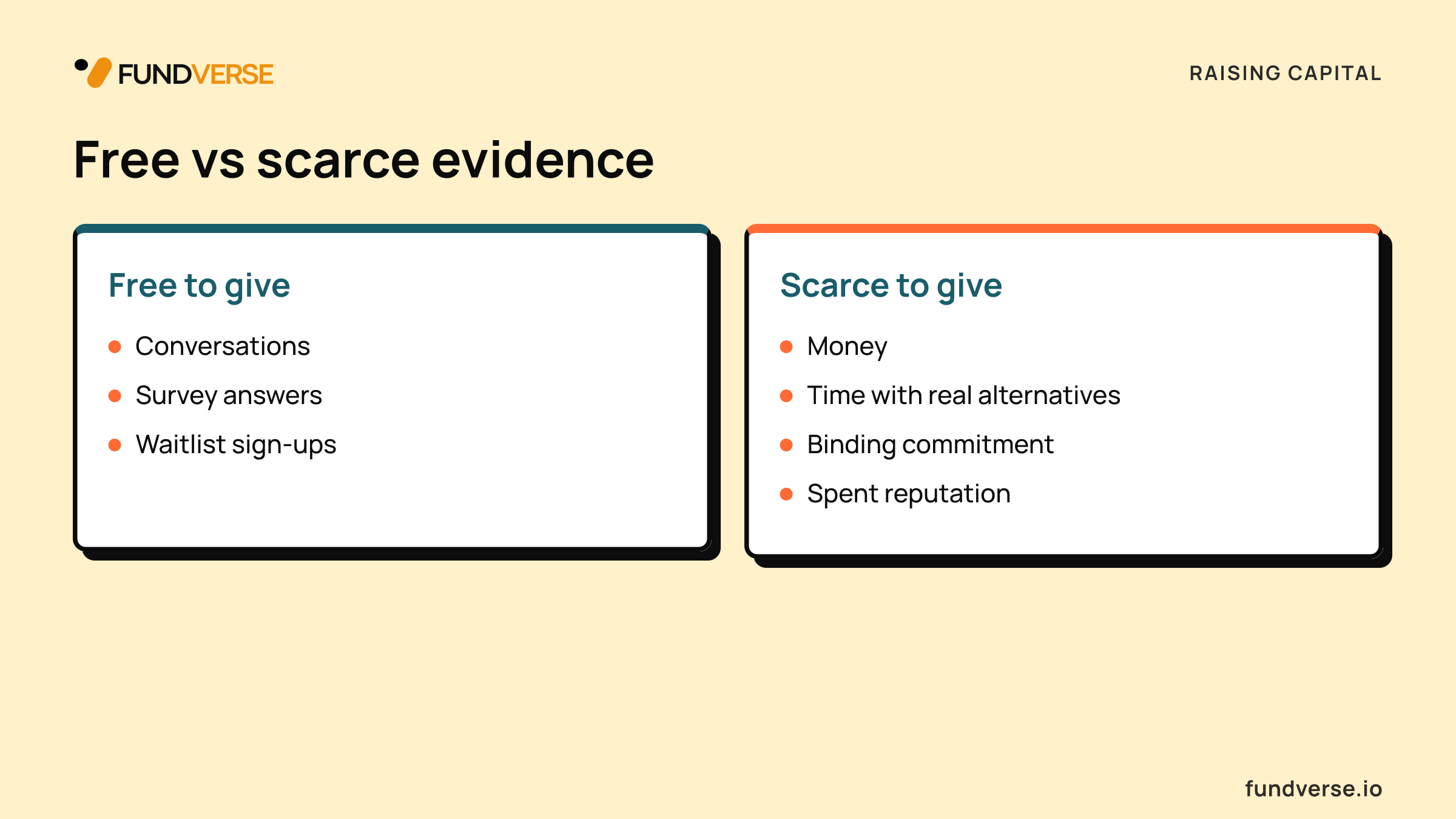
Surveys and waitlists share the flaw. A respondent who says a feature is important has not been asked what they would give up for it, whether budget, attention or the effort of leaving whatever they use now. A sign-up takes seconds, needs no budget approval and can be undone by ignoring the next email. A count of sign-ups tells you the ad worked or the headline was interesting. It does not tell you anyone will pay.
The useful distinction is between evidence that is free to give and evidence that is scarce to give. Scarce things include money, time that has a real alternative use, a commitment that creates an obligation, and reputation spent on your behalf, such as an introduction to the colleague who controls the budget. When a counterparty gives up one of those, they have run their own cost-benefit analysis and decided you are worth it. Conversations and sign-ups still help you learn what the problem looks like and who has it, and a carefully built waitlist can serve a purpose. They are poor tools for deciding whether to commit money. Use them to learn and use payment to decide.
Climb the commitment ladder
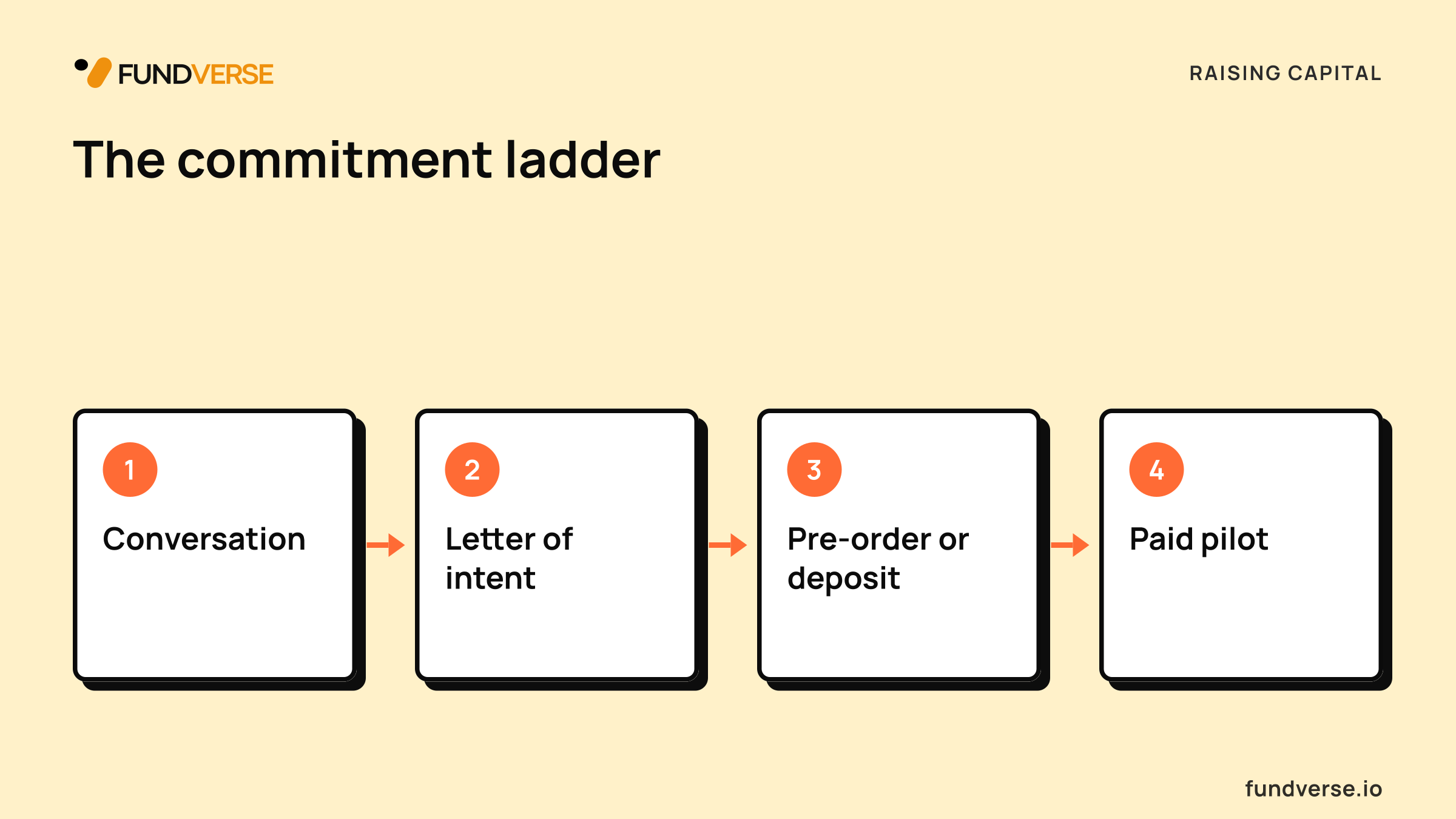
Not every customer will pay in full before a product exists, and demanding it can distort the test. Think of a ladder instead, where each rung asks the counterparty to give up a little more and so tells you a little more. The skill is knowing what each rung actually proves.
Letters of intent
A letter of intent is the lowest rung with any weight. It costs the signer some time and perhaps an internal conversation, but it is usually non-binding and carries no payment. It shows that someone with some authority was willing to put their name to interest, not that a budget exists. A letter naming a price, a volume and a start date is far stronger than one saying the company is excited to explore a partnership. Ask who signed, whether they control the money, and what would have to happen internally before a purchase order appeared. If the answers are vague, treat it as a warm conversation on letterhead.
Pre-orders and deposits
With a deposit, money has moved. A refundable one shows the customer was willing to part with cash temporarily but kept an exit. A non-refundable deposit is stronger and harder to get, which is itself information. Watch the size relative to the payer: a token amount that is trivial for them proves little, while one that someone had to justify internally proves more. Watch for deposits from friends, and for discounts so deep the price no longer resembles what you will charge. A pre-order at half your intended price tells you the customer likes a bargain.
Paid pilots
For business customers a paid pilot is often the strongest rung, because it asks for money and for the customer's time, data and attention. One priced at a meaningful rate, with defined scope, success criteria and a stated path to a larger contract, is close to a sale. A free pilot is weaker: it is a trial, and the customer is spending your resources. Be careful with pilots paid from an innovation budget, which exists to fund experiments that often end without any intention to buy. A good test is whether the person funding the pilot also owns the problem the product solves.
Use the ladder to decide what to ask for, not as a scorecard. If a prospect will not climb past conversation, that is a result. If a few reach a deposit or paid pilot and the rest stay low, you have also learned who your real customer is, usually a narrower group than the one in your first pitch.
Deliver it by hand first
Once someone has paid, you have to deliver, and this is where many founders reach for software. Resist. Deliver the outcome manually, in whatever clumsy way works. This is sometimes called a concierge version: you do by hand, for a few customers, the work the product would eventually do automatically. If your idea reconciles supplier invoices for small manufacturers, you open a spreadsheet and reconcile their invoices yourself.
Saving the cost of a build is a side benefit. The real value is that doing the work teaches you what no interview can: how long a job takes, which part is hard, which customers send messy inputs, and what the customer values once it arrives, which is often not what the pitch emphasized. You also learn the real delivery cost, the number you need most and are least able to guess.
Keep a plain record. For each customer, note hours spent, direct costs, what you charged and what went wrong. After a handful of jobs you can calculate contribution per customer: price minus delivery cost, including a fair value for your own time. Many ideas look attractive until your hours are priced like a salary. If the margin disappears, ask which hours automation could plausibly remove. An honest answer might be that software removes a third and the rest are judgment calls that will always need a person. That is a different business from the one in the pitch, and better learned now. Be straightforward with customers that this is an early service, set an honest scope and deliver what you promised; most are comfortable with that when the price reflects it.
Set your loss limit first
A test without a stopping rule is a hobby that slowly consumes your savings. Before you start, decide in writing the most you will lose and what result would make you stop. Doing it in advance matters because the mind grows generous mid-project: after two months, a lukewarm result begins to look promising and sunk cost argues for one more month.
The loss limit should be a fraction of your truly free savings, money you could lose without endangering housing, family needs or an emergency, and it should leave room for a second attempt. Here is a hypothetical. A founder has $30,000 saved and holds back $18,000, six months of living costs, untouched. That leaves $12,000 of free money. She risks no more than half on the first test, so her loss limit is $6,000, and the rest is kept for a revised version, since ideas often need one.
Now the test, with assumed numbers. She plans a concierge freight-paperwork service for small retailers. She budgets $1,500 for a landing page and outreach tools, $1,000 for part-time help with delivery and $1,500 for modest paid acquisition: $4,000 in all. That leaves $2,000 of buffer inside the $6,000 limit. Her time is not budgeted, but she caps the test at ten weeks.
She then writes the kill criteria as outcomes, not feelings. At least five businesses must pay a non-refundable deposit of $300 or more within six weeks. At least three must agree to a second paid month at the full intended price. And the manual delivery cost, with her time valued at a fair hourly rate, must leave a contribution margin she could live on. If she reaches week six with two deposits, the first criterion has failed, and she stops or changes the offer. She does not extend the deadline because the two who paid were very nice.
The arithmetic caps the downside at an amount she can absorb and makes the thresholds specific enough that a result is a result. It also shows a quiet advantage of getting paid first. If five customers each pay $300, she has recovered $1,500 of the $4,000 before building anything, so a successful test costs less than a failed one.
Know what the evidence is worth later
A good test also produces a small body of evidence that outside capital providers can read, and each reads it differently. Investors want proof that a specific customer will pay and that the business can grow from there. Three paying customers, a record of what they paid and why, and a measured delivery cost tell them far more than a deck of market-size estimates, and they show you test before you spend.
Lenders care about something narrower: whether cash will arrive and repay them. Signed commitments with prices and payment terms, from a customer who has already paid once, help them see a revenue stream rather than a hope, and for small loans or invoice-based financing a record of on-time payers can outweigh a growth story. Grant makers look for evidence of need and of execution ability, and a paid pilot shows both. Our piece on vetting grant applicants for execution ability explains why.
All three are asking the question you asked first: will someone really pay? Keep the record clean so you can answer. Store signed agreements, payment confirmations, delivery logs and your contribution calculations in one place so you can share them quickly when a conversation turns serious. A data room is the natural home for this material once you start talking to capital providers.
Adapt the test to the customer
The ladder is universal, but the rungs are not equally available in every market.
For a business-to-business service, the strongest signal is usually a paid pilot or signed purchase commitment, and the main trap is mistaking an enthusiastic user for a buyer. The person who loves your idea may have no budget. Find out early who signs, how procurement works and how long it takes. A long sales cycle is not a failure, but it changes how much runway your loss limit must cover. A test that needs six months of procurement cannot fit a ten-week cap, so choose customers with shorter paths, such as owner-run businesses, or lengthen the plan and budget honestly.
For a consumer product, amounts are small and decisions quick, so pre-orders are the natural test. The risk is the gap between curiosity and purchase: people will click on almost anything, and far fewer enter card details. The most informative number is the share of visitors who pay, not the number who sign up, and you can test price directly by showing different prices to different groups. Be careful with launch discounts, which attract bargain hunters whose behavior does not predict how full-price customers will act.
Where customers pay in cash and may have no card or bank record, the logic holds but the instruments change. A deposit can be mobile money or cash handed over in person, and the commitment can be an advance for a first delivery rather than a signed contract, since informal contracts can be hard to enforce. The drawback is that cash leaves no trail, which hurts later when lenders or investors ask for proof. Keep a simple ledger from the first sale: date, customer, amount, what was delivered, and photograph receipts if you issue them. Customers who return and pay again without being chased are the best evidence you will have, and an honest notebook of repeat purchases can persuade more than a polished model. If you are exploring routes beyond conventional venture funding, our guide to alternative funding routes in emerging markets covers what fits where.
When your test produces paying customers and a clean record, Fundverse for founders can help you take that evidence to investors who fit your stage, and investor matching narrows the field so you do not spend the proof on the wrong audience.
Write the stopping rule today
If you do only one thing from this guide, write the stopping rule before you speak to a single customer. Put on one page your loss limit, your end date, and the number of paying customers, at what price, that would count as success. Date it, and send it to one person who will hold you to it, such as a mentor, co-founder, spouse or adviser willing to ask in week ten what happened. Founders rarely fail the test because the evidence was unclear. They fail it because they quietly rewrote the target when the evidence arrived, and a page written in advance and shown to someone else is the cheapest protection against that.
Frequently asked questions
Topics
validate business idea
pre-sell product
paid pilot
concierge MVP
startup validation
kill criteria
letter of intent
pre-orders
Raising or investing?
Find the right people on the other side of the table, and run the round in one place.