
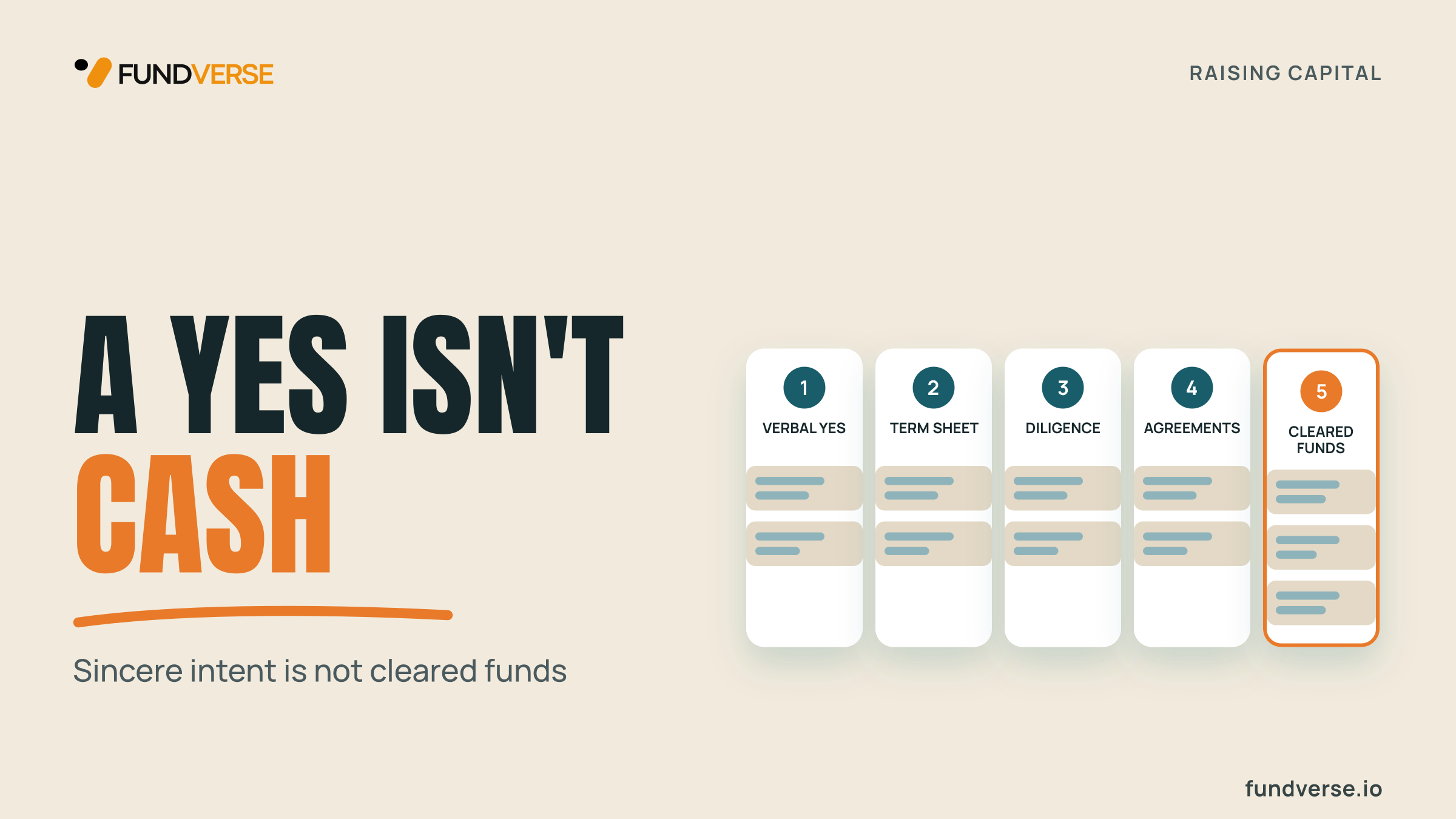

An investor's yes can be sincere and still not binding. See which approvals, documents and conditions sit between a verbal commitment and cleared funds, and how to plan around them.
An investor can say yes, mean every word, and still never send the money. Nobody has to lie or change course for that to happen. A yes spoken at the end of a meeting reports what one person, or a small group, thinks at that moment, while the authority to move capital usually sits elsewhere, behind steps the speaker cannot skip.
Between that sentence and cleared funds, meaning money that has landed in the account and can be spent, lie approvals, documents and conditions, any of which can alter the outcome. An organization that treats the yes as a balance starts paying for hires and commitments the money has not yet covered. A funder who says yes casually lets the other side build on something it never promised.
Why a sincere yes binds no one
A verbal yes is a statement of present intent. In effect it says: given what I know today, I plan to pursue this and recommend it. It creates no duty to invest, lend or grant. Practice varies by jurisdiction, but a conversation in which amount, price and conditions are still open and nothing is signed rarely amounts to an enforceable promise. The more important point is practical. The person speaking is usually an advocate, not the final decision-maker, and who actually decides depends on the kind of capital.
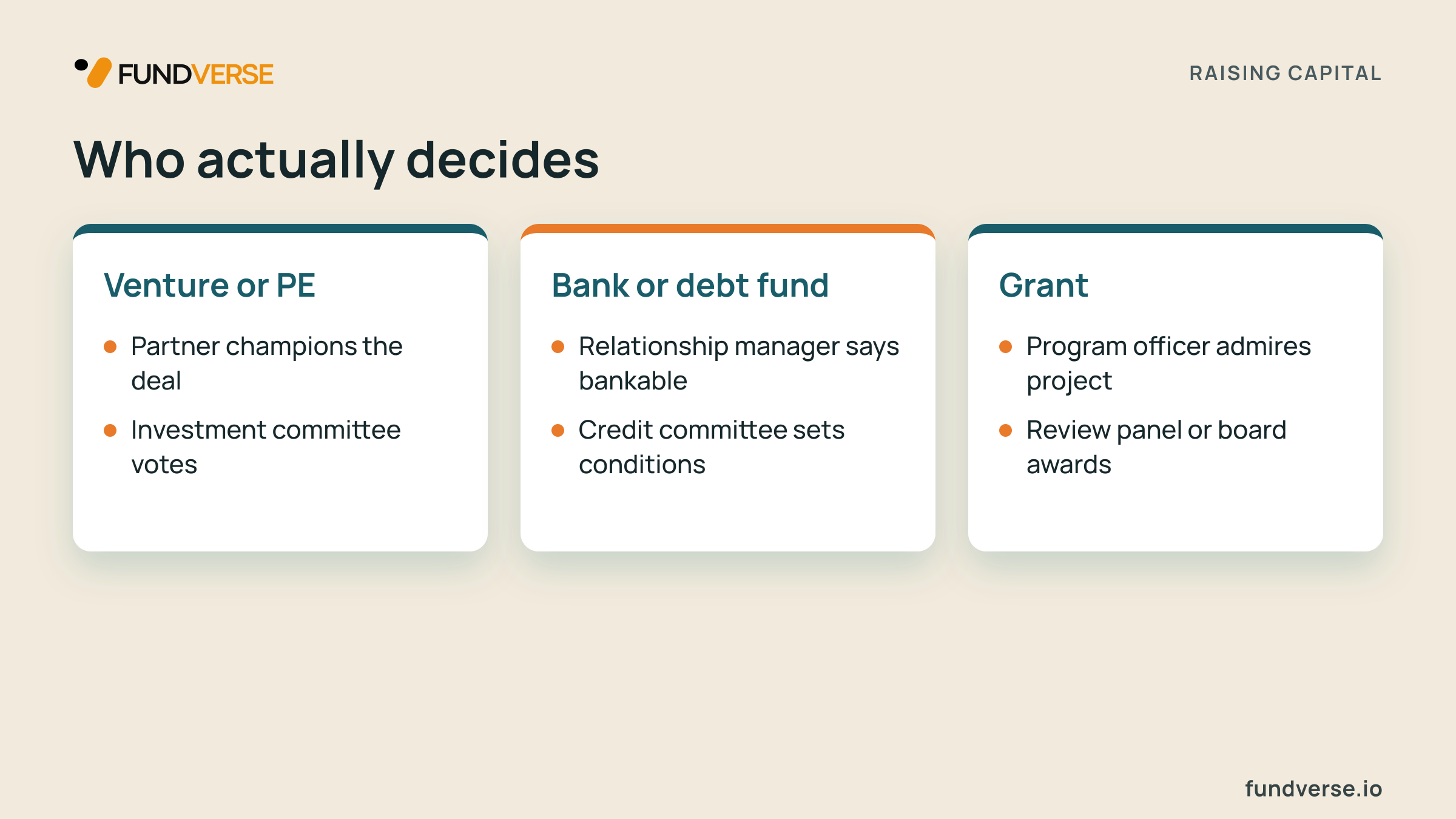
At a venture or private equity firm, the partner a founder meets typically becomes the champion of the deal inside the firm. The investment committee, or the wider partnership, votes after seeing a memo and the results of diligence, and the champion can be outvoted or can change their own view once the facts come in. An angel investing personal money can often decide alone, which makes their yes closer to the real thing, though it still depends on diligence and signed documents.
Lending follows the same shape with different tests. A relationship manager at a bank or debt fund can sincerely tell a borrower the business looks bankable, but a credit committee then tests the facility against repayment capacity, collateral and the institution's own lending limits. It may attach conditions such as security, guarantees or covenants, which are financial tests the borrower must keep passing, and the person who said yes often cannot change those rules. Grants add a third version: a program officer may admire a project and say so warmly, yet the award is normally made by a review panel or board comparing applications against criteria and a fixed budget. In every case the yes is real information about someone's view, but it is not yet the approval that releases money.
The road from yes to cleared funds
Once the advocate has won internal support, the first paper usually appears: a term sheet for an equity deal, an offer or commitment letter for a loan, or an award notification for a grant. On the central questions of amount, price and structure these documents are mostly non-binding. A few clauses usually do bind, notably confidentiality and often exclusivity, where the company agrees not to solicit or negotiate other offers for a stated period. That creates an asymmetry: the company can be locked in while the investor is still free to walk, so it is worth reading the term sheet for what each side is actually committing to. A loan commitment issued after credit approval is firmer, but it is normally still subject to documentation and conditions.
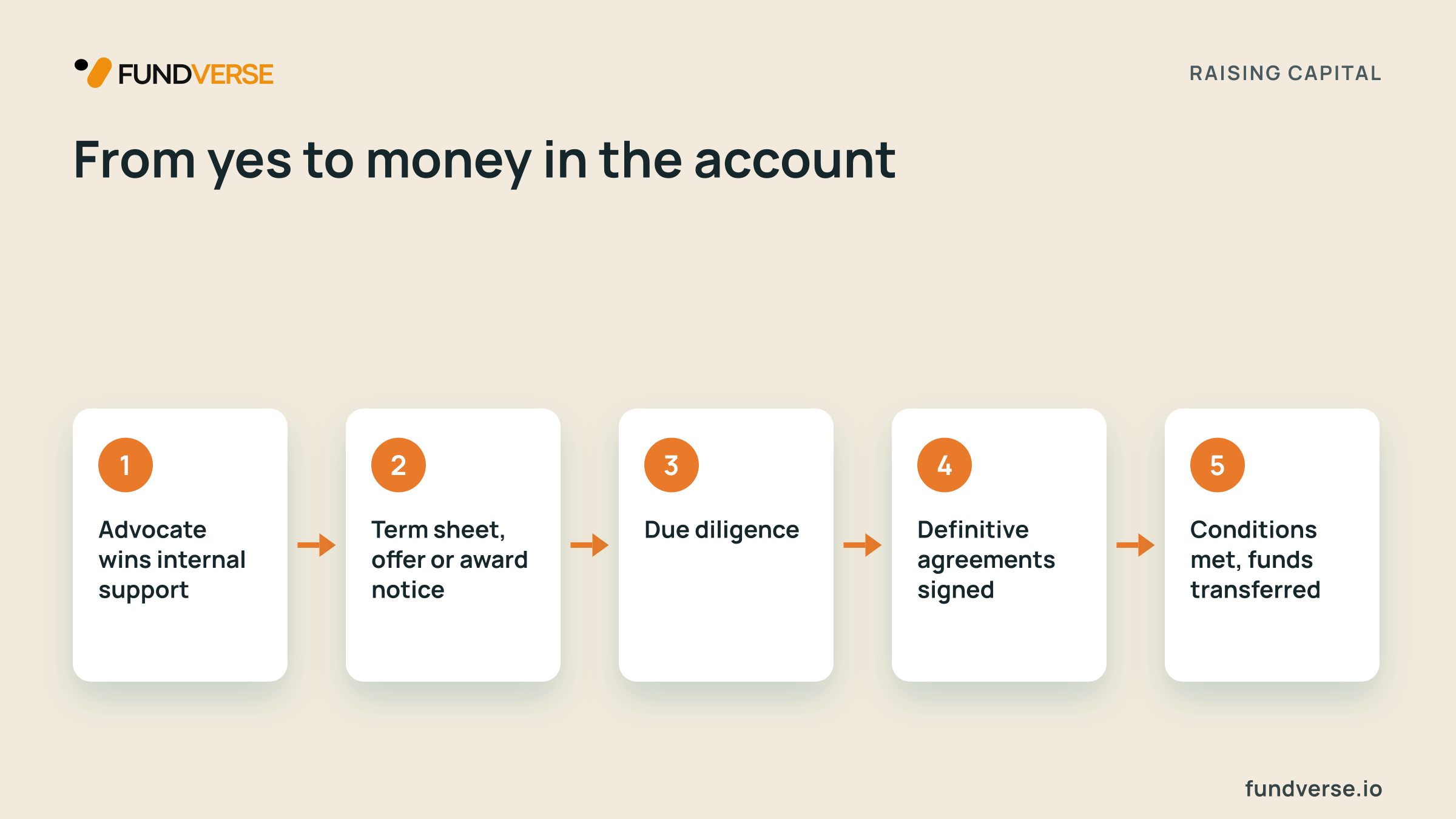
With the paper agreed, due diligence begins. This is the funder checking that what it was told is true: financial statements, customer contracts, ownership, legal and tax position, regulatory standing. A well-organized data room shortens it, and a process that never reaches diligence is itself a warning sign. What diligence finds feeds directly into the definitive agreements, the documents that actually bind: a share subscription and shareholders' agreement, a loan agreement with security documents, or a grant agreement. Drafting them often reopens points the term sheet left loose, such as warranties about the business, investor protections and covenants.
Even signed agreements often say that money moves only after conditions precedent are met. These are specific things that must happen first: security registered, board resolutions passed, a regulatory approval obtained, insurance in place, evidence that other funding has closed. Only then does the transfer happen, and for some capital it is still not one payment. Grants are often released in installments tied to milestones, and a fund may need to call money from its own investors before it can wire anything.
Why deals fail without bad faith
Most deals that collapse involve no deception. The most common cause is what diligence finds: a customer contract turns out to be terminable on short notice, an ownership question is unresolved, or the financials differ from the deck by more than a rounding error. These findings change the funder's view of risk, so it may reprice, restructure or withdraw, and a sincere yes given before the facts were checked becomes a sincere no afterward.
A second cause is the funder's own capacity. A venture or private equity fund does not normally hold all its committed capital in cash. Its investors commit the money, and the fund draws down or calls it when needed, usually with a notice period. A partner can say yes without having checked that the remaining allocation, concentration limits or investment period fit the deal. Lenders face the equivalent in exposure limits and their own cost of funds. Then come conditions outside anyone's control: rates move, comparable valuations fall, a bank tightens its credit policy, a grant program's budget is cut or redirected, or a new partner joins the committee and asks questions the champion never expected.
| Capital type | Who decides | Usually binding early | Common ways it falls away | When cash moves |
|---|---|---|---|---|
| Venture or private equity fund | Investment committee or partnership | Confidentiality and exclusivity on the company side | Diligence findings, price disagreement, fund capacity, mandate fit | At closing, after the fund calls capital if it must |
| Angel investor | The individual, sometimes with a syndicate lead | Often the same limited clauses, or none | Diligence, personal liquidity, change of mind | At closing, once documents are signed |
| Bank or debt fund loan | Credit committee or credit risk function | Little beyond fees and confidentiality until a credit-approved offer | Credit policy, weak repayment capacity, unmet security or documentation | On drawdown, after conditions precedent are met |
| Grant | Review panel or board | Usually nothing until the award is formally made | Budget changes, eligibility or compliance checks, unmet award conditions | In installments, often tied to milestones |
Read across the rows, equity deals tend to fail on diligence and price, debt deals on credit policy and paperwork still to be completed, and grants on budgets and compliance. Knowing which kind of risk applies tells you where to look for trouble.
Planning around the unclosed yes
For an organization raising capital, the safest rule is to treat funds as spent only when they have been received. A worked illustration, with assumptions chosen to show the mechanism and not to describe any real deal or benchmark, shows why. Suppose an organization holds $240,000 and spends $40,000 a month, so it has six months of runway (cash divided by monthly spend). It hears a verbal yes for $600,000 and, relying on it, hires people that lift monthly spend to $70,000. Runway drops to about 3.4 months. If closing takes four months from the yes, the cash runs out before the money arrives, with the new payroll already committed.
Now hold spending at $40,000. After four months, $80,000 remains and the funds arrive with room to spare. If closing slips two more months, cash reaches zero exactly at month six, which shows why a buffer matters even in the careful version. The yes did not change the runway; only cleared funds do.
Spending can therefore follow the closing milestones instead of the conversation. A signed term sheet may justify drafting job descriptions. Signed definitive agreements may justify offers with start dates contingent on closing. Irreversible commitments such as long leases or full-time salaries wait until conditions are met and the money has landed, and where the business must commit earlier, it should prefer arrangements it can cancel or scale back. The logic matches sequencing early hires by what actually constrains the business.
The same caution applies to other conversations. A founder who stops talking to other funders after one yes has made that yes the only option, and exclusivity can formalize the problem, so it is reasonable to negotiate how long it lasts and what the investor commits to during it. A pipeline that records real stages, not just contacts, shows quickly when one deal is wobbling and another needs attention.
The most direct way to learn where a deal stands is to ask early, before anyone is attached to an outcome. Who besides you has to approve this, and when does that group next meet? Is the amount, structure and price approved, or only the opportunity? Which conditions must be met before funds are released, and how long does each usually take? If the money comes from a fund, when will it call the capital, and does the allocation depend on anything else closing? A funder who answers specifically is usually further along than one who answers vaguely, and a vague answer is information too, much as the difference between interest and genuine intent shows up in behavior more than in enthusiasm.
What providers owe the other side
The burden of clarity should not fall on founders alone. A person with a funder's name on their email signature is heard as speaking for the institution, so they should separate three statements that often blur: I like this, I will recommend this, and this has been approved. Saying that the deal goes to committee next month, that the committee has not yet seen it, and that diligence and documentation remain is more useful than saying the firm is in. Specifying what is approved, what is not and what could still change the terms lets the other side plan accurately.
Updates matter as much as the original statement. If a fund's capacity changes, a champion leaves or a credit policy tightens, the other side should hear it quickly, not after weeks of silence. A funder who withdraws late, after the other side has paid legal fees, turned down alternatives under exclusivity or made hires, imposes real costs and is likely to be remembered for it. Founders and advisers talk to one another, and a reputation for saying precisely what is meant is worth protecting.
If you run conversations on either side of a raise, Fundverse's pipeline management lets you record which approval stage each investor, lender or applicant has actually reached, and its data room keeps diligence materials in one place so that stage moves faster.
A yes should come with conditions
The most useful version of a verbal commitment names what it depends on. A founder can answer an encouraging yes by asking what has to happen before the money arrives. A funder can offer support and add in the same breath what remains to be approved, checked and signed. Both sentences cost almost nothing to say, and each replaces a guess with a plan.
Until the last approval, document and condition are done, a verbal commitment is a good reason to keep preparing, keep talking and keep the diligence materials ready. It is a poor reason to spend. Welcome the yes, work toward the wire, and run the business as if the wire may take longer than anyone has said.
Frequently asked questions
Topics
verbal commitment investor
term sheet non-binding
conditions precedent
due diligence stages
funding falls through
fundraising runway planning
investment committee approval
cleared funds
Raising or investing?
Find the right people on the other side of the table, and run the round in one place.