
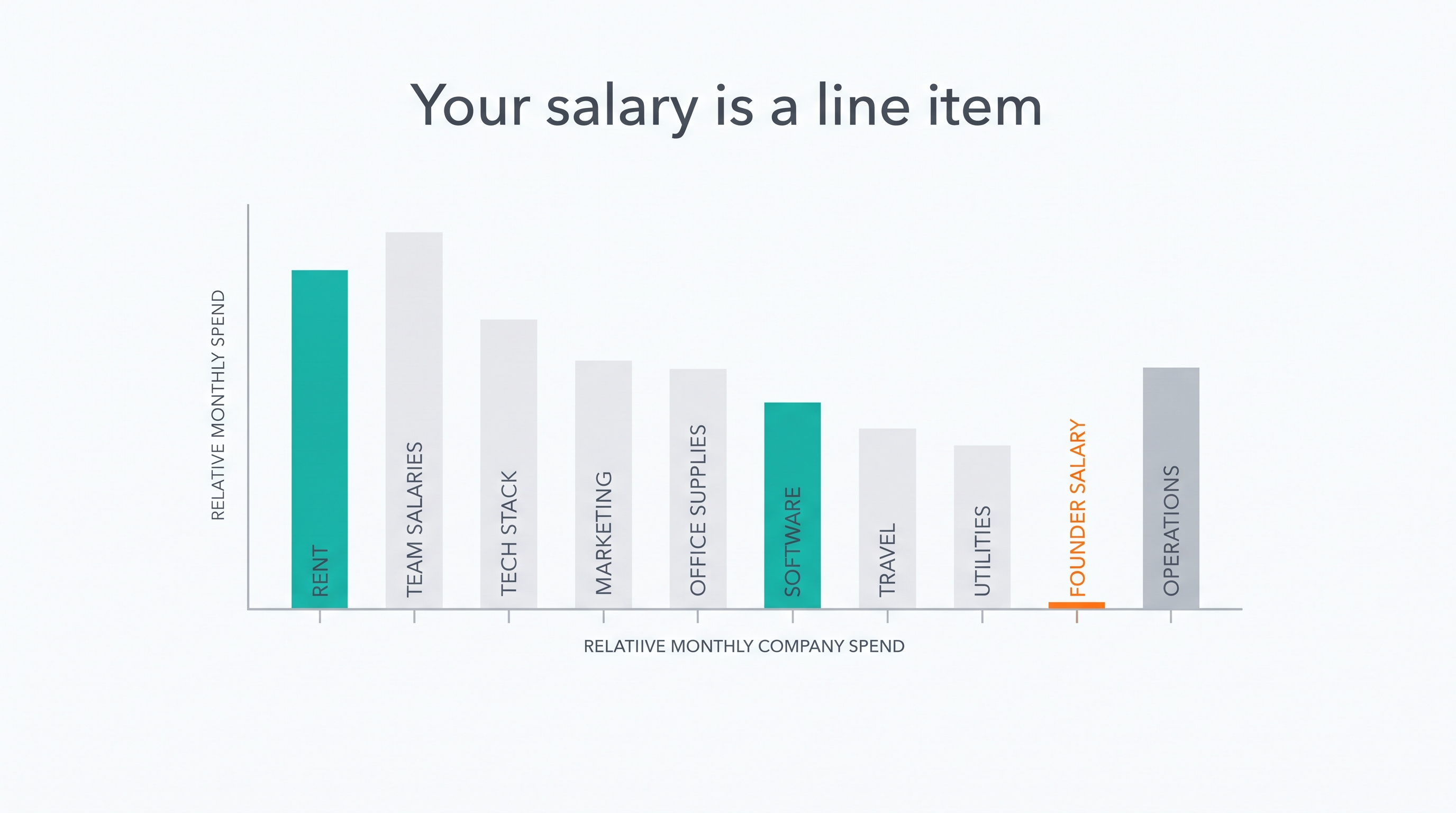

Most founders pay themselves too little or too much, and both mistakes cost the company. Here is a practical argument for a deliberate, defensible founder salary, and how to set one at each stage.
Ask ten founders what they pay themselves and you will get ten answers, most delivered with a mix of pride and embarrassment. Some pay nothing and call it commitment. Others quietly draw a salary that would make an investor wince. Almost nobody has a reasoned answer.
Your salary is a financial decision, not a character test. Set it deliberately, at the lowest level you can sustain without distorting your judgement, and review it against your runway on a schedule. Underpaying yourself is not noble, and overpaying yourself is not harmless. Both are failures of planning.
Why the Founder Salary Problem Is Real
Startup culture rewards visible sacrifice. Stories of founders eating instant noodles and sleeping on sofas are told as proof of conviction. The result is a quiet pressure to pay yourself as little as possible, for as long as possible, and to treat any other choice as a lack of seriousness.
But a company is a system, and the founder is its most important component. If that component is under constant financial stress, the whole system performs worse. You make shorter-term decisions. You say yes to the wrong customer because rent is due. You take a bad deal because you cannot afford to wait for a good one. Money worries do not stay in your personal life; they leak into the company's strategy.
The opposite problem is just as real. A founder who sets a comfortable salary before there is revenue is spending investor money, or their own savings, on lifestyle rather than on learning. Every pound drawn is runway lost, and runway is the one resource you cannot manufacture later.
Pay the Minimum That Keeps You Clear-Headed
The right founder salary is not a market rate and not zero. It is the lowest figure that covers your real personal costs, with a small buffer, so that money is not the thing occupying your head at 3am. Think of it as a floor, not a reward.
Start from your costs, not from a benchmark
Benchmarks for startup founder pay are useful for context, but they ignore your circumstances. A founder with a mortgage and two children has a very different floor from a founder sharing a flat. Write down your fixed monthly costs: housing, food, transport, insurance, debt repayments, and any dependants. Add a modest buffer for the unexpected. That is your starting number, and you can defend it to anyone because it is arithmetic rather than ego.
Treat the salary as a line in your runway model
Your runway is cash divided by monthly burn, and your own pay is part of that burn. A founder who removes their salary to stretch runway by a few weeks has often bought very little: the real levers are usually hiring pace, tooling and customer acquisition. Model your salary alongside those, and see how much it actually moves the date you run out of money. Often the answer is less than you feared, and that is a useful finding.
What the Right Number Looks Like at Each Stage
There is no universal figure, and anyone quoting one without context is guessing. What does hold across stages is the logic: the more external capital and proof you have, the more a modest salary becomes an expected part of running the business.
| Stage | Typical approach | Main risk |
|---|---|---|
| Bootstrapped, pre-revenue | Pay what savings or a day job allow; set an explicit end date for unpaid work | Burning personal savings with no plan |
| Bootstrapped, with revenue | Pay a floor salary first, then raise it as profit allows | Reinvesting everything and drifting into founder burnout |
| Pre-seed | A modest salary covering personal costs, usually below market rate | Drawing too much too early and shortening runway |
| Seed and beyond | A salary that reflects the role, still typically below senior market rates | Underpaying so far that you cannot keep hiring peers |
The bootstrapped founder salary
If you are bootstrapping, nobody sets your pay but you, which makes discipline harder. A sensible rule is to pay yourself a floor salary as soon as the business reliably covers it, and to treat increases as something earned by profit, not hope. Our post on surviving as a bootstrapper covers the mindset side of staying independent.
The pre-seed founder salary
At pre-seed, investors generally expect founders to be paid modestly, enough to live on and well short of what the same person would earn in a large company. A very low figure can read as poor financial planning, while a high one signals the opposite problem. Either way, you should be able to explain the number in a sentence. If you are working out how much to raise in the first place, how much to raise at each stage is a good companion read.
The Strongest Counter-Argument
The best objection goes like this: early-stage companies are fragile, every pound matters, and a founder who takes no salary signals total commitment. Investors like to see skin in the game. Surely it is rational to pay yourself nothing until the business can afford it?
There is truth in this. In the very earliest phase, before any money has come in, unpaid work is often unavoidable, and a founder's equity is a real form of commitment. I am not arguing that you should invent a salary the business cannot fund.
The flaw is in treating zero as a strategy rather than a temporary condition. Unpaid work with no end date is a slow leak. It narrows who can found a company to people with savings or a partner's income, and it pushes founders towards founder burnout and eventually towards quitting at exactly the moment the company needs them most. Investors also notice. A founder who cannot say how long they can survive unpaid is presenting a risk, not a virtue. Skin in the game is shown by your time, your equity and your judgement, not by how close to insolvency you live.
How Investors Read Your Salary
Investors do not look for the lowest possible number. They look for judgement. A salary that is lean, explained and tied to a plan tells them you understand cash. It sits naturally in a use-of-funds slide and in the financial model they will review in due diligence.
Be ready for three questions. What do you pay yourself today? What will you pay yourself after this round? And when does that change? If the answers are consistent with your runway and milestones, the topic closes quickly. If they are vague, it raises doubts about the rest of your numbers. Having your financials and supporting documents organised in one place helps, which is why many founders keep them in a data room before they start conversations. For more on what reviewers look for, see what investors actually want to see.
Planning a raise? Build your investor list, organise your financials and pitch with a clear use of funds, all in one place on Fundverse.
What to Do Differently Starting This Month
None of this requires a finance degree. It requires an hour with a spreadsheet and a willingness to be honest. Work through these steps:
- Calculate your personal floor. Add up fixed monthly costs and a small buffer. That is your minimum salary.
- Add it to your runway model. See how much your pay really changes the date you run out of cash.
- Set a review date. Decide in advance when the salary will rise, for example after a funding round or a revenue milestone.
- Put an end date on unpaid work. If you must work unpaid, define how long, and what would end it.
- Write your one-sentence justification. If you cannot explain your salary simply, adjust it until you can.
- Check in on yourself. Treat energy and stress as inputs to the business, and revisit the number if money worries are affecting your decisions.
If you are preparing to raise, make sure your salary, burn and milestones tell the same story. Our guide to due diligence by funding stage shows what to have ready, and the first $100K roadmap covers the earliest capital decisions.
Final Thoughts
The founder salary problem is really a planning problem dressed up as a moral one. Pay yourself enough to think clearly, little enough to protect your runway, and be able to explain the number to anyone who asks. Do that, and you protect both the company and the person building it.
Frequently asked questions
Topics
founder salary
what to pay yourself
startup founder pay
founder compensation
runway
bootstrapped founder salary
pre-seed founder salary
founder burnout
Raising or investing?
Find the right people on the other side of the table, and run the round in one place.