

Readiness to raise is usually treated as a checklist of documents and metrics. A better test is whether outside capital has a specific job that your business cannot already do for itself.
Ask a room of founders whether they are ready to raise and most will answer by listing what they have: a deck, a data room, a few quarters of revenue, a growth rate they are proud of. The list is reasonable, and investors do ask for those things. But it answers the question an investor is asking, not the one the business should ask first.
That first question is simpler and harder: what would this money change that we cannot already do? If the answer is specific, bounded and tied to a way of earning back more than the money costs, you are probably ready, whatever your deck looks like. If the answer is some version of "we'd feel less pressure," no checklist will rescue the raise, and the money may only hide what is causing the pressure.
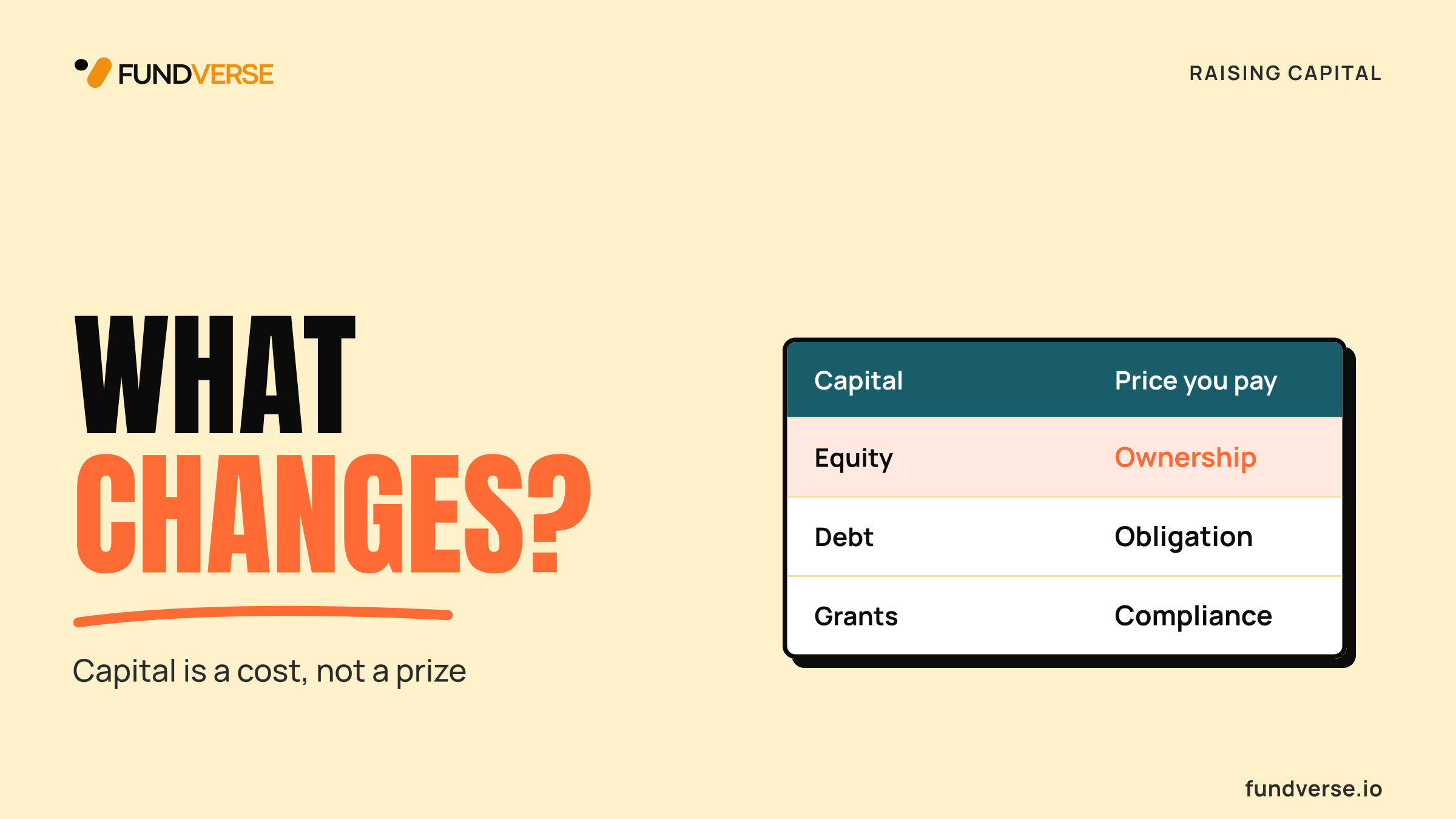
Capital is a cost, not a prize
Much of the language around fundraising treats a raise as a reward, something a business earns by growing, like a promotion. Announcements reinforce the idea. Nobody posts about the covenant package or the board seat; they post the number. But outside money is a purchase, and like any purchase it carries a price and obligations.
Equity is usually the most expensive form in the long run, because it is paid for in ownership and control. Every share sold is a permanent claim on future profits and on the proceeds of any sale, and investors typically also receive rights: a say over certain decisions, information rights, preferences on exit. A founder who sells a fifth of the company at an optimistic valuation has not received free money. She has sold a fifth of everything the company will become, and she now answers to new people about how it gets there.
Debt looks cheaper because the lender takes no ownership, but it converts uncertainty into obligation. Repayments fall due whether the quarter went well or not. Lenders often take security over assets and attach covenants, which are conditions such as minimum cash cover or limits on further borrowing; breach one and the lender may be able to demand repayment or renegotiate on its own terms. Grants are not free either. They usually restrict how funds are spent, require reporting against milestones, and sometimes allow clawback if the work is not delivered. Their cost is compliance, rigidity and management attention. Something that costs this much should be bought for a reason.
The job the money has to do
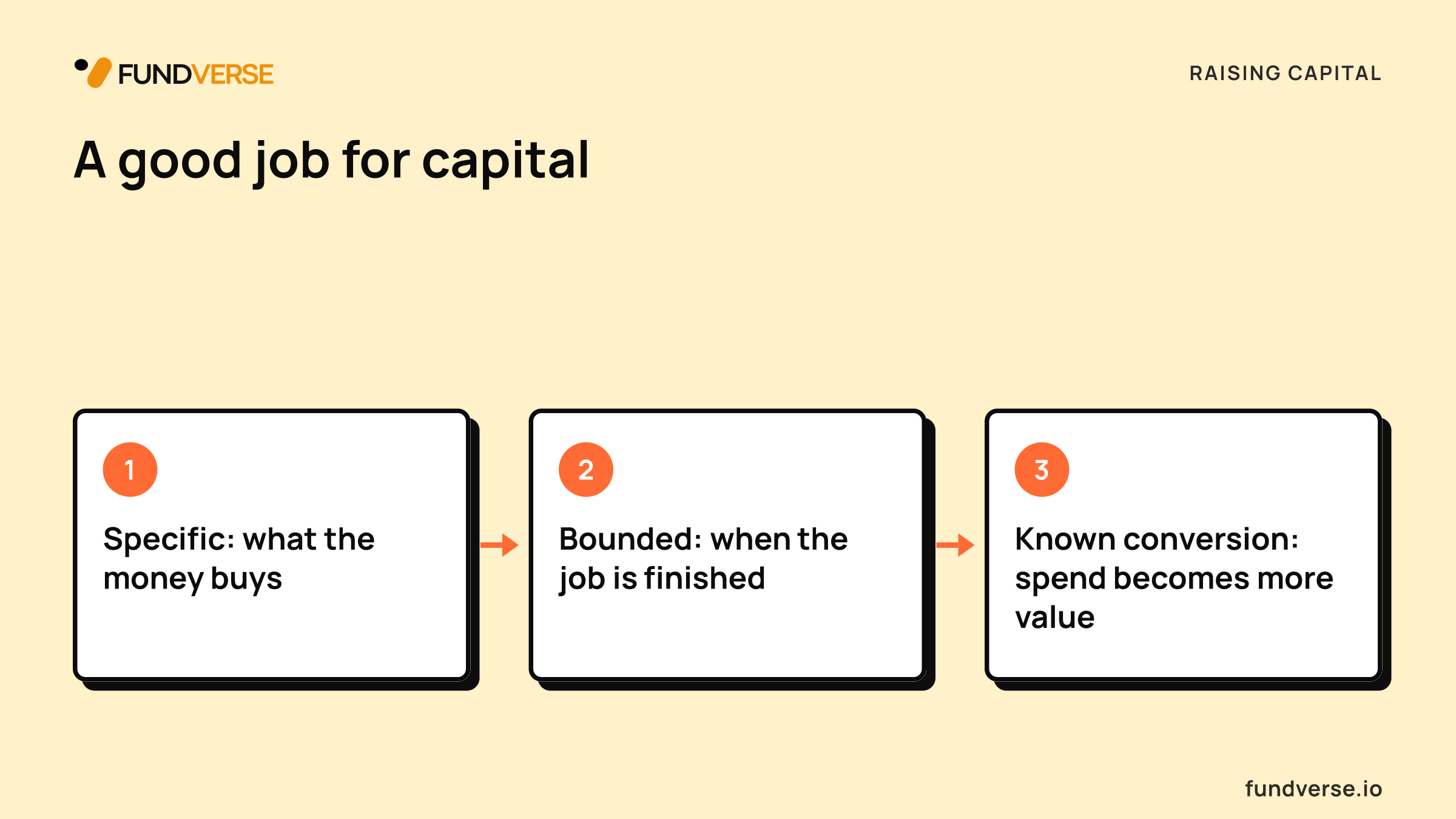
Borrowing from product thinking, ask what job the capital is being hired to do. A good answer has three features. It is specific, so you can say what the money buys. It is bounded, so you can say when the job is finished. And it has a known conversion: you can explain with reasonable confidence how the spending turns into more cash or value than it costs. Three hypothetical examples show how this works across different kinds of capital.
Take a packaged goods manufacturer that sells to retailers on sixty-day terms. Orders are rising ahead of a seasonal peak, but it must pay for raw materials and production weeks before customers pay it. Suppose, purely for illustration, that an extra batch costs 100 to produce and sells for 130, but the cash only returns two months after the money goes out. The job is to bridge that gap. A working capital facility secured against inventory or receivables fits it, because the lender is repaid as the receivables are collected and the cost of the facility can be set directly against the 30 of margin it unlocks. The business could not do this itself without starving other parts of operations, and the lender's risk is limited to a short, visible cycle.
Now a software company with a product that customers use and renew, considering equity to hire more salespeople. Here the job is less obvious, and the test earns its keep. If the company has evidence that each salesperson, once ramped, brings in contracts worth more than their cost over the customer's lifetime, and it can only hire as fast as its cash allows, equity has a clear job: accelerate a sales motion that already works in a market where speed matters. If instead it has not learned how to sell repeatably, and the founders hope more salespeople will reveal the answer, the money is being hired to do research, and expensive research at that. Equity investors do fund learning, but the price of the learning should be understood in advance, in ownership given up.
Finally, a developer building a small solar installation with a long-term contract to sell the power. The job is to buy a productive asset with contracted, predictable cash flows. Asset or project finance is designed for exactly this: the lender underwrites the asset and the revenue stream, and the loan is repaid from what the asset produces. Selling equity in the developer to fund the same build would probably cost far more than the debt, because the equity would be paying a premium for risk the contract has largely removed.
In each case the money has a job, an end point and a path back. It also follows that the same business can be ready for one type of capital and not for another.
Structural need or symptom?
The harder cases are businesses that genuinely feel short of cash, where the shortage has a cause money does not address. Capital can hide such a problem for a while and then make it larger, so an honest diagnosis matters more here than any pitch preparation.
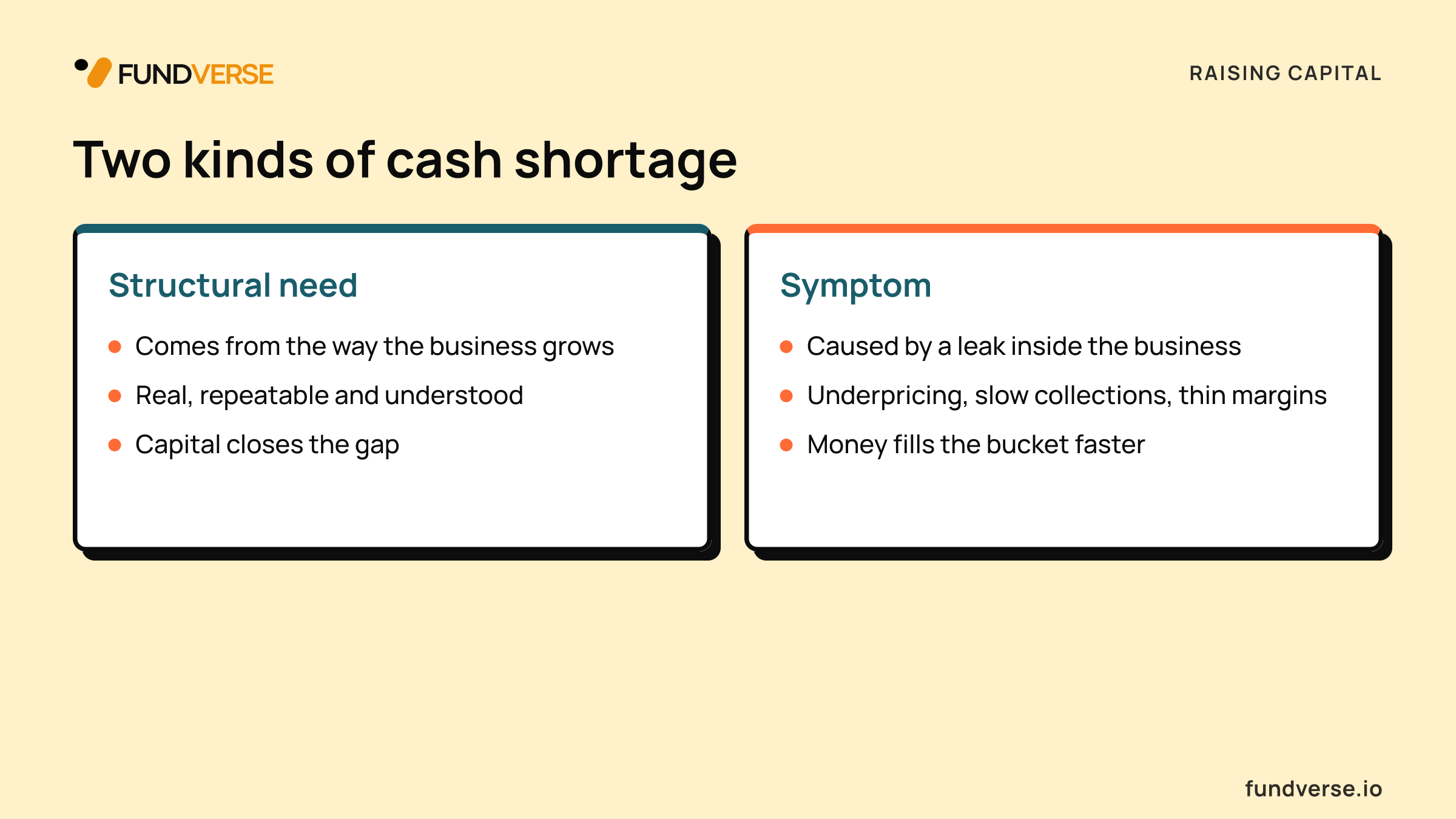
A structural need comes from the way the business grows. A company that must buy inventory before it can sell it, or build capacity ahead of demand, will consume cash as it expands even if every unit is profitable. That gap is real, repeatable and understood, and capital closes it. A symptom is a shortage caused by a leak inside the business, where outside money simply fills the bucket faster than it drains. Pricing is one common leak: a business that underprices its work needs more volume to cover costs, more volume needs more working capital, and the appetite for funding grows with every sale. Slow collections are another. If customers pay in ninety days when terms say thirty, the company is lending to its clients for free, and tighter credit control or a small discount for prompt payment may release more cash than a loan, without interest. Thin margins are the third: if each unit leaves too little behind, scaling multiplies the shortfall, and capital buys time but, if nothing changes, only a larger version of the same problem.
A practical way to sort the two is to change one thing at a time in the cash forecast. If a modest improvement in collection days or a small price rise closes most of the gap, the need was largely a symptom. If the gap persists under disciplined pricing and collections, and grows in proportion to healthy growth, it is structural. Honest answers here often show that a business needs a smaller raise than it thought, a different one, or none.
There is a fair counterargument. Fixing leaks takes time and sometimes money, and a business under strain cannot always repair pricing or margins while staying alive. A short bridge may be sensible. Even then the job should be specific: buy time to complete a defined repair, with a date by which it should be done. That is a long way from hoping capital will relieve a general sense of strain.
Readiness depends on who is lending
The checklist view of readiness also fails because different capital providers ask different questions. Being ready for one is not being ready for another, and treating them alike wastes months.
A lender wants to know whether it will be repaid, on schedule, with room to spare. It looks at the stability of cash flow, the ratio of cash available for debt service to the amount owed, the quality of any security, and what happens in a bad year. If your business triples, the lender gains nothing extra, since its upside is capped at interest and fees, so it studies the downside. The convincing evidence is a clean history of cash generation, reasonable margins, sensible customer concentration, and forecasts showing repayment holding under stress. A fast-growing company that burns cash can be impressive and still unfinanceable by a bank.
An equity investor reasons from the other end. Because the investor shares in the upside and can lose everything, the central question is whether the business could become large enough to return the fund's capital many times over. That needs a big enough market, a plausible route to a meaningful share of it, a team able to execute, and a return profile that justifies the risk of failure. A steady, profitable business with modest growth may be a good company and a poor equity investment, because its likely payoff is respectable but not what that pool of capital needs. Grant makers use yet another lens: does the work serve their stated purpose, and can the organization deliver and report on it?
This is why the job should come before the checklist. If the job is financing inventory against confirmed orders, assemble a lender's evidence; chasing equity investors will produce polite refusals. If the job is a high-risk push into a large market, a lender will rightly decline and equity is the instrument built for it. Starting from the job tells you whom to approach and what to prepare. Our guide to choosing between equity, debt and blended capital goes further into how those paths differ.
Model the business twice
The most practical pressure test is also the least glamorous. Build two versions of the next two or three years, one with the money and one without. Most founders model only the first, because it is the one shown to investors. The comparison is what teaches you something.
The version without the money should be a serious attempt, not a straw man. What does growth look like if you reinvest only what the business generates, tighten collections and adjust pricing? Where does it slow, and why? The gap between the two models is the real contribution of the capital. If it is large, tied to specific spending and clearly worth more than the cost, you have found your job. If the two lines look almost the same, the money is a convenience, and you should ask honestly whether the convenience justifies the price. If the unfunded version shows the business running out of cash, you may be looking at one of the leaks described above.
Then stress the version with the money, because investors and lenders will. Assume sales arrive a few months late, costs run higher, customers pay more slowly, and the plan works half as well as hoped. What happens to cash, repayment capacity, your ownership and your options? With debt, the question is whether you can still meet repayments and covenants in the partial-success case. With equity, it is whether a business growing more slowly than promised can raise again or survive without raising, and whether the terms you accepted leave room for either. With a grant, it is whether you can hit the milestones if the timeline slips.
Partial success is the case that matters most and the one most plans ignore. Full success is easy to fund and full failure is easy to understand. The painful outcomes sit in the middle, where a business grows but not fast enough, carrying obligations sized for a better result. A plan that survives only if everything works is a bet placed with other people's money and your own company. To see how different valuation assumptions change what an equity raise would cost in ownership, the startup valuation calculator lets you run the numbers before you speak to anyone.
Once you know what the money is for, the next step is finding providers whose mandate fits it. Investor matching on Fundverse is built around that fit, and a data room helps you present the evidence each type of provider will look for.
The reason matters more than the paperwork
The documents matter. Clean accounts, a clear story and an organized data room will speed up any raise, and a business without them will struggle. But they are packaging. What decides whether a raise is a good idea is what sits inside: a defined job, a believable path from spending to return, an honest read on whether the need is structural, and a plan that holds up when things go only partly right.
A founder who can say that in two sentences is usually in a stronger position than one with a perfect deck and a vague purpose. And if the exercise shows the money would not change much, that is a useful answer too. Not raising is a legitimate outcome of asking the question properly, and it leaves the company with its ownership, flexibility and choices intact.
Frequently asked questions
Topics
fundraising readiness
when to raise capital
cost of capital
working capital facility
equity vs debt
funding need
fundraising strategy
financial modeling for fundraising
Raising or investing?
Find the right people on the other side of the table, and run the round in one place.