

A practical guide for first-time founders raising pre-seed outside the US: when a Delaware C-Corp is actually needed, which records to prepare, how to choose an instrument, size the round and approach investors.
A common belief among first-time founders outside the United States is that no serious investor will write a check until the company has been rebuilt as a Delaware C-Corporation. Sometimes that is true. Often it is not, and founders who assume it spend months and real money on lawyers and filings before they have spoken to a single investor who cares.
The better question is narrower: what does the specific investor you want to approach need in order to invest, and what does your current company already give them? Some of that is legal requirement, such as what local law lets a company issue or what a fund's own mandate permits. Much of it is only preference, a habit of working with familiar paperwork. The steps below follow the order a founder meets them, separating the two as they go, and end with a checklist you can test yourself against.
Decide where to incorporate
Start from your investors, not a template
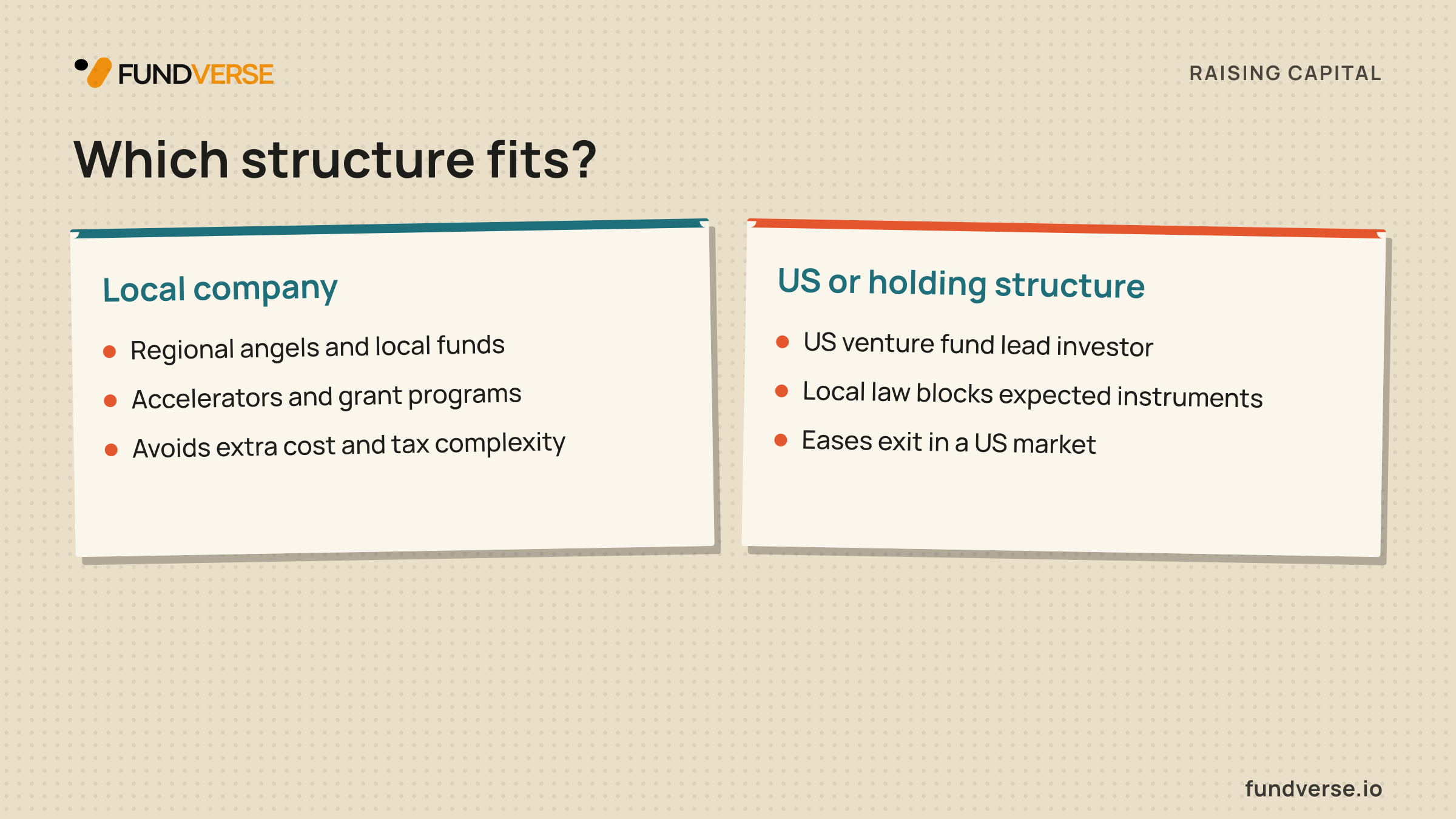
Where a company is incorporated decides which laws govern its shares, how easily investors can hold them and which courts enforce the agreements. A local company works for many investors: regional angels, local funds, accelerators, grant programs and development finance institutions usually invest in the company where it operates, and some are required to. A Delaware C-Corporation is a US corporation with a well-worn body of corporate law and standard documents that US investors and their lawyers can read quickly, which is the whole of its appeal.
So the first piece of work is a list of the investors you realistically expect to approach, and a plain question to each type: where do you invest, and into which kind of entity? If your likely checks come from angels and funds in your home market, changing structure early may add cost and tax complexity with no benefit. If you intend to raise from US funds or angels who use standard US documents, a US parent or an international holding company may help.
When a US or holding structure helps
A US entity or holding company tends to become worthwhile in a few situations. The most common is a lead investor that is a US venture fund whose documents, internal approvals or fund agreement assume US corporate law. Another is when local law makes it awkward to issue the instruments investors expect, grant stock options or give preferred rights. A third is when the company expects to sell to, or list in, a market where a familiar structure eases the exit. A holding company in a neutral jurisdiction can also pool investors from several countries under one set of rules.
None of these is universal. Some investors will accept your local company with local-law documents, some will ask for a move into a US parent only at the priced round, and some will make it a condition now. Ask early, and ask the lawyer who would do the work what it would cost and how long it would take.
Count the cost of crossing borders
A cross-border structure costs more than the filing fee. Legally, the founders may need to exchange their shares in the local company for shares in the new parent, leaving the local company as a subsidiary. In some countries a share swap can count as a taxable disposal unless a specific relief applies, and whether it applies depends on the country, so take advice from a tax professional there before any shares move.
Then there is the ongoing load. A parent and a subsidiary each need their own records, bank accounts and annual filings, and money moving between them raises transfer pricing questions, meaning the rules for setting fair prices on services and funds passed between related companies. Founders living abroad may also create tax residency questions in more than one country, and some countries restrict moving money out or require approval for foreign shareholders, which can slow the very investment you are trying to receive. None of this argues against a structure an investor genuinely requires. It argues for paying for it when a real investor asks, not before.
Assemble your company records
Whatever structure you settle on, investors will want proof that the company exists, that the founders own it and that nothing important is missing. Gathering these records before you approach anyone is cheaper than repairing them under a deadline, because gaps found in diligence are slow to fix and make investors wonder what else is loose.
Registration and constitutional documents
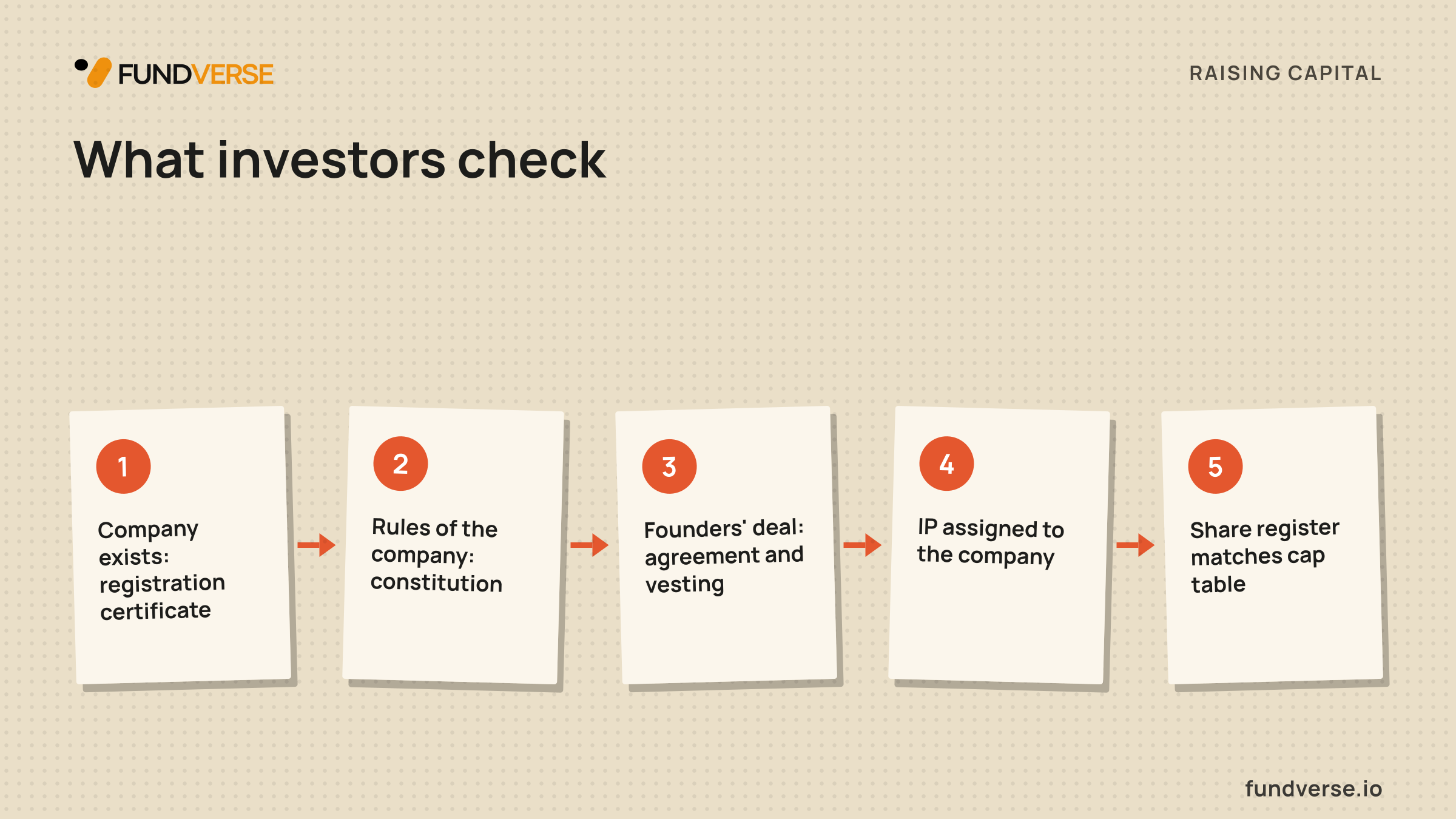
The certificate of incorporation, or company registration certificate, is the registrar's proof that the company legally exists. The constitutional documents set the rules for how it runs; their name and form differ by country, such as articles of association in many common-law countries or bylaws in the US. Investors read them for the share classes the company may issue, restrictions on transferring shares, how directors are appointed and how decisions are approved.
One issue surfaces here regularly. Some constitutions authorize only a single class of ordinary shares, which rules out the preferred shares a priced round usually involves. Amending the constitution is a normal step at that point, not a defect, but knowing in advance avoids surprises.
Agreements between the people
A founder agreement or shareholders' agreement records who owns what, who does what, what happens if a founder leaves or the founders disagree, and how big decisions are made. Without one, a dispute between co-founders is settled by default law, which is rarely what they would have chosen, and no investor wants to buy into that uncertainty.
Founder vesting means the founders earn their shares over time, commonly across several years, often with an initial waiting period before any shares vest. If a founder leaves early, the company can buy back or cancel the unvested part. Investors ask for it because pre-seed money backs a team, and a team in which one person can walk away with a large unearned share is a weaker bet. It is mostly an investor preference rather than a legal rule, though how it must be drafted to be enforceable varies by country.
An intellectual property assignment is a signed document by which each founder, employee and contractor transfers to the company the rights to what they built for it. In many places the law gives rights in a creation to its creator unless they are transferred in writing, so work done by freelancers, or by founders before the company existed, may not belong to the business. A gap here is among the commonest reasons diligence slows down.
Ownership and compliance records
The share register is the company's legal record of who holds shares. The cap table is the working view, in a spreadsheet or software, of ownership by percentage, including options and anything that will convert later. The two must agree. Many countries also require companies to record or file beneficial ownership, meaning the individuals who ultimately own or control the company, which investors and banks use for identity and anti-money-laundering checks. Keep all three current, with every issuance backed by a signed document and the approvals your constitution requires.
Finally, show the company is in good standing: tax registration, any sector licenses, data protection compliance if you handle personal data, and employment registrations if you have staff. The list depends on your country and sector; a payments company and a software tool face very different ones. A known gap with a plan reads far better than one an investor finds first.
Prepare the diligence folder
Investors usually ask for the same package after the first serious meeting: the documents above, signed founder and shareholder agreements, IP assignments, key customer or supplier contracts, tax and licensing evidence, any past financing documents, and financial information. Holding all of it in one organized data room before you start means the first request is answered in hours, which signals a team that runs a tidy company.
At pre-seed you may have little revenue, but you still need numbers. Historic financial statements, even a short set of management accounts, show what has been spent and what, if anything, has come in. A cash flow forecast shows month by month when money arrives and leaves. Burn rate is the net cash the company loses each month, and runway is how many months current cash lasts at that rate. Together they tell an investor how long their money buys progress and whether the round you propose is sized to a real plan. Projections are believed only when each assumption can be explained; the financial model mistakes that make investors question a business shows how they lose credibility, and calculating your runway covers the arithmetic.
Four documents then carry the story, each with a different job. The pitch deck is the visual argument used in meetings. The one-page teaser is a summary sent cold or by an introducer so a busy investor can decide in a minute whether to reply. The business plan is the longer written explanation, which some funders and grant makers expect and many angels never read. The product demonstration shows the thing working, and for many pre-seed investors it counts for more than the slides. Tailor them to the reader, as argued in why one deck for every investor fails.
Choose your instrument
The instrument is the legal form of the investment. At pre-seed, three dominate, and understanding how each works lets you judge what you are agreeing to when an investor sends terms. The first two defer the question of what the company is worth, which is why they are popular when there is no revenue to price against.
SAFEs and convertible notes
A SAFE (simple agreement for future equity) is a contract in which an investor pays now and receives shares later, when a priced round happens. It is not debt and carries no interest or repayment date. A convertible note is a loan that converts into shares at the next priced round, so it carries interest and a maturity date, when repayment is technically due if no conversion has happened. That makes notes heavier for a company with little cash.
Both usually carry a valuation cap, the maximum valuation at which the investment converts, and often a discount, a reduction on the price paid by later investors. A worked illustration, with invented round numbers: an investor puts 100,000 into a SAFE with a 5 million cap, and the next round values the company at 10 million. The investor converts as if the company were worth 5 million, so their shares cost half what new investors pay and the 100,000 buys twice as many. Had the round valued the company at 4 million, the cap would not bite and the investor would convert at the round price, or at a discount if one applies. The lesson: a lower cap helps the investor and costs the founders more dilution later, so model it before agreeing.
A caution for founders outside the US: the standard SAFE was written with US law in mind. In other countries a lawyer may need to adapt it or use a local equivalent, such as a convertible loan agreement, so that it works under your company and securities rules.
Priced rounds and the terms that matter
In a priced equity round, investors buy shares at an agreed valuation immediately. It takes more negotiation and legal cost, because there is a term sheet and a full set of documents, but no valuation question is left for later. Some regional investors and institutions prefer it for that reason.
Valuation matters because of dilution, the fall in each existing owner's percentage when new shares are issued. If founders own all of a company and sell 20 percent in the round, they own 80 percent afterward. Two terms then shape what that percentage is worth. A liquidation preference decides who is paid first when the company is sold or wound up: with a simple one-times preference, the investor recovers their money before ordinary shareholders receive anything. If the preference is also participating, the investor then shares in what remains as well. Pro-rata rights let an investor buy enough shares in future rounds to keep their percentage; a normal request, but one that reduces room for a new lead. Test a number before proposing it with the startup valuation calculator, and read why selling a slice of the company also sells a say in its decisions.
Size the round
The amount to raise comes from a plan, not from comparison with other startups. Work backward from the milestone the money must reach, usually the evidence that makes the next round possible, such as paying customers, a working product or a regulatory approval. Then list what reaching it costs month by month: salaries, tools, development, legal and accounting, marketing and equipment.
Required funding is monthly burn multiplied by the months needed, plus a contingency, minus cash already on hand. As an invented illustration, a team burning 20,000 a month that needs 15 months to reach its milestone, adds a 25 percent buffer and holds 30,000 in cash would need 20,000 × 15 = 300,000, plus 75,000, minus 30,000, so 345,000. The buffer matters because plans slip, and because a company should not be raising again while still testing. Outside the US, also allow for currency movements if costs and investment are in different currencies, delays in cross-border transfers and the legal costs of the round itself.
Then check the number against the market. A very large ask relative to local early-stage checks narrows the field, and a very small one may leave you raising again before the milestone. Raising less is sometimes the stronger move, as argued in why a smaller round can be better.
Find investors who fit
A good fit means the investor backs your stage, sector and geography, with a check that matches your round. Which source delivers one depends on the company. Investor databases filter by stage, sector and location, though their data can be out of date, so confirm recent activity before writing. Accelerators offer small investments, structured mentoring and an investor network. Angel networks bring together individuals who often write the first checks outside major hubs, and a good angel can add operating experience. Grants provide non-dilutive money, meaning you keep your ownership, though they bring reporting duties and sometimes narrow eligibility. Development finance institutions, which back businesses for development impact, more often work through funds and programs than direct pre-seed equity. For the wider picture, read why the investors you need may not be venture capitalists.
Build a list of perhaps thirty to fifty qualified names, ranked by fit, with the reason each is on it, and ask each the entity question from the start of this guide. Fundverse investor matching can help narrow the list, but your own judgment about fit decides who goes on it. Turn the list into a working pipeline, as covered in this piece on fundraising pipelines.
Approach investors with a plan
A warm introduction, one made by someone the investor trusts, usually gets a faster reply than a cold message. To get one, ask people who know both sides: founders the investor has backed, accelerator staff, lawyers and advisers. Give them a short forwardable email, a few lines on what the company does, why this investor and what you are asking for, so the introducer's job takes thirty seconds. Introductions are not a strategy on their own, as this article on warm introductions explains. Without one, a cold message can work if it is short, specific to the investor's focus and carries one proof point.
Run the conversations in a compressed window so investors compare you at the same time and momentum builds. Book first meetings over a couple of weeks, note each investor's concerns, send promised materials the same day and end every call with a clear next step. Separate polite interest from genuine intent, and do not count a verbal yes as money; see why a verbal commitment is not money in the bank. If the round stretches, watch your runway.
Most mistakes in this process come from the same source: acting before asking. Founders flip to a US entity before an investor requires it, or stay local when the lead plainly needs otherwise and find out at term sheet stage. They copy a US SAFE without adapting it, accept a cap or preference they have not modeled, or pitch investors who do not invest in their region. Each is avoided by the discipline this guide began with: find out what the investor needs, then fix only that.
Check your readiness
Before you send the first message, run through this checklist. Any item you cannot tick is a task, not a failure.
- You know which structure your target investors need, and you have asked them rather than assuming.
- The certificate of incorporation and constitutional documents are in hand, and you know whether they allow the shares you plan to issue.
- Founder and shareholder agreements are signed, with vesting in place.
- IP assignments are signed by every founder, employee and contractor who built something.
- The share register, cap table and beneficial ownership records match and are current.
- Tax registration, licenses and sector compliance are in order, or gaps are listed with a plan.
- Financial statements, a cash flow forecast, burn and runway are ready and explainable.
- The deck, teaser, business plan and demo exist, tailored to each investor type.
- You have chosen an instrument and modeled dilution at your proposed cap, discount or price.
- The funding amount comes from a milestone plan with a buffer.
If you want this preparation in one place, Fundverse gives you a data room for your documents and tools to build and track your investor pipeline, so the paperwork and the process stay organized while you raise.
Once your documents are in order and conversations begin, the questions investors ask will turn to specifics, from cap table details to who will lead. The thing to watch then is whether early interest becomes a term sheet within the window you set.
Frequently asked questions
Topics
pre-seed fundraising outside US
Delaware C-Corp for non-US founders
SAFE vs convertible note
startup due diligence documents
how much to raise pre-seed
international pre-seed investors
founder vesting
fundraising readiness checklist
Raising or investing?
Find the right people on the other side of the table, and run the round in one place.