

The same 20% can mean a passive shareholder or a veto over your exit. How rights, preferences and early investors shape what equity really costs a founder.
Ask a founder what a seed round costs and the answer arrives instantly, as a percentage. Twenty percent, maybe fifteen if the negotiation went well. It is a clean number, easy to compare, easy to model on a cap table and easy to repeat to a cofounder over coffee. It is also the least informative number in the deal.
A percentage describes only how proceeds are divided when everyone is paid the same way on the same terms, and real exits rarely work like that. Between the day a founder signs and the day the company is sold, closed or recapitalized, a long list of decisions will be made, and the rights attached to the shares decide who gets a vote, who gets a veto and who gets paid first. Selling 20% of a company is, in practice, selling a share of every one of those decisions.
Same 20%, different deals
Imagine two founders who each sell 20% of their companies for the same amount of money. The first issues plain common shares to an investor, who becomes an ordinary shareholder with a right to information. The second issues preferred shares carrying a liquidation preference, a board seat, a veto over new share issues, a veto over any sale of the company, and a clause that adjusts the investor's conversion price if the company later raises at a lower valuation. On a cap table the two look identical. When something goes wrong, or even moderately right, they are different companies.
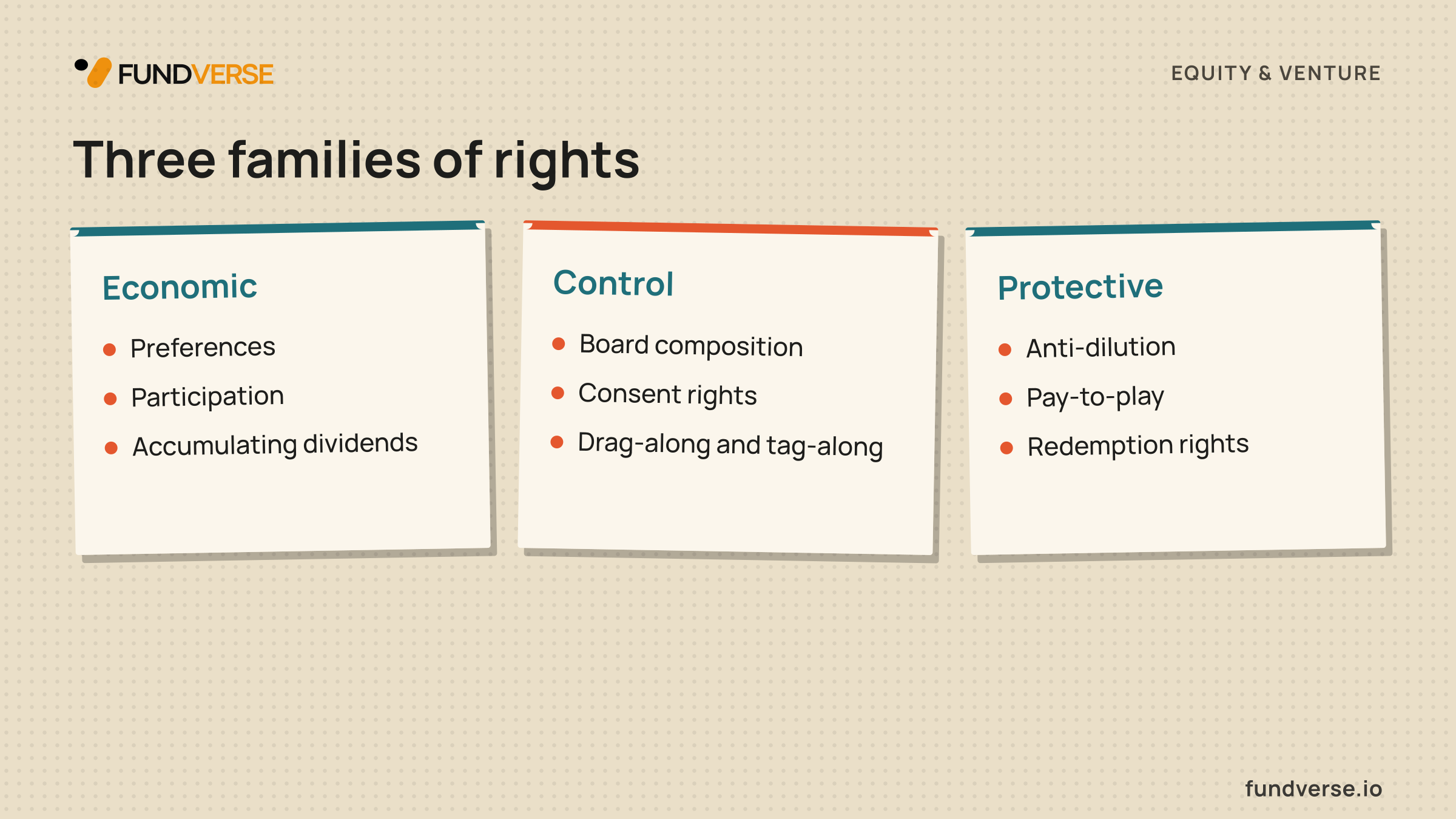
It helps to sort these rights into three families. Economic rights decide how proceeds are split: preferences, participation, dividends that accumulate. Control rights decide who can say yes or no: board composition, consent rights over specific actions, drag-along and tag-along terms. Protective rights adjust the investor's price or position if the company disappoints: anti-dilution adjustments, pay-to-play provisions, redemption rights. A founder who negotiates only the valuation is haggling over the one number the investor can afford to concede, because a higher price at the top of the page can be quietly earned back through the clauses beneath it.
None of this is sinister. Investors are putting money into an uncertain enterprise and asking for protection in the scenarios where they are most exposed. Many of these terms are reasonable, and a standard, clean set is easier to explain to the next investor. But each one transfers something, and the transfer is invisible if you look only at the percentage. Our piece on founder-friendly and investor-protective term sheets goes through the clauses one at a time; here the interest is in what they do together.
Who gets paid in a modest exit
The clearest place to watch rights at work is the exit waterfall, the order in which sale proceeds are distributed. Here is a deliberately simple hypothetical, an illustration of mechanisms and not a description of any real company. A company raises $4 million for 20% of its shares, so the founders hold 80% and the investor 20%. The investor holds preferred shares with a 1x liquidation preference, meaning they are entitled to their $4 million back first. We compare two versions: non-participating, where the investor takes either the $4 million or their 20% share, whichever is greater, and participating, where the investor takes the $4 million and then also shares in what remains as if they owned 20%. Later rounds, debt, fees and an option pool are ignored.
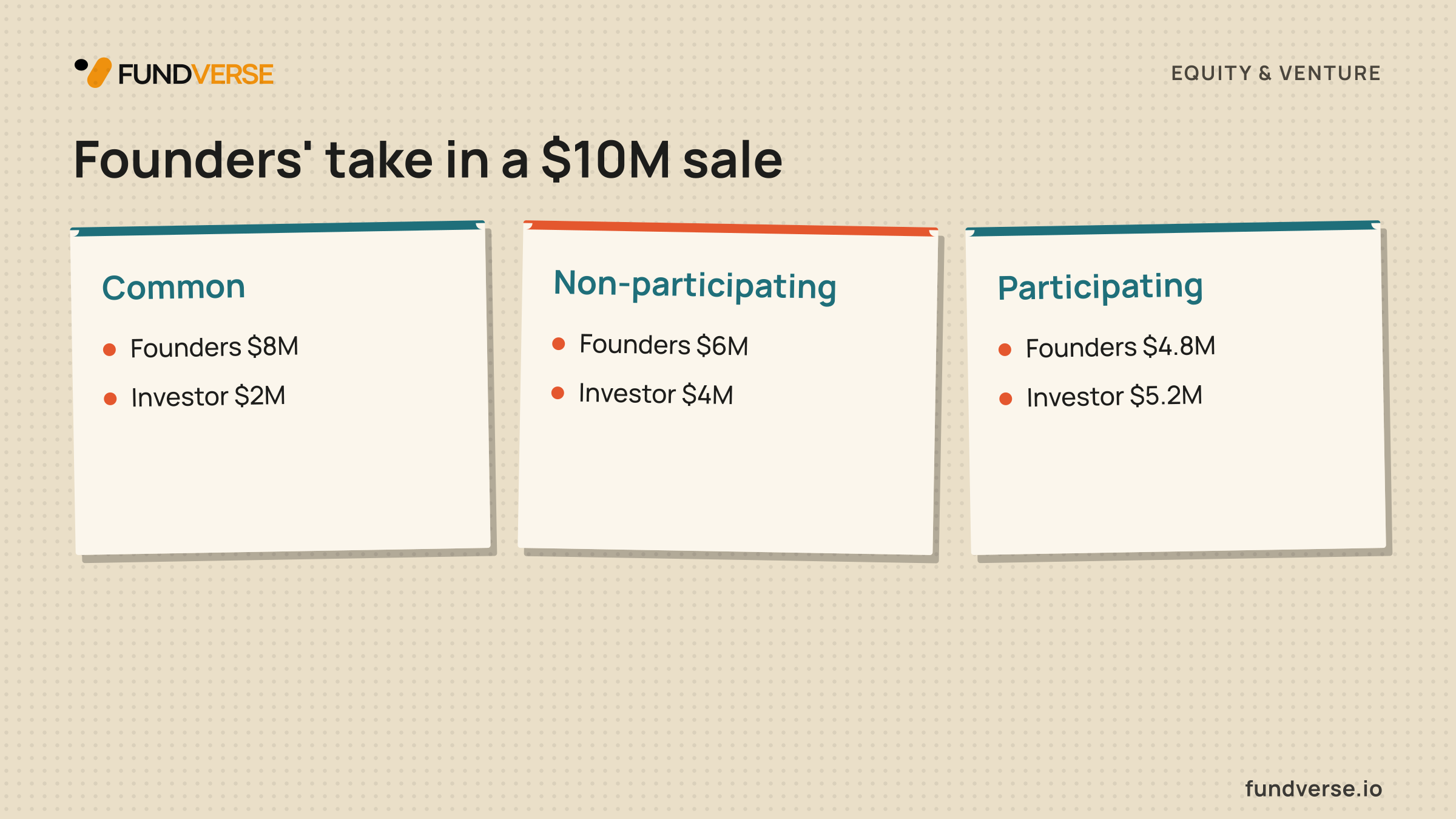
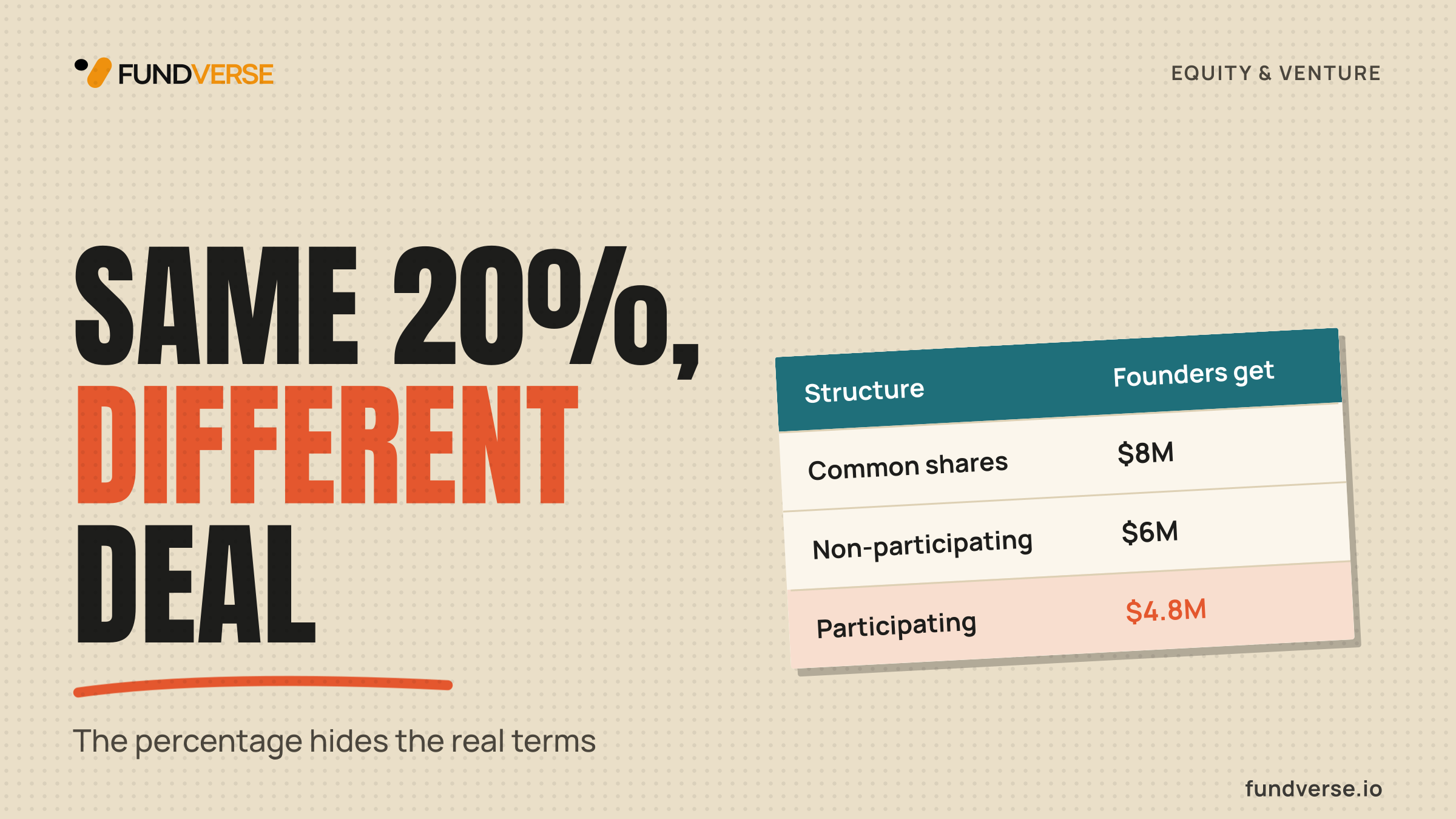
Start with a $10 million sale. With plain common shares, the founders receive $8 million and the investor $2 million, the 80/20 split everyone expected. With a non-participating preference, the investor compares $4 million as a preference with $2 million as 20% of the proceeds, and takes the $4 million. The founders divide the remaining $6 million, and their effective share has fallen from 80% to 60%. With a participating preference, the investor takes the $4 million, then 20% of the remaining $6 million, which is $1.2 million, for $5.2 million in total. The founders receive $4.8 million, or 48% of the proceeds, from a company they believed they owned 80% of.
| Sale price | Common shares only (founders / investor) | 1x non-participating (founders / investor) | 1x participating (founders / investor) |
|---|---|---|---|
| $3 million | $2.4M / $0.6M | $0 / $3M | $0 / $3M |
| $10 million | $8M / $2M | $6M / $4M | $4.8M / $5.2M |
| $40 million | $32M / $8M | $32M / $8M | $28.8M / $11.2M |
The table shows the shape of the problem. At a low price the preference swallows the proceeds: a $3 million sale pays the founders nothing under either preferred structure, because the investor's $4 million claim exceeds the whole sale. At a high price a non-participating preference stops mattering, because the investor does better by converting to ordinary shares and the founders receive their expected 80%. Participation never switches off. Even at $40 million the investor receives $11.2 million, or 28% of the proceeds, from a 20% stake. The cap table says one thing and the waterfall says another.
Now add control. Suppose a buyer offers $10 million in year four. The founders are tired and would take $4.8 million or $6 million, depending on the structure, and move on. But an investor with a $4 million preference and a veto over a sale may prefer to wait, since only a much larger outcome returns a real multiple of what they put in. A founder who has sold that veto has handed over a vote on when the story ends. The right that protects the investor from a bad sale can also be used to resist a good-enough one, and the founder does not get to decide which it turns out to be.
Anti-dilution provisions run on the same logic in the direction of a bad round. If the company later raises at a lower valuation, an investor with a weighted-average adjustment receives extra conversion shares, and one with a full-ratchet clause is repriced entirely to the new, lower price. A new investor will usually price the round knowing this will happen, so the cost lands on the founders and other common holders, who have the least protection. It also changes behavior. A founder who knows the ratchet will bite may put off a necessary reset for longer than is healthy.
The quiet cost of the first investor
Some costs appear on no term sheet. The first outside investor shapes what the company can credibly become, starting with the signal they send. Later investors read a cap table the way a buyer reads a house's history. A respected early backer can make the next round easier, which is a real benefit. The reverse also holds: an early investor with unusual terms, a reputation for being difficult, or simply not the kind of fund that follow-on investors expect to see can make others hesitate. Nobody will say so; they will find a different reason to pass. Choosing a first investor is choosing the first sentence of the story every future investor will be told.
Then there is expectation. Equity investors are not buying a steady yield. They are underwriting a distribution of outcomes in which a few cases produce nearly all the return, and they behave accordingly. A fund that needs outsized results will push for growth and tolerate risk that an owner might not take on their own account, and it will be less excited by a respectable, profitable, mid-sized company. That is not a flaw in the investor; it is the arithmetic of their fund. It is also why the question of whether a good business is an investable one belongs before the first conversation, not after the first check.
Those expectations bear hardest on pivots and on modest plans. An early shareholder counting on a very large outcome has little reason to back a plan aimed at a smaller, surer one, so a company that would be well served by a focused niche or a profitable plateau may find its board organized around a different destination. Changing direction might be exactly right for the business, yet it needs agreement from people whose returns depend on another path. The founder keeps the idea. The investor keeps a say in whether the idea can change.
There is a fair counterargument, and it deserves its weight. Good investors add what money cannot buy: introductions, discipline, hiring help, a second opinion when the founder is too close to a decision. Control rights are often used sparingly, and many investors never invoke them. A founder who treats every investor as an adversary will raise less and may build less. The claim here is narrower. These rights exist in the bad scenarios, which are the ones where the relationship is under the most strain, and a founder who has priced only the good scenarios has priced half the deal.
When equity is the wrong tool
If equity carries this much hidden cost, when is it worth paying? When the business has a payoff that only equity can fund. It suits uncertain, high-variance, long-horizon bets with no cash flows yet to service a loan and an upside large enough to compensate a shareholder for the risk. It is a poor fit for a business that can already describe its own cash flows.
Consider a company with steady revenue that needs money to buy inventory, open a second site or bridge the gap between paying suppliers and collecting from customers. Debt can serve that need: the lender is paid a defined amount on a defined schedule and then leaves, taking no share of the future. Revenue-based finance works similarly, with repayments flexing to monthly revenue, which can suit businesses whose sales fluctuate. A grant, where one is available and suited to the activity, may carry no repayment and no ownership claim, though it brings its own reporting conditions and limits on use. What separates all of these from equity is permanence. A loan ends when it is repaid. A share has no maturity date.
The difference compounds with success. Suppose a profitable business could either borrow what it needs on a fixed repayment schedule or sell 20% of itself. If the business later becomes worth ten times as much, the loan still costs exactly what was agreed, while the 20% has grown tenfold in value. Equity is cheapest when the company fails and most expensive when it thrives, the reverse of how a founder would choose to pay for capital. That can still be a fair trade when nothing cheaper can do the job. Our guide to choosing between equity, debt, quasi-equity and blended capital covers the instruments in more detail.
Debt has its own price, of course. Lenders want security or reliable cash flow, covenants can restrict what the business does, and a missed payment has consequences that a missed milestone with an equity investor does not. A business with unpredictable revenue and no collateral may find debt unavailable or dangerous. The point is to match the instrument to the cash flow the capital is meant to produce, and to notice when equity is being chosen out of habit, because peers seem to be doing it, and not because the business needs it.
Three exits before you sign
A practical way to bring this together is to model the deal as it would behave, not as it is described. Before signing, build a simple spreadsheet and run three exits through the proposed terms: a poor one, a middling one and a great one. Define them specifically. A poor exit might be a sale for less than the total capital raised, a middling one a sale at a modest multiple of it, and a great one the outcome in your plan.
For each scenario, ask two questions. First, what do I personally receive after preferences, the option pool, any debt and fees, and the shares belonging to other founders and early employees? Founders are often surprised by how far the personal number sits from the headline ownership figure, and how thin it can be in the middling case, which is the one most likely to occur. Second, who can block this exit? Count the votes and consents: the board, the preferred class, any investor with a specific veto, any drag-along threshold. If an outcome you would accept can be stopped by someone whose incentives differ from yours, you have found a cost no percentage would have shown you.
Then run the same three exits through the alternatives: a smaller raise, a debt or revenue-based structure, a grant, or no raise at all. Most founders skip this step, and it is the one that makes the decision real, because it swaps the question of whether the terms are acceptable for whether they beat the next best option. A startup valuation calculator can help anchor the price side, and a well-kept cap table makes the modeling quick, but the real work is asking awkward questions while you still have the leverage to change the answers.
Comparing investors on more than headline terms starts with knowing who is likely to fit your business. Fundverse's investor matching can help you build a shortlist before the term sheet conversations begin.
One more habit is worth building in. Ask each prospective investor how they behaved when a company they backed did poorly, and when it received a modest offer instead of a spectacular one, then ask the founders they have funded. Those answers show how the rights on the page are used in practice. A clause is only a possibility until someone chooses to use it, and the choosing is the part you can still research.
So before you give away a single point, do the exercise that matters most: write down the three exits, fill in your own payout and the list of people who can stop each one, and put the alternatives beside it. If the structure still looks worth it when the poor and middling cases are on the page, you are paying a price you understand. If it only looks good in the great case, the percentage was never the number to negotiate.
Frequently asked questions
Topics
cost of equity
liquidation preference
founder control
anti-dilution
exit waterfall
term sheet
consent rights
when not to raise equity
Raising or investing?
Find the right people on the other side of the table, and run the round in one place.