

A slow round is a runway clock colliding with an investor process. Learn how to calculate your point of no return, diagnose the stall and choose a lever before cash decides for you.
Two clocks run during every fundraising round, and only one of them belongs to the company. The first is runway: the months of cash left at the current rate of spending. The second is the investor's process, with its partner meetings, diligence that waits on documents, committee approvals and legal drafting. A round starts to feel slow when the second clock keeps its pace while the first keeps shrinking.
The mismatch does more than cause stress. Each month it shifts bargaining power from the company to the investor, and the usual founder response, waiting for the next meeting, spends the one resource that could fix it. A founder who decides in advance what the company will do when the clocks diverge makes that choice with cash still in the bank, instead of discovering the answer in the last quarter of it. The reasoning applies to equity and also to lenders and grant makers, whose committees and funding cycles are often even less flexible.
Learn why rounds run long
Most of the delay in a round sits in steps the company cannot speed up. A first meeting with an associate leads to a second with a partner, and the partner takes the deal to a weekly or monthly partnership meeting. Diligence, meaning the investor's checking of financials, customers and legal standing, waits on documents and reference calls. An investment committee then approves terms, lawyers draft the definitive agreements, and conditions must be met before money moves. Lenders have credit committees and security paperwork, and grant makers often decide in fixed review cycles. Every hand-off waits on someone else's calendar, so the founder's own speed governs only the steps the founder controls.
Because so much of the timetable belongs to others, silence deserves a hard reading. An investor who wants a deal tends to generate motion: requests, introductions, a date for the next committee. A lukewarm investor has little reason to deliver an uncomfortable no and often prefers to let the conversation fade while keeping the option open in case others commit. Silence is usually a slow or soft no, not a pending yes. Calendars do cause genuine gaps, so test the silence with a process question: when does the next committee meet, and what does the investor need before then? A real prospect can answer with a date, while a soft no gets a vague reply. The gap between interest and commitment is explored further in our piece on investor interest and genuine intent.
Read your runway like an investor
Investors ask for the cash balance early, and they use it. Runway is the number of months until cash runs out at the current rate of net burn, which is monthly spending minus the cash coming in. An investor who sees only a few months left knows the company has little ability to walk away. They can wait, push on valuation, press for stronger protections, or let the process drift until the company is more flexible. Founders lose leverage not because the business gets worse but because the alternative to this deal starts to look like insolvency.
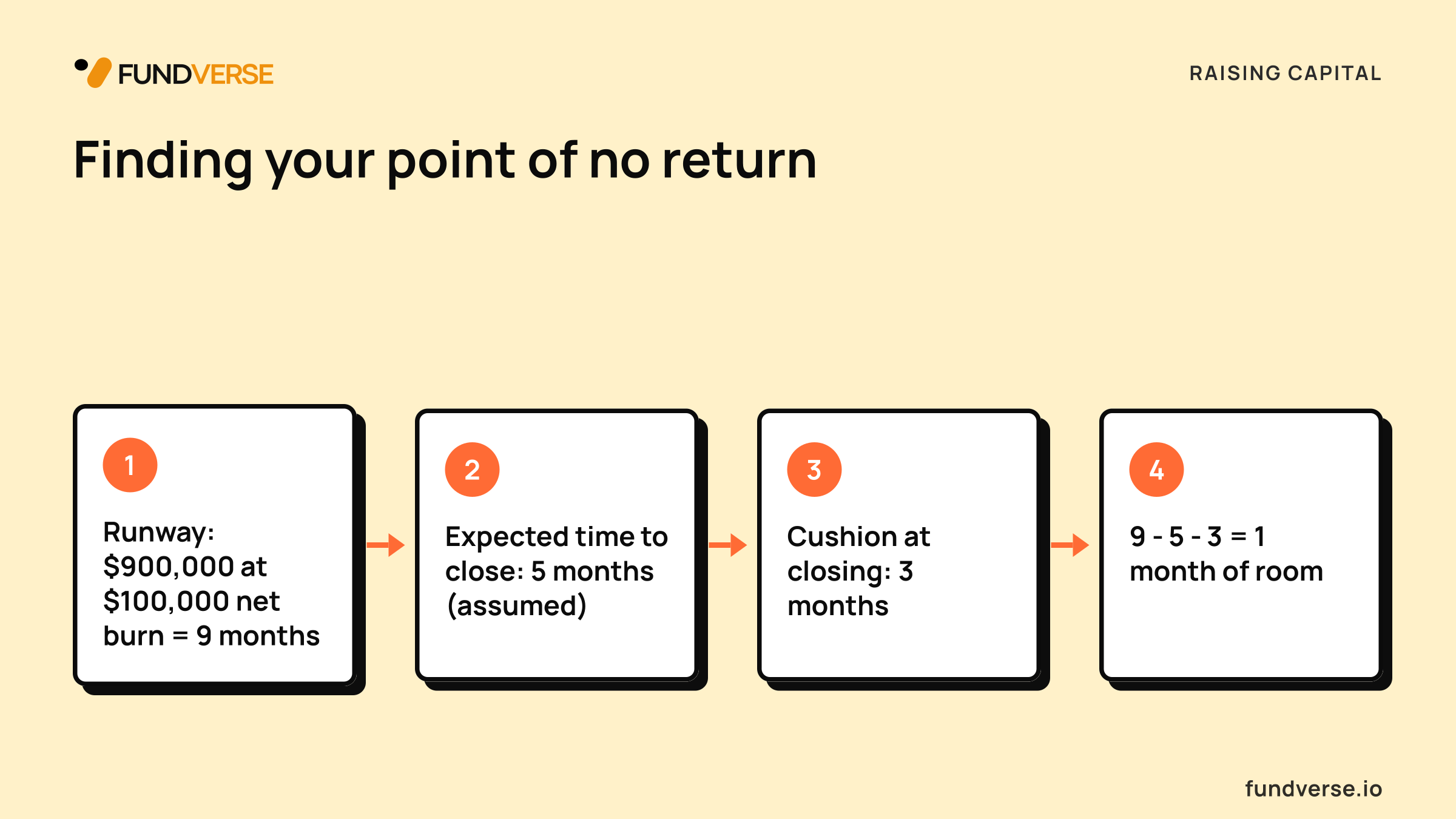
A worked illustration with assumed numbers shows when this bites. Say a company has $900,000 in the bank and net burn of $100,000 a month, which is nine months of runway. Suppose a round like this takes about five months from the first serious meetings to cleared funds. That figure is an assumption, so replace it with what your own conversations and comparable raises suggest, and err long. Then add a cushion of three months, the cash you want left at closing so that a slipped signing does not mean missed payroll.
The point of no return falls where remaining runway equals expected time to close plus the cushion. Here, 9 minus 5 minus 3 leaves one month of room, so this company has almost no slack before it starts. With twelve months of cash, the same arithmetic leaves four. A term sheet is usually negotiated around the middle of a process, so the company that begins at nine months negotiates with roughly six or fewer months visible on its balance sheet, exactly where leverage thins. Run the calculation on the day you decide to raise, not on the day cash starts to worry you. The method for net burn is laid out in our guide to calculating runway.
Diagnose the stall
Once you know how much room you have, the next question is why the round is slow, because the fixes differ and the wrong one burns weeks. A quick count settles most of it: how many qualified investors the company has spoken to, how many have asked for diligence materials, and how many have a dated next step.
Too few qualified investors
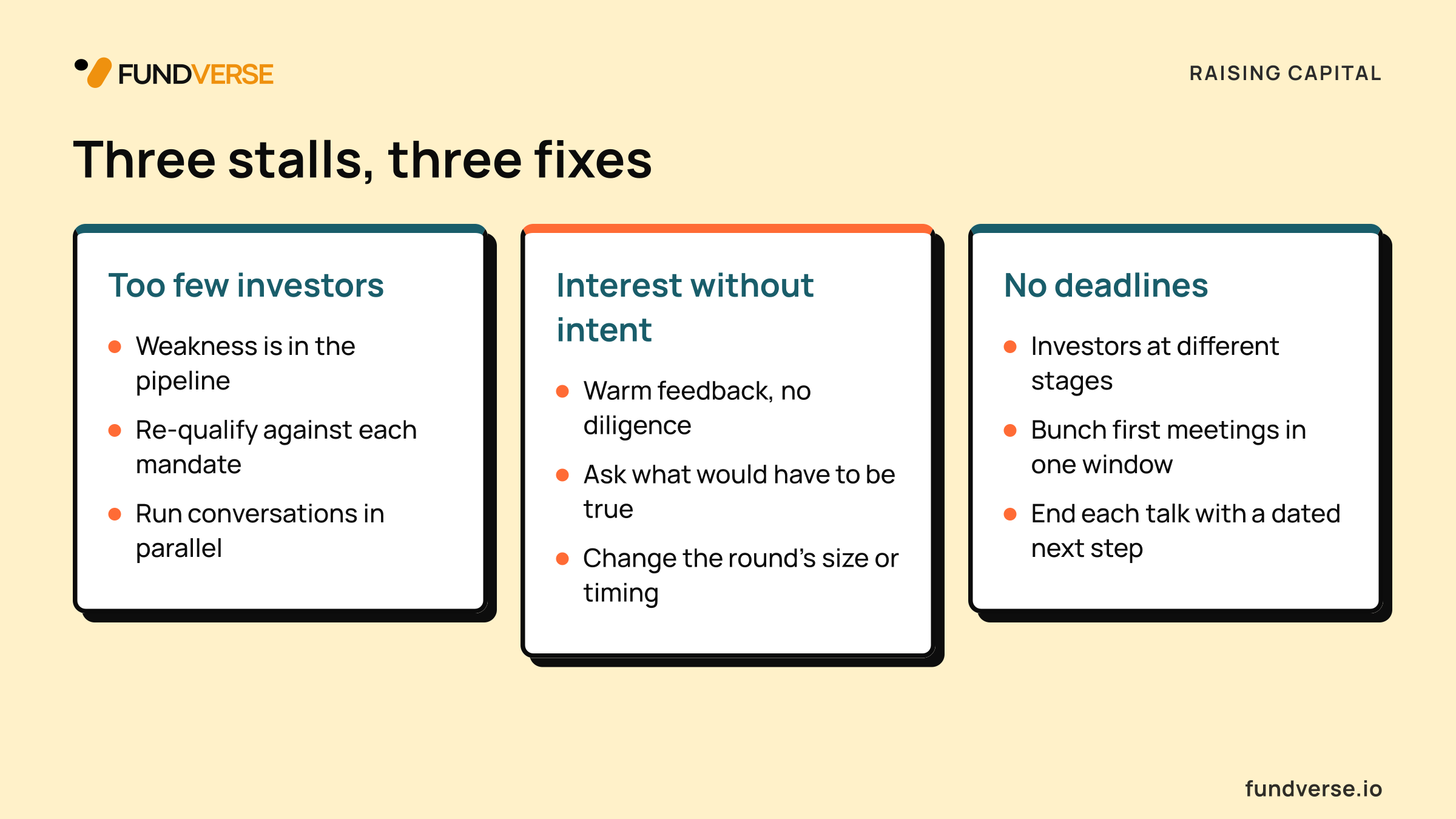
If few conversations exist, and many first meetings end in a mismatch on stage, check size, sector or geography, the weakness is in the pipeline. A round run with one or two investors at a time depends entirely on their calendars. The fix is to re-qualify against each provider's actual mandate, then run several conversations in parallel so that one slow committee does not set the timetable. A pipeline that records stage and next step for each investor, as described in this look at fundraising pipelines, makes the gap visible.
Interest without intent
Plenty of meetings, warm feedback and no diligence requests point to a conviction gap: investors like the company but not enough to spend effort on it. Ask each one what would have to be true for them to proceed, and listen for the objection: traction, market size, team or the terms of the round. If the same objection recurs across investors, no process change will fix it, and the round as designed needs to change, usually in size or timing. Why meetings stall before diligence goes deeper on reading those objections.
No deadlines or structure
Sometimes investors are engaged but sit at different stages and nobody has a date, which means the process itself lacks structure. Bunch first meetings into one window, share an expected timeline, and end every conversation with a dated next step. Keep the urgency real, because invented competing offers are usually discovered and damage trust. Saying plainly that the company intends to close by a certain month is honest, and it is enough to make investors decide whether they can keep pace.
Set a trigger and pick a lever
Fix the date in advance
Turn the calculation into a trigger date: the day remaining runway equals expected close time plus cushion. Agree it with cofounders, the board and the finance lead while nobody is desperate, along with the rule that applies on that day. If there is no signed term sheet, approved credit or award notice by then, a lever gets pulled. Without a pre-agreed date, every week seems to justify one more meeting, and the decision arrives when the options are at their worst.
Choose the lever
| Lever | What it fixes | Trade-off to accept |
|---|---|---|
| Tighten the process with a timeline | A process problem, by compressing parallel conversations into one window | Investors who cannot meet the dates drop out; works only where real interest exists |
| Cut the round size | A conviction problem tied to the ask, since smaller checks need fewer approvals | Less cash, so the next raise may come sooner |
| Bridge from existing investors | Buys months to reach a milestone | Insiders can set the terms, dilution follows, and it signals little if insiders are not fully behind you |
| Venture debt | Extends runway with limited dilution | Repayments, covenants (conditions the company must keep meeting) and sometimes warrants; lenders usually want a credible equity backer |
| Revenue-based financing | Funds growth against recurring revenue | Repaid as a share of revenue, often costly in effective terms, and needs steady revenue |
| Cut burn | Pushes out the cash-out date immediately | Slows the growth investors want to see |
The diagnosis should steer the choice, and levers combine. A process stall calls for a tighter timeline. A conviction stall tied to the size of the ask may be better answered by a smaller round than by a longer wait for the bigger one. A bridge only delays a conviction problem; it does not solve it, so it fits best when the company is close to a milestone that will change the investors' answer. A modest cut in burn plus a small insider bridge can restore the cushion without forcing a worse round.
Use the next 30 days
Treat the month as a repair sprint with a hard review at the end. The steps are discrete and can be checked off, so a short list fits.
- Recompute net burn and runway from the current bank balance, and write down the trigger date.
- Sort every investor by evidence: meeting scheduled, in diligence, terms discussed, or no reply in two weeks, which you should treat as a probable soft no.
- Ask each active investor for the next step, its date, and what they need before it.
- Add qualified names against real mandates until several conversations run in parallel.
- Assemble diligence materials before they are requested, including financials, cap table, key contracts and policies, so a request is answered in days.
- Open a backup conversation on a bridge or debt now, because those also take weeks to complete.
Some of the delay in a round is the company's own, and tools can remove it. A pipeline tracker shows which investors have a dated next step, an organized data room shortens the gap between a diligence request and an answer, and investor matching can help widen a list by mandate fit. None of this makes an investor decide faster or guarantees a close. It means the investor's clock is the only slow one.
If your round is stalling, try Fundverse to track every investor conversation against its next step and keep diligence materials in one data room, so the delays that are yours can be removed.
The next signal to watch is not a term sheet but whether investors' answers become dated and specific within two or three weeks. If they do, the process is moving at the investors' pace and the trigger date is a safeguard. If they do not, treat the trigger as already approaching and bring the lever decision forward, while there is still cash to choose with.
Frequently asked questions
Topics
fundraising taking too long
startup runway
fundraising timeline
bridge round
venture debt
revenue-based financing
fundraising process
point of no return runway
Raising or investing?
Find the right people on the other side of the table, and run the round in one place.