
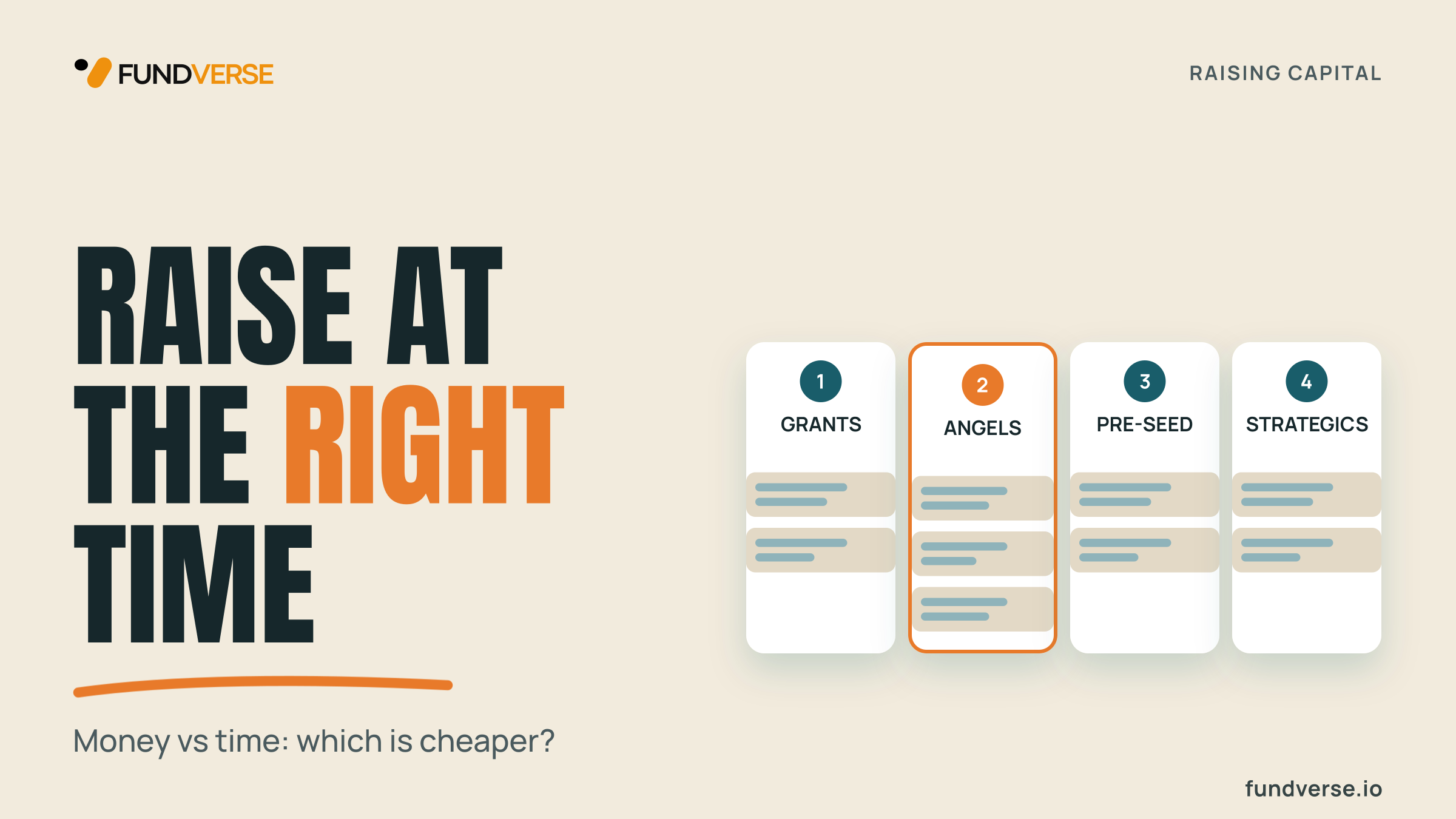

Founders ask whether they are ready for investors. A better question is what evidence an investor could not get by waiting, and which kind of capital pays for the next proof most cheaply.
Ask a founder with no revenue when they should start talking to investors and the reply is usually another question: am I ready yet? It sounds sensible, but it has no answer, because readiness is not a trait a founder possesses. It is a relationship between what you can show and what a particular kind of investor needs to see before the risk feels worth taking.
The more useful question is what evidence you could show that an investor could not get by simply waiting. If the answer is none, you are asking them to carry a risk that time would resolve for free. My view is that a pre-revenue startup is ready when the next piece of evidence costs less to buy with outside money than to produce alone. That point arrives at very different moments for grants, angels, pre-seed funds and strategic backers, which is why “when” never has a single answer.
Investors are buying less uncertainty
Without revenue, an investor is buying a reduction in uncertainty, and what they will pay depends on how much of it you have already removed. Most early uncertainty falls into four buckets: technical (can it be built), market (will anyone pay), regulatory (will it be allowed) and team (can these particular people do it together). Revenue persuades mainly because one number answers several of those questions at once. Without it, you have to substitute other proof: a working prototype, a signed pilot, a regulator's written guidance, a team that has already shipped something together.
Seen from the other side of the table, this explains why investors often wait. A careful investor who can meet you again in six months, with more of the uncertainty gone, loses little by waiting and often gains a good deal. Your task is to give them a reason not to wait, and that reason is almost always evidence that exists today and is hard to fake.
One unknown, two ways to resolve it
Here is a test I find more useful than any readiness checklist. List the four unknowns and pick the single biggest, meaning the one that would end the company if it came back the wrong way. Then ask whether it is cheaper to resolve with your own time or with someone else's money.
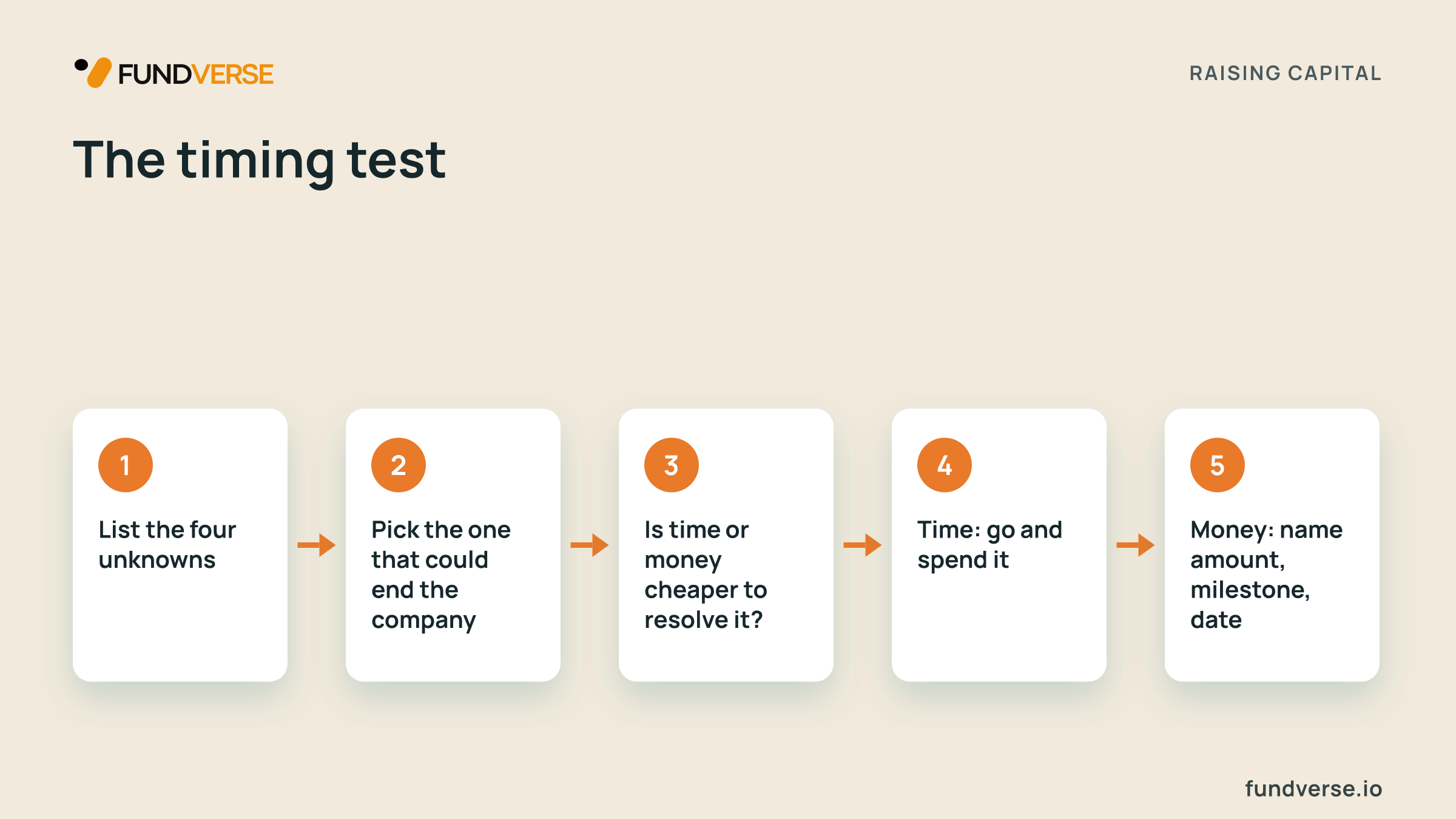
If the answer is time, go and spend it. A founder unsure whether small clinics will pay for scheduling software can find out by calling clinics and asking for a deposit, with no capital required. Raising first would mean selling that unknown at the deepest discount it will ever carry. If instead the biggest unknown is whether a manufacturing process works at a useful scale, no amount of hustle replaces equipment and technicians. That is a money problem, and a founder who can name the amount, the milestone it buys and the date it arrives is ready to start, because an investor can see exactly what their capital turns into. A sharper version of this question is explored in before you raise, ask what the money would change.
Each kind of capital wants different proof
Grants and other non-dilutive funding can be approached earliest. A grant maker is typically funding a hypothesis that fits its mandate, not underwriting a return, so the proof it needs is a credible plan, a capable team and a clear match with its goals. The trade is slower timelines, reporting obligations, and the risk of bending the business toward whatever the funder wants if you chase money that does not suit you.
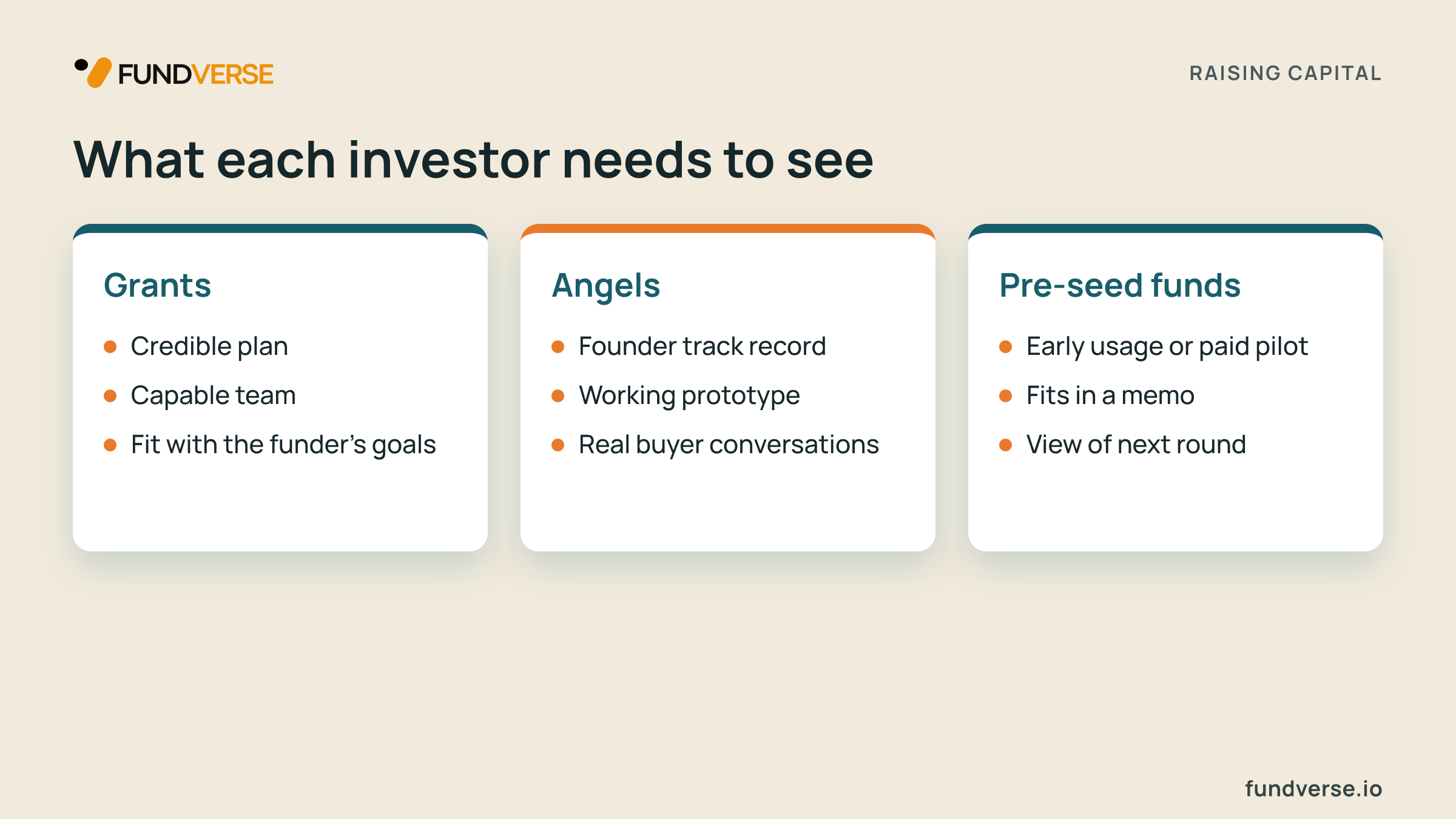
Angels come next. They often back a person as much as a plan, so a founder's track record, a working prototype and a handful of real conversations with buyers can be enough, and an angel can say yes on conviction in a way an institutional fund usually cannot. Pre-seed funds need more, because someone has to defend the decision to partners and, behind them, to the people whose money the fund manages. That usually means something that fits in a memo: early usage, a paid pilot, a clear view of what the next round will require.
Strategic and corporate backers are the odd one out. They care about fit with their own roadmap, so the proof is technical validation, a shared customer or an integration, and they can show interest earlier than financial investors if you are solving something they would otherwise have to build. The catch is that a strategic on the cap table can make its competitors wary of the next round, so a check that arrives early can cost something later.
Going too early costs more than time
Take a hypothetical founder with a deck for a freight-matching marketplace and no conversations yet with carriers or shippers. She sends it to forty investors in a month. Most pass politely, and a few say to come back when there is supply on the platform. Nothing dramatic has happened, but forty people now hold a first impression of a deck without proof, and several are exactly the ones she would want to meet in six months. First impressions are hard to rewrite.
If somebody does offer money at that stage, the price reflects peak uncertainty. A low valuation means giving away more of the company for the same cash, and it becomes the reference point that every later investor tests against. The share of every future decision you sell is not easy to buy back. The raise also eats months of attention that could have gone to the one unknown that mattered.
Going too late is a different trap
Now reverse the hypothetical. A team building software for clinics has eight months of cash and a finished prototype, and decides to build one more feature before raising. Fundraising routinely takes longer than founders plan, for reasons covered in why raising the money can take longer than building the thing. By the time the first meetings happen they are at five months, then four. Investors can tell, even if no one says so, from the compressed timeline and the eagerness to skip questions.
Diligence slows, which is how an investor asks for better terms without saying it aloud. A decent business ends up negotiating as though it were a weak one. Going too late is expensive because it removes your ability to walk away, and the ability to walk away is most of your bargaining power.
The best case for raising early
The strongest objection is that money buys speed, and in some markets speed is the product. If a window is closing or competitors are better funded, producing proof slowly on your own can mean arriving with perfect evidence and no market left. There is a fairness point too: many founders have day jobs or dependents, and telling them to generate the evidence alone quietly favors those who can afford to.
I take both seriously, and I think they restate the test rather than refute it. When money is clearly cheaper than time, raise. What I would resist is the vaguer version, raising because it feels like a milestone. Speed only counts when the dollars are tied to the unknown. Otherwise early money buys a longer runway for the same uncertainty, which is just a slower way of finding out.
Signals that the timing is right
Start with runway. Work backward from how long a raise might take, be pessimistic about it, and add the time you would need to keep running the business if the first round of conversations goes nowhere. Begin when your cash comfortably covers that, not merely the optimistic version.
Relationships should begin months before you ask. Share short updates, ask for advice rather than money, and let investors watch your claims become true. A warm introduction carries far more weight when the person making it has seen progress. Three signs suggest you are close: you can state your biggest unknown in one sentence, you can say what the money turns it into and by when, and the people you have been updating start asking when you plan to raise. The clearest sign against is being unable to say what you would do differently with the money.
What to do while you wait
Waiting is not idleness. It is the period in which you make the evidence cheaper to show and the raise cheaper to run.
- Attack the biggest unknown with the cheapest test you can design, ideally one where someone commits real money, as in finding your first ten paying customers.
- Send a short monthly update to the handful of investors and advisors you would want to hear from later: what you learned, what you decided, what you need.
- Build your financial model and data room gradually, so that a yes can be followed by documents within days.
- Apply to grants and programs that fit your stage; their timelines are long and they cost no equity.
- Learn how companies like yours get valued, starting with how to value a pre-revenue company, so you can recognize a bad price when you see one.
When the evidence starts to build, it helps to know which investors and funders actually back companies at your stage. Fundverse can help you find them through investor matching and keep your materials organized as the proof accumulates.
Next, write down your biggest unknown in a single sentence, and next to it the date by which you intend to have resolved it with your own time or decided that you need money to do so. Then watch what investors ask you in early conversations. When their questions move from “what is this?” to “how quickly can you get there?”, the evidence is doing its job and the timing is probably close.
Frequently asked questions
Topics
pre-revenue startup fundraising
when to raise investors
pre-seed timing
angel investors
grants for startups
fundraising runway
startup evidence investors
Raising or investing?
Find the right people on the other side of the table, and run the round in one place.