

You have zero revenue. But your company has real value. This guide breaks down the four methods investors use to value pre-revenue startups — and how to justify a valuation that works for you.
You have zero revenue. But your company has real value.
The question every pre-revenue founder faces is simple: how much is my company worth? The answer is anything but simple. Without revenue, profits, or predictable cash flows, traditional valuation methods fail completely. Yet investors write cheques for millions based on little more than a pitch deck, prototype, and founding team.
How do they arrive at these numbers? The answer lies in specialized pre-revenue valuation frameworks that evaluate qualitative factors like team strength, market opportunity, technology risk, and competitive positioning.
This guide breaks down the four primary methods investors use to value pre-revenue startups. Understanding these frameworks empowers you to negotiate from a position of knowledge rather than accepting whatever valuation investors propose.
The Challenge of Valuing Pre-Revenue Companies
Traditional valuation methods rely on financial metrics that simply do not exist for pre-revenue startups. Revenue multiples, discounted cash flow analysis, and comparable public company metrics are all useless when there are no numbers to analyse.
Instead, pre-revenue valuation requires a fundamentally different approach. Investors are not buying revenue or profits. They are buying potential. The fundamental equation is simple:
Pre-Revenue Valuation = Potential × Probability × Comparability
Potential means market size, business model scalability, and the addressable opportunity if you succeed. Probability means team execution capability, product-market fit evidence, and competitive positioning. Comparability means what similar startups raised at what valuations in current market conditions.
Method 1: The Berkus Method
The Berkus Method was created by prolific angel investor Dave Berkus in the 1990s. It is a straightforward model that values a pre-revenue company by focusing on risk factors instead of financial projections.
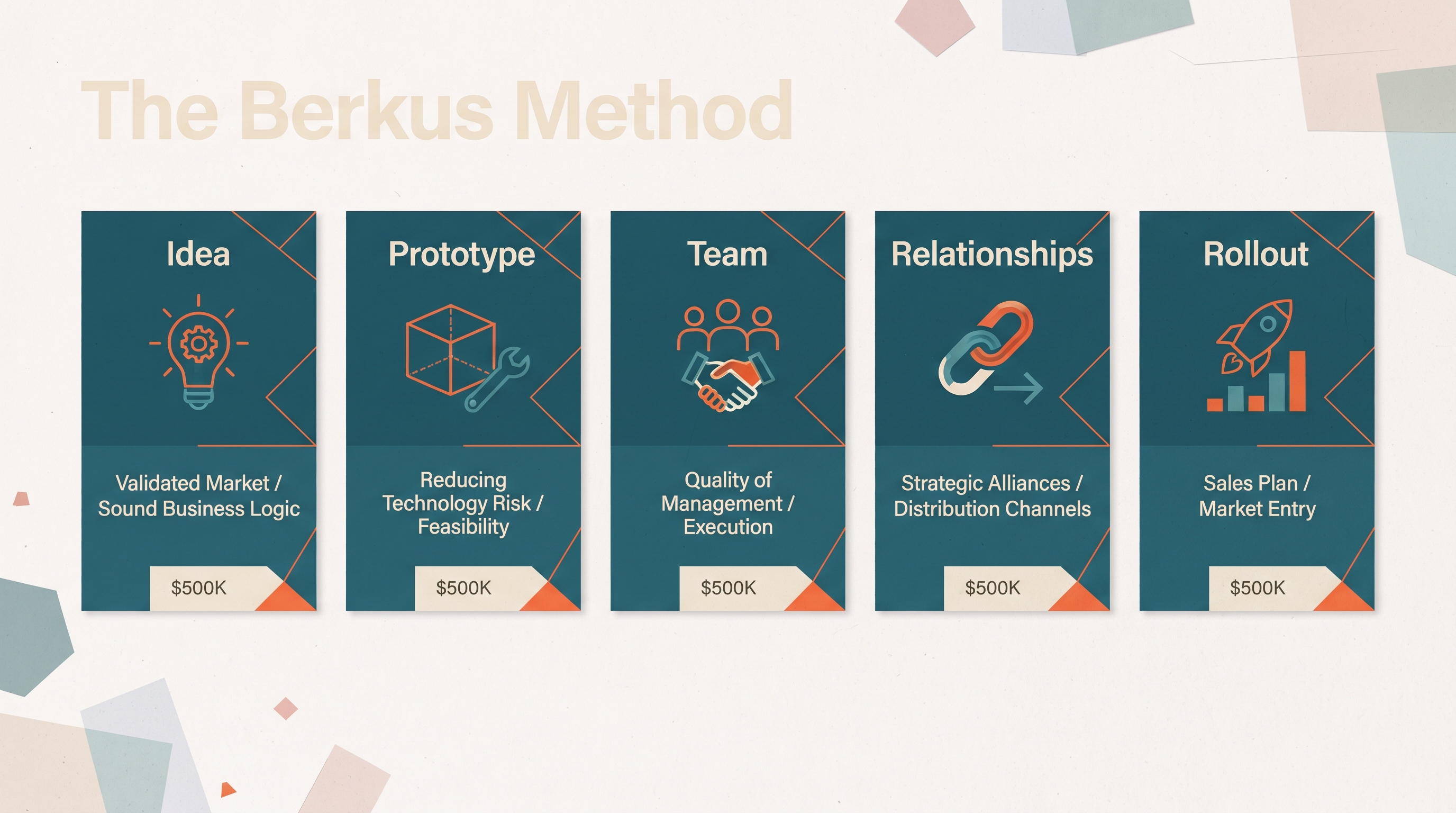
The method assigns a specific monetary value to five key elements that could influence the success of a startup. Each element is assigned a value of up to $500,000, depending on the perceived strength and potential of that aspect. At a perfect score, a startup's valuation tops out at $2.5 million.
The Five Factors:
- Sound Idea — $0 to $500,000: Is it innovative? Does it solve a real problem? A strong and compelling idea can be worth a substantial portion of the startup's value.
- Prototype — $0 to $500,000: A prototype shows that the founders have moved beyond just thinking about the idea and have built something tangible.
- Quality Management Team — $0 to $500,000: A strong management team can be one of the most important indicators of startup growth. Investors want to see the right combination of experience, skill sets, and passion.
- Strategic Relationships — $0 to $500,000: Key partnerships, distribution channels, or advisors that lend credibility to the startup.
- Product Rollout or Sales — $0 to $500,000: If you have begun testing your product in the market, have early users, or have signed customers, it adds value. A startup that is already getting traction could be in a much better position than one still stuck in development.
The Berkus Method offers a highly simplified way to come up with a pre-revenue valuation estimation. However, it is fairly limited in scope and does not take the market or competitive advantage into account.
Method 2: The Scorecard Method
The Scorecard Method, also known as the Bill Payne valuation method, compares the pre-revenue startup to funded startups, adjusting the average valuation depending on factors like stage, market, and region. It takes a similar approach as the Berkus Method, with the addition of more factors.
Step 1: Find the Benchmark
Determine the average pre-money valuation for pre-revenue startups in your market. Crunchbase and AngelList are excellent resources for researching startup valuation data to find a pre-revenue valuation benchmark.
Step 2: Compare and Adjust
Once the average has been determined, the pre-revenue startup is compared to similar venture deals in-market, considering the following factors:
- Strength of the Management Team — 0% to 30%
- Size of the Opportunity — 0% to 25%
- Product/Technology — 0% to 15%
- Competitive Environment — 0% to 10%
- Marketing/Sales Channels/Partnerships — 0% to 10%
- Need for Additional Investment — 0% to 5%
- Other — 0% to 5%
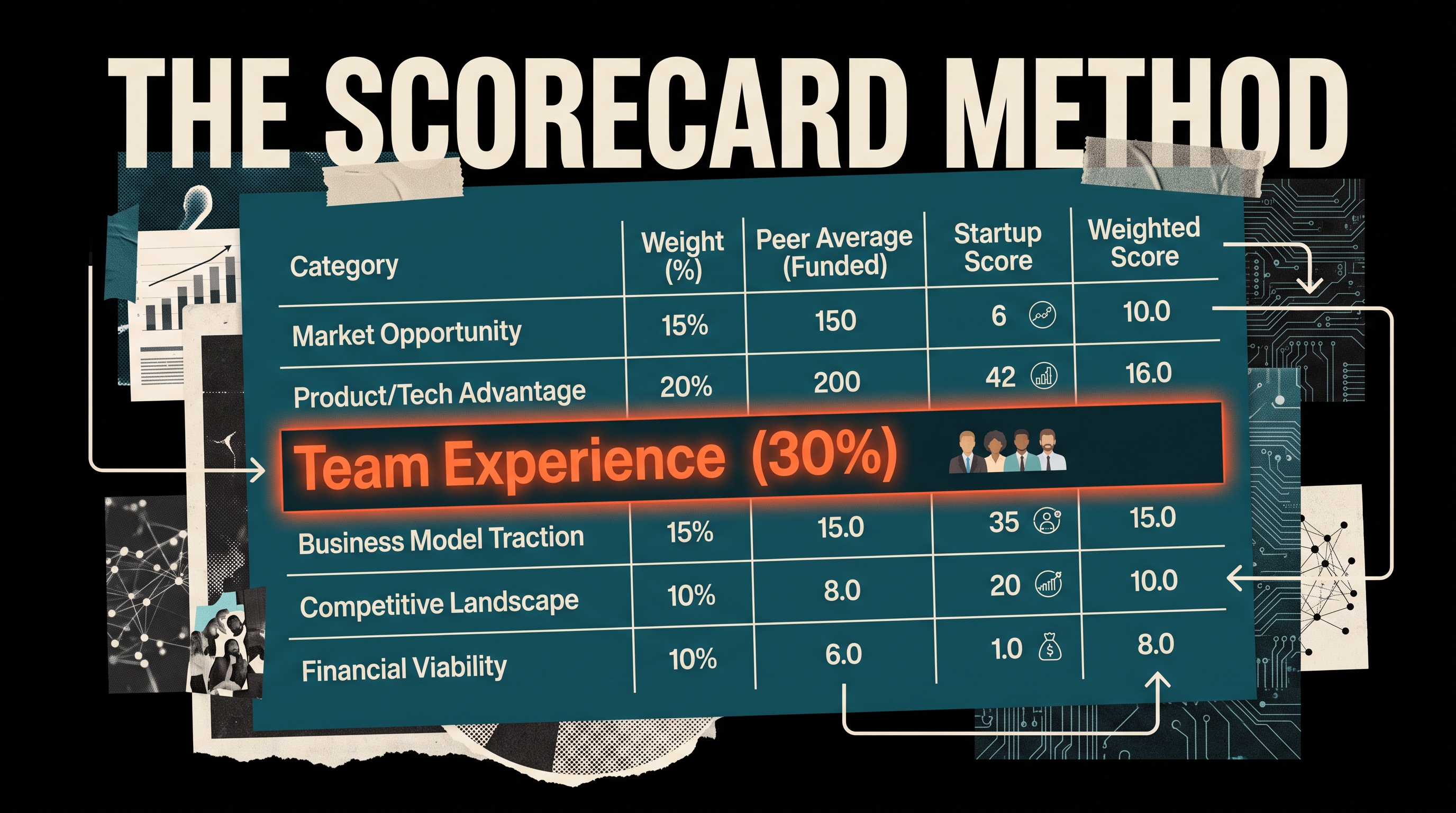
The ranking of each factor is subjective. Something to note about this model is the weight placed upon a high-quality team, which is reflective of Payne's argument that "a great team will fix early product flaws, but the reverse is not true".
In a typical example, a startup with an excellent team (125% of the norm), a big market opportunity (150% of the norm), and a market-average product (100% of the norm) would receive a valuation above the benchmark.
Method 3: The Venture Capital Method
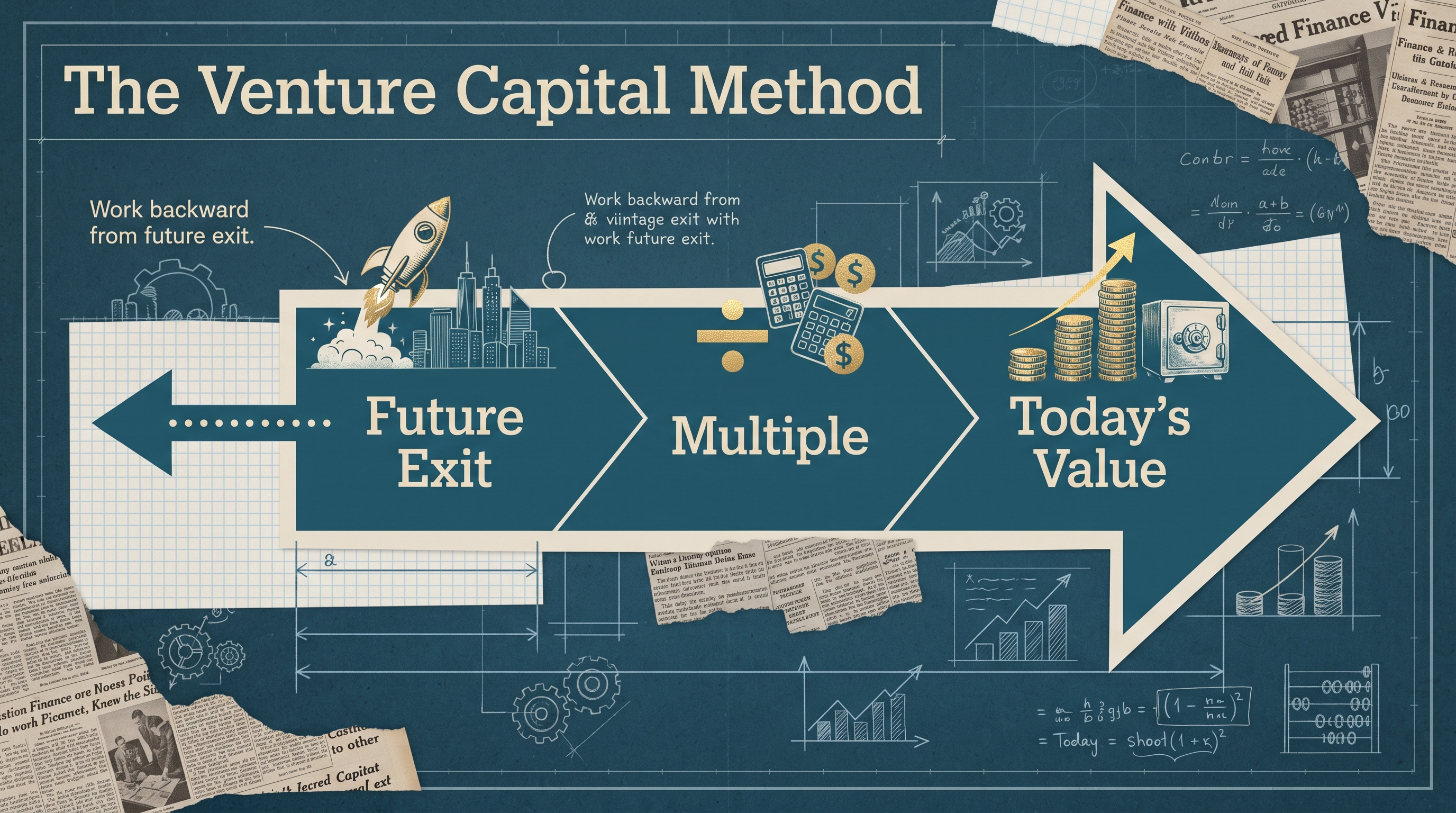
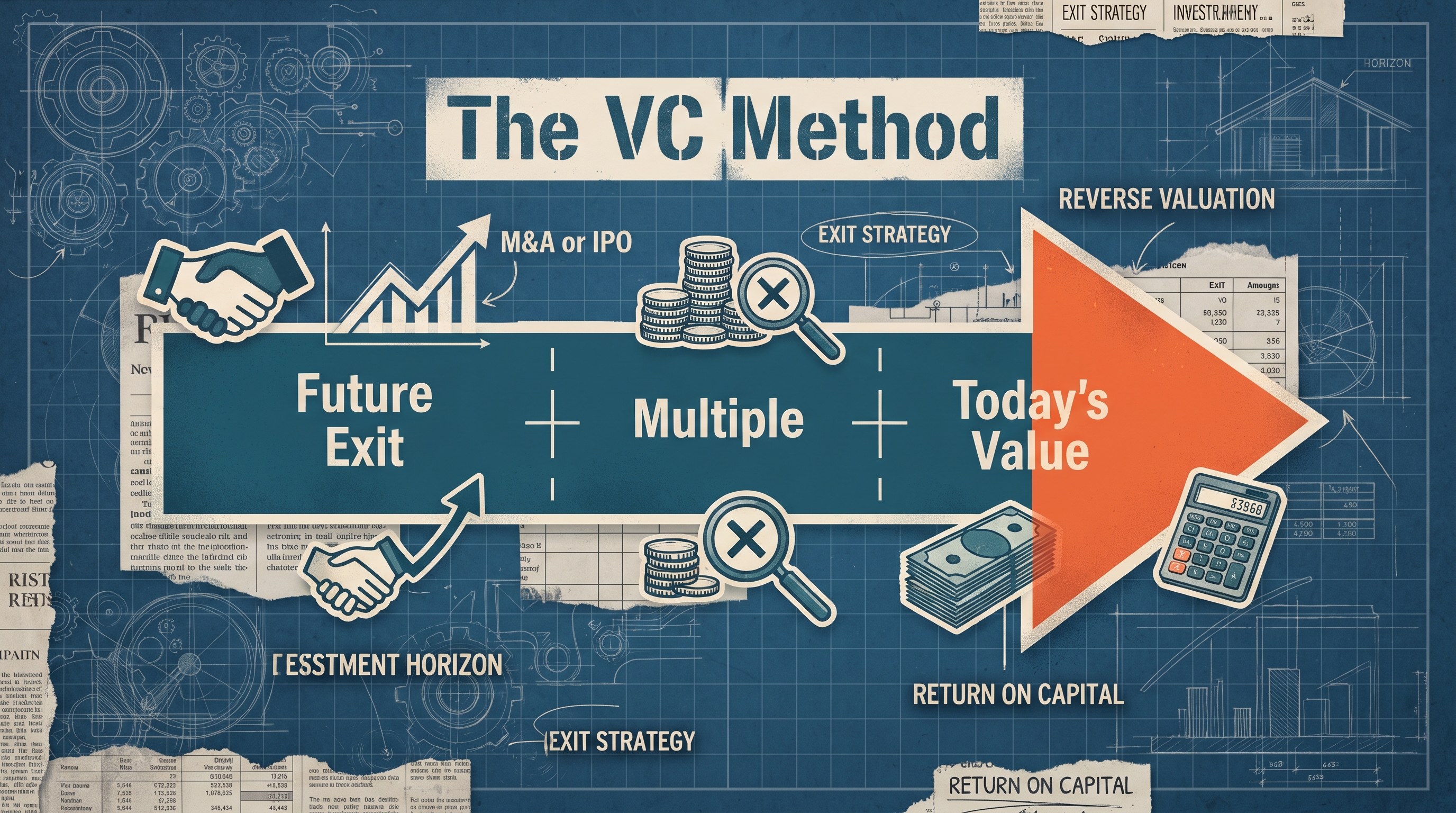
The Venture Capital Method (VCM) is a forward-looking approach that works backward from a future exit. Both VCM and Discounted Cash Flow are suitable for pre-revenue startups, though DCF presents unique challenges due to inherent uncertainties.
Step 1: Estimate Future Revenue
Estimate what the company's revenue will be at the time of exit — typically 5 to 7 years in the future.
Step 2: Apply a Profit Multiple
Apply an appropriate profit or revenue multiple based on comparable public companies or recent acquisitions.
Step 3: Work Backward
Apply the target return on investment (typically 10x to 30x for early-stage investors) to work backward to the current valuation.
VCM proved particularly insightful for early-stage companies because it allows valuations across multiple investment rounds, providing a dynamic view of equity stakes.
Method 4: Comparable Transactions
Comparable transactions, also known as market comparables, look at what similar companies at a similar stage recently raised. The logic is simple: if startups in your sector and stage are valued at certain multiples of revenue, users, or ARR, yours might fall within that range too.
This method is particularly useful for early-stage startups where future growth potential is more important than current financials.
How to Find Comparables:
- Research funding rounds on Crunchbase, AngelList, and PitchBook
- Look for similar stage, same vertical, and recent raises (last 12–18 months)
- Create a mini comp set to guide your expectations

Pre-revenue startups typically rely on user metrics and traction, while later-stage companies use trailing twelve months or annual recurring revenue.
What the Market Actually Looks Like
Valuations are not arbitrary. They follow patterns based on stage, traction, and market conditions.
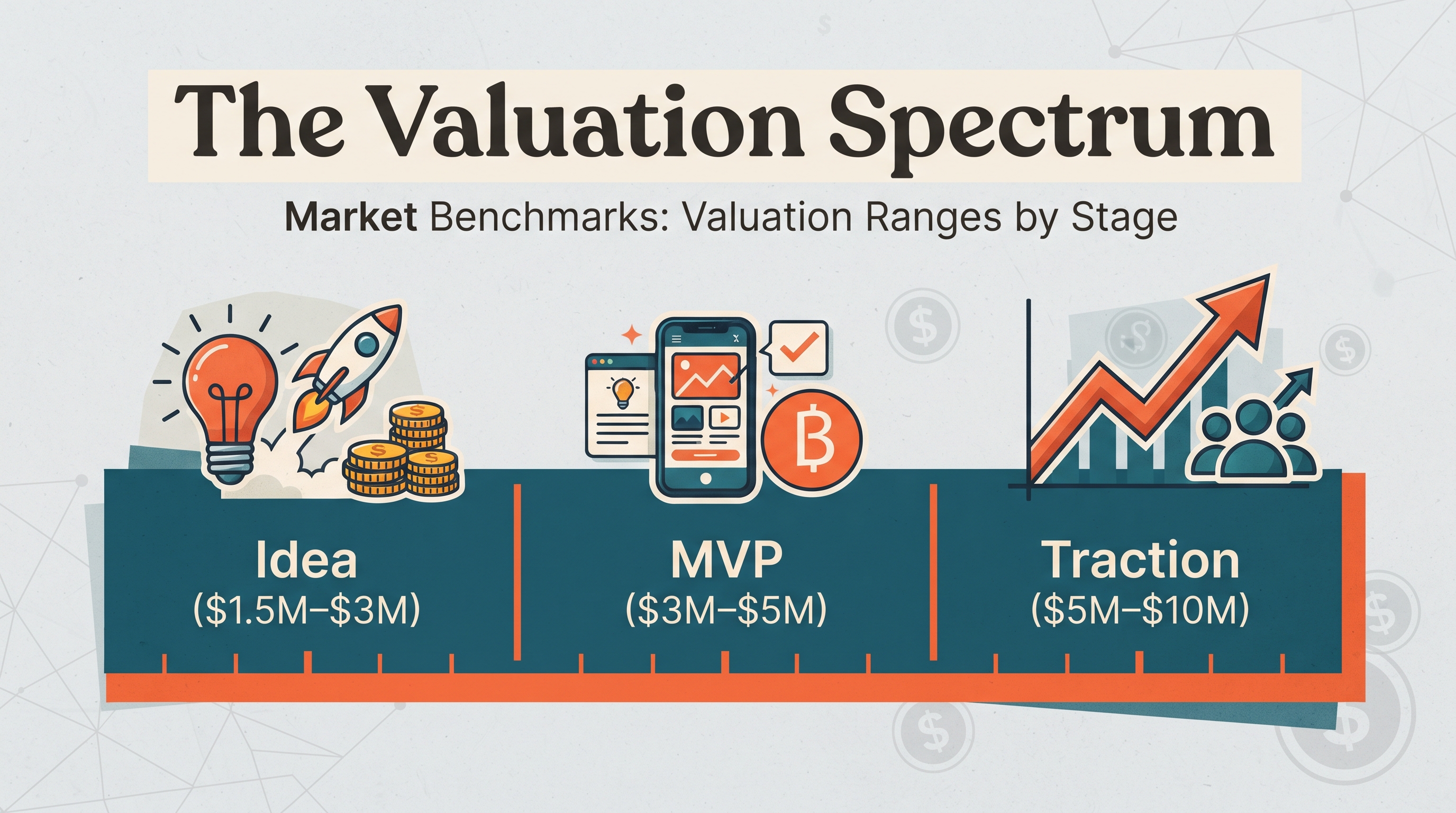
2025–2026 Valuation Benchmarks:
- Idea stage: $1.5M – $3M pre-money
- MVP with beta users: $3M – $5M
- Revenue-generating: $5M – $10M
- Growing traction: $10M – $15M+
According to Carta's most recent data, the average U.S. pre-seed pre-money valuation is $5.7 million, with a $5.3 million median. According to PitchBook's 2025 Pre-Seed & Seed Report analyzing 8,000+ deals, median pre-revenue seed valuations reached $7.5M in 2025, up from $5.2M in 2022. However, the range is enormous: bottom quartile at $2.8M, top quartile at $15M+. This 5x variance is explained entirely by team pedigree, traction metrics, and sector dynamics.
The median pre-seed, pre-money valuation was $7.7M as of the end of Q3 2025. The median seed pre-money valuation in Q1 2025 was $16M — up 18% year-on-year — even as deal volume shrank 28%.
SAFE Valuation Caps
In 2025, early SAFE valuation caps commonly fall between $5 million and $15 million at pre-seed and $10 million to $25 million at seed, depending on stage, traction, and market. Y Combinator's standard SAFE in 2024 was $3M to $5M cap at pre-seed.
How to Increase Your Pre-Revenue Valuation

Even with zero revenue, you can justify a strong valuation by building credibility before you fundraise.
Build an MVP — Show a working product early. A prototype demonstrates that you can execute on your vision.
Get Letters of Intent — Even pre-revenue, you can justify value using waitlist signups, LOIs or pilot commitments, user engagement data, and unit economics modeling. Example: "We've signed 8 LOIs with enterprise customers averaging $12K ACV. That's $96K in pre-launch demand".
Build a Strong Team — Highlight skills and track record. A great team will fix early product flaws, but the reverse is not true.
Pick Your Market — Choose high-value comparables. Industry, geography, and team all shift the numbers.
Get Early Sales — Get traction before fundraising. Even if it is small, it is proof.
The Traps to Avoid
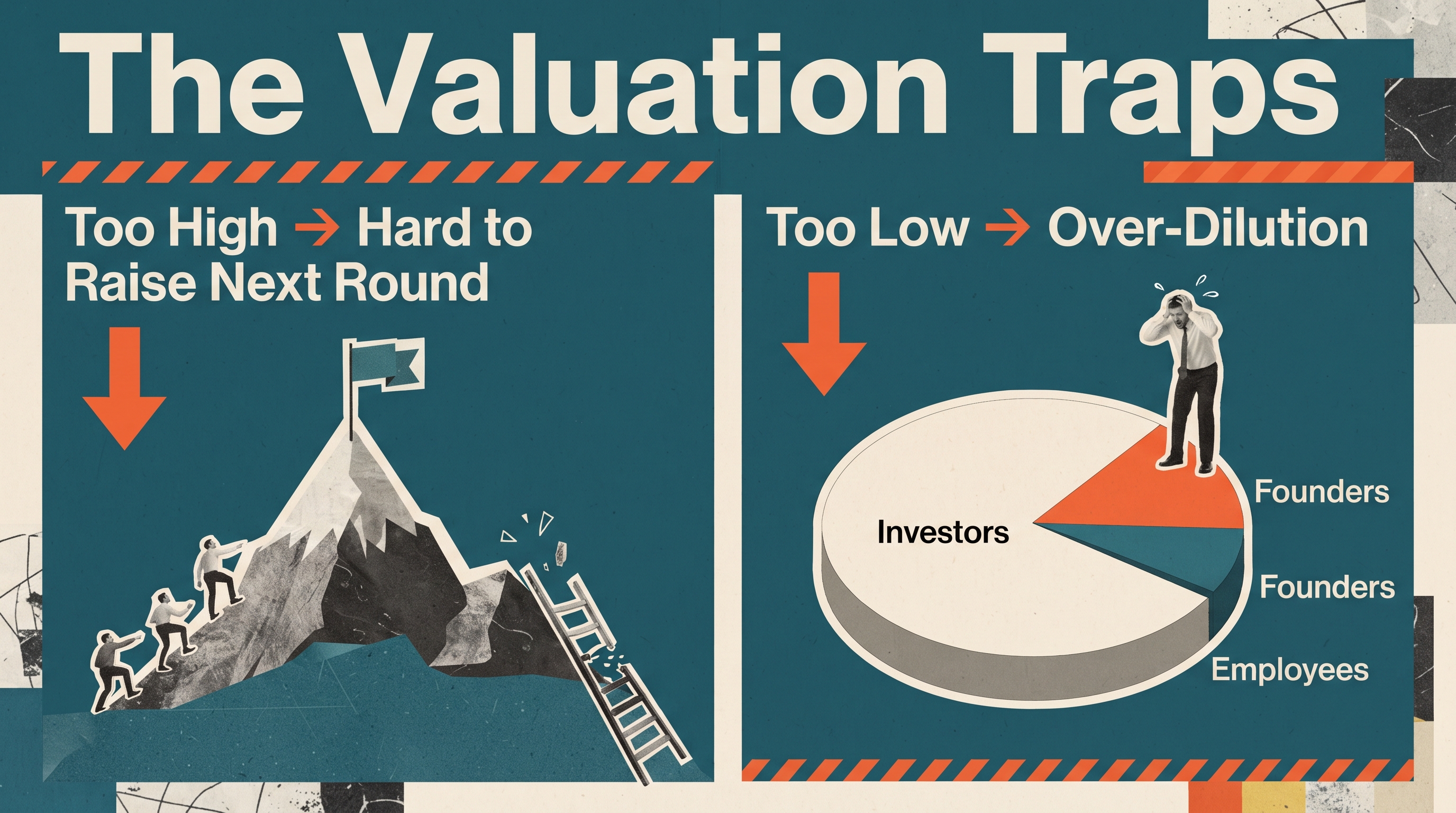
Going Too High
Setting your valuation too high can make your next round harder to raise if you have not grown fast enough to justify the leap. A higher valuation means you raise more money for less equity, but it also raises investor expectations.
Going Too Low
Going too low may signal desperation or inexperience and leave you over-diluted at the early stage. A lower valuation might feel like you are giving up too much too soon, but it can create more breathing room for growth and future fundraising.
The Ownership Math
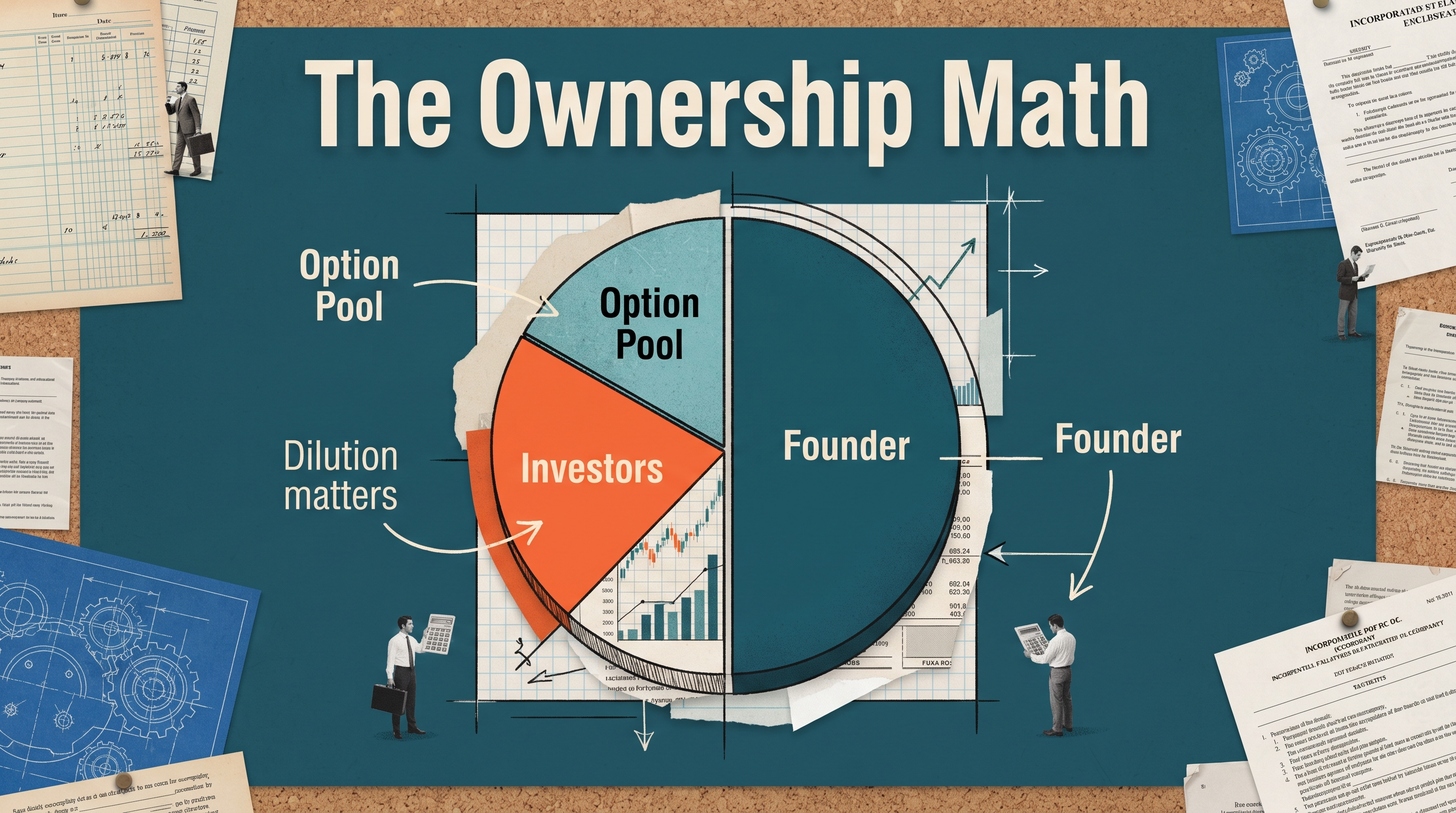
Your valuation should leave room for investor incentive (~20–25% ownership), future rounds (avoid too much dilution), and team options (~10–15% pool). Example math: raising $500K at $5M post = 10% dilution. Raising $2M at $8M post = 25% dilution.
The Bottom Line
Valuation is negotiation, not math. At early stages, valuation is not just a math equation — it is a mix of market comparables, investor sentiment, team strength, vision and narrative, and fundraising supply and demand.
The four methods covered in this guide provide a structured approach to what might otherwise seem like arbitrary number selection. Understanding these frameworks empowers founders to negotiate from a position of knowledge rather than accepting whatever valuation investors propose.
Before you raise your next round, know your benchmarks. Build your proof points. Understand your leverage. And remember: the number you agree on today shapes everything that comes next — how much of your company you give up, how investors perceive you, and your ability to raise future rounds without facing a down round.
 Ready to value your pre-revenue company? Use the Fundverse Valuation Free Tool — includes the Berkus Method calculator, Scorecard Method worksheet, and comparable transactions template. Start knowing your worth today.
Frequently Asked Questions
Topics
pre-revenue startup valuation
Berkus Method
Scorecard Method
VC Method
startup valuation
pre-seed valuation
seed valuation
valuation cap