
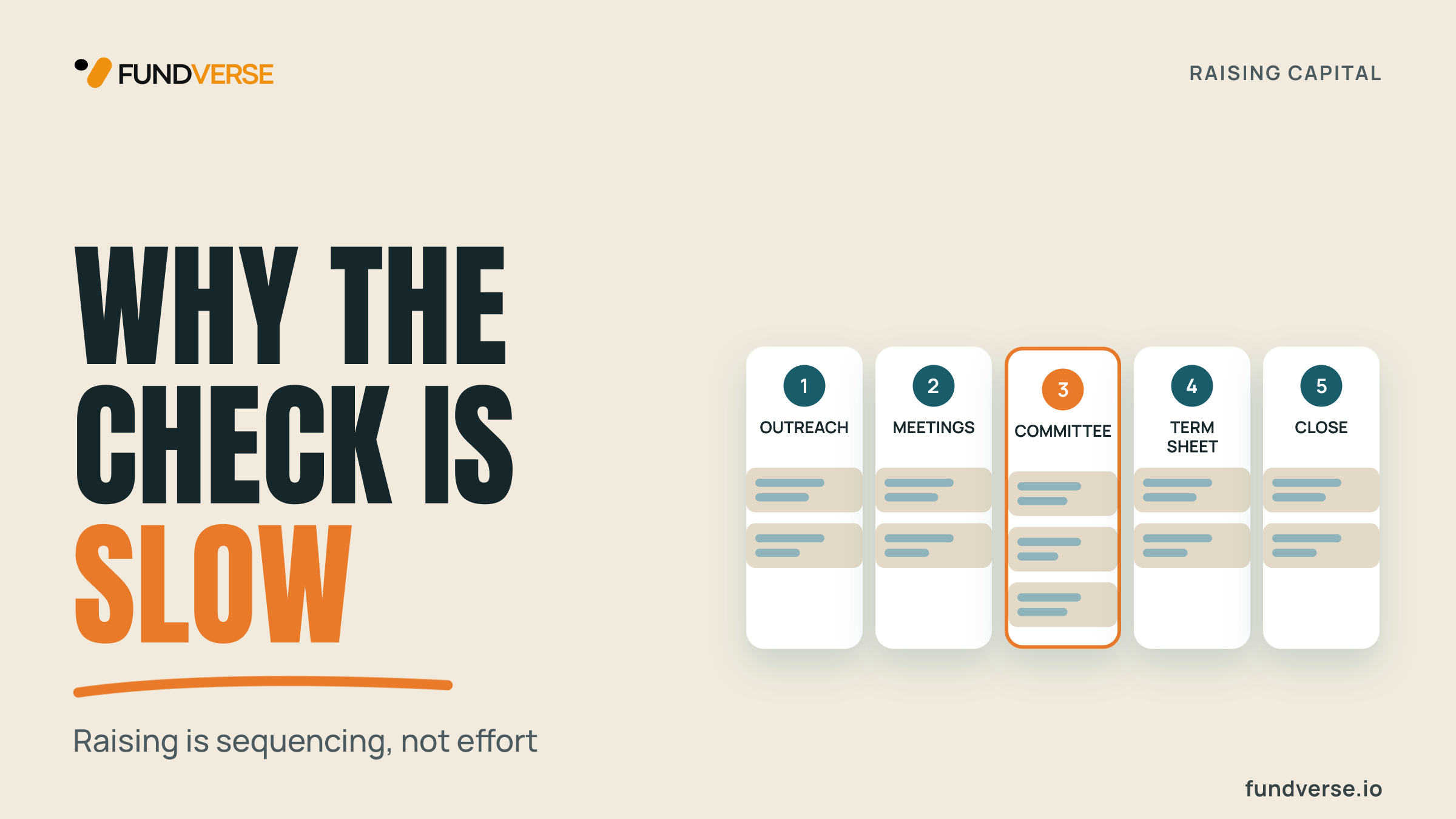

A product is built by effort. Capital is raised through a chain of other people's decisions, each waiting on the next. That structure explains why a fundraise runs long, and what founders can do about it.
A small team can often build a working version of its product in a few months. The same team may then spend longer than that trying to raise the money to build the next version. Founders find this baffling, and many conclude that something must be wrong with them or with the business. If the product works, why does the check take so long?
The better explanation is structural. Building is a problem of effort: you decide what to do, you do it, and the pace is largely set by your own team. Raising is a problem of sequencing. Your outcome depends on a series of decisions made by other people, each waiting on someone else, and most of them lose nothing by waiting. The delay says little about your company. It is what that kind of system produces.
Effort versus dependency
A product team holds its own levers. If a feature is late, it can add people, cut scope, work a weekend or change the approach. Progress is uneven and often frustrating, but the levers sit inside the building, and someone who works harder or smarter usually moves the date.
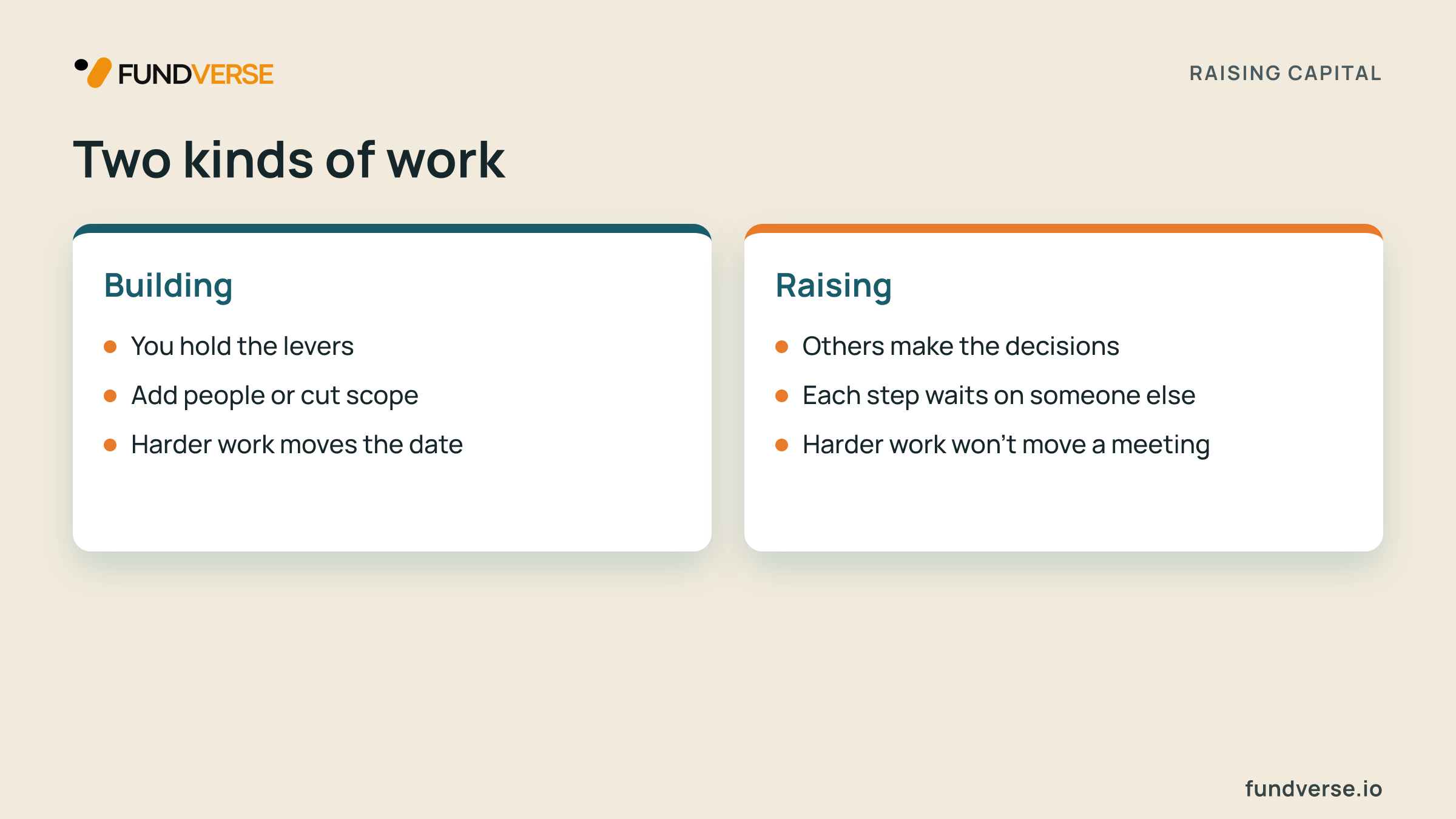
A founder in a raise controls far less. She can send more emails, sharpen the deck and prepare the data room, and all of that affects how a process starts much more than how it ends. Once a partner has taken a meeting, what happens next depends on that partner presenting to colleagues, who meet on a fixed day, who may want a co-investor to confirm interest, who may want references, who send documents to lawyers with other clients. Working harder does not make an investment committee meet on Tuesday instead of next Monday.
That is a dependency chain in practice, and each link is reasonable alone. A partner who wants a second opinion is being prudent. A committee that meets weekly is organized. A lender whose credit team reviews files in order of arrival is being fair. But the elapsed time is the sum of the waits, and the waits sit largely outside the founder's control. Add a step that has to be done twice, such as a revised term sheet that sends the file back to committee, and weeks pass without anyone doing anything wrong.
Why waiting is rational
Logistics alone would suggest the fix is better scheduling. There is a second force that is harder to see from the founder's side: for the person deciding, waiting is often the best available move.
An investment in a young company is hard to reverse, and the information about it improves with time. A quarter from now the investor will know whether the pipeline converted, whether the key hire stayed and whether other investors showed up. The cost of waiting is the chance the deal goes elsewhere. The cost of committing early is backing something that looks different once more facts arrive. For most deals, and especially borderline ones, the second risk looks larger. A deliberate "not yet" costs little and may be worth a lot.
There is a social layer too. Nobody wants to be first into a round that others are watching, because first money signals conviction no one else has yet validated. The fund that leads carries the reputational risk if the company stumbles, plus the work of building the round. The fund that follows gets a validated deal and a cleaner story for its own committee. If every investor would rather follow, the round does not start until someone is persuaded, pressured or surprised into leading.
None of this makes investors cynical, and not every slow answer is a polite no, though some are. Plenty of delay is honest uncertainty. The point is the asymmetry: patience is cheap for the provider and expensive for the seeker, who is the one burning runway. One party has time, and the other is paying for it.
The same pattern in every kind of capital
It is tempting to call this a venture quirk. The bottlenecks change from one capital type to another, but the shape stays the same.
In venture and growth equity, the bottleneck is consensus. One enthusiastic partner is rarely enough: the deal needs a champion, a partnership vote, a lead to set terms and often other investors to fill the round. Each is a separate calendar. Then documentation begins, and lawyers on both sides negotiate protective provisions, side letters and disclosure schedules, with every change passing back through principals busy with other deals.
In bank lending and private credit, the bottleneck is credit approval. The relationship manager or originator may like the business, but the decision belongs to a credit function that tests the financials, the security and the repayment capacity against policy. If the file has gaps, questions go back to the borrower and the clock effectively restarts. Collateral valuations, title searches, insurance and conditions to drawdown each add steps, often handled by third parties who are in no hurry.
Asset finance can look faster because the asset is the security, but it has its own chain of supplier quotes, valuation or inspection, insurance and dealer arrangements that must line up before funds move. If one slips, the whole facility waits. Grants and development finance are the most openly calendar-bound. Many programs review applications in cycles, with fixed windows, panel meetings, external due diligence, compliance checks and board approvals that may happen only a few times a year. Missing a window can add months that no founder energy can recover.
Different institutions, different vocabulary, same fact: a group makes the decision, on a schedule, with other things competing for attention. The founder participates in the process but does not author it.
How four months becomes eight
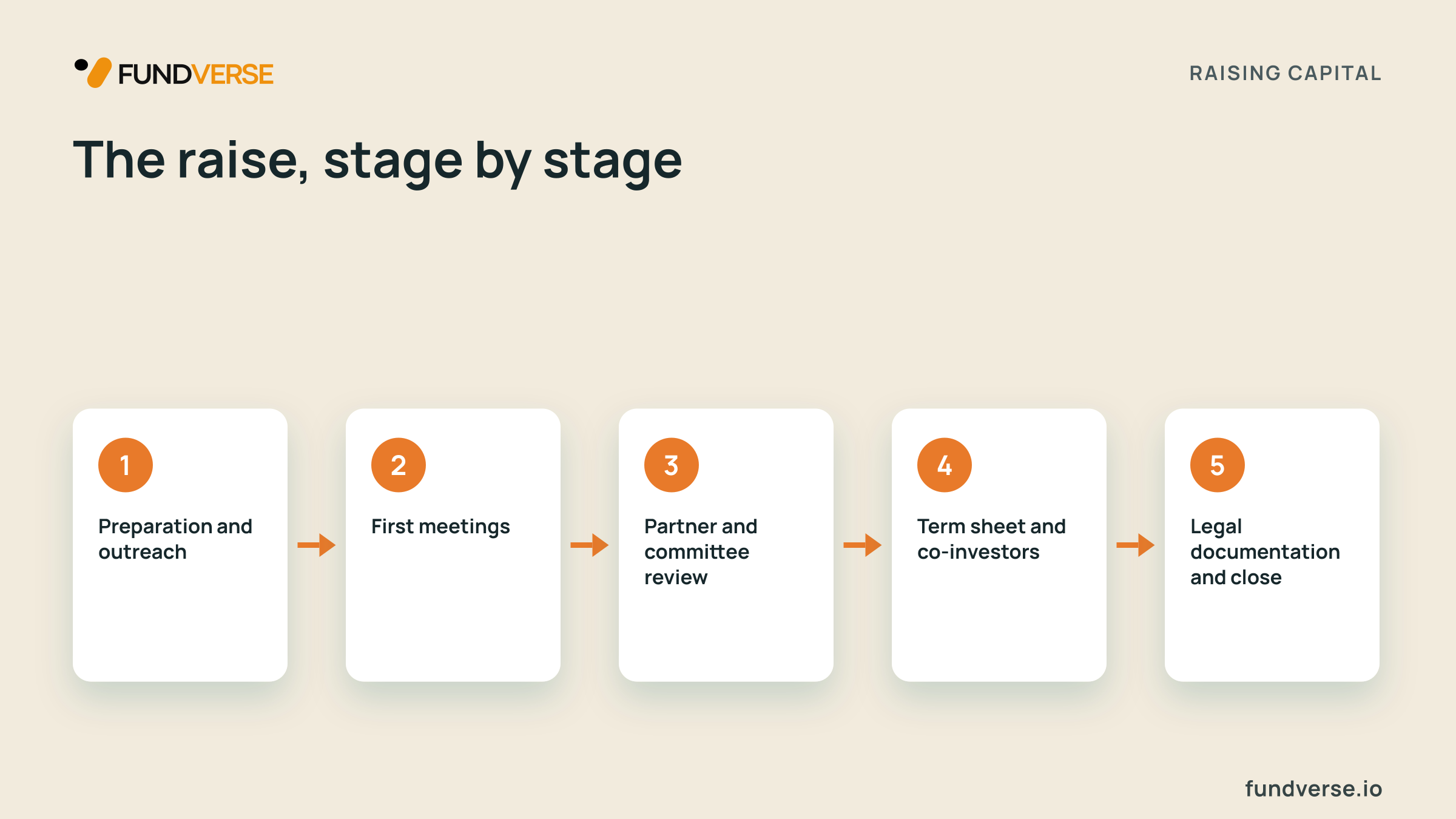
A hypothetical makes the arithmetic visible. Imagine a company with a working product raising an equity seed round. The founder plans four months: one to prepare and contact investors, one for first meetings, one for diligence and negotiation, and one to close. The plan is sensible, but it assumes every interaction happens promptly and in sequence. The numbers below are illustrative assumptions, not data.
| Stage | Founder's plan | What happens | Elapsed |
|---|---|---|---|
| Preparation and outreach | 4 weeks | Materials take longer than expected; first replies arrive slowly, some after a reminder | 6 weeks |
| First meetings | 4 weeks | Partners are traveling or tied up in other processes; second meetings are scheduled two to three weeks out | 7 weeks |
| Partner and committee review | Assumed inside diligence | An investor wants a few more months of data before presenting; another asks for a reference round | 6 weeks |
| Term sheet and co-investor assembly | Assumed instant | The lead will commit only if a second fund joins, and that fund starts its own review | 5 weeks |
| Legal documentation and close | 4 weeks | Two rounds of comments, a disclosure issue, one investor's final approval delayed | 8 weeks |
Each stage is a handoff to someone with a calendar of their own, and each handoff carries some chance of adding a week or two. Those delays rarely cancel out, because nearly all of them point the same way: later. Stages the founder pictured as overlapping turn out to be sequential, because one party will not move until another has. The elapsed weeks above total thirty-two, roughly eight months. Put an investor who "needs one more quarter" at the front, and the process stretches well beyond that.
The table leaves out the hidden cost, which is the founder's attention. A raise is not a background task. It means preparing for meetings, following up, answering diligence questions in detail and riding out a process where good news and silence alternate. Suppose, again hypothetically, she spends a third of her working time on it. Over eight months that is close to three months of full-time effort diverted from the product, the team and the customers. And the company is being judged while this happens: momentum that stalls because the CEO is in meetings shows up in the metrics investors are watching. A slow raise can quietly weaken the story it is trying to sell.
Is it really just structure?
A fair reader will push back. Sometimes a long process does reflect a weak business, an unclear pitch or a founder who has not done the work. Slow responses can be polite refusals, and repeated requests for more data can mean an investor has not found the conviction to proceed. A company that is truly compelling for a given pool of capital often finds the process moves faster.
But as a rule, the inference runs the wrong way. Length alone tells you little, because structure lengthens good and bad processes alike. The more useful signals are in the details: whether the investor's questions are getting more specific, whether new people are being brought in, whether next steps carry dates. Specific engagement on a slow calendar differs from vague warmth with no calendar at all. Founders who read every delay as a verdict tend to decide badly, discounting a round to hurry it or abandoning a good lead too early. Providers who treat their own slowness as neutral may underrate what it costs the companies they want to back.
If you are running several investor conversations at once, Fundverse can help you keep each one, with its stage, next step and dates, in one place so a stalled process shows up early. See Fundverse for founders.
Shortening the chain by design
If the problem is a chain of dependencies, the answer is to shorten the chain or run several at once. The strongest lever founders have is concentration in time. Talking to one investor at a time makes the whole raise as slow as that investor. A deliberate, compressed process, with first meetings clustered into a few weeks, brings several investors to their decision points around the same time. Their calendars still bind them, but in parallel, and the faster ones generate information that moves the slower ones. Interest becomes visible, and the incentive to wait weakens when waiting risks losing the deal.
The same logic applies across capital types. A company might prepare a bank or credit conversation, an asset finance quote and a grant application together, so the long approval cycles start early and overlap instead of running one after another. That takes organization, because each source asks for similar information in different formats. Well-kept financials, contracts and a data room that answers the common questions in advance remove whole rounds of requests, and every round removed saves a week or more. It also helps to know which sources fit at all, which is what investor matching is for, since time spent with a provider who was never going to do the deal is the most expensive delay of all.
Deadlines help only if they are real: a date tied to something that actually happens, such as a bridge expiring, a customer commitment that needs funded capacity, or a closing date set by a lead willing to move. An invented deadline that goes unenforced teaches investors that nothing is urgent. Better to ask each investor what their process requires and when a decision can be made, then hold them to the dates they give. A firm that cannot name a date has told you something. Asking plainly what would need to be true for a decision, and by when, is not pushy; most professional investors respect it, and many are relieved to be asked.
Providers have a part too. A funder that tells applicants how long each stage takes, which committee decides and what would unlock the next step does something that costs little and changes outcomes for everyone. Explained delays feel like process. Unexplained ones feel like rejection, and companies walk away from good opportunities because they cannot tell the difference.
The most practical conclusion concerns planning rather than persuasion. Assume the raise will take twice as long as you expect and plan runway accordingly. If your plan says four months, fund six to eight months of operations before you start, and treat the extra time as insurance, not optimism. A company with that cushion can say "not yet" back to an investor, run a real process and walk away from a bad term sheet. A company with ten weeks of cash can do none of those, and the investors across the table know it. Begin while you still do not need the money, count the weeks you would need if every handoff slipped, and set your start date by working backward from the day your cash actually runs out.
Frequently asked questions
Topics
how long fundraising takes
fundraising timeline
startup runway planning
investor decision process
parallel fundraising process
due diligence timeline
grant and DFI funding cycles
raising capital
Raising or investing?
Find the right people on the other side of the table, and run the round in one place.