
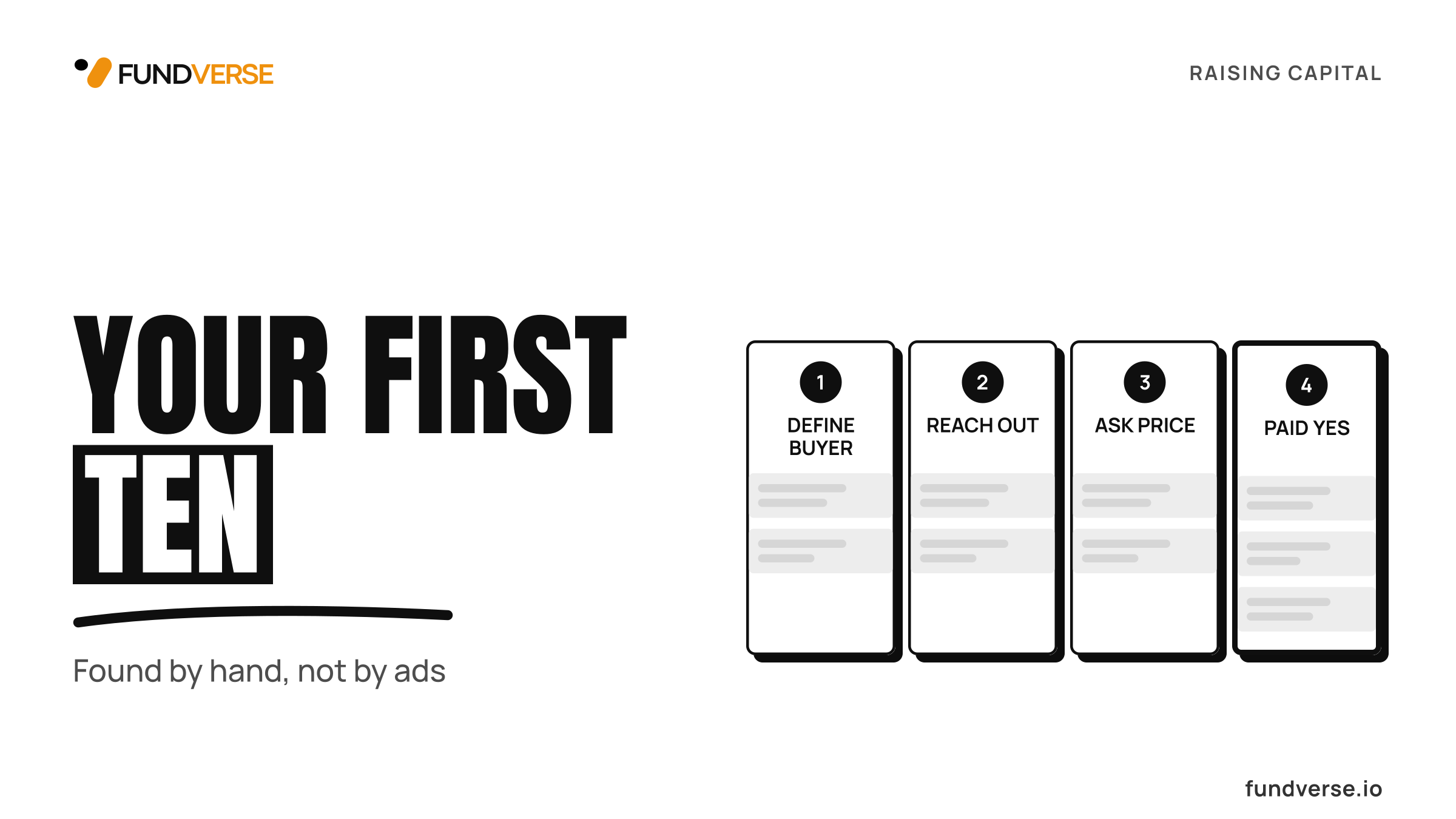

The first ten customers are found by hand, not by marketing. A practical guide to choosing a narrow buyer, asking for payment early, and recording the evidence so capital providers can trust it.
Ask a founder where their first customers came from and the honest answers are rarely glamorous. A former colleague who ran operations at a distributor. A friend of a friend who had the exact problem. Someone met at a trade association lunch who said, a little offhandedly, "send me a quote." Almost nobody says an advertising campaign, and those who do usually bought the customers with money they could not really afford to spend.
That pattern is the process, not a flaw in it. The first ten customers are not a small version of the next thousand, and treating them as one pushes founders to build funnels before they have a message. They are found by hand, through specific people with a specific, painful problem. Their deeper value is rarely the revenue, which is usually modest. It is the evidence: proof that a defined kind of buyer will pay for the same reason, more than once. That is what an equity investor, a lender or a grant maker can actually underwrite.
Accept that it will be manual
Marketing channels work by averaging. Ads, search and content reach many people cheaply and convert a small fraction, which only makes sense once you know who that fraction is and what to tell them. Before that, you have no message that has survived contact with a buyer, so spending on reach mostly buys expensive confusion. A thousand impressions teach you little. One forty-minute conversation with someone who says no, and tells you why, can teach you a great deal.
Your own network and sales conversations give you what channels cannot: the chance to ask follow-up questions. Why now? Who else has to approve this? What do you do today instead? The answers shape the product, the price and the pitch, and they cost nothing. The limit is that your network is finite and skewed toward people like you, which is fine for ten customers and dangerous only if you mistake the network's goodwill for the market's appetite.
Define the narrowest buyer
The instinct is to describe a broad market, because a large addressable market sounds fundable. For finding customers it is close to useless. A working definition names a type of organization, a role inside it, and a problem that is both urgent and already has money attached. Urgent means something is going wrong this quarter: spoilage, late shipments, failed audits, lost tenders. Budgeted means someone already spends on it, even badly, so your sale replaces a cost instead of inventing one.
A quick test is to complete this sentence: "Our buyer is the [role] at a [type of organization] who deals with [problem] by [workaround], and it costs them roughly [amount] a [period]." If you cannot name the workaround, you have probably not spoken to enough buyers. If the cost is hard to state, the problem may be a mild annoyance, and mild annoyances rarely survive a procurement process.
Narrow also means being able to say no. A founder who sells to anyone ends up with ten customers who want ten different things, which is a consulting firm rather than a business. Ten customers of the same kind, buying for the same reason, form a pattern, and the pattern is what the whole exercise is meant to produce.
Find them where the problem lives
Once the buyer is defined, four routes are worth working at the same time. Direct outreach means a short message to a named person that describes the problem the way they would: "I'm talking to plant managers about unplanned downtime on packaging lines; do you have fifteen minutes?" People respond to being recognized. A list of fifty well-chosen names beats five hundred scraped ones, partly because you can personalize it, and partly because a narrow definition makes the list easy to build.
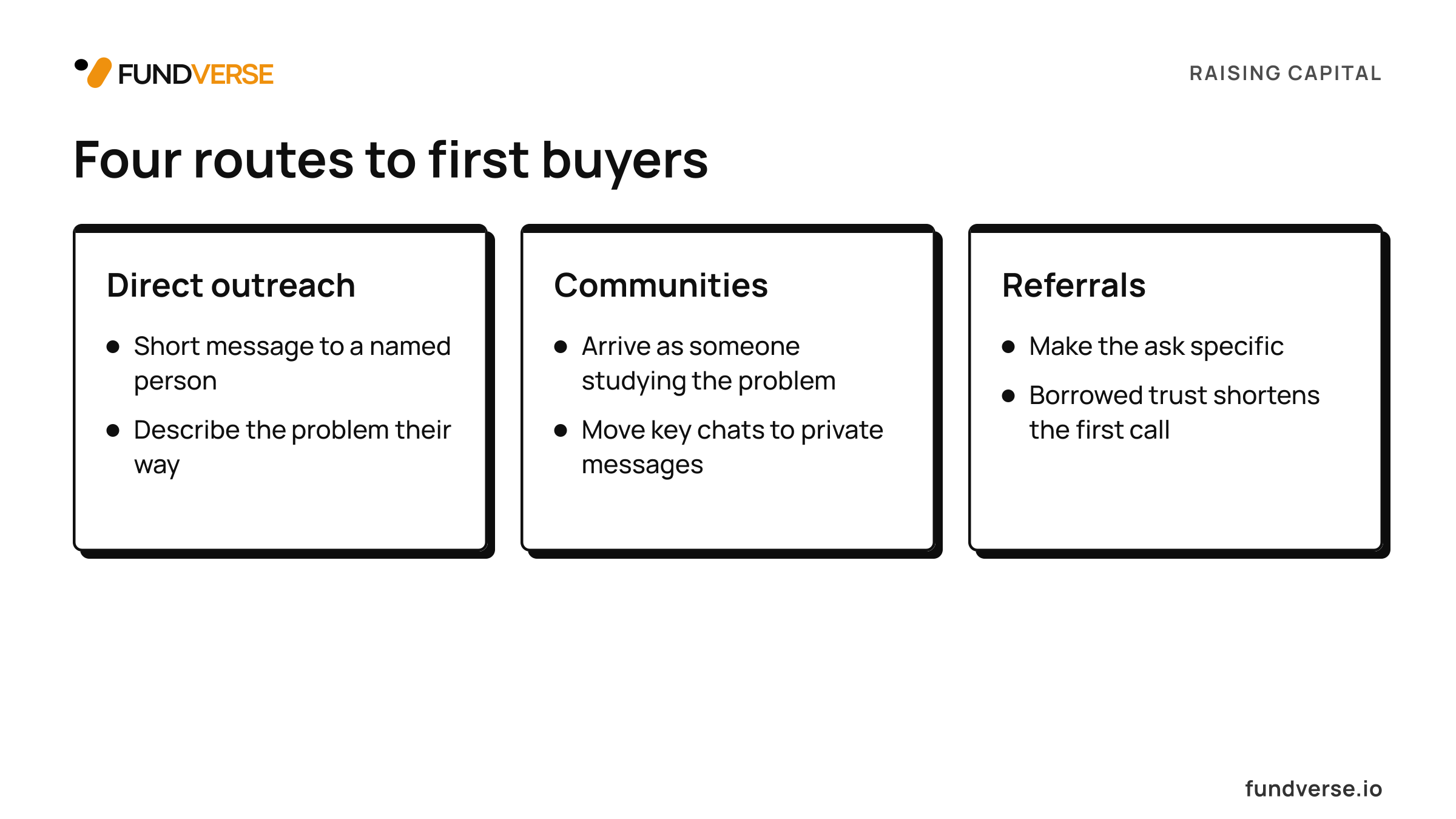
Communities are where your buyers already complain: trade associations, professional forums, regional business groups, supplier meetups. Arriving to announce a product usually fails. Arrive as someone studying the problem, answer questions honestly, and let the conversations that matter move to private messages. The complaints themselves are useful, since they show the language buyers use and which workarounds are common.
Referrals work best when the ask is specific. "Who else do you know?" gets a shrug, while "Who do you know that runs a clinic with several locations and complains about scheduling?" gets a name. A referral carries borrowed trust, which shortens the first conversation, so ask every early customer and every candid prospect who declined. Then there are existing workarounds, the most underused route. Anyone who has built a spreadsheet, hired a part-time fixer or stitched two tools together to solve your problem has already shown they care, and has told you roughly what they pay. They need no convincing that the problem exists.
Ask for money early
The common sequence is to build, demonstrate, and discuss price at the end once the buyer is warm. It feels polite and it hides the most important information, because price is part of the problem definition. Raise it in the second conversation, if not the first: "This kind of problem tends to cost you around X; I'd expect to charge Y. Does that fit how you think about it?" The reaction teaches more than any feature discussion and separates budgeted problems from interesting ones. For a longer look at why a missing sale is so often a pricing issue, see our piece on pricing and product problems.
Pilots deserve particular suspicion. A free pilot costs the buyer nothing, so it proves almost nothing, and it tends to drag on because nobody has a reason to decide. If you offer one, make it paid, even at a reduced rate, with a fixed length, a success measure agreed in advance and a stated price for continuing. A paid pilot with a clear conversion path is a sale in progress. An open-ended free one is a favor.
Early discounts are fine if they buy something: a case study, a reference call, a longer commitment, access to data, or a faster decision. Record the list price and the discount separately. A customer paying half price in exchange for a testimonial is still evidence, but a lender or investor will want to know the real price was named and tested. If every customer got an unexplained concession, the honest reading is that nobody has tested the price.
Tell buyers from polite supporters
Early on, your network is kind to you. Friends and former colleagues want you to succeed, so they say encouraging things that cost them nothing. The difference between support and demand shows in what people do. Real buyers tend to introduce you to the person who signs without being asked, raise price, terms or delivery dates before you do, describe what happens if the problem goes unsolved, share real volumes or current spend, and agree a next step with a date that they then keep.
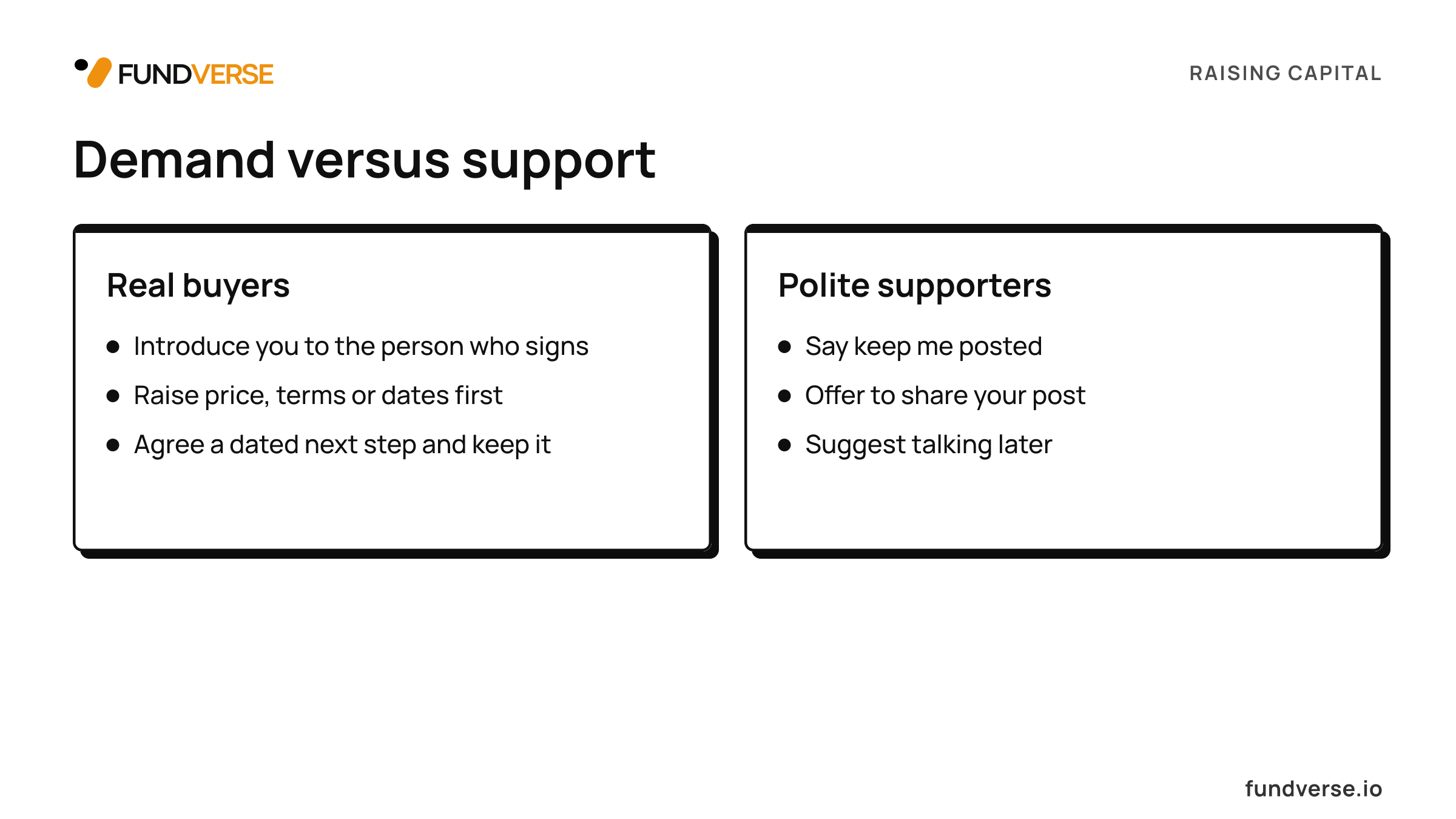
Supporters say "keep me posted," offer to share your post, and suggest talking again when the product is further along. None of that is insincere, and supporters are valuable for introductions and advice. They are simply not customers, and mixing the two lists produces forecasts that fall apart. A useful discipline is a column for "has paid or signed" that nothing else is allowed to enter.
See the math in an example
This is a hypothetical example, not a real company, and the numbers are invented to show the shape of the effort. Imagine a founder who has built a refrigerated-storage monitoring service for independent restaurants: small sensors in walk-in coolers, plus a monthly service that handles alerts and compliance logs. It is hardware plus service, so there is no website sign-up to lean on. The buyer is defined narrowly: owner-operators of restaurants with one to three locations and fresh seafood or dairy-heavy menus, who have already lost stock to a failed cooler. Their workaround is a handwritten temperature log and hope.
Over ten weeks, the founder builds a list of 120 matching restaurants from local trade groups, a food-safety trainer's contacts and a former employer. Of the 120, 90 are approached, about half directly and half through referrals, and 30 agree to a call. Twelve reach a second conversation where price is stated: a hardware deposit plus a monthly fee. Five of those say it is too expensive or not a priority, and one stays undecided. Of the remaining six, four sign a paid pilot with a fixed 90-day term and a stated measure of no unlogged temperature excursions, and one pays in full for a year after seeing the first alert. One more signs a standard monthly agreement.
The funnel reads 120 names, 90 approached, 30 calls, 12 priced conversations, 6 signatures. That is six customers for ten weeks of near full-time work, or roughly 15 approaches and 5 calls per customer, and reaching ten will probably take a second round that goes faster because the language is sharper and the first customers can make introductions. The numbers do not show that the business is a hit. They show a repeatable motion with a measurable cost, which is exactly what an investor or lender wants to see before trusting a forecast.
The same math exposes risk. If four of the six were friends of friends, the founder should say so and try to reach a few strangers before claiming the motion works beyond the network. Effort per customer is the most useful number here, because it feeds directly into how much capital it takes to reach the next fifty.
Record the evidence as you go
What do ten customers prove? Not size, since ten customers is a rounding error to any serious fund. They prove three smaller things that matter more at this stage. One is repeatability: the same kind of buyer, reached in a similar way, bought for the same reason. Another is early retention: customers renewed, expanded, or at least kept using the product after the novelty faded. The third is who bought and why, in the customers' own words, which tells a capital provider whether the problem is painful or merely popular.
Most founders discover these questions during due diligence, when memory has blurred and details are gone. A better habit is a simple customer record kept from the first call. For each customer, capture the buyer's role and organization type, how they were found, the date and content of the first price conversation, list price against price paid, the stated reason for buying, who signed, contract terms, onboarding dates, usage or renewal events, and any reference they have agreed to give. Add the lost deals too: who declined and what they said. A record that includes the noes looks far more credible than one that shows only wins.
Keep the underlying documents as well: signed agreements, invoices, proof of payment and short notes from calls. An organized folder from the start becomes the data room when a raise begins, and our guide to what investors actually want to see covers how that folder tends to be read.
Match the evidence to the capital
Different providers read the same ten customers differently. An equity investor wants a repeatable motion and a reason to believe it scales: who the buyer is, how long a sale takes, what it costs to win one, and whether the first customers resemble the next hundred. The pattern matters more than the total.
A lender asks something narrower: will cash arrive and keep arriving? Signed contracts, payment history, customer creditworthiness and concentration all matter, and if one customer is most of the revenue, that is the first question. Clean invoices with on-time payment can be worth more than an impressive but vague pipeline, and our look at how loans are priced on collateral rather than business quality explains why documentation like that moves terms.
A grant maker wants evidence that the problem is real and the founder can deliver, so the record helps in a different way: stated needs, outcomes achieved and a credible account of who benefits. With any of the three, the founders who do best are those whose numbers reconcile and whose story matches their documents. If you are still weighing which kind of capital fits, this comparison of equity, debt and blended capital is a useful companion.
Once your customer record is in order, investor matching on Fundverse can help you find capital providers whose appetite fits the evidence you have built.
Ten is a sample, not a milestone
It is tempting to treat ten as a finish line, a number you reach and announce. It is more useful as a sample, which lets you ask whether the people you sold to look like a market or a coincidence. The honest answer may be partial: perhaps six form a clear pattern and four were favors. That is still a result, because it tells you where to narrow the definition and which customers to look for next.
If you finish with a clean record, a stated price that people paid and a short list of the reasons customers gave for buying, you hold something rarer than revenue: a story a stranger can check. Capital providers rarely fund enthusiasm, but they will back a founder who can show how demand was found, what it cost, and why it is likely to happen again.
Frequently asked questions
Topics
first ten customers
first paying customers
early-stage founders
customer discovery
startup traction
pilot pricing
customer evidence due diligence
founder-led sales
Raising or investing?
Find the right people on the other side of the table, and run the round in one place.