
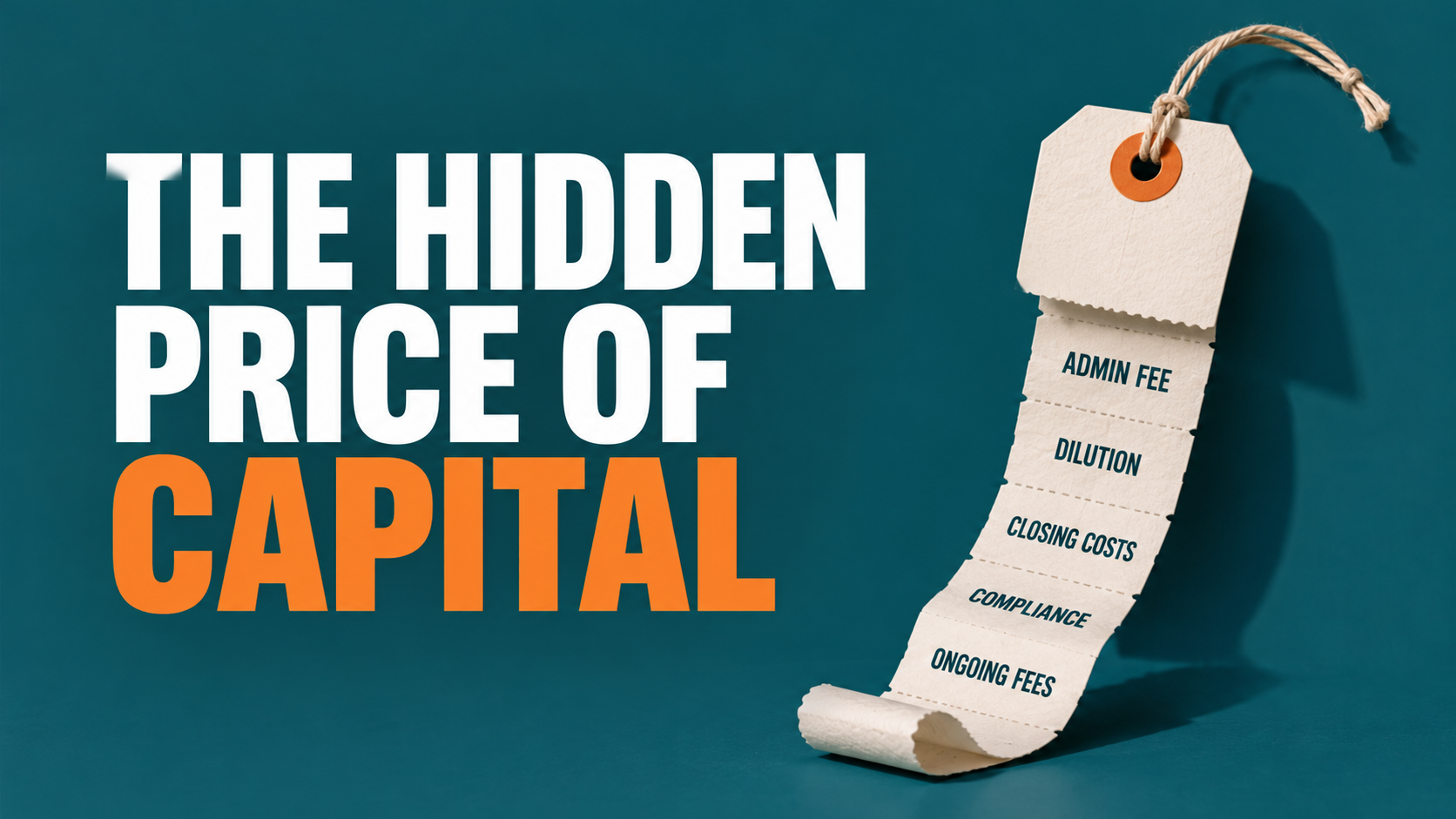

Dilution is the one cost of capital that arrives as a number, so it dominates negotiations. Equity, debt and grants all carry other costs that decide whether an offer is actually cheap.
Dilution gets negotiated hard because it is the one cost of capital that arrives as a single number. A percentage of the company changes hands at a stated valuation, the arithmetic fits on a napkin, and any two offers can be lined up and compared in a minute. The other costs come without a number attached. They show up as hours taken from the people running the business, as consent rights that quietly shape later decisions, as reporting duties, restricted use of funds and cash held back in an account. Because nobody adds them up, they tend to be accepted by default.
A financing should be judged by everything it takes from the organization, and ownership is only one line in that account. The point matters most for borrowers and grant recipients, who give up no equity and so often describe their money as cheap or free, but it applies to equity just as much. The price of capital is the total of what an organization pays, permits and puts up with in return for it, and an organization that compares only the visible part will systematically choose the wrong offer.
Why dilution gets all the attention
There are good reasons dilution dominates the conversation. It is permanent, because shares once issued stay issued unless someone buys them back. It compounds, since each new round takes a slice of what earlier rounds left. And it is easy to benchmark, so advisers and peers can all say whether a given percentage for a given amount sounds right. A number that is easy to compare gets compared, and the comparison creates the feeling that the pricing question has been settled.
It has not been. Think of the cost of capital as everything the organization gives up or is constrained by as a consequence of taking the money: ownership, cash, control, flexibility and time. Dilution covers only the first, and only for equity. An investor's rights, a lender's conditions and a grant maker's reporting rules sit in other sections of the paperwork, which get less attention precisely because they carry no headline figure. The sections below take those costs one at a time, starting with what an equity investor receives beyond its percentage.
Costs that arrive as terms
Control that outlasts the check
In an equity round, the ownership percentage describes economics, not authority. What a minority investor can actually do is set by protective provisions, a list of decisions such as issuing new shares, taking on debt or selling the company that need the investor's consent. Each one is a place where a later plan can be delayed or reshaped. A larger option pool created before the investment lands only on existing holders, which raises the effective price of any headline valuation. How a minority stake becomes a say in later decisions is worked through in selling 20% of your company.
The liquidation preference, which decides who is paid first, and how much, when a company is sold or wound up, shows the same gap in money terms. Suppose an investor puts in $2 million for 20% with a 1x non-participating preference, meaning it can take its money back or convert to shares, whichever pays more. If the company sells for $3 million, 20% is worth $600,000, so the investor takes the $2 million and everyone else shares the remaining $1 million. The investor owns 20% on paper and receives two-thirds of the proceeds. The lesson is that the headline percentage describes a good outcome only. In a strong exit the preference never matters. In a weak one it decides the result, which is why it belongs in the price.
Cash that never reaches the business
Debt carries no ownership cost, but the quoted interest rate is only the starting point. Take a $500,000 one-year loan at 10%, interest only, with a 2% arrangement fee deducted at closing and $8,000 of legal costs paid from the proceeds. These numbers illustrate the mechanism and are not market benchmarks. Interest is $50,000, the fee $10,000 and legal costs $8,000, a total of $68,000. The business receives $482,000 to use, so the real cost is about 14.1%, not 10%. If the lender also requires $100,000 held in a reserve account, usable cash falls to $382,000 and the same $68,000 becomes about 17.8%. The rate never changed. What moved was the amount of money the business could actually spend, and a rate quoted on the full principal hides that.
Covenants add a cost that is not cash at all. A covenant is a promise to keep the business inside stated limits, such as a minimum cash balance or a maximum ratio of debt to earnings, and breaching one can let the lender demand early repayment or reprice the loan. Meeting it may mean skipping spending the business would otherwise make, so the price is paid in decisions not taken. Security carries a price too, since collateral pledged to one lender is unavailable to the next, a dynamic covered in how collateral quality drives loan pricing. A loan in a currency the business does not earn adds exchange-rate exposure that no interest rate describes, which is why currency risk can matter more than the rate.
Grants with strings attached
A grant involves no ownership cost and no repayment, which is exactly why its other costs are underestimated. Money usually comes for a defined purpose, so the organization may end up building what the funder wants rather than what it would have chosen. Payment may be tied to milestones, which means financing the work first and waiting to be reimbursed. Reporting, audits, procurement rules and matching-funds requirements all consume staff time, and development finance and blended finance providers often add environmental and social standards the organization must meet and document. None of this is a reason to refuse the money. It is a reason to put a figure on the administrative capacity required and ask whether the organization has it.
The bill for getting there
Before any term applies, there is the cost of arriving at it. Raising capital is a second job layered on the first, and it falls on the same few people: the founder, the CEO, the CFO. Meetings, follow-ups and data requests pull attention from running the organization, and the cost lands as slower decisions and thinner oversight rather than a line in the accounts. The effort often outlasts the work the money will fund, as explained in why raising money can take longer than building the product.
Direct costs follow from that effort. Borrowers often cover the lender's legal and valuation fees, equity rounds involve lawyers on both sides, and funders need records clean enough to survive diligence, which may mean paying for reviewed or audited accounts earlier than planned. A process that drags for months can also carry a reputational cost. In many investors' eyes, a company visibly shopping a deal for a long time starts to look like one others have passed on. That is a market perception, not a rule, but it is a reason to run a tight, targeted process.
The best case for ignoring this
The strongest objection deserves a straight answer. Dilution is the one cost that can never be undone. A covenant ends when the loan is repaid, a grant's reporting ends with the grant, and time lost raising can be made up, but shares sold stay sold. On this view, an organization agonizing over reserve accounts while casually accepting a lower valuation is misallocating its worry. Scrutiny can even be a benefit: lenders impose discipline, investors bring networks and credibility, and a grant maker's standards can make an organization more fundable later.
Much of that is right. In most equity rounds, ownership is the largest single cost, and nothing here argues for negotiating it less hard. But permanence belongs to the instrument, not to dilution alone. Equity has no maturity, so its consent rights and preferences last as long as the shares do, often far longer than any loan. Temporary costs still have to be paid while they last, and a covenant breach in a poor quarter can do more damage than a few points of dilution would have. The benefits are real too, but they belong in the same account, not in place of it. A funder who brings introductions and credibility may be worth tighter control, and that judgment can be made only when both sides are written down.
Adding up an offer
The practical answer is to build a ledger for every offer before negotiation starts, using the same lines whatever the instrument:
- Ownership given: the percentage sold, adjusted for any option pool increase, and what the investor receives in a weak sale rather than a strong one.
- Cash cost over the life: interest, fees, legal costs and money held in reserve, measured against the cash actually usable.
- Rights granted: consents, board seats, security, and anything restricting later financing or a sale.
- Obligations after closing: covenants, reporting, audits, limits on how funds are spent, and who will do the work.
- Process cost: the time and fees to close, and the delay before the money arrives.
Once the lines are filled in, offers can be compared on something more honest than the headline. Sometimes the lower-dilution offer turns out to be the more expensive one. Sometimes the pricier one is right because it arrives in time, from a funder whose networks and patience the business needs. Questions put to funders early surface most of this before a term sheet hardens: what requires your consent, what happens in a $3 million exit versus a $30 million one, what must be reported and how often, who pays the fees. Whether the money is worth the price at all is the question in asking what the money would change, and the term-level trade-offs are laid out in founder-friendly versus investor-protective term sheets.
Process cost is the part of the bill an organization can shrink most directly. Fundverse's investor matching helps you spend time on funders whose mandates fit, and its data room keeps diligence material ready so each request doesn't restart the work.
The next time an offer lands, whether a term sheet, a loan commitment or a grant agreement, fill in the ledger before the first negotiation call rather than after the second. The lines most organizations skip are the ones that decide what the money really cost.
Frequently asked questions
Topics
cost of raising capital
equity dilution
true cost of debt
hidden costs of funding
liquidation preference
loan covenants
grant compliance costs
comparing funding offers
Raising or investing?
Find the right people on the other side of the table, and run the round in one place.