
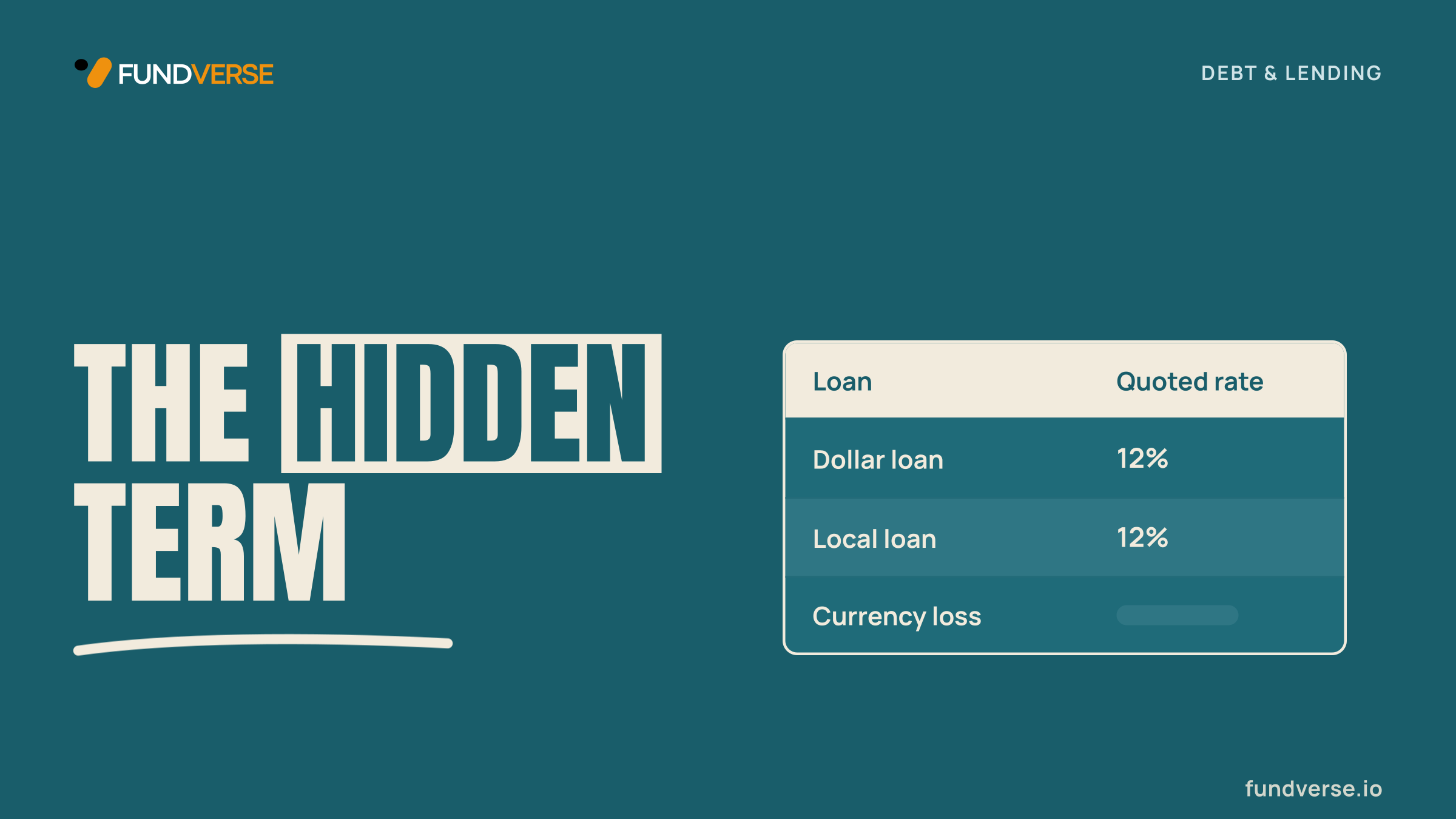

A 12% dollar loan can cost a local-currency business far more. Why currency risk, not the headline interest rate, decides who gets funded in emerging markets, and who should bear it.
Two lenders offer the same company the same loan. Both quote 12% a year, both want the same repayment schedule, and both send a reasonable-looking term sheet. The only difference is that one lends in dollars and the other lends in the currency in which the company's customers pay. Ask a finance director which is cheaper and, if the quoted rates are identical, you might hear that it makes no difference. It makes nearly all the difference.
For many businesses in emerging and frontier markets, the interest rate is the smaller part of what a hard-currency loan costs. The larger part appears on no term sheet: how much the local currency is likely to lose against the dollar before the loan is repaid. That hidden term decides which businesses are fundable, how much dollar money actually lends locally, and where it goes instead. It cannot be made to disappear, so the interesting question is who should hold it.
The price tag leaves out a term
A loan is a promise to hand over a fixed quantity of something. If the borrower earns dollars, the promise is in what the borrower has. If the borrower earns naira, rupees, shillings or pesos and borrows dollars, the promise is in something the business does not produce, and each repayment requires it to sell local currency and buy dollars at whatever rate prevails that day.
That changes what the loan is. A local-currency loan is a bet on the borrower's business. A dollar loan to a local-currency earner is a bet on the business and a short position in the borrower's own currency, bundled together and sold to someone who may not have asked for it. The borrower is, in effect, writing an unpriced option on the exchange rate and paying for it out of operating cash flow.
Lenders know this, which is why many simply decline to lend to local-currency earners at all. Dollar funds mostly end up financing exporters, companies with dollar-linked pricing, and businesses with some hard-currency revenue. Those are not the only good businesses. They are the ones for whom the loan's currency matches the cash flow, so the one term nobody can price is absent.
One loan, worked through
Here is a hypothetical, and every number is an assumption chosen for clarity, not a description of any real company or market. A distributor sells goods to retailers and is paid entirely in local currency (LC). It borrows $1,000,000 for three years at 12%, interest paid annually, principal repaid at the end. The exchange rate starts at 100 LC per dollar, so the loan is worth 100 million LC. Suppose the local currency loses 8% of its value against the dollar each year, so the rate moves to roughly 108, then 116.6, then 126 LC per dollar.
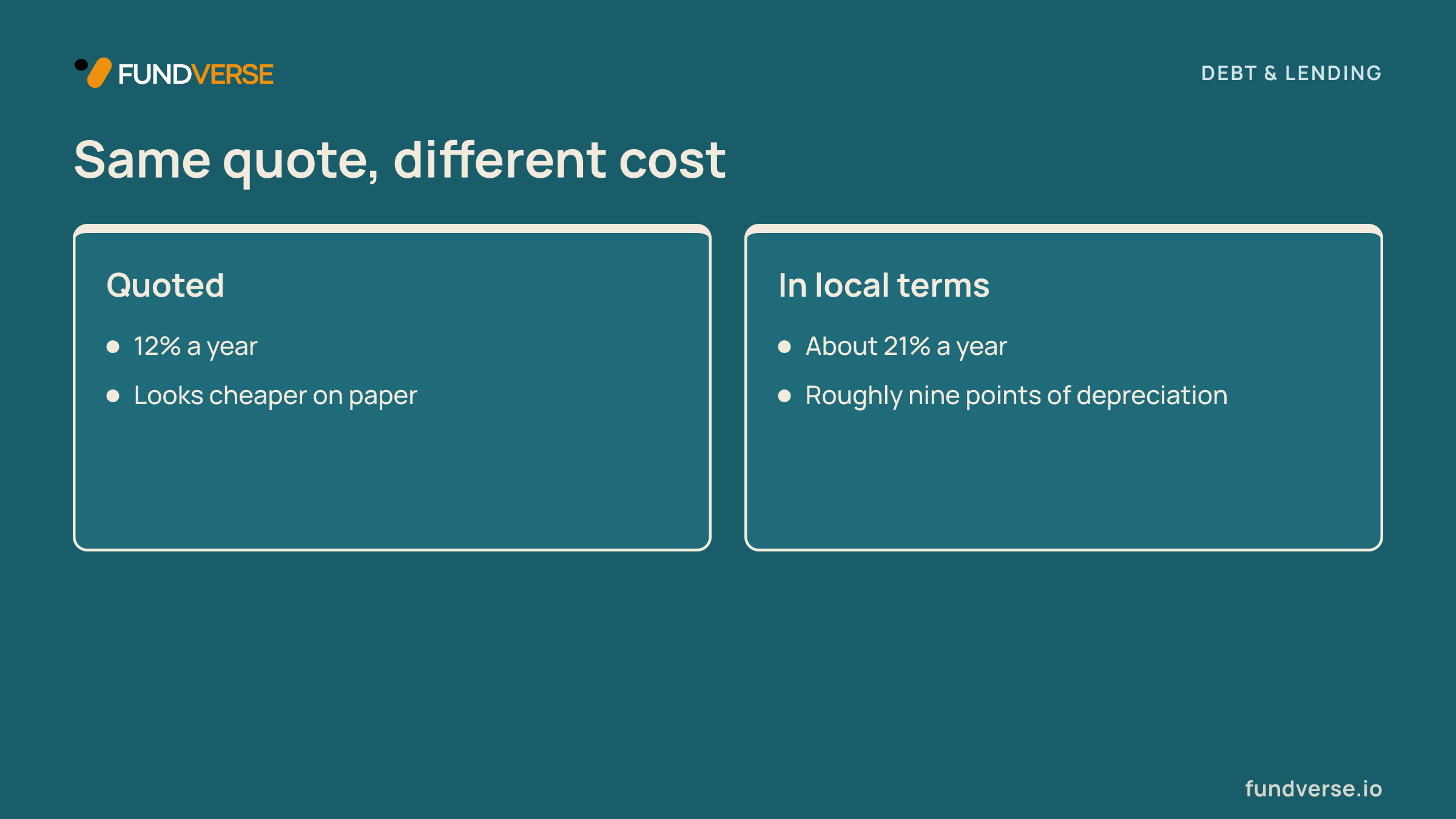
The interest is $120,000 every year, but its local cost climbs: about 13.0 million LC in the first year, 14.0 million in the second, and 15.1 million in the third. In the third year the company must also repay principal, which now costs about 126 million LC rather than the 100 million it received. Altogether the company pays roughly 168 million LC over three years for 100 million LC borrowed. The annual cost in local terms comes to about 21%, which is close to what you get by multiplying 1.12 by 1.08 and subtracting one. The 12% quote hid roughly nine points of depreciation.
Now the part that matters for credit. Suppose the distributor puts the proceeds into inventory and equipment that earn a local return of 18% a year. A local-currency loan priced at 18% or even 20% works for that business. The dollar loan quoted at 12% loses money every year, despite looking cheaper on paper. The business has not changed and the lender has not been unreasonable. The currency path alone moved the loan from affordable to unserviceable.
Two further points sharpen the picture. The damage is uneven: if the currency falls faster than assumed, the same loan is ruinous, and if it holds steady, the borrower comes out well ahead. And the principal is the largest exposure, concentrated at the end, when depreciation has had the longest to compound. A borrower who keeps up with interest for two years can still be wiped out by the final payment.
What parity says about the hidden term
Where does an assumption like 8% come from? Finance offers an anchor called covered interest parity. If you can borrow in one currency, convert it, lend it in another and lock the return with a forward contract, you should end up with the same result as staying put. Otherwise someone could earn a riskless profit. The consequence is that the forward exchange rate is tied to the interest differential: the currency with the higher interest rate trades at a forward discount of roughly the size of the gap.
Take illustrative numbers: local borrowing costs 20% a year and dollar borrowing costs 4%. Parity says the forward market should price the local currency about 15% weaker per year than spot. If a borrower could fully hedge the dollar loan at that forward rate, the all-in cost would come out at about the local interest rate. The saving from borrowing at the lower dollar rate is, in a well-functioning market, exactly what the hedge costs. The low rate was never free money. It was a lower payment today in exchange for a currency risk deferred to later.
Two cautions. Parity describes what a hedge costs, not what depreciation will actually be. Over any given period the currency may fall by more or less than the forward implies, and an unhedged borrower wins or loses on the difference. Some borrowers, over some periods, have done well borrowing unhedged in hard currency, but a business that survives only if that gamble pays off has a financing plan that depends on luck. Second, parity holds best where markets are deep. Across much of the frontier they are not, and that is where the next problem begins.
Why hedging is thin where it matters
In principle, the borrower should just hedge. In practice a hedge needs a counterparty willing to take the other side, and those are scarce in smaller currencies. Forward and swap markets in many frontier currencies are shallow, with few dealers and wide spreads. Where contracts exist they tend to be short, often a year or less, while a business loan may run three to seven years. Rolling a short hedge over a long loan leaves the borrower exposed to the price of the hedge changing, which is its own risk.
A bank writing a forward in a thinly traded currency has to hedge its own position, and if it cannot, it charges a heavy premium for holding the risk. Capital controls, convertibility limits and the chance that a central bank changes the rules mid-contract raise that premium further. Ticket size matters too: a dealer will not build documentation and credit lines for a small business borrowing a modest amount. And the natural counterparties, those who would want to be long the local currency for years, such as local pension funds or insurers, often face regulatory or operational barriers to taking that side.
The result is an unglamorous market failure. The risk is real and quantifiable, there are holders who could carry it, but the plumbing between them and the borrower is missing or expensive. The various fixes are attempts to build that plumbing.
Who should hold the risk
Start with the borrower. A small or mid-sized business has revenue in one currency, costs mostly in the same one, and nothing across which to spread currency risk. It cannot diversify, cannot easily hedge, and often has the least information about where exchange rates are heading. A shock that is a rounding error to a global investor can be fatal to it. Handing it the currency risk puts the risk on the party least able to absorb it.
The lender looks better placed, but only somewhat. A dollar fund has dollar liabilities: its investors expect returns measured in dollars. If it lends in local currency and the currency falls, it loses, and it has taken a risk its investors may not have signed up for and its mandate may not allow. A single fund with a few loans in one country is concentrated in exactly the way that makes currency risk painful.
A sounder principle is that risk should sit with whoever can hold it most cheaply, usually someone who can pool it across many exposures or who has natural liabilities in the currency. A diversified institution lending in dozens of currencies faces a smaller net risk than a single-country borrower. A local pension fund with obligations in local currency reduces its risk by holding local-currency assets. Every fix below is an attempt to route the risk to holders like these, and each has costs.
Four fixes, four trade-offs
The most direct fix is for the lender to lend in local currency and price in the expected depreciation, setting the rate high enough that, converted back to dollars, the expected return is acceptable. This puts the risk with the lender and pays it for carrying it, and it can work for funds that build local-currency capacity, raise local-currency capital, or run diversified books. The trade-off is that the headline rate looks eye-watering, borrowers balk, and the lender must still be right, or at least not badly wrong, about depreciation. Exchange-rate forecasts are poor. A lender that guesses low loses money, and one that guesses high loses the deal.
A second fix changes the borrower rather than the loan. If the business can link revenue to the dollar, by pricing in dollars, indexing price lists to the exchange rate, or selling to customers who pay in hard currency, a dollar loan matches its cash flow. It is the cleanest solution when available, and often it is not. Retailers and service providers selling to consumers cannot easily reprice, and customers who see prices rise with the exchange rate may simply buy less, shrinking demand just when the business needs it.
A third family ties repayment to the business itself. In revenue-based repayment the borrower pays a share of takings, so the schedule flexes automatically with local-currency sales and a weak currency does not break it. Indexed loans, which adjust the local amount owed to the exchange rate, are the same risk under a different label. Revenue-based structures protect the borrower from a cash squeeze but pass the risk to the lender in another form: if the business grows slowly, the lender waits longer, and the dollar value of what it eventually collects may be lower. They suit lenders who can price a longer, more variable payback. They are a poor fit when the business's costs are in dollars and its revenue is flat. Readers weighing such structures may find the wider comparison in our guide to equity, debt, quasi-equity and blended capital useful.
The fourth route is to hand the currency layer to an institution built to carry it. Specialist currency facilities exist to offer local-currency loans or swaps to lenders that cannot easily hedge, pooling exposures across many currencies and markets so no one loan is a single-country bet. Blended finance does something related: a development funder takes a first-loss position, absorbing the initial slice of any losses, which makes it safer for commercial lenders to lend locally at all. The broader shift toward blended structures is partly a response to exactly this problem.
The trade-off here is capacity and subsidy. Development finance is finite, and a facility that charges less than the true cost of the risk is spending someone's concessional money, which must be justified and rationed. If pricing is too generous, it crowds out private hedging that might have developed. If it is too tight, it does not reach the borrowers who need it. There is also a quieter moral hazard: a first-loss layer may lull a lender into weaker underwriting. Done carefully, though, it is the one fix that moves the risk to a holder genuinely better placed than either party to the loan.
Why this beats the interest rate
Most negotiations focus on the rate, because it is visible and negotiable, and a point or two off the coupon feels like a win. In the worked example, the gap between a 12% and a 13% quote is one percentage point, while the currency term was worth about nine. Borrowers and lenders spend their effort on the smaller variable and leave the larger one implicit, where it surfaces only when things go wrong.
It also explains a puzzle: why capital seems plentiful in the world and scarce for local businesses, even good ones. The constraint is often not a shortage of money or a high required return but a shortage of anyone positioned to hold the currency gap. That connects to the wider pattern in why promising businesses struggle to access capital, and to why a sound business can be unfundable on the terms that happen to be on offer.
Comparing offers across currencies is easier when the terms, repayment currency and structure sit side by side. Fundverse for founders helps businesses present their revenue profile to suitable lenders, and Fundverse for investors helps capital providers screen for currency fit.
Questions to ask before signing
For a borrower, the first question is simple and frequently skipped: in what currency does revenue arrive, and in what currency do the main costs go out? A business whose receipts and largest costs are both local has a mismatch against a dollar loan, however sound its margins. A business with partly dollar-linked income has a partial hedge, and it is worth measuring how partial. The second question is what depreciation the loan quietly assumes. Every fixed-rate hard-currency loan carries an implied break-even, the rate of depreciation beyond which the business cannot service the debt. Compute it by converting each repayment at a range of exchange-rate paths and comparing the total to projected local cash flow.
Lenders should ask the mirror image: does our portfolio's revenue match our loans' currency, and if not, who has been paid to bear the difference? If nobody has, the risk has not been removed, only left in the borrower's balance sheet as credit risk waiting to materialize. Defaults on dollar loans to local earners often look like business failure in the data when the proximate cause was the exchange rate, and funders that treat them as the same thing keep mispricing both.
Then comes the question that ties the others together: if the currency moves against us, who is left holding the gap? A good structure answers it in writing, through a local-currency tranche, a revenue-linked repayment, a first-loss layer, an indexation clause, or a lender that has accepted a priced currency position. A bad one answers by silence, which means the borrower holds it by default. Before signing, run your own downside test. Find the exchange rate at which the business can no longer cover debt service from local cash flow, write it down, and ask whether anyone in the deal, you included, has a plan for the day the currency gets there.
Frequently asked questions
Topics
currency risk
emerging market lending
local currency lending
dollar loans
hedging frontier markets
blended finance first-loss
covered interest parity
private credit emerging markets
Raising or investing?
Find the right people on the other side of the table, and run the round in one place.