

Raising more money feels safer, but extra capital raised before a milestone costs more ownership than the same money raised after it. Here is how round size, dilution and runway connect.
Two companies can raise the same $2 million in total and end up with very different amounts of the business left in their own hands. The difference lies in when the second million is raised and what the company has proved by then. Round size is the number that gets announced, but it says nothing about what the money cost the owners, what it let the company do, or how much room it left for things to go wrong.
Organizations tend to optimize for the announceable number because the useful one takes arithmetic. Usefulness is what the company can do with the capital that it could not do before, less what it gave up to get it: ownership, flexibility, months spent raising and sometimes a repayment schedule.
How round size sets the price
Each side of an equity round wants something different. The company wants the most useful capital for the smallest giveaway. The investor, usually a fund with return targets of its own, wants enough ownership that a good outcome matters to the fund as a whole. The two wants meet in a single piece of arithmetic: the share sold equals the new money divided by the post-money valuation, which is the company's pre-money value plus the cash just invested. Put $1 million into a company valued at $4 million before the deal and the post-money value is $5 million, so the investor owns 20%.
Because funds often start from the stake they need rather than from a valuation, check size and valuation get negotiated together. An investor who wants roughly a fifth of the company and plans a $2 million check is implicitly proposing a $10 million post-money value, or $8 million pre-money. That is how a bigger round can arrive at a higher price. Still, the price stays anchored to the investor's reading of the evidence: the traction, the team, the market. A larger check adds no evidence, so beyond some point the extra dollars are priced at the same valuation and the existing owners are simply selling more of the company at that price.
What the extra million costs
A hypothetical illustration shows the trade, with assumptions chosen for clarity rather than as benchmarks. A software business is valued by an investor at $4 million pre-money whether it raises $1 million or $2 million. Its plan spends $70,000 a month and reaches a milestone, steady recurring revenue from paying customers, in about twelve months. Reaching that milestone is assumed to support a next round at $12 million pre-money. That last figure is a guess about the future, and the whole comparison rests on it.
| Measure | Raise $1M | Raise $2M |
|---|---|---|
| Post-money value | $5M | $6M |
| Share sold in this round | 20.0% | 33.3% |
| Existing owners after this round | 80.0% | 66.7% |
| Runway at a flat $70,000 a month | About 14 months | About 28 months |
| Second $1M after the milestone, at $12M pre-money | Sells 7.7% | Not needed yet |
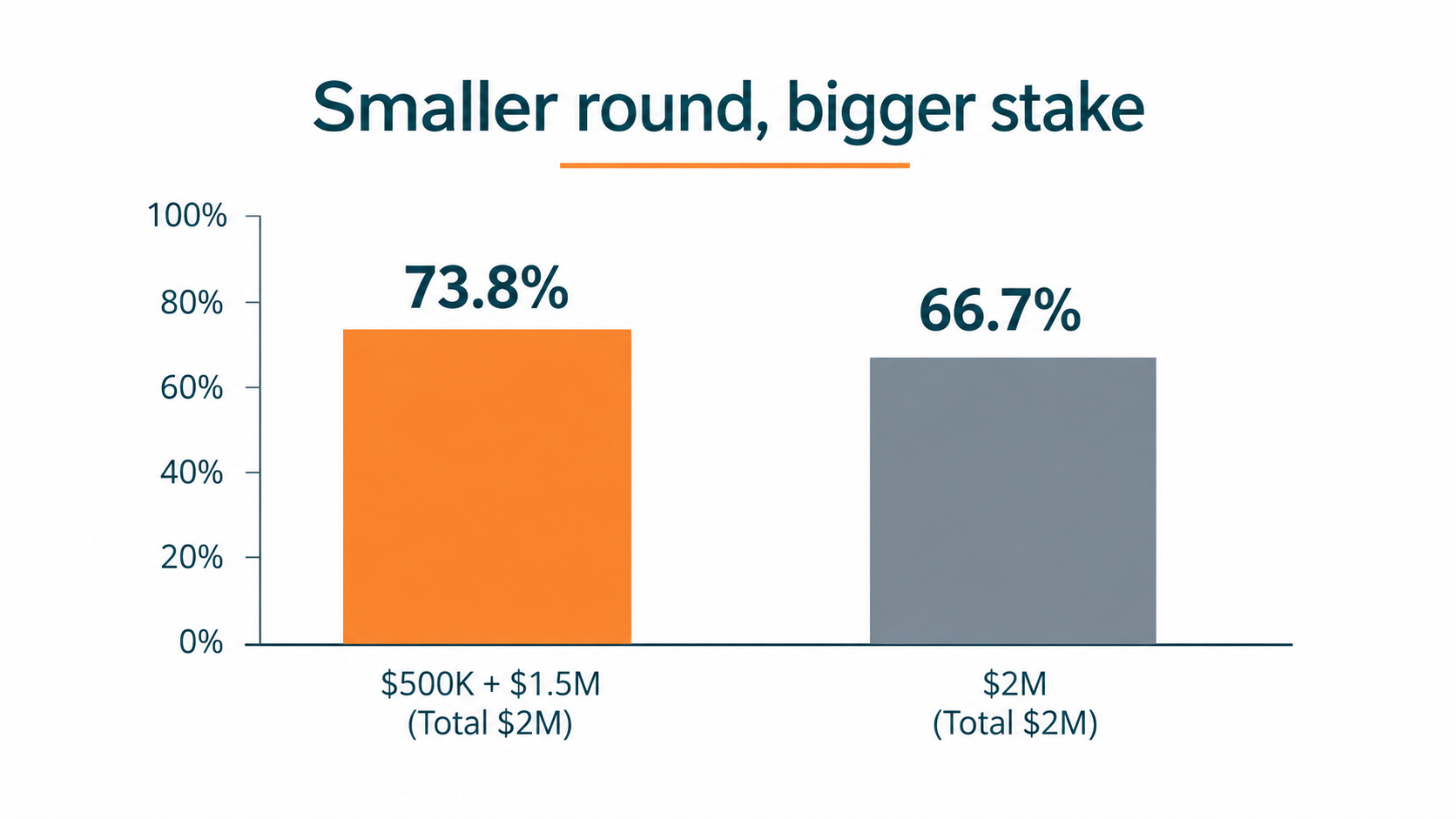
| Existing owners holding after $2M in total | 73.8% | 66.7% |
The useful question is what the second million buys. Raised now, it costs 13.3 points of ownership (the move from 20.0% to 33.3% sold) and adds about fourteen months of cash. Raised after the milestone, the same million costs 7.7 points, because $1 million divided by a $13 million post-money value is 7.7%, and the company by then has proved something. Applied to the 80% the owners kept, that leaves them with 73.8%, against 66.7% in the bigger round: roughly seven points for the same $2 million of total capital. The early money is not wasted, but what it purchases is insurance against the milestone arriving late. Whether seven points is a fair premium depends on how likely the delay is, and on how much each point of ownership matters later, a theme developed in selling a share of every future decision.
Where the risk lands
The smaller round is cheaper only if the plan holds. With fourteen months of cash and a milestone due at month twelve, the company has two months of cushion. A raise commonly takes several months from first conversation to money in the bank, as covered in why raising can take longer than building. The founders would therefore have to start the next raise around month six or seven, before the milestone is proved. If the milestone then slips by four months, they negotiate with almost no cash left, the weakest position in fundraising, and a bridge on poor terms can cost more than the points the smaller round saved.
The bigger round buys protection against exactly that scenario, paid for in advance and with certainty. The choice is therefore never smaller versus bigger in the abstract. It is whether the cash is sized to a specific piece of progress, plus a cushion for delay and for the time it takes to raise again, and whether the company is paying for more cushion than the risk justifies.
Costs a larger round hides
Larger rounds carry costs that never show on the dilution line. Spending tends to expand to fit the cash: if monthly burn drifts from $70,000 to $100,000, the $2 million lasts twenty months instead of twenty-eight, and the owners have diluted themselves for a runway they did not get. A higher post-money value also raises the bar for the next round, since later investors will want the company to be worth meaningfully more than $6 million before they put money in at a profit. And a bigger target needs more checks, so a round that stalls half-filled can drag on for months and send a signal of its own, while a modest round that one lead investor can cover tends to close sooner and leave management time for the business.
When the bigger round is right
None of this makes small rounds a virtue. A manufacturer building a plant, a hardware company that cannot sell until it has tooled production, or a project developer facing fixed construction costs cannot reach a milestone in slices, because the milestone itself is expensive. Thin capital markets matter too: where follow-on funding is scarce, a company that raises the minimum may find no second round at any price, and a larger buffer is prudent rather than greedy. A genuinely better valuation at the larger size, or an investor who contributes far more than money, can also tip the balance, provided the figures are tested against what the money will actually do.
Debt and grants follow the same logic
With other instruments the arithmetic changes but excess capital still has a price, paid in a different currency. A loan is repaid out of what the business can service, so a bigger loan adds fixed repayments that continue whether or not the milestone arrives, and drawn cash that sits idle still accrues interest. On committed facilities, undrawn amounts often attract a fee. Where equity charges the owners in dilution, debt charges the borrower's cash flow, which is why lenders test repayment capacity before they test ambition.
Grants usually avoid both costs, but larger awards typically bring heavier reporting, tighter conditions and disbursement in tranches tied to milestones. A smaller first award delivered cleanly can be a better route to the next one than a large award the organization struggles to administer.
Sizing a round to its plan
A defensible round size comes from working backward from the plan, not forward from the largest number funders might tolerate. Begin by naming the milestone that would change how funders view the company, in terms they can verify: revenue, signed contracts, a permit or a completed pilot. Then cost the path to it month by month, including hiring and the timing of cash from receivables, not just expenses, so that the monthly burn is realistic. On top of that goes a buffer for delay, commonly a few months of spending, plus the months a new raise will take.
With that total in hand, run the dilution twice: at the valuation your evidence supports today, and at the valuation that would apply once the milestone is reached. The gap between the two is the price of buying insurance early, and it can be weighed against the cost of running short of cash. The runway step is covered in how founders calculate runway before raising, and the valuation step can be tested with the startup valuation calculator before any conversation with funders begins.
Fundverse's financial analysis and valuation tools can help you model how different round sizes change ownership and runway before you approach funders. Run two scenarios side by side and see which plan your evidence actually supports.
Before the next round is sized, one test is worth running on your own plan. If the round were half the amount, which milestone would it still reach, and if you cannot name one, what exactly is the other half of the money for?
Frequently asked questions
Topics
funding round size
how much to raise
startup dilution
runway and milestones
pre-money and post-money valuation
raising capital
seed round size
Raising or investing?
Find the right people on the other side of the table, and run the round in one place.