
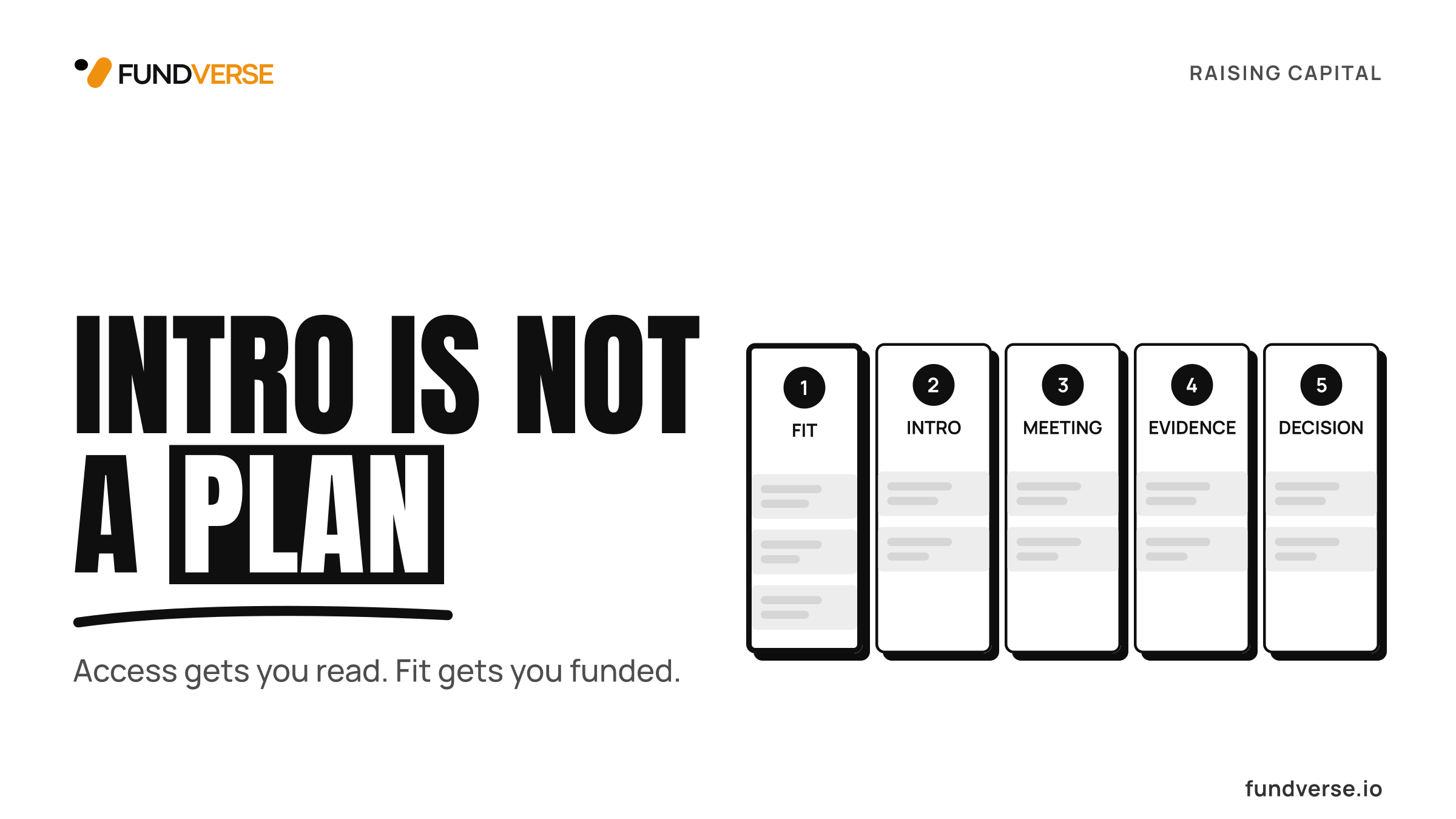

A warm introduction gets you read, nothing more. Why founders mistake access for progress, what a real fundraising strategy rests on, and how to use introductions well inside it.
Ask a founder how she plans to raise and a common answer is a name. She knows someone who knows a partner at a fund, and a coffee is already booked. It is a sensible first move and a poor plan, because an introduction solves one problem, getting read. It says nothing about whether the reader can write the check, wants this kind of business, or can act within the window the company has.
A warm introduction is one channel into a strategy, and the strategy itself is something else: a repeatable way of finding capital that fits, built from mandate, stage, check size, timing and evidence. Introductions can help enormously, but only inside that structure.
What an introduction really buys
Investors, lenders and grant officers share a problem: more requests than attention. An introduction from someone they trust works as a filter. The referrer has spent some of their own judgment, implicitly saying this is a real business run by a serious person. A stranger's claims are unverified, while a colleague's endorsement lets the reader extend provisional credit, which is why warm introductions tend to be answered faster and read more charitably. That value is real.
Its limits show up when you list what the referrer does not know and cannot supply. They rarely know how much a fund has left to invest, whether it is holding capital back for existing companies, whether a partner already backs a competitor, or whether the check size matches the need. They cannot manufacture conviction, which comes only from the investor's own reading of the market, the team and the evidence. And they cannot write the check, because a committee does that on criteria the referrer does not control. An introduction moves a founder from the pile to the desk. Everything after that is decided on fit and proof.
How meetings pile up without progress
Consider a hypothetical founder, Imani, who builds solar-powered cold storage units for farming cooperatives. She has two working pilots and a generous network. Over four months, friends and former colleagues produce eight introductions, which become six meetings. Every conversation is warm. The feedback is "fascinating," "keep us posted," "come back when you have more traction." She tells her board the raise is going well, because her calendar is full. No term sheet appears.
Looking at who she met explains why. Two were software-focused seed funds that rarely back equipment-heavy businesses. One was a later-stage fund whose smallest check exceeded her entire round. One was an angel who loved the idea but whose check would cover a fraction of a single unit. The introductions did their job, since each investor read her materials. They simply delivered her to the rooms her friends happened to know. Her real need, part equipment, part working capital, part proof of scale, suited asset lenders, a grant for pilot expansion or a development finance facility, and none of those were in her network.
This is access mistaken for progress. Progress is an investor moving toward a decision: asking for data, bringing in a colleague, requesting references, testing the numbers. A pleasant meeting with no next step is information too, and it is usually a polite no. A founder who counts meetings is measuring the reach of her network, not the odds of her round.
Start with fit, not access
A strategy runs in the opposite direction from Imani's calendar. It begins by asking what exactly is being raised and who funds that, and the answer differs sharply by capital provider. Angels invest personal money in small checks, often in sectors they know, and can move quickly, but they cannot fund a large capital need. Venture funds must return their own fund many times over, so they need a market big enough for that outcome, a thesis that matches the stage and sector, and a check that buys a meaningful stake. Where a fund sits in its life matters too, since a fund near the end of its investment period may have little left to deploy.
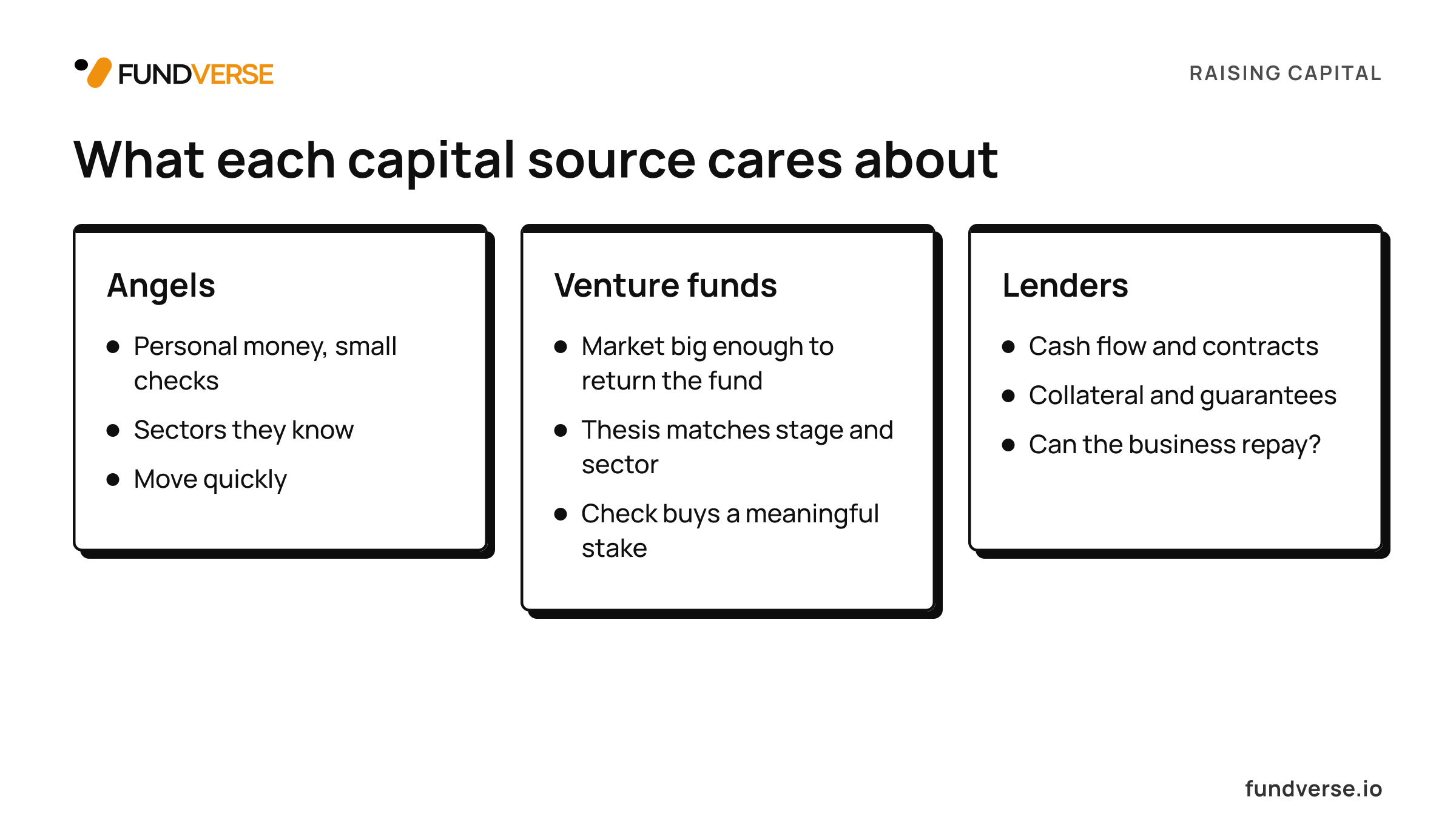
Lenders ask something different: can this business repay, and what happens if it cannot? They weigh cash flow, contracts, collateral and guarantees above the growth story, which is why a bank loan is priced on collateral quality rather than on how good the business is. Grant makers fund against program objectives, with eligibility rules, application cycles and reporting duties, and take no equity. Development finance institutions pair impact goals with commercial discipline, usually writing larger checks through longer processes. None of this is visible from a contact's job title. It is visible in mandates, past deals and stated criteria.
From there the target list can be built by fit and sequenced by what each source unlocks and when the business needs it. Imani might pursue a pilot grant and a small angel round to generate measured spoilage data, approach lenders once cooperative contracts are signed, and open the larger equity or development finance conversation when installations repeat. Once the list exists, it has to be run as a pipeline, a discipline covered in our piece on why a pipeline is not a contact list.
Evidence that travels alone
The test of any strategy is what happens when nobody vouches for you. A cold reader has no borrowed trust, so the material has to carry the case, and what counts as evidence depends on who is reading. A lender wants contracts, payment history and cash flow that show repayment. A grant maker wants outcomes and proof the team can deliver. A venture investor wants a large market, repeatable sales and economics that improve with scale. For Imani that could mean measured spoilage reductions from the pilots, signed cooperative agreements, installation cost and margin per unit, and payment records from the cooperatives. Organized in a data room, these let a stranger verify the claims without a call, and building investor confidence without revenue covers what to do when the record is thinner.
A useful self-test: could a two-paragraph summary and a link to the evidence earn a reply from someone who has never heard of you? If the process only works through a friend, the evidence is not yet doing its job, and the friend is covering a gap that will reappear in diligence.
When relationships really do matter
The strongest objection deserves a fair hearing. In relationship-driven markets, where formal data is sparse, credit histories are thin and investors lean on trusted networks to judge risk, introductions can matter more than anything in the deck. First-time founders with no revenue history or recognizable credentials gain the most, because a respected referrer substitutes for the track record they lack. Some funds rarely engage with cold approaches at all. All of that is true, and if the choice is a warm path to a fitting investor or a cold email to the same one, take the warm path. The claim here is narrower: an introduction is worth most once you know whom to ask for, and it cannot be the whole plan.
Using introductions well follows from that. Make the ask specific: not "anyone in venture" but "the partner who leads equipment-backed deals in agriculture." Choose referrers whose judgment the recipient already respects, ideally someone who has invested in, bought from or worked with you, and invite them to be candid about whether they are comfortable vouching. Make forwarding effortless with a short standalone summary: what the business does, what you are raising and for what, why this investor specifically, and one proof point. And remember that a referrer's goodwill is finite. Each introduction to the wrong investor spends some of it, which is one more reason fit comes first.
If you are building a target list, Fundverse can help you organize capital providers by stage, sector and check size, and keep each conversation's progress in one place, so introductions go to funders you have already chosen on fit.
Reading the funnel after the intro
Whether the process works can be measured, and the measure is conversion rather than activity. Track each introduction through its stages: introduction made, first meeting, second meeting, diligence request, offer. The second meeting is the first real signal, because the investor chose to spend more time, and a diligence request means the investor wants to test belief rather than merely entertain it. Each drop-off points to a different problem.
If introductions rarely become first meetings, the weakness lies in the referrer or the summary, so change who asks and what gets forwarded. If first meetings rarely become second ones, listen to the reasons. "Too early" or "outside our sector" means the list is wrong and should be rebuilt around mandate. "Not convinced demand is real" means the evidence needs strengthening before the next meeting. If second meetings do not become diligence, the numbers or terms may not fit the funder's economics, and the form of capital itself may need rethinking. Change one thing at a time, and be cautious about drawing conclusions from a handful of conversations.
These measures give you a rule for every introduction before it is spent. Before asking anyone for the next one, write two lines: why this investor's mandate, check size and timing fit your business, and what evidence you would send if nobody were vouching for you. If either line is empty, the introduction is not ready to be used.
Frequently asked questions
Topics
warm introduction fundraising
investor introductions
fundraising strategy
investor fit
raising capital
investor mandate
fundraising funnel conversion
Raising or investing?
Find the right people on the other side of the table, and run the round in one place.