
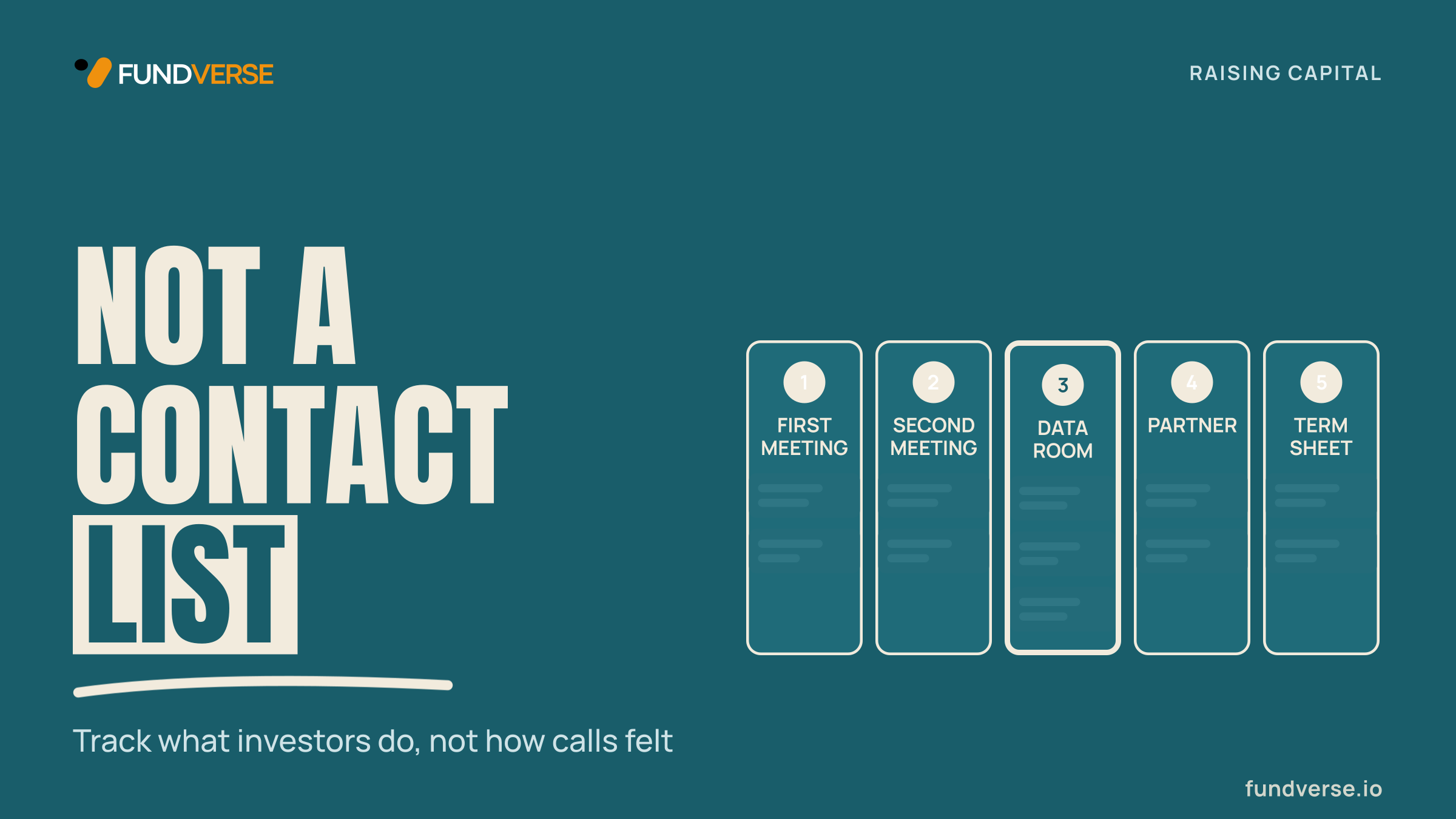

A list of investor names measures effort, not progress. A staged pipeline shows how much capital is likely to close, by when, and which stalled conversations deserve your scarce time.
Ask a founder how the raise is going and the answer tends to arrive as a count: sixty investors on the list, twenty emails sent, fifteen calls booked. The numbers are accurate, and they are offered with the confidence of a progress report. What they cannot tell you is whether the round will close.
A fundraising pipeline is a model of how conversations turn into committed capital, and a model earns its keep by answering three questions a list cannot: how much money is likely to arrive, by when, and which conversation deserves your next hour. Founders, CFOs and project developers who track only contacts end up mistaking activity for progress, and they usually learn the difference when the cash runs short.
Why a list feels like progress
A contact list feels productive because everything on it is countable and under your control. You can add ten names in an afternoon and feel the round getting bigger. What you cannot control is what any of those people decides, and that is the only thing the round depends on.
The deeper problem is that a list treats every row as equivalent. An investor who replied with a polite 'send me the deck' sits beside one who has asked for customer references and brought a colleague to the second call. Both read 'in contact'. Three things are missing from that row: where the person actually is in their decision, what evidence shows they are moving, and what stands between them and a commitment.
Without those, the question that matters has no way of being answered. Expected capital is a sum across many conversations, each weighted by how likely it is to finish and how long it will take, and a headcount cannot be added up into that. The cost shows up in time. Raising competes with running the business, as we looked at in why raising money can take longer than building the product, so hours go to whoever replies fastest rather than to whoever is most likely to commit.
What a real pipeline records
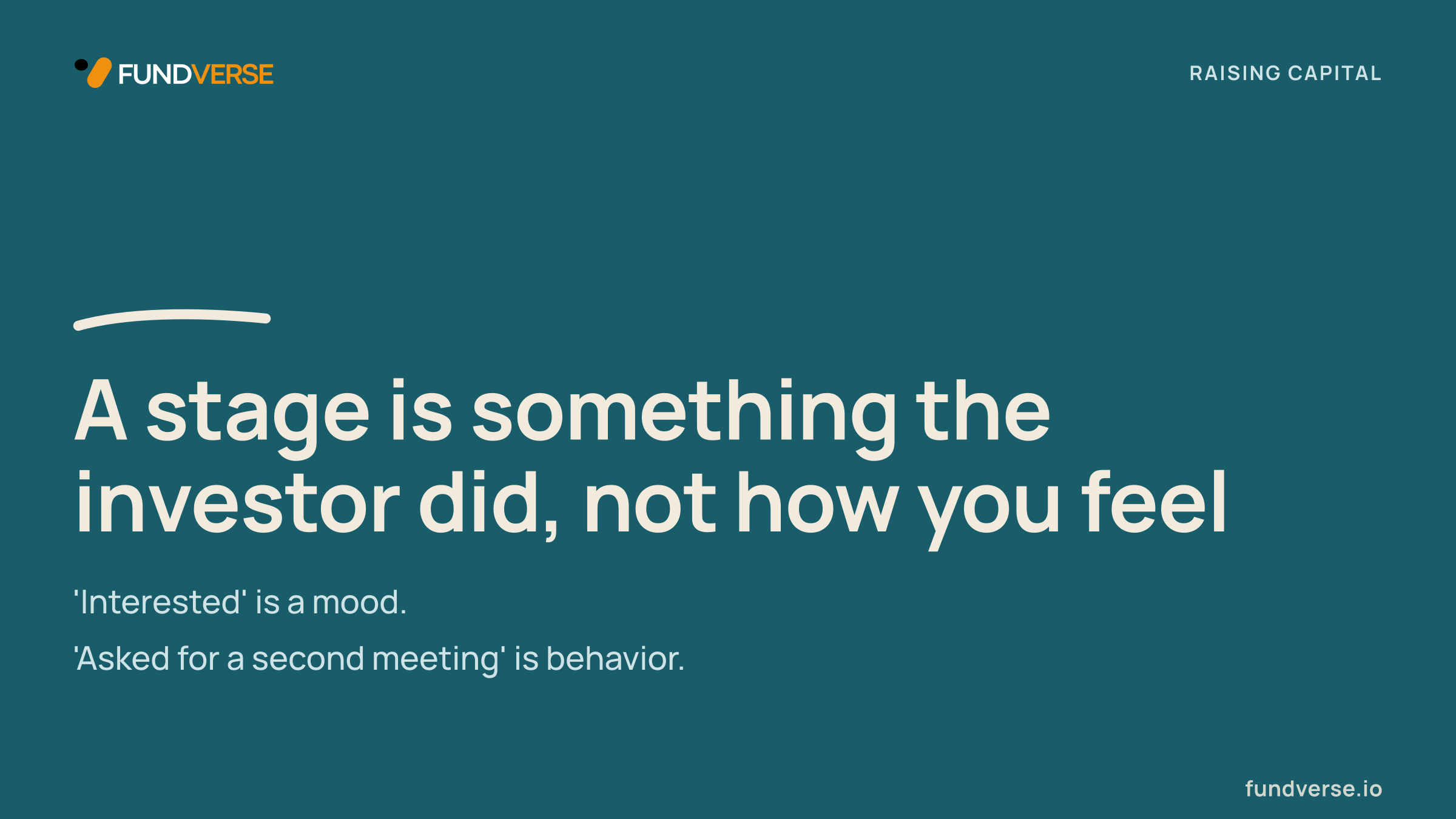
A pipeline starts by defining stages in terms of what the other party has done, never how you feel about the conversation. 'Interested' is a mood. 'Asked for a second meeting' is behavior, and so are being given access to your data room, introducing you to a partner or credit committee, and issuing a term sheet or credit offer. Each of these costs the investor effort or political capital, which is why they are better evidence than warmth. A good test is whether a colleague could verify the stage without asking how the call felt.
Around each stage, a working row needs a few more fields:
- Stage, defined by something the investor did
- Evidence of intent, such as the documents they requested or the colleague they brought in
- Next step, with an owner and a date
- The specific blocker, meaning what must change for this to advance: a mandate mismatch, a missing lead investor, an unanswered diligence question
- Potential amount and expected timing
Evidence and blocker look similar but do different jobs. Evidence says why you believe the investor is moving; the blocker says what would stop them. A deal with strong evidence and no named blocker is probably being flattered by optimism. The owner and date on the next step matter for a related reason: a deal with no dated next step is drifting, and drift is how rounds quietly stall. Sometimes the owner is the investor. 'Their partner meeting is on the 14th' is a legitimate next step because it records whose move it is and when silence becomes meaningful.
One funnel cannot fit every funder
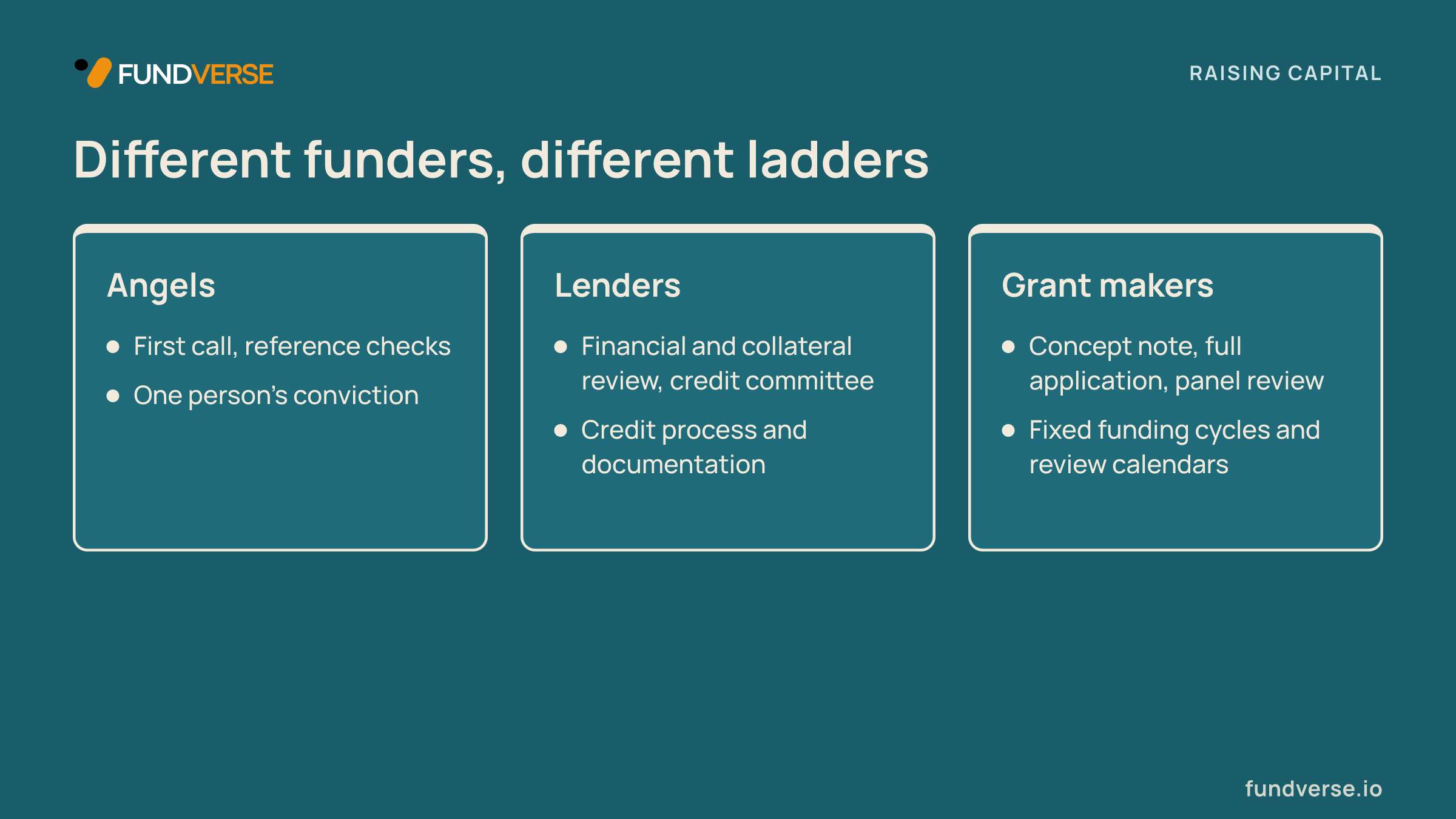
It is tempting to build one funnel with generic stages and push every funder through it. That misleads, because the same stage name means different things to different capital providers, and their clocks run at different speeds.
| Capital type | Observable stages | What sets the pace |
|---|---|---|
| Angels | First call, follow-up questions, reference checks, a stated amount | One person's conviction, often shaped by who else is in |
| Venture funds | First meeting, second meeting, partner introduction, diligence, term sheet | Partner consensus and the firm's meeting and committee rhythm |
| Family offices | Introductions, repeat meetings, adviser involvement, diligence, decision | Trust in the principals and how many people must agree |
| Lenders | Application, financial and collateral review, credit committee, offer, security documents, drawdown | Credit process and documentation rather than enthusiasm |
| Grant makers | Eligibility check, concept note, full application, panel review, award, agreement | Fixed funding cycles and review calendars |
A lender asking for three years of accounts is far into a process that is largely mechanical, while an angel asking for the same documents may simply be curious. A grant maker's calendar can cost you months regardless of how strong the application is, because the panel only meets on certain dates. Family offices often decide slowly because the decision rests on trust built across several meetings. Each capital type therefore deserves its own stage ladder and its own expected timeline, while one common measure ties them together: expected committed amount, by date.
Dana's list versus Dana's pipeline
Consider a hypothetical founder, Dana, who runs a business making small refrigerated storage units for food producers. She wants to raise $1.2 million in equity. Her spreadsheet holds 40 investors, with columns for name, firm, email and a status that reads 'in contact' on every row. She feels well supplied.
Rebuilt as a pipeline, the same 40 names look different: 24 have had one meeting and nothing since, 9 have had a second meeting, 4 have been given data room access, 2 have met a partner, and 1 has sent a term sheet. Suppose Dana assigns each stage a rough chance of ending in a commitment: 5% for a first meeting only, then 15%, 30%, 50% and 80% for the later stages. These weights are invented to show the arithmetic and are not benchmarks. Multiplied through (1.2 + 1.35 + 1.2 + 1.0 + 0.8), they imply about five and a half investors closing. If she assumes each writes about $150,000, that is roughly $830,000 against a $1.2 million target.
The list said forty. The pipeline says there is a gap of around $370,000 before timing is even considered, and it says where the problem sits: the top is crowded with names at the stage that rarely converts. It also changes what Dana does on Monday. Her blocker column shows that three of the four data room investors are waiting on customer references. Collecting those references unlocks more value than twenty new outreach emails, and the list could never have told her so.
The same numbers also size the effort still needed. Dividing $1.2 million by $150,000 gives eight commitments. Her current mix produces roughly one commitment for every seven names, so eight commitments would take close to sixty names at that mix, not forty. As her late-stage deals mature the mix will shift, but the exercise reveals something a list hides: she is likely under-prospected and short of time to fix it.
Reading the pipeline for leaks
Once stages are defined, the conversion between them becomes informative. If many investors reach a second meeting but few are given data room access, something is breaking after the first impression: perhaps the story is compelling but the evidence behind it is thin, or the investors were never a mandate fit. A drop earlier points to targeting or the opening pitch instead. Early on, with few conversations, these rates are noisy, so treat them as ranges and replace your assumptions with real figures as your own history builds.
Stalled deals are the second thing to look for. Every stage has a normal dwell time that depends on the capital type, and a deal that sits beyond it without a dated next step is stalled. Silence after data room access deserves particular attention: did they open the documents, did questions follow? Be careful with the opposite error, though. A grant maker whose cycle has not opened is waiting, not stalled, and your pipeline should know the difference. Working back from your runway and the date you must start raising tells you how many weeks the pipeline has to turn conversations into commitments.
A fair objection to all this
The strongest case against this view is that stage probabilities are guesses, and a spreadsheet of guesses can create false precision. Investors also surprise founders in both directions, and a stage reached is not a check written. For a small, informal raise from a handful of friends and family, a full model can feel like overkill.
All of that is true, and none of it undermines the case. The value of a pipeline is not that its forecast is right but that its assumptions are explicit, so reality can correct them. A founder who assumed 30% of data room investors would commit and sees far fewer doing so learns something early. Insisting on observable evidence also guards against polite interest being counted as intent. And even the small raise benefits from the same fields: a stage, a next step, a date and a blocker fit on a single line.
Where software fits
A spreadsheet handles a few dozen rows well. It strains when several people touch the same conversations, when stage dates must be remembered, and when documents and notes live in scattered inboxes. Pipeline management and investor CRM software, such as Fundverse's, is useful at that point because it can hold stages, next actions, blockers and history in one place, so the memory of each conversation does not depend on one person. It does not create investor interest or replace the conversations themselves. The logic above comes first, and the tool is simply somewhere to keep it. We go further into this in why capital relationships run on deal memory.
If your raise has outgrown a spreadsheet, Fundverse's pipeline management and investor CRM can hold your stages, next actions and blockers in one place, so you can see where each conversation stands.
Try this before the next investor call: sort your list by what each person has done, not by what you hope they will do, and delete the word 'interested' from every row. Then ask one question. If you added no new name from today, how much of your round would still close, and by what date?
Frequently asked questions
Topics
fundraising pipeline
investor pipeline
investor CRM
fundraising process
pipeline stages
raising capital
investor conversion rate
stalled deals
Raising or investing?
Find the right people on the other side of the table, and run the round in one place.