
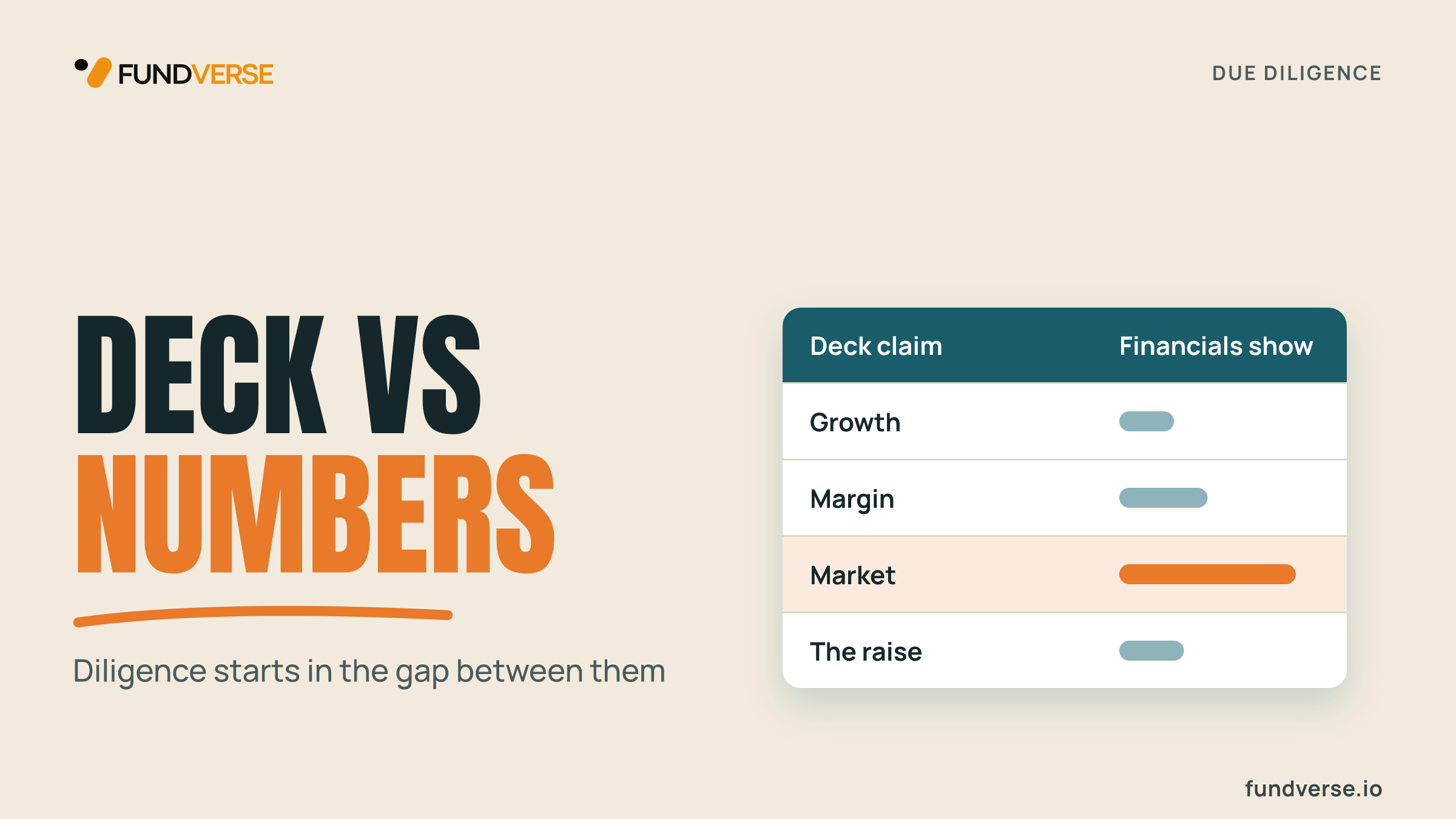

A pitch deck is a claim and the financials are the evidence. Here is where investors, lenders and grant makers find the gaps, and how founders can test their own consistency first.
A pitch deck is allowed to choose. It can show the strongest chart, round a flattering figure and leave out whatever would need a slide of its own to explain. A financial model is not allowed to choose, because every number in it feeds another: revenue becomes receivables, receivables become cash, and costs fall due on particular dates. The two documents can describe the same company and still disagree, usually without anyone intending it.
A deck is a set of claims: the business is large, growing, profitable on each sale and worth the amount being asked for. The financials are the evidence for or against each claim. When an investor, lender or funder opens both side by side, diligence begins in the space between them. Founders can check that space first, and it is far cheaper to do so at their own desk than in the middle of someone else's review.
One document persuades, the other reconciles
Selection is not dishonesty. No ten-minute pitch can carry every caveat, so a deck leads with what matters most and trusts the rest to follow. A model has the opposite obligation. The profit and loss, the balance sheet and the cash flow statement must agree with one another, so a model cannot claim something in one place without paying for it in another.
That is why a growth assumption is harder to defend in a model than on a slide. Faster growth means more hiring, more inventory or delivery capacity, more money tied up between billing and collection, and a larger funding need. A slide can show the growth and leave those consequences unstated. Most gaps reviewers find come from exactly this sequence: the deck was written first, the model was built or updated later, and nothing forced the two to agree. The cause is usually neglect rather than deceit, but a reader cannot tell which from the outside, and until the founder explains, the less flattering reading tends to win.
Where decks and numbers part ways
Four contradictions turn up often enough that experienced reviewers check for them almost by habit. Each is a place where a persuasive claim has to survive contact with arithmetic.
Growth that does not arrive as cash
Decks tend to report growth as revenue, bookings or contracted value, which are different measures sometimes used interchangeably. Cash is another measure again. Take a business that invoices a steady amount each month and collects ninety days later. It must pay three months of costs before the first collection lands, and every increase in sales widens that gap, so growth consumes cash instead of producing it. The reverse also happens, since annual prepayments can make cash look stronger than earned revenue. A reviewer who compares revenue with cash collected, and checks how old the receivables are, is asking whether the growth in the deck is growth the business can afford to fund. The mechanics are laid out in why a growing business can still run out of cash.
Margins that leave costs out
A headline gross margin often counts only the most direct cost of delivering the product. A fully loaded view adds what it takes to serve a customer: payment processing, hosting, onboarding, support, account management, refunds and the share of staff time spent on delivery. Reviewers rebuild the margin from the ledger, and if their figure sits far from the deck's, two questions follow. Is each sale less profitable than claimed? And will scaling make it worse, because the omitted costs grow with every customer instead of shrinking?
A large market and an expensive customer
Market size slides work from the top down: a large population, a share of it, a price. The model works from the bottom up, starting with what it costs to win one customer, known as customer acquisition cost. If winning a customer takes several demonstrations, a long sales cycle and a salaried salesperson, but the model counts only advertising spend, the cost is understated and the route to market looks cheaper on paper than in practice. That cost then has to be set against the gross profit the customer generates over time, because how long a customer takes to repay their own acquisition shows whether the market is reachable at a price the business can bear. A very large market served at a loss on each customer is not an opportunity, only a larger loss.
A raise that does not fit the plan
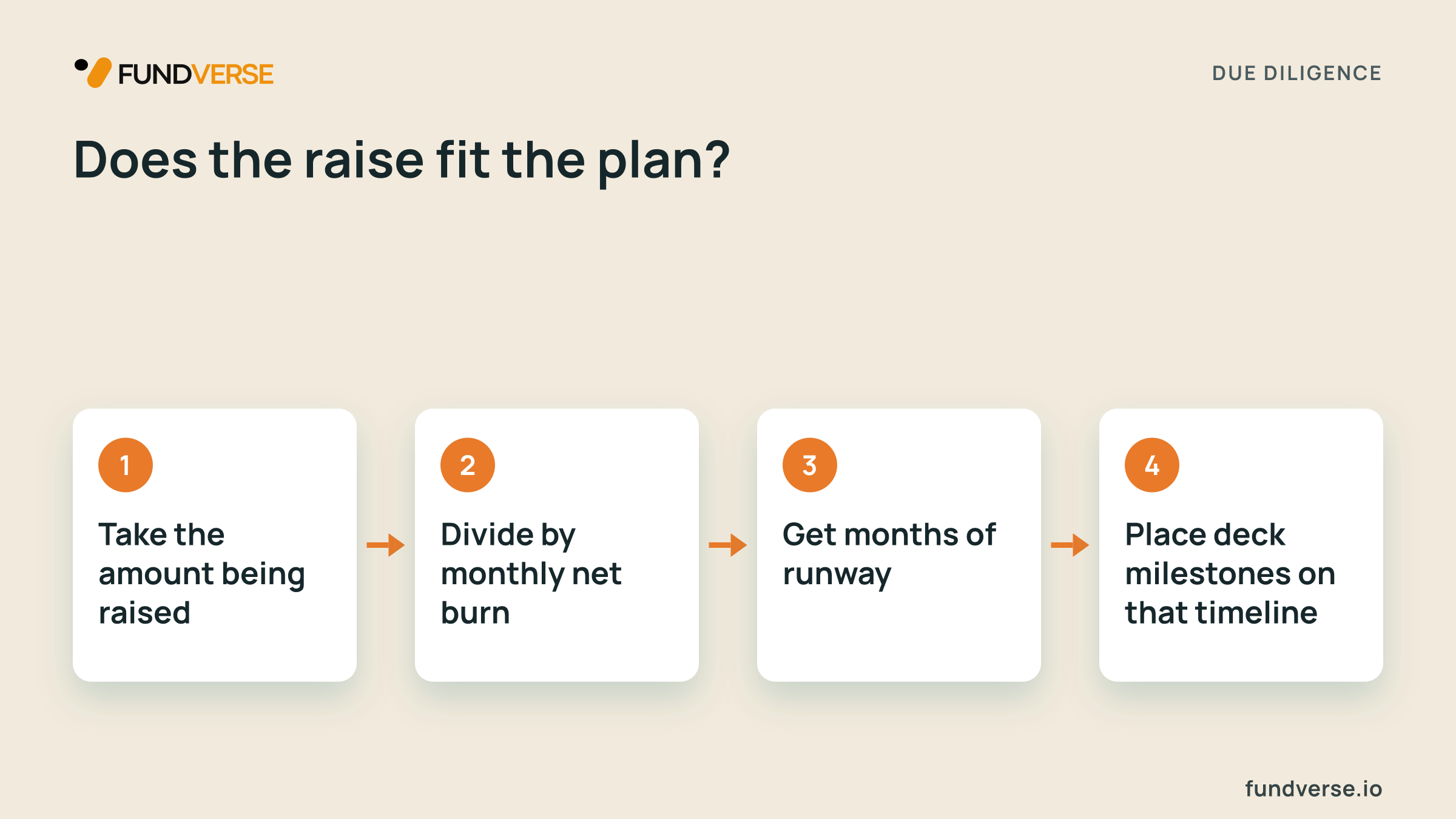
The ask is the figure that joins the deck to the model, so it is often where they disagree most visibly. Divide the amount by the monthly net burn in the model and the result is the months of runway it buys. As a simple illustration, a raise of $1.2 million against net burn of $100,000 a month buys twelve months. Then place the milestones the deck promises on that timeline. If the product launch, the first large customers and the next fundraise fall after month twelve, the round does not fund the plan. The use-of-funds slide can fail in the other direction, with percentages for hiring, marketing and product that match nothing in the model's headcount and spending lines. Either way the investor concludes that the amount was chosen first and the plan fitted around it. Founders can work through this in how to calculate runway before raising capital and asking what the money would change.
Same gap, three different questions
A discrepancy is not read the same way by everyone, because each capital provider uses the numbers to answer a different question. An equity investor is buying a share of an uncertain future, so the growth story matters and early losses are expected. What a gap threatens is the credibility of the story. An overstated margin makes the investor wonder what else was overstated, and the usual results are a lower valuation, harder questions about terms or a quiet pass. A gap the founder spots and explains first does the opposite, because it shows command of the business.
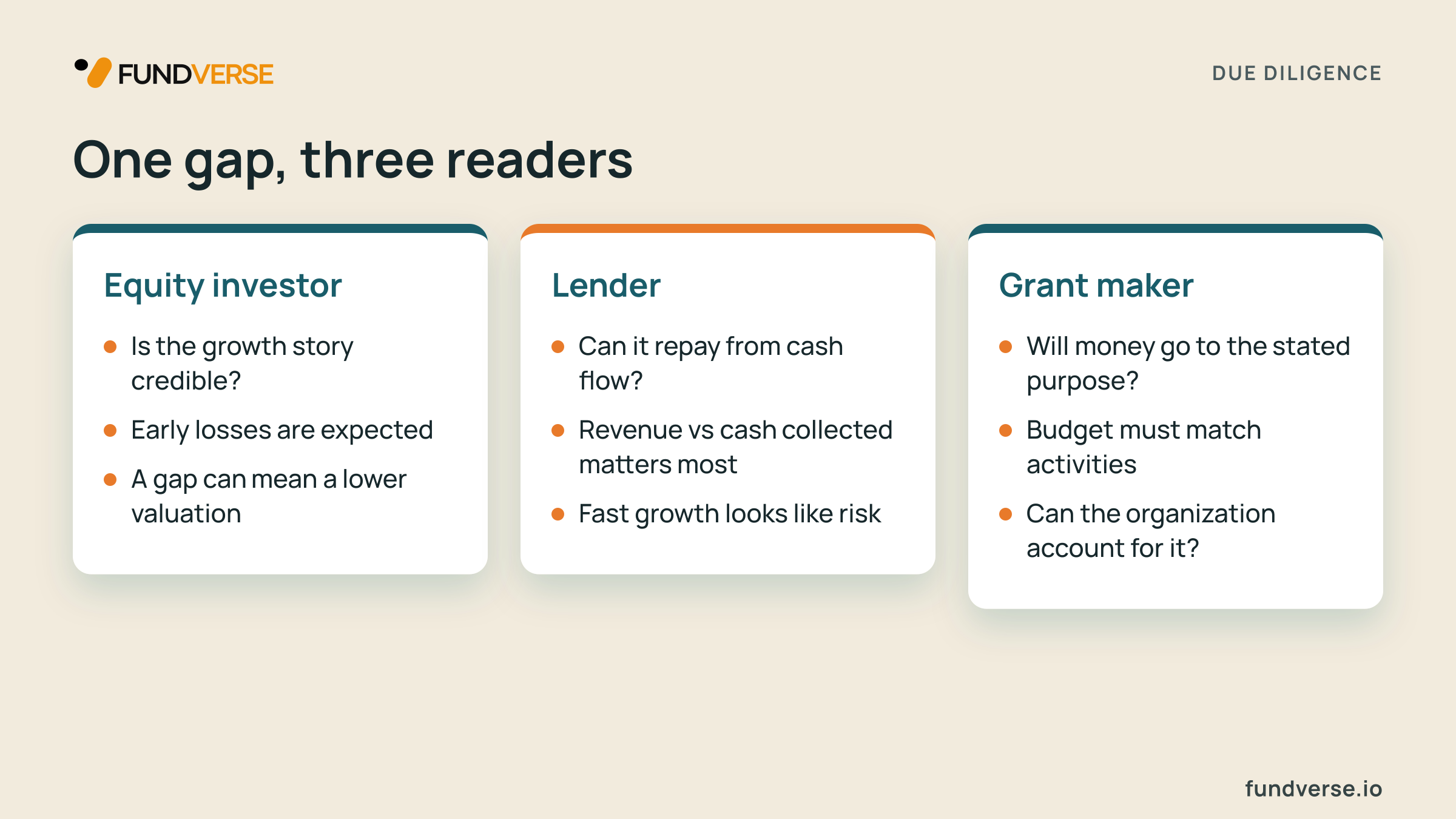
A lender is not paid for upside. It is repaid from cash flow, with collateral or guarantees as the fallback, so it reads the same documents for repayment capacity: how much cash the business generates after operating costs, how reliably, and how comfortably that covers scheduled payments. Growth interests a lender only as a source of future cash. A gap between reported revenue and cash collected is therefore the most serious one, because it bears directly on whether a payment can be made on the due date, and rapid growth that absorbs working capital looks like a risk rather than a strength. The lender's perspective is developed in why a bank loan is priced on collateral quality.
A grant maker or development funder asks a third question: will the money be spent on the stated purpose, and can the organization prove it? They compare the budget with the activities in the proposal, look for costs that do not belong to the funded work, and judge whether the numbers show an organization able to account for what it receives. A confident impact story sitting on a budget that cannot deliver the activities raises doubts about execution, a theme explored in how to vet grant applicants for execution ability.
Running the check before anyone else
The remedy is mechanical, and it works best before any outreach. Treat the deck as a list of claims and test each one in turn.
- List every factual or numerical claim in the deck, including implied ones such as growth rate, margin, payback period, market size and delivery timeline.
- Beside each claim, write the financial line that supports it and the figure found there. A claim with no supporting line is itself a finding.
- Rebuild three derived numbers from the ledger yourself: cash collected against revenue, fully loaded margin, and acquisition cost per customer including sales time.
- Divide the raise by monthly net burn, mark each promised milestone on the resulting timeline, and check that the use-of-funds slide matches the model's spending.
- Hand both documents to someone who did not build them and ask them to find the mismatches you missed.
Where a claim and a figure disagree, decide which one is wrong. Fix it, or write down the cause and what is being done about it. This is the step founders skip and the most valuable one. A mismatch found by an investor reads as a problem the founder did not know about, while the same mismatch, explained in advance, reads as a business run with attention. Sometimes the check shows that a claim cannot be defended and must come out of the deck, or that the plan needs more money or more time than hoped. That is an unwelcome result, but a better place to learn it than a closed door.
Marcus, Fundverse's AI, can review a pitch deck and flag claims that need support, and Fundverse's financial analysis tools and fundraising readiness checks give you a structured way to test those claims against your numbers before you approach anyone.
Consistency is not the same as quality, and a deck and model that agree can still describe a weak business. But a business whose documents contradict each other is rarely judged on its merits at all. Take the one claim in your deck you most want investors to believe. Which line in your financials proves it, and if the figure beside that line disagrees, could you explain why before someone else asks?
Frequently asked questions
Topics
pitch deck financials
investor due diligence
financial model consistency
fundraising readiness
use of funds
unit economics
cash conversion
customer acquisition cost
Raising or investing?
Find the right people on the other side of the table, and run the round in one place.