

With no revenue, bookkeeping feels optional. But the records investors, lenders and grant makers value most are the ones you cannot rebuild later. Here is what to start keeping, and why.
Picture a founder eighteen months into building logistics software, with no customers and no revenue. A grant program asks her for a breakdown of how the money so far has been spent. This is a hypothetical, but a familiar one. The funds came from her savings, a loan from a relative and a modest check from a former colleague. Some costs went through her personal card, a laptop was bought months before the company existed, and the relative now remembers the loan as an investment. Nobody did anything wrong. Nobody wrote anything down either.
A pre-revenue business has no income to report, so bookkeeping feels like something that can wait for the first sale. Yet its records are the only evidence of how it spends money and makes decisions. Some can be rebuilt later with effort. Others depend on what people remember or agreed, and memory drifts toward whatever is convenient. This guide is mostly about that second kind.
Why reconstruction fails
A bank statement shows that 4,000 left the account on a given date. It does not say whether that was a prototype, a legal retainer or a founder's rent. Working out the purpose of a hundred such lines takes days, and the job usually lands in the middle of a raise or an application, when time is shortest. Worse, the reconstructed version tends to be tidier than what happened, and an experienced reader can feel the tidiness.
Each party reading your records wants something different, though the evidence overlaps. Equity investors want to know who owns what, on which terms money went in, and whether spending matches the story of progress. Lenders look at repayment capacity: existing obligations, personal guarantees, and whether the business's money can be told apart from yours. Grant makers check that costs were eligible, incurred for the funded purpose and documented, and some will not count spending that predates an award. Tax authorities want consistent treatment of founder loans and related-party dealings and, where a development-related credit exists, records made at the time rather than recalled afterward.
Open a separate bank account
This is the cheapest habit on the list and the most expensive to skip. The business account is the spine of your records, because every other document can be checked against it. When personal and business money share an account, someone must decide, transaction by transaction and years later, which was which. That someone will be an accountant billing by the hour, or an investor's analyst who quietly marks you down. In many places, blurred finances can also weaken the legal separation between you and the company, which is why you incorporated in the first place.
If you have not incorporated yet, open a dedicated account anyway, and move to a company account once the entity exists, with a short note of what was transferred. Then add one small discipline: save every receipt or invoice the day it arrives, named with date, vendor and amount, with a one-line purpose. A receipt for a software subscription says nothing. One annotated hosting for the pilot test with two freight brokers tells a story that holds up.
Write down what founders put in
Money a founder puts into the company is one of three things: a purchase of shares, a loan that must be repaid, or a contribution with no shares and no repayment. On a bank statement all three look identical, so the terms must be written when the money moves: amount, date, type, and for a loan the interest rate, repayment expectations and whether it can convert into shares.
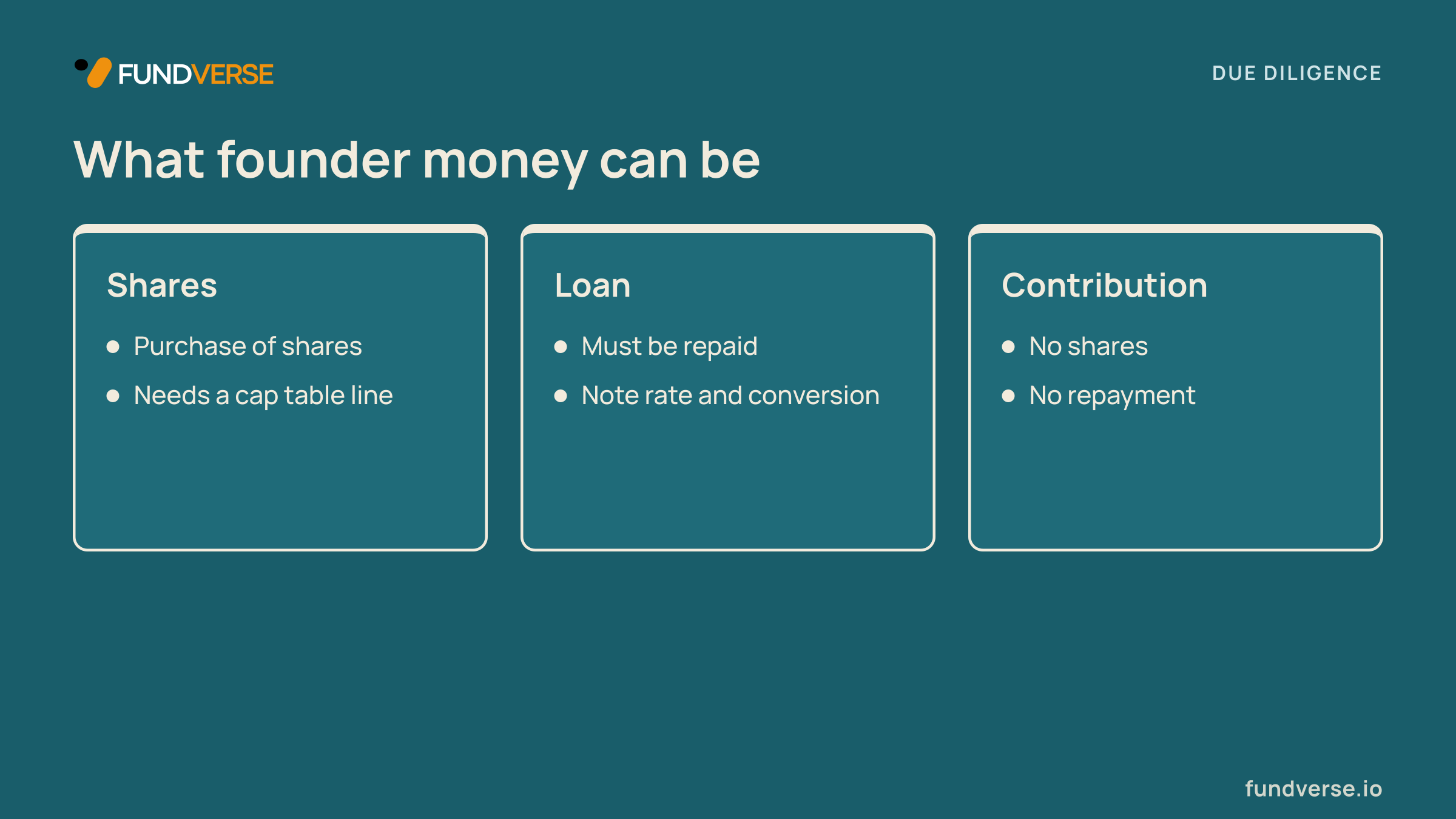
Consider a founder who wires 20,000 into the company and says nothing. A year later an investor asks whether that is debt. If it is, part of the new round could end up repaying the founder, which changes what the investor is actually buying. If it is equity, the founder bears the risk of loss like everyone else and the cap table needs a line for it. A two-paragraph note signed at the time settles the question before anyone has a reason to disagree.
Related-party money deserves extra care: family and friends, a cofounder's other company, a director's firm that invoices the business. Investors and tax authorities look in exactly these places for value leaking out or claims hiding in. Keep a signed trail, meaning a simple agreement, a dated note of who approved it, and invoices describing real work at plausible prices. Where equity is involved, the piece on the cofounder equity split and vesting covers the structure; the records habit is making sure what you agreed is written and signed.
Tag spending by purpose
Once the money is separated, sort it by what it was for. A workable starting set is product build, testing and research, legal and compliance, founder time, and general administration. Use categories in accounting software or a column in a spreadsheet; the tool matters less than deciding at the time of entry rather than at year end.
It pays off in three places. Grant reports usually ask for costs by activity. Development credits and incentives, where a country offers them, generally depend on showing which spending went to qualifying work, and the rules vary enough that you should check yours early. And investors will ask how much went into building versus validating, which is really a question about whether you have been learning or just spending. With a tagged ledger you answer in minutes; without one, from memory.
Founder time is the category most often lost. Even if you pay yourself nothing, keep a log of hours by activity, a few lines a week. Unpaid time never appears as an expense, yet it is often the largest input to the product, and some funding and incentive schemes want evidence of it. Whether to pay yourself at all is a separate decision, covered in the founder salary problem.
Date your assumptions
A forecast spreadsheet gets overwritten. Each edit erases the earlier belief, and within a year nobody, including you, can say what you thought in month three. The fix is mundane: when you make a significant change, save a copy with the date in the filename and a short note on what changed and why. Keep a separate list of the assumptions that drive the numbers, such as price, expected conversion, hiring timing, build cost and launch date.
Plans change, and that is no failing. What worries an investor or lender is a plan that changed without explanation. If launch moved from month nine to month fifteen, a dated trail showing that a supplier slipped or a pilot exposed a missing feature reads as learning. No trail reads as drift. It also keeps you honest with yourself, since it is hard to claim you always expected the delay when your own file says otherwise.
Track cash and runway monthly
You do not need a financial model. You need one page, updated monthly: opening cash, money in, money out by category, closing cash, and average monthly spend over the last three months. Runway is closing cash divided by that average. With 90,000 in the account and spending averaging 15,000 a month, you have about six months. Subtract commitments you owe but have not paid, such as invoices, tax and contracted work, and the number shrinks.
The value is partly the number and partly the history. Monthly snapshots let you explain later why spending rose, when you decided to hire and why runway fell faster than planned. They also keep the raise honest: raising money often takes longer than expected, and a runway shorter than the process you are starting is a weak position to negotiate from. The same cash view is the first thing to check when cash is tightening even though activity looks healthy.
Match the setup to the stage
At the idea or prototype stage, with founders funding everything and a few transactions a month, a separate account, a spreadsheet, a receipts folder and a one-page log of money in is enough. Once outside money arrives, contractors join or a grant or pilot begins, move to accounting software with a bank feed, categories and monthly reconciliation, and put every money-in arrangement in writing. When you are preparing a raise, a loan application or formal grant reporting, or running payroll or several currencies, add a part-time bookkeeper and have an accountant review the books periodically.
Software tends to come before the bookkeeper because it imposes consistent structure and imports bank transactions automatically. The bookkeeper becomes worth paying when the monthly close takes more than an hour or two, when reconciliation slips more than a month behind, or when a funder will expect reports the ledger cannot produce. By then the help costs little next to untangling a year of entries. At every stage the monthly routine has the same shape:
- Reconcile the bank account against the ledger
- File every receipt and invoice with a one-line purpose
- Update the log of money in, including terms and signatures
- Refresh the cash and runway page
- Save any changed forecast with the date and a note on what changed
When your records are in order, they need somewhere to live that investors can actually navigate. Fundverse's data room is one way to organize and share them when the time comes.
Get the terms on one page
Three mistakes account for most of the expensive tangles. Mixing personal and business money rarely feels serious in month two and is a mess by month twenty. The handshake loan, a friend or relative lending on a promise to be repaid when things go well, leaves two years later a different remembered rate, a different deadline, or no loan at all. And the casual promise of equity, help me launch and you will get a piece, accumulates until an investor's lawyer asks who has a claim on the company and the honest answer is that nobody wrote it down.
The last two share one cure, and it is the habit worth keeping if you keep no other. In the same week that money or a promise changes hands, put the terms on one page: who, how much, whether it is equity, a loan or a gift, what happens on repayment or a sale, and the date. Get both parties to sign it. Other records can be tidied up later. The other person's memory of the deal is the one record you do not control, and the signed page is the only thing that replaces it.
Frequently asked questions
Topics
pre-revenue bookkeeping
startup financial records
founder loans vs equity
startup runway tracking
grant reporting records
due diligence preparation
startup accounting setup
Raising or investing?
Find the right people on the other side of the table, and run the round in one place.