
A well-structured data room doesn't just answer investor questions, it demonstrates operational maturity. This guide breaks down exactly what a startup data room is, what to include at each funding stage, common mistakes to avoid, and how to use it to close your round faster.
There is a moment in nearly every fundraising process where the tone shifts. The pitches are done. The investor is interested. A term sheet may even be signed.
And then someone asks: "Can you share access to the data room?"
For many founders, this is where the real work begins and where deals are won or lost. If your data room is scattered across Google Drive folders, email attachments, and a desktop called "Investor Docs FINAL v3," you are introducing friction at the worst possible moment. A messy data room tells investors they might not be able to trust the foundation, even if they love the business .
According to industry analysis, 89% of investors now require secure digital access to due diligence materials via a virtual data room, making it the expected baseline from seed stage onwards . This guide explains exactly what a startup data room is, what belongs in it at each stage, the common pitfalls that kill deals, and how to use it to build investor confidence from the first click to the close.
What Is a Startup Data Room?
A startup data room is a secure, organized online repository of documents shared with potential investors during the fundraising process. It centralizes your financials, legal documents, team information, market data, and product details so that investors can conduct due diligence without a constant back-and-forth chain of individual document requests .
At its best, a data room does two things simultaneously: it speeds up your fundraise by answering investor questions before they are asked, and it signals to your investors that your team is organized, transparent, and ready to be scrutinized. At the seed stage where traction may be limited, a well-built data room can be a meaningful differentiator
How a Data Room Differs From Generic File Sharing
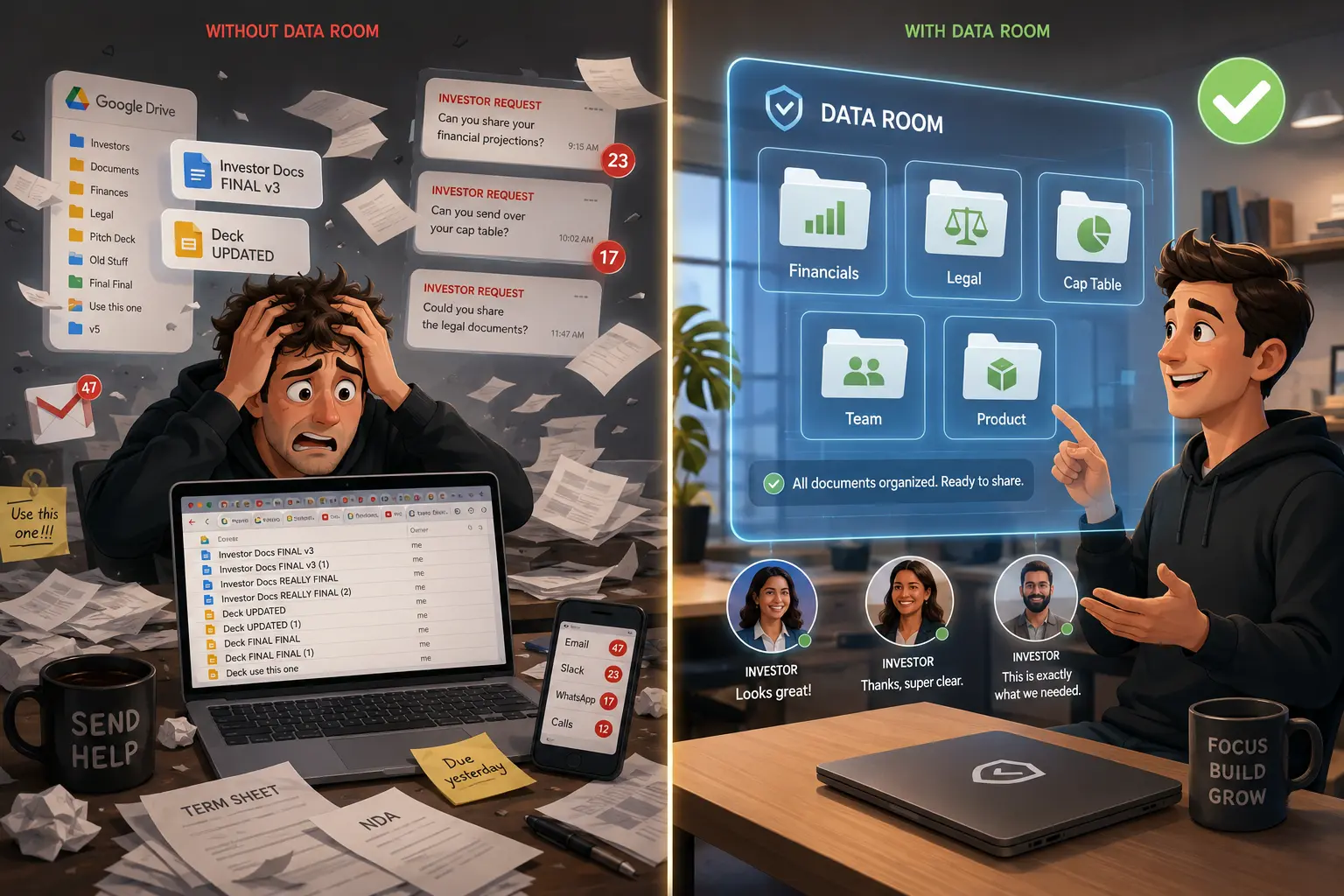
A virtual data room (VDR) is fundamentally different from consumer file-sharing tools. Unlike standard cloud storage, a purpose-built VDR provides stronger security and granular permission controls, full activity tracking and audit logs showing exactly who viewed which document and for how long, protection features even after download (such as encryption and access revocation), better document organization with indexed folder structures, and deal-ready tools specifically designed for due diligence workflows .
Google Drive and Dropbox are built for everyday collaboration. A VDR is built for high-stakes transactions where security, control, and investor experience directly impact your valuation .
Why Startups Need a Data Room
The fundraising process is, at its core, an information problem. Investors need to evaluate your business quickly and thoroughly. Founders need to field dozens of requests without losing focus on running the company. A data room solves both sides of that problem .
It Reduces Back-and-Forth With Investors
Instead of responding to individual document requests from every investor you speak with, a data room lets you direct all parties to one centralized location. Every investor works from the same information at the same time, which eliminates version control problems, reduces email overhead, and keeps your fundraising process moving at the pace you set rather than the pace of the slowest document request .
For founders running a competitive process with multiple investors simultaneously, this efficiency compounds quickly.
It Signals Organizational Maturity
A well-organized data room tells investors something about how you run your company before they have asked a single question. It demonstrates that you value transparency, that you have nothing to hide, and that your internal operations are disciplined enough to survive scrutiny. As one analysis puts it: "Your data room isn't just a folder of documents. It's a mirror that reflects how you've been running the business when no one was watching" .
It Gives You Control Over the Narrative
When you control which documents investors see and how they are presented, you shape the due diligence story. Instead of reacting to random requests that pull your narrative apart, you proactively lay out the evidence that supports your investment case .
What to Include in Your Investor Data Room
Deciding what to include can feel overwhelming. The guiding principle is to include documents that validate your company's claims around the investment proposition, not to upload every file you have ever created.
Core Document Categories
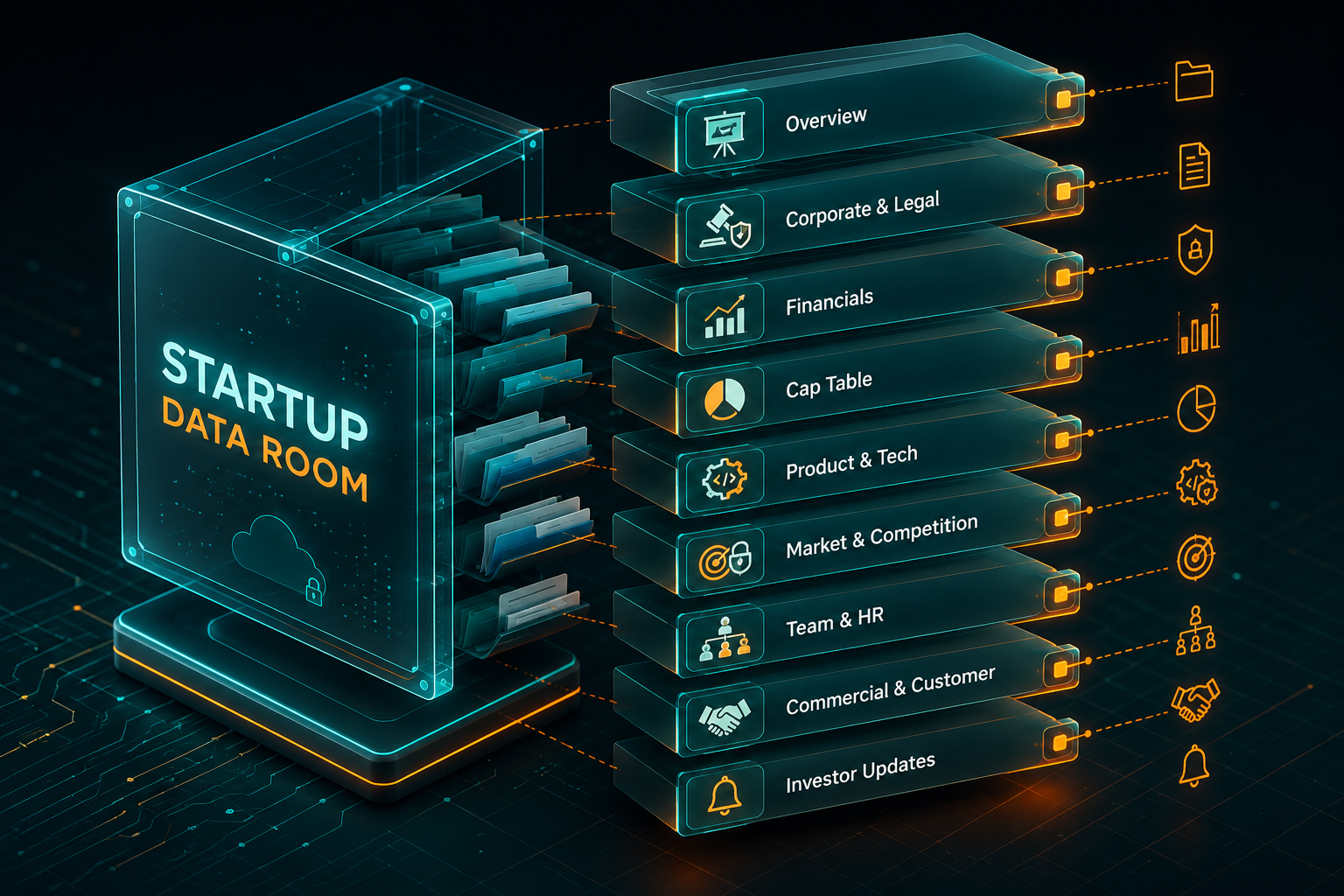
Every startup data room should be organized into clearly indexed folders. A standard structure includes these sections :
1. Overview Folder
Your most recent pitch deck, a one-page company summary, and any term sheet if one exists. Consider including a "Read Me First" document that explains the folder structure and key contact points .
2. Corporate Structure & Legal
• Certificate of Incorporation and bylaws• Shareholder agreements and voting agreements• Board resolutions and meeting minutes• Business licenses and permits
3. Financials
• Historical financial statements (P&L, balance sheet, cash flow)• Current cash position, burn rate, and runway• Financial projections with clearly stated assumptions• Revenue breakdown by product or customer segment• Unit economics (CAC, LTV, payback period)• Tax returns and filings
4. Cap Table
Your fully diluted capitalization table showing all shareholders, option pools, SAFEs, convertible notes, and vesting schedules. Investors will cross-check this against your verbal story, any inconsistencies here are a major red flag.
5. Product & Technology
• Product demo video (pre-recorded is best)• Product roadmap for the next 12–18 months• IP documentation: patents, trademarks, copyrights• Technology stack overview and architecture• Security certifications and data privacy policies
6. Market & Competition
• Market research and sizing analysis• Competitive landscape with feature and pricing comparisons• Customer segmentation and positioning
7. Team & HR
• Founder bios, LinkedIn profiles, and track records• Organizational chart with reporting lines• Key employment contracts and option grants• Hiring plan for the next 12 months
8. Commercial & Customer
• Key customer contracts (anonymized if necessary)• Customer references and testimonials• NPS scores or satisfaction data• Sales pipeline, win rates, and churn metrics
9. Past Investor Updates
Including the last 6 months of investor updates is one of the most underused yet powerful additions to a data room. It shows the progression of your business over time, signals that you take investor communication seriously, and demonstrates transparency with both good and bad news .
What Not to Include
A concise, well-curated repository is far more impressive than an oversized one . Avoid uploading:
• Outdated drafts of documents• Duplicate files across multiple folders• Irrelevant internal communications• Unfiltered data dumps without context or annotation• Sensitive personal data that does not relate to the business
Every document should earn its place by providing meaningful insight into your business .
Data Room Contents by Funding Stage
One of the most common mistakes founders make is treating a data room as a fixed document set. What investors expect to see changes significantly from pre-seed through Series A.
Pre-Seed Data Room
At the pre-seed stage, investors are betting on founders and ideas. There is rarely extensive revenue data. Keep it tight, typically 8 to 12 documents:
• A polished Pitch deck• Founder bios and LinkedIn profiles• Problem statement and market research summary• Product demo or prototype (video or live link)• Early user feedback, waitlist data, or pilot results• Basic cap table• Incorporation documents• Financial model with clearly stated assumptions
A sparse but well-organized data room is more credible than an artificially padded one at this stage.
Seed Round Data Room
By seed stage, investors want early evidence that something is working. Lead with your strongest traction signal:
• Pitch deck and one-page summary• Financial model and 12–24 month projections• Current MRR or ARR and month-over-month growth• Cap table with current round details and outstanding SAFEs• Key customer contracts, letters of intent, or pilot agreements• Competitive landscape analysis• Team overview and org chart• Last 6 months of investor updates• Product roadmap
Sharing past investor updates is particularly effective here, it signals transparency and shows your progression over time.
Series A Data Room
Series A due diligence is substantially more rigorous. Investors writing larger checks are evaluating whether your unit economics and sales motion are repeatable at scale:
• Detailed financial model covering 3 years with scenario assumptions• Monthly P&L and cash flow statements• Full cap table including all previous rounds• Customer cohort analysis and retention data• CAC, LTV, and payback period by acquisition channel• Sales pipeline and conversion rate metrics• Team bios and compensation structure• Board deck history• All legal documents including IP assignments and regulatory compliance
Common Mistakes Founders Make With Data Rooms
Even promising startups can see deals collapse because of data room failures. These are the most frequent pitfalls that will make the deal sink if not handled rectified early:
Inconsistent Numbers Across Documents
If your pitch deck says one thing, your financial model says another, and your CRM shows a third, investors will notice. Discrepancies in revenue totals or unexplained variances between board minutes and management accounts raise immediate concerns about financial accuracy and internal control. Before opening your data room, reconcile every number across every document.
Missing Intellectual Property Assignment Documents
Unclear IP rights, unfiled patents, or lack of assignment agreements from contractors can derail investment quickly. Investors need assurance that your company fully owns its technology. If a past contractor still has a claim on part of your codebase, that is a major red flag.
Outdated or Incomplete Information
A data room with last quarter's financials or expired compliance certificates signals weak operational discipline. Keep documents current and update proactively, not just when an investor asks
Overloading With Irrelevant Material
Uploading hundreds of unfiltered files, duplicates, or irrelevant drafts overwhelms reviewers and suggests poor internal organization. Investors value clarity and precision. Curate carefully before sharing the documents.
No Founder Agreements or Vesting Schedules
Verbal promises do not count. If equity splits, vesting terms, and what happens when a founder leaves are not documented, investors will slow down or walk away.
Waiting Until the Last Minute
Building a data room after the term sheet is signed creates a bottleneck that can kill deal momentum. Prepare the data room before you begin outreach, so it is ready the moment an investor asks.
How Fundverse Helps Founders Prepare Investor-Ready Data Rooms
Preparing a comprehensive, well-organized data room is a significant undertaking especially for first-time founders who have never been through institutional due diligence.
Fundverse helps founders build and manage investor-ready profiles that align with what global venture capital firms actually expect to see. The platform guides you through:
• Structured Due Diligence Preparation: Understand exactly which documents investors at your stage will request, with templates and checklists that prevent costly omissions.• Centralized Document Management: Organize your pitch deck, financials, cap table, legal documents, and market research in one investor-grade profile that signals operational maturity from the first click.• Investor Matchmaking: Once your data room is ready, connect with matched investors actively deploying capital in your sector and stage so your organized materials find the right audience.
When your data room reflects discipline and transparency, due diligence accelerates. Fundverse exists to help founders reach that standard.
Final Thoughts
A startup data room is not just a folder of documents assembled under pressure. It is a strategic asset that communicates how you run your business when nobody is watching.
The founders who raise successfully do not treat the data room as a last-minute due diligence burden. They build it early. They keep it current. They organize it logically. And they use it to tell a consistent, compelling story that holds up under scrutiny.
Every hour you invest in your data room before fundraising begins saves days of back-and-forth during due diligence and can mean the difference between a round that closes and a round that quietly disappears.
Frequently Asked Questions
Topics
what is a startup data room
what is data room for a startup
startup data room explained
startup fundraising documents
investor data room
virtual data room for startups
startup fundraising checklist
startup due diligence preparation
startup investor documents
startup fundraising process
data room checklist for startups
secure document sharing for fundraising
due diligence data room
data room best practices
startup deal room
fundraising data room template
investor-ready data room