

Investors treat valuation as an opening position, but they test every assumption in your model as evidence of how well you know the business. Here is how to defend yours.
A valuation is where two parties' interests meet, so it moves as they push on each other. An assumption in a financial model does something else: it states how the business works, and a statement about the world is either supported or it is not. That is why an investor can concede ten percent on price in one meeting and spend an hour on a single churn figure in the next. The two numbers are doing different jobs.
The difference decides where preparation should go. Many founders rehearse the valuation conversation, with a target figure and a floor, and leave the model to be defended on the day. This piece argues for the reverse. A founder whose assumptions hold up can move on price without losing ground, while one whose assumptions fall apart finds that price was never the real negotiation.
Price moves, assumptions get tested
A valuation depends on a great deal that sits outside the model: how much of the company the investor needs to own to justify the check, what other deals compete for their attention, whether other offers exist, and what terms come attached. Two investors can read identical numbers and arrive at different prices, and both can be reasonable. That is why price is a negotiated outcome. It is also only one of several costs of capital, as the cost of raising capital beyond dilution explains.
Assumptions behave differently. Growth rate, gross margin, customer acquisition cost (what it costs in sales and marketing to win one customer), churn (the share of customers who leave in a period) and working capital (cash tied up between paying suppliers and collecting from customers) are claims about how customers, costs and cash actually behave. Anyone can ask where a claim comes from and judge the answer. Experienced investors do not read the model as a prediction, because they know the future will not match it line by line. They read it as a window into the founder's thinking. If the plan assumes a certain monthly churn, the follow-up is why that figure, and what the founder knows about which customers leave and what makes them go. The reasoning behind a number tells the investor more than the number itself.
How one weak number spreads
Take a single assumption and follow it through, with figures chosen only to show the mechanism. A model assumes it costs $500 to win a customer, and that each customer pays $1,200 a year. A $400,000 sales budget then buys 800 customers and $960,000 of annual revenue. The $500 figure came from a handful of early customers who arrived through the founder's own network. An investor who has watched acquisition costs climb once a business moves past friendly early adopters assumes $900 instead. The same budget now buys about 444 customers and roughly $533,000 of revenue, which is 44% less. Reaching the planned 800 customers would take $720,000, so the cash need rises by $320,000. Someone has to fill that gap, through a larger raise, more dilution or a slower plan.
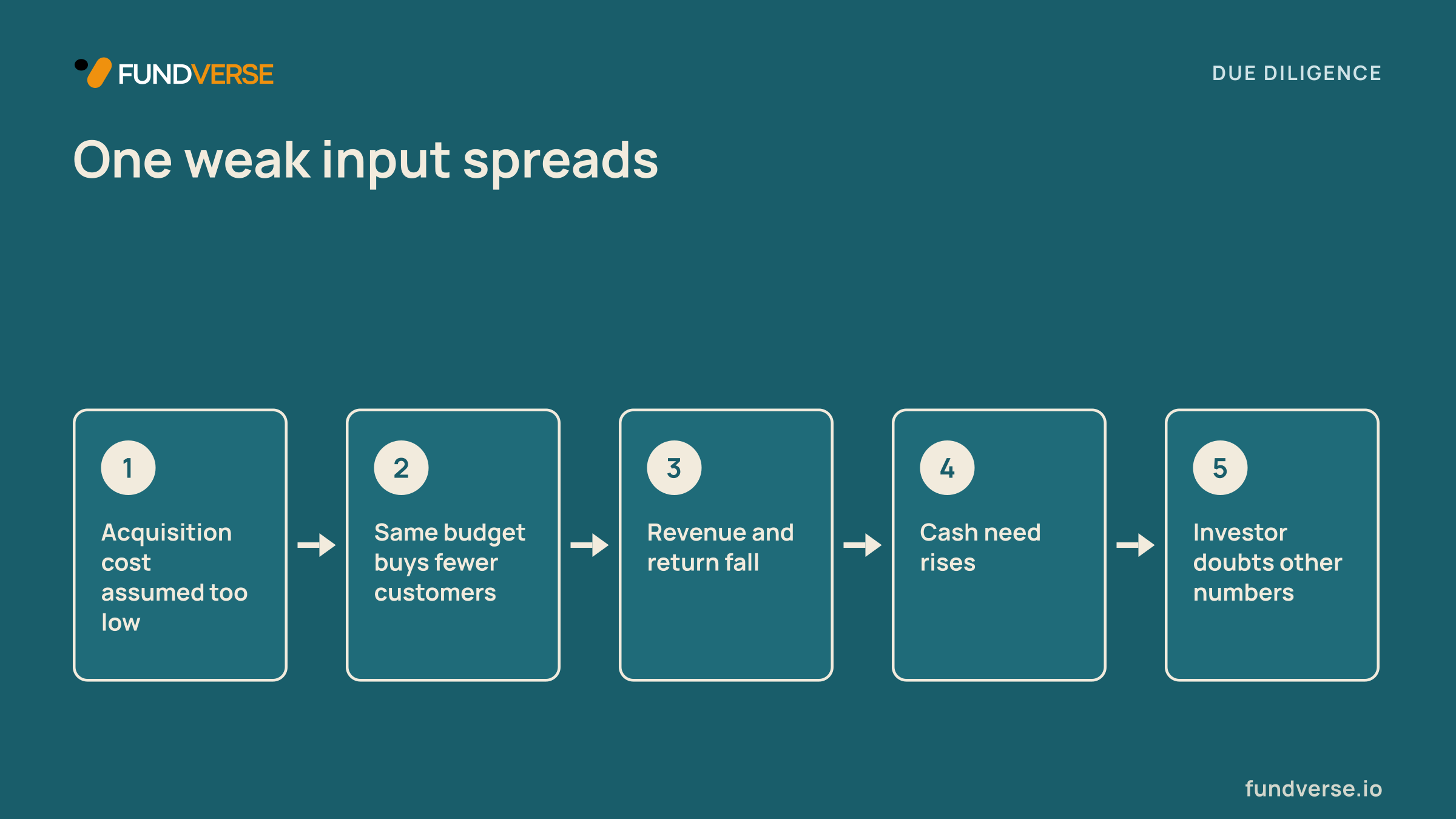
The effect reaches the investor's return too. Suppose their case rests on $20 million of revenue in year five, valued at three times revenue at exit. That is $60 million, and a 20% stake bought for $2 million would be worth $12 million, a sixfold return. If the revenue shortfall carried through the plan, which is a simplification, the exit value falls to about $33.6 million and the stake to about $6.7 million, or roughly 3.4 times the money, before counting dilution from the extra capital. One unsupported input has nearly halved the implied return, and the founder has not yet been asked about anything else.
The arithmetic is not the most damaging part. The investor's next thought is which other numbers were chosen the same way. Growth, margin and collection periods are linked to acquisition cost, and a model works like a chain: once one link is shown to be unsupported, the reader cannot tell which others are. The investor can then rebuild the model on their own assumptions, at which point the founder's version stops mattering, or discount all of it. Price talks suffer as well, because every later concession starts to look like an admission that the original figure was inflated.
What a defensible assumption contains
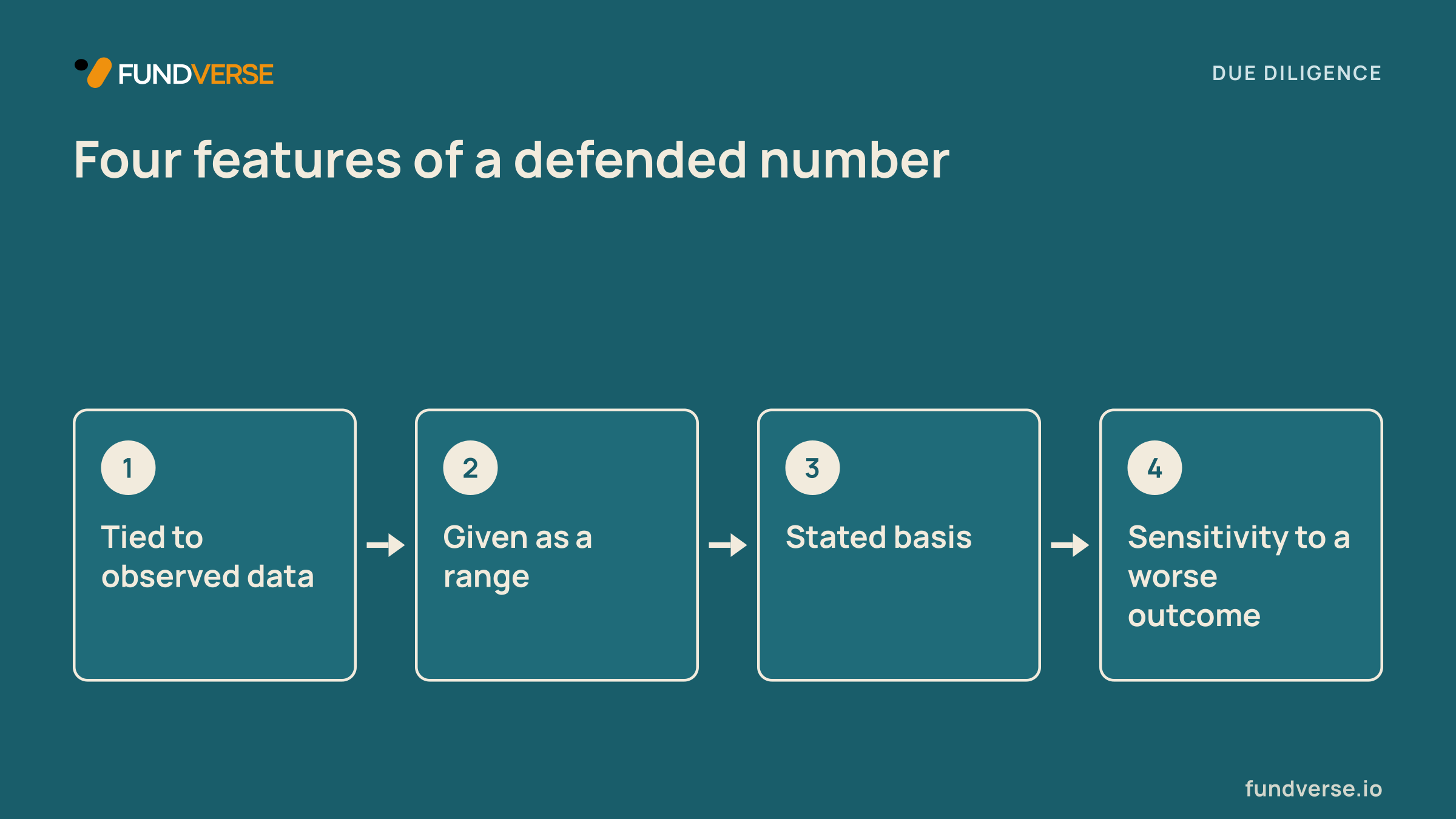
Defensible does not mean correct, since nobody knows next year's churn. It means the number can be traced to a source and tested against a worse outcome. Four features separate a defended assumption from a guess. First, it is tied to observed data: a cohort of real customers, invoices, pilot conversion rates, supplier quotes. Second, it comes as a range with a base case and plausible low and high values, because a single point implies precision nobody has. Third, it has a stated basis, the reasoning that carries it from the data to the forecast, such as why acquisition cost is expected to rise as the business moves from referrals to paid channels. Fourth, it comes with sensitivity: what happens to cash, to runway and to the plan if the assumption turns out worse. An investor who finds that the founder has already run the downside learns something no polished forecast can show.
How the evidence changes by stage
An early-stage business has little history, so its evidence is made of proxies: paid pilots, conversion from real conversations, comparable pricing, quotes for the costs it will incur. Calling an assumption a hypothesis under test is defensible, while dressing it as a fact is not. An established SME is judged against its own record. Investors and lenders set the forecast beside the last few years of actual margins, seasonality and receivable days, and any departure from that record needs a reason a skeptical reader would accept.
The provider shapes the emphasis too. A lender is indifferent to upside and tests the downside: whether cash flow still covers repayments if revenue falls, how large working capital needs get at their peak, and how much headroom remains before a covenant is breached. SMEs and project developers approaching lenders may bargain over rate and tenor, but they are judged on whether the cash flow forecast survives that questioning. A growth-equity investor leans on retention by cohort and on whether the cost of the next customer holds up beyond the early adopters. The discipline is the same, but the questions that matter most differ.
Defending the model line by line
Scrutiny rarely arrives as a general impression. It comes one assumption at a time, and the founder's answers are judged cumulatively. The questions follow a recognizable pattern: where does this number come from, what happens if it is half as good, and what would change your mind? Preparing means writing a short answer to each for every major driver, naming the data, the range and the observation that would make the founder revise the figure. "I don't know yet, and here is how we will find out" is a strong answer when it comes with a range and a plan to test it. It is far more credible than certainty the founder cannot support.
A fair objection says early-stage forecasts are fiction and investors know it, so the effort is wasted. Investors do not expect accuracy, and at the earliest stages they weigh the team and the market heavily. What they judge is process. Whether a number proves wrong in a year matters less than whether it was reasoned, because the process is what the investor will be relying on when the business departs from plan.
Conceding price, keeping credibility
When the assumptions are defensible, a concession on price becomes a trade rather than a retreat. The founder can say that if the investor believes churn will run higher than the base case, here is what that does to value and here is why the data suggests otherwise. If the investor still wants a lower price for the risk they see, the conversation can happen, but it is about their appetite for risk, not about the numbers. Without that footing, the investor's lower figure reads as the true value and the founder's as a bluff. The background on setting a realistic valuation without revenue shows how far the same logic stretches.
Pressure-testing before the meeting
The most useful preparation is to do the investor's work first. Questions about the deck usually start in the gap between its claims and the model, which is covered in when the deck and the numbers disagree. A sequence that works for founders, finance leads and project developers alike:
- List every driver of growth, margin, cost and cash, and label each as observed, inferred or hoped.
- For each one, write the source, a base case and a low-to-high range.
- Run the downside together: halve growth, raise acquisition cost by half, add thirty days to collections, and note the month cash runs out.
- Find the one or two assumptions that move the outcome most and spend your evidence-gathering effort there.
- Ask someone who did not build the model to question where each number comes from, and watch where you hesitate.
- Check that every claim in the deck matches a figure in the model.
The downside run should be connected to cash, not just to profit, so it helps to know your runway before you raise, as calculating runway sets out. A tool like the startup valuation calculator can then show how a different assumption changes the range an investor is likely to consider.
Fundverse's financial analysis and valuation tools give you a place to run base and downside cases on your own assumptions, so you can see how each one moves value and cash need before an investor does it for you.
Pick the one assumption in your model that an investor would find hardest to believe. If they asked tomorrow where it comes from, would your answer be evidence you can show, or only conviction you hold?
Frequently asked questions
Topics
financial model assumptions
defensible valuation
investor due diligence
customer acquisition cost
churn assumptions
sensitivity analysis
fundraising financial model
valuation negotiation
Raising or investing?
Find the right people on the other side of the table, and run the round in one place.