

A new lead investor is about to price your startup's next round. Here is how dilution, the new valuation and the new terms each affect your stake, and what you can do before the round closes.
A follow-on round changes three different things about an investor's early stake, and they do not move together. The percentage of the company you own will probably fall, the company gets a new price per share that resets what your holding is worth, and the new money may come with terms that are paid out ahead of the shares you hold.
None of the three is bad news by default, and a small investor controls few of them. To see why, it helps to start with who is actually setting the terms.
1. A new lead sets the price
The lead investor in a round is the one who negotiates it. They agree the valuation, the amount, the type of shares and the other terms with the company, usually write the largest check, and often take a board seat. Other investors then join on those terms instead of bargaining over each one. So the price your earlier check will be measured against, and the rights attached to the new money, come out of a negotiation between the company and someone who is not you. The company has good reason to accept: a credible lead who has done the diligence makes it far easier to fill the rest of the round.
Why you are informed, not asked
Existing investors usually hear about a round once the main terms are agreed, because the decisions sit with the board and with whichever shareholders hold the votes the documents require. Issuing new shares normally needs board approval and, depending on the company's articles and any shareholder agreement, sometimes the approval of a class or percentage of holders. A small holder rarely has enough shares to move those thresholds. Some jurisdictions give shareholders statutory pre-emption rights on new issues, but these are often waived in the company's constitution or by resolution at the time of a funding round, and others give no such right at all.
What a small investor usually has is a set of contractual rights from the original investment documents (information rights, perhaps a pro rata right, perhaps a consent right if the holding was large) plus a working relationship with the founders. Leverage is limited, and it is better to know that early than to discover it at closing. What you can do is understand exactly what the round will do to your numbers, so here is one set of figures to work through.
2. Dilution shrinks the slice
Dilution is the fall in your ownership percentage when a company issues new shares. Your shares do not disappear; there are simply more shares in total, so each one is a smaller fraction of the company. The figures below are made up to show the mechanism and are not benchmarks. Assume the company has 2,000,000 shares in issue, you hold 100,000 of them (5%), and the last round priced shares at $3.00, so your holding is marked at $300,000.
The round in numbers
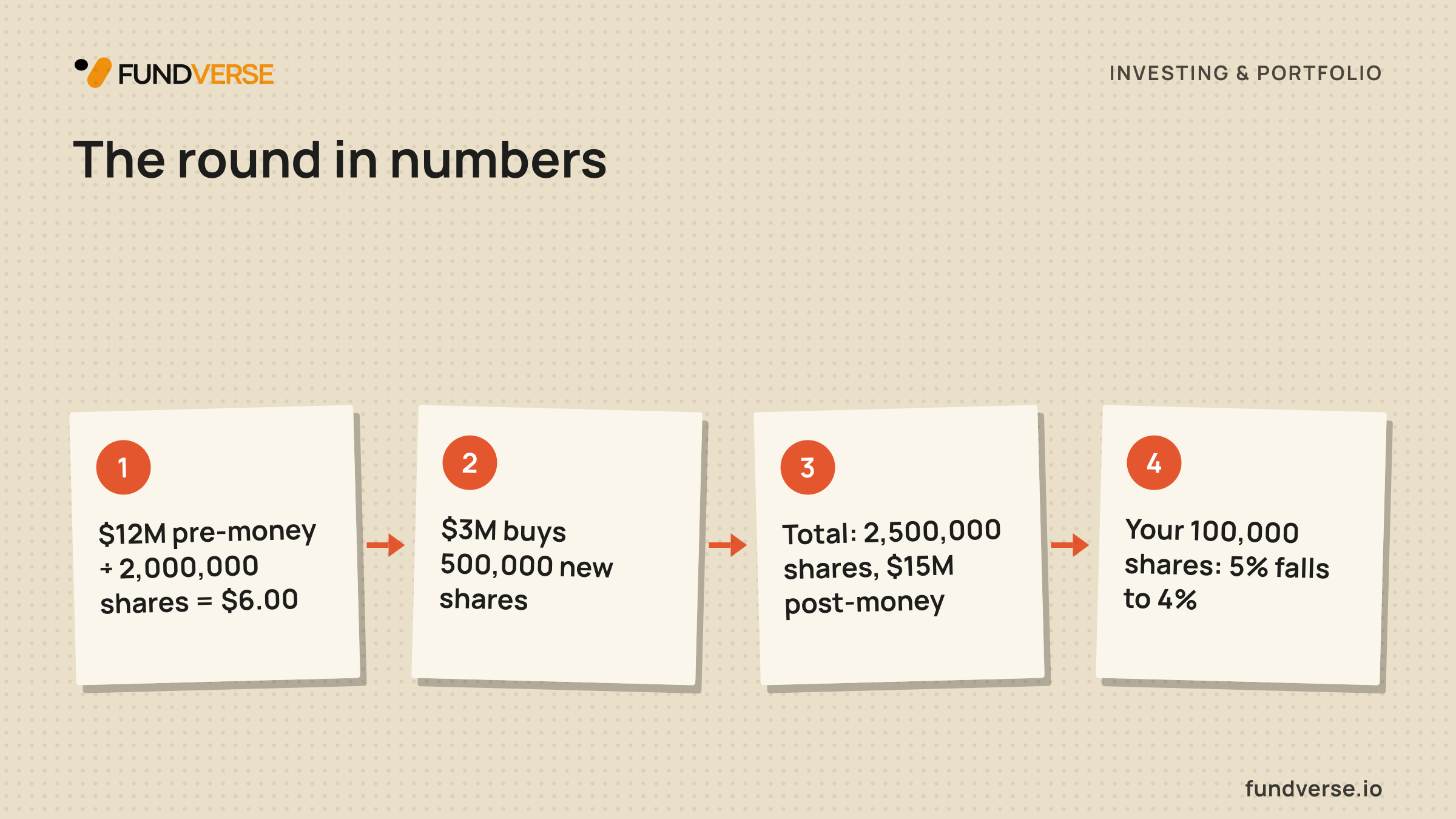
A new lead proposes to invest $3 million at a $12 million pre-money valuation, which is the value agreed for the company before the new cash goes in. Dividing $12 million by the 2,000,000 existing shares gives a new price of $6.00 a share. At that price, $3 million buys 500,000 new shares. The company now has 2,500,000 shares and a post-money valuation of $15 million. Your 100,000 shares are now 4% of the company, down from 5%.
Why the value can still rise
Value the same holding at the new price: 100,000 shares at $6.00 is $600,000, double the earlier mark. Your stake's value rose while your percentage fell, because a smaller slice of a more valuable company can be worth more than a larger slice of a less valuable one. That is the normal shape of a healthy round.
One thing to ask about is the employee option pool, the block of shares set aside for current and future staff. Leads often want it enlarged before they invest. If that increase is counted inside the pre-money valuation, it is carved out of the existing holders' side and not the new investors', so the same headline price can leave you with noticeably less than the simple math above suggests.
3. The new price resets your holding
The price per share in the round becomes the new value of your stake. If it is higher than what earlier investors paid, the round is an up round. If it is about the same, it is flat. If it is lower, it is a down round. In our example the price doubled, so the paper value of your holding did too.
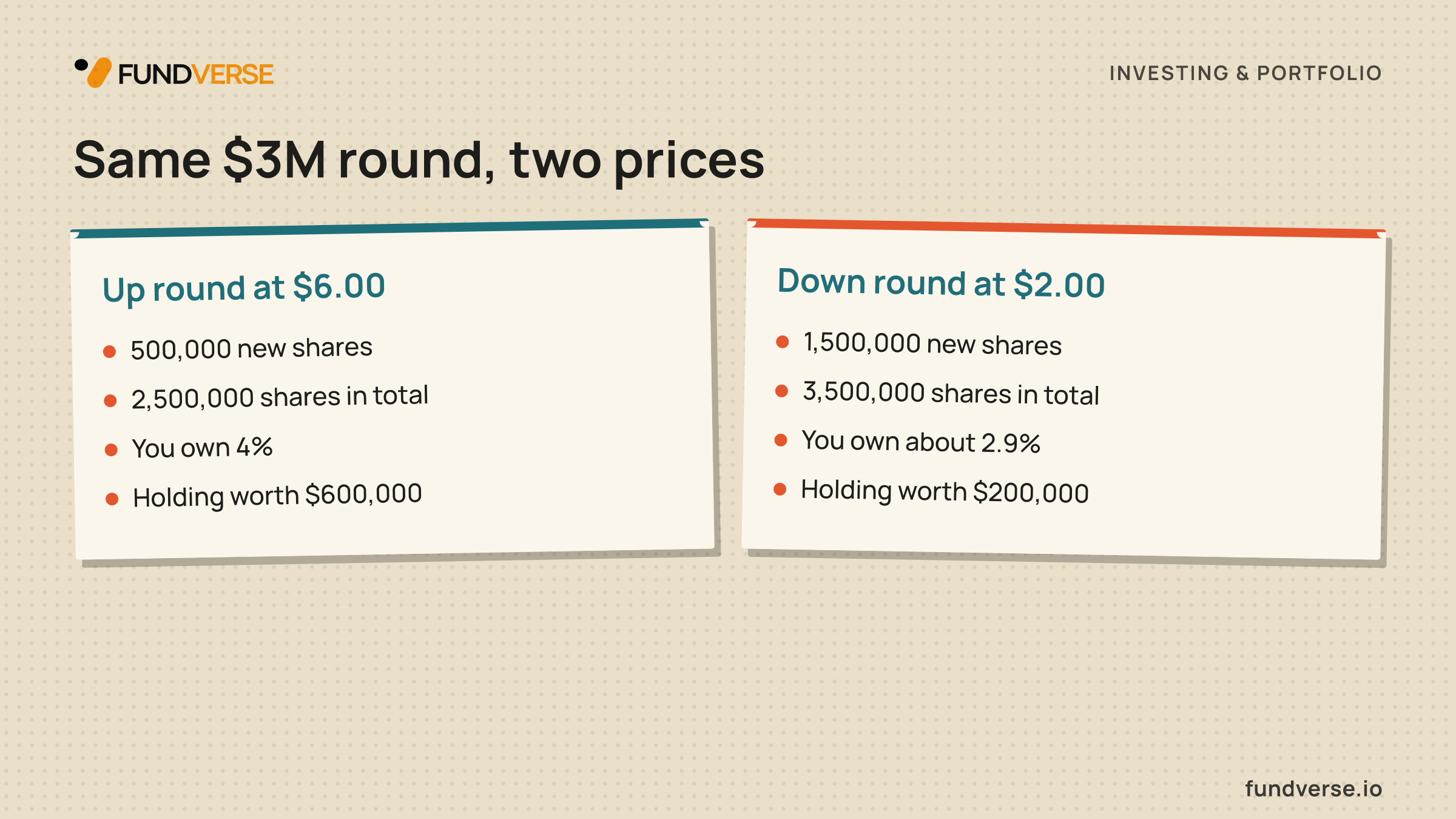
In a flat round your percentage still falls, but the value per share stays where it was. A down round hurts twice. Suppose the new price were $2.00 against the earlier $3.00. Your 100,000 shares would be marked at $200,000. And because the same $3 million now buys 1,500,000 new shares instead of 500,000, the company would have 3,500,000 shares and your 100,000 would be about 2.9%, a much bigger drop than the 4% in the $6.00 case.
A higher price is also not automatically good news. It raises the bar the company has to clear to justify its next round, and it sometimes comes with heavier terms elsewhere, as the next section shows. And the mark is only a paper value. It turns into cash when shares are sold, which for most early holdings means an exit or a secondary sale the company permits.
What anti-dilution protection does
Anti-dilution protection is a contractual right, usually attached to preferred shares, that adjusts the price at which those shares convert into ordinary shares if a later round is priced lower. After the adjustment each preferred share converts into more ordinary shares, which offsets part of the loss. The common form, broad-based weighted average, softens the blow in proportion to how many shares are issued at the lower price. A full ratchet, which is rarer and more aggressive, resets the conversion price to the new low price outright. If you hold ordinary shares, a note or a simple SAFE, you probably have none of this, so check which kind of share you actually own. It only matters in a down round.
4. New shares may rank above yours
Price is only one thing a lead negotiates. The other is how the new shares are paid when the company is sold or wound up. A liquidation preference says that holders of certain shares get a set amount first, before the proceeds are shared among everyone else. A common version is 1x non-participating: the new investors take back the money they put in or, if it would give them more, convert to ordinary shares and share like everyone else. In the example round, the $3 million investors would own 20% of the company ($3 million of $15 million). If it were sold for $10 million, they would take their $3 million first, leaving $7 million for everyone else. In a sale at $100 million, converting would give them $20 million, more than their $3 million back, so they would convert and the preference would not matter.
Seniority is the order in which preferred shares are paid. Often the newest shares rank ahead of earlier ones, though some rounds treat all preferred shares equally (pari passu). Participating preferences, where the holder takes the preference and then also shares in what remains, are less common but make the stack heavier. Ranking matters in modest sales, and hardly at all in large ones. So a higher price paired with heavy terms can leave existing holders no better off at a small exit than a lower price with clean terms would.
If you hold a note or SAFE
A convertible note or SAFE is not yet shares. It is a right to receive shares when a priced round happens, so the new lead's round is the event that turns your money into equity. It converts at a price set by the round, usually reduced by a discount, a valuation cap, or both, and you normally get whichever produces the lower price.
Say you hold a $50,000 SAFE with an $8 million cap and a 20% discount, and, to keep it simple, the cap is divided by the 2,000,000 existing shares. The round price is $6.00, the discount price is $4.80, and the cap price is $4.00. You get the lowest, so $50,000 buys 12,500 shares, about 0.5% of the 2,500,000 shares after the round (slightly less once your new shares are counted in the total). On a note, accrued interest usually converts as well. Real instruments differ in how they count shares in the cap, notably between older pre-money SAFEs and post-money SAFEs, and you usually receive a new series of preferred carrying the round's rights, so read yours before assuming.
5. Using the rights you have
Pro rata rights give an existing investor the option to buy a share of a new round, in proportion to current ownership, to keep their percentage. In the example you own 5% and the round is $3 million, so your allocation is $150,000. That buys 25,000 new shares at $6.00 and leaves you with 125,000 of 2,525,000 shares, just under 5%. (Rounds are often sized so allocations fit inside the total, in which case you would hold exactly 5%.) It is an option, not an obligation, and it is a fresh investment at the new price and on the new terms, so judge it as you would any new deal. Pro rata rights usually exist only if your documents grant them, sometimes only above a minimum holding, they come with a response deadline, and a lead can squeeze allocations when the round is in demand.
Start with your own paperwork: the share certificate or instrument, the investment agreement and any side letter. Look for pro rata, information rights, consent rights over new share classes, anti-dilution and the conversion mechanics of your instrument. Then ask the company, with the same habit of checking claims that goes into verifying a company before you invest. Reasonable questions to put to a founder before closing:
- Is a term sheet signed, and what are the valuation, round size and any option pool increase?
- Will the new shares be preferred, and where do they rank against mine?
- What liquidation preference do they carry, and is it participating?
- Does my pro rata right apply, and by what date must I respond?
- If I hold a note or SAFE, how many shares will it convert into?
- Does this round need my consent or a shareholder vote?
- Can I see the cap table before and after the round?
Rights vary by country and by what was actually signed. Statutory pre-emption, shareholder approval rules and the treatment of preferred shares and convertible instruments all differ across jurisdictions, and two investors in the same company can hold different rights. What the law and your documents guarantee is usually a short list; everything else, from the allocation you are offered to how quickly you get information, depends on goodwill and negotiation. Take legal advice on your own agreements before you decide, especially when the amount matters to you.
If you hold stakes in several startups, keeping each company's round history, rights and ownership figures in one place makes follow-on decisions like this much quicker. Fundverse's investor tools are built for tracking a portfolio that way.
When the term sheet arrives, the practical steps are to ask for the post-round cap table, work out your pro rata amount and its deadline, and have your instrument checked against the new terms. After closing, update your records with the new share count and price, and keep the new preferences in view, because they will shape how you read the company's next round.
Frequently asked questions
Topics
new lead investor follow-on round
dilution existing investors
pro rata rights
liquidation preference
anti-dilution protection
SAFE conversion priced round
down round existing investors
Raising or investing?
Find the right people on the other side of the table, and run the round in one place.