

Analyst, associate, principal and partner describe who owns a decision and who answers for it, not just seniority. See what each title does across a deal and what to verify before you rely on one.
Seniority and accountability are different things, and investment firms blur them constantly. Seniority is time served and experience. Accountability is whose name is attached to a decision when it is made, and whose judgment is questioned when it goes wrong. The titles of analyst, associate, principal and partner are best read as a ladder of the second kind, and age or years of service track it only loosely.
The distinction matters because it changes what you do with a title. A founder stops asking how senior the person across the table is and asks what that person can deliver: a fair hearing, an internal champion, a vote or a signature. A junior professional stops waiting for the next title and asks which decisions they will be trusted with next. To show where that trust sits, this article follows the work behind each title and then a single deal moving through all of them.
Why the same title shifts meaning
No regulator or professional body defines what a principal is. Each firm sets its own titles, usually to manage hiring, pay and how it looks to outsiders, so a title carries a rough ordering inside a firm and little reliable meaning between firms.
At a seed fund the team is small, and an associate may source companies, take first meetings and carry a deal a long way because nobody else is available. At a large buyout firm the same title sits inside a deep structure where the work is narrower: modeling, diligence coordination and process management on much larger transactions. At a credit fund the titles belong to people who underwrite a borrower's ability to repay, so the craft is cash-flow analysis, covenants and security rather than growth and exit. A family office may give its few staff titles borrowed from institutional firms while the real decision sits with a family member or an investment council. A development finance institution (DFI) often uses titles such as investment officer, senior investment officer and director, and its decisions move through formal approval bodies shaped by a mandate from its shareholders.
Geography adds a further layer, though practice varies by firm more than by country. US firms tend to use the four titles fairly literally, European firms often add investment manager or director, and many African and Asian funds, particularly those with development finance backers, mix institutional titles with local conventions and the reporting structures their investors require. A title is best treated as a hypothesis about someone's role, to be tested rather than assumed.
The analyst owns accuracy
An analyst is accountable for the correctness and completeness of the work. The tasks include market mapping (listing the companies and competitors in a sector so the team knows what exists), first-pass screening against the fund's criteria, building and checking financial models, assembling diligence materials such as customer data, contracts and financial statements, and drafting sections of the investment memo. The analyst answers for whether numbers tie, whether sources are real and whether anything material was missed.
What is not yet expected is a verdict the firm acts on. Good analysts form a view and say it, but the view is an input, because nobody relies on an analyst's judgment alone to commit capital. That is exactly why the accuracy of the inputs carries so much weight.
How analyst work shapes the deal
Everyone later in the process builds on the earliest work. A screening summary that frames a company as a crowded, low-margin business may mean it never reaches a partner, whatever its merits. A summary that overlooks weak unit economics can instead send a team through weeks of diligence before the flaw surfaces. A model error is worse. If a formula double counts revenue or mishandles a debt schedule, the whole case looks better or worse than it is, and the mistake tends to be found after the firm has grown attached to the deal.
The practical lesson for founders is that the analyst reading your materials is often the first filter. Clear, consistent numbers are not a courtesy to the analyst; they are what keeps your company in the pipeline.
The associate owns the workstreams
An associate is accountable for pieces of a live deal, not only pieces of a document. In due diligence the associate owns workstreams such as financial, commercial or legal review, manages outside advisers like accountants and lawyers, and runs the data room, the secure repository where a company shares its documents. The associate also runs the financial model end to end, writes the investment memo the committee will read, and is usually the company's day-to-day contact. When a founder needs an answer on timing or a missing document, this is the person who gives it.
The change from analyst is that errors now have owners. If a diligence area is missed, the associate who held that workstream answers for it. Judgment is still bounded: associates propose conclusions on their workstream, and someone more senior decides what the firm makes of them.
Sourcing-led and execution-led firms
Execution means the work of turning interest in a company into a closed investment: diligence, negotiating documents, coordinating advisers and getting through approvals. In an execution-led firm, common in larger buyout and credit shops, associates spend most of their time on that machinery and rarely meet companies before a deal is live. In a sourcing-led firm, common in early-stage venture, associates may attend events, build relationships with founders and bring in companies the partners later pursue. The same title therefore tests different skills: process discipline in one case, curiosity and network in the other.
The principal runs the deal
Principal, vice president and, in some firms, director describe the level at which a person leads deals. The principal manages the relationship with the company, forms a recommendation, supervises analysts and associates, and begins to own origination (finding deals) and a share of the portfolio after investment. Accountability now attaches to the recommendation itself: if a principal brings forward a weak case, that is a failure of judgment, not of work quality.
Founders often miss a distinction here. Running a deal is not the same as having authority to approve one. Principals frequently champion deals with real passion and still cannot commit capital. Their power is persuasion: they frame the opportunity, answer the committee's questions and lend the credibility of their track record. The vote and the signature sit higher up. A principal who says the firm is keen is voicing personal conviction, quite possibly sincere, but the firm has not yet spoken.
The partner answers for the outcome
Partner and managing director are the titles where authority to commit capital normally sits. Partners vote at the investment committee, answer for the fund's overall performance, hold the relationships with limited partners (the pension funds, endowments, family offices and other investors who supply the fund's capital), take board seats in portfolio companies and lead fundraising for the next fund. When an investment fails, the partner explains it to those limited partners and carries the reputational cost into the next raise.
Equity partners and salaried partners
Two people can hold the partner title and sit in very different positions. An equity partner shares in the firm's economics, including the profit share on its funds, and usually has a say in firm-level decisions. A non-equity or salaried partner has the title and often senior duties but is paid mainly through salary and bonus, with little or no ownership. Equity partners typically hold the votes that matter most and bear the most direct financial consequence of a bad call, so a salaried partner's real authority may be narrower than the title suggests. Arrangements vary by firm, which makes it a fair question to ask.
Carried interest and responsibility
The mechanism behind that difference is carried interest, the share of a fund's profits that goes to the investment team. A simple illustration, with assumptions shown: suppose a fund returns investors' capital plus $50 million of profit, and its terms give the team 20% of profit once investors have their capital back. The team's carry pool is $10 million, shared among the people the firm designates, in proportions the firm sets. Many funds also require a minimum return to investors before carry is paid, and terms differ widely.
Carry pays out years after investments are made and only if the portfolio performs. Junior staff therefore earn mostly salary and bonus, and a larger share of pay comes from carry as people rise. The structure ties reward to responsibility: the people who vote and answer for the fund's results are the ones whose wealth depends on them. What any individual receives depends on that firm's arrangements, not on the title.
One deal, four sets of hands
Take a typical deal in a generic fund. It begins with sourcing: a company arrives through a referral, an event or outbound search. Partners and principals usually hold the relationships that produce the best referrals, while analysts and associates widen the net by mapping the market and tracking companies. Screening follows. An analyst or associate checks the company against the fund's mandate and writes a short summary, and whoever decides it merits a meeting, often a principal, owns that call.
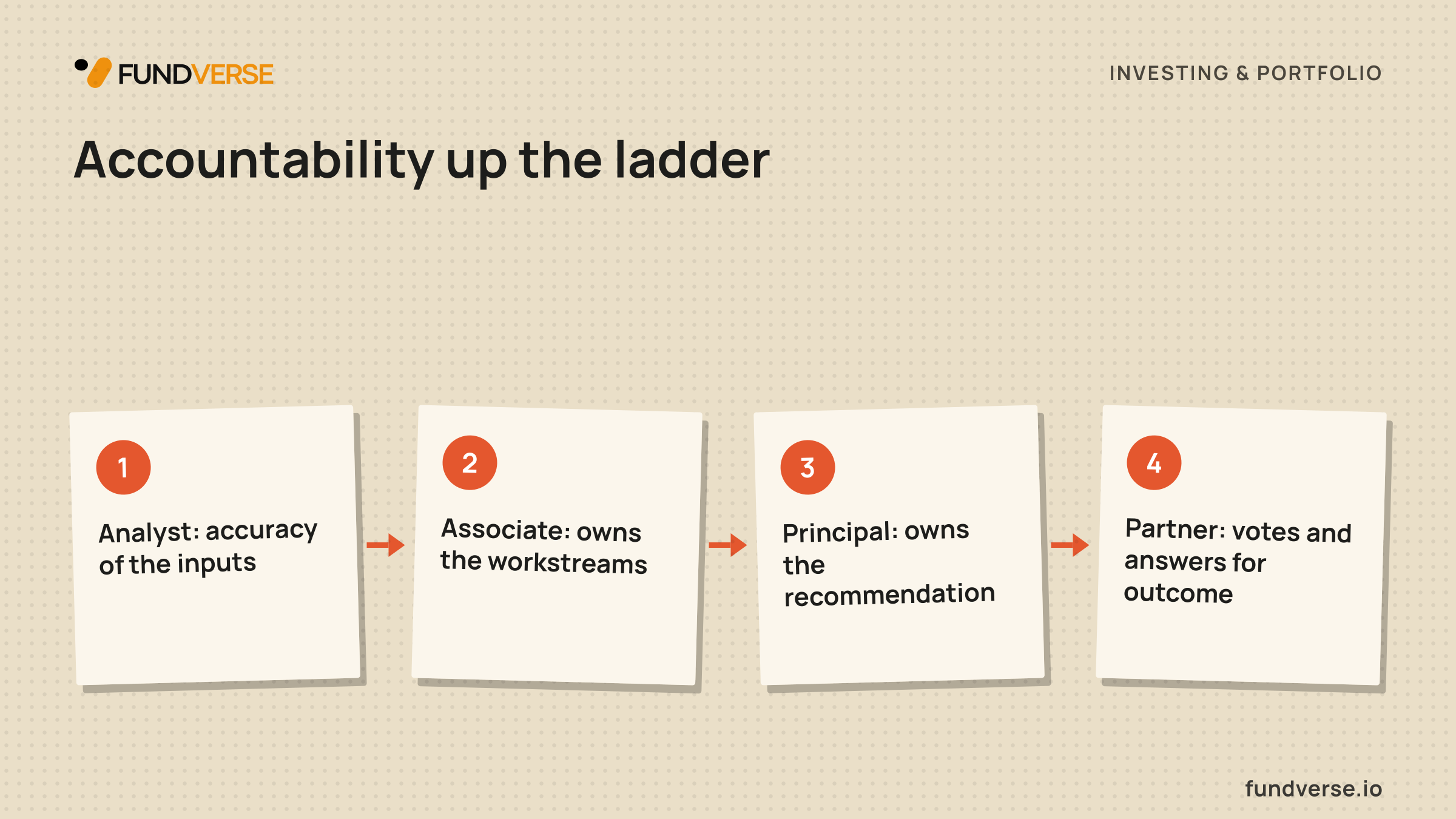
If the company progresses, a principal takes the lead and an associate becomes the day-to-day contact. Diligence splits into workstreams: the associate owns the model and the data room, the analyst builds supporting analysis, and outside advisers report to the associate. The principal forms a recommendation and the associate writes it up in the memo. At committee, a partner or group of partners votes, usually after questioning the principal. The outcome may be to approve, decline or ask for more work, and approval can be conditional on terms or further checks. After closing, ownership shifts again: a partner often takes the board seat, the principal manages the relationship, and the associate and analyst track reporting, covenants or milestones against what the memo promised.
Every stage has a named owner and a person who answers for it. When a deal stalls, the cause is often that ownership at one stage was unclear: nobody was driving diligence, or nobody was willing to champion the recommendation at committee. For the full sequence inside a venture firm, see From Deal Submission to Investment Decision Inside a Venture Capital Firm.
How the ladder shifts by fund type
That sequence holds in outline, but the approving body and its priorities change. In debt and credit funds the approving body is typically a credit committee, and the central judgment is whether a borrower can repay, under what covenants and with what security. A credit principal's recommendation is therefore about downside protection, and a partner's vote is about whether the risk fits the fund's strategy. In buyout firms the deals are large and the investment committee formal; the associate's role is heavy on modeling and process, and approvals are often staged, with an early approval to spend money on diligence and a final one to sign. In venture, the committee can be a single partner meeting or an informal vote, and in a small fund one partner may hold effective authority.
Development finance institutions add mandate constraints. An investment officer may do much of what a principal does elsewhere, but approval flows through internal committees and, for larger transactions, a board, and the deal must fit the institution's development objectives, country limits and policies. A sponsor dealing with a DFI should expect a longer path, more documentation on impact and compliance, and a clear separation between the person who works the deal and the bodies that approve it. Family offices vary most: some run institutional-style committees, while others are effectively decided by one or two family members whatever the team is called.
How founders should read titles
With that map in hand, the practical test for any person you meet is two questions: can they champion my deal internally, and can they vote on it? An analyst or associate can be a valuable ally who makes your materials easier to understand, but a warm relationship with them is not a partner's conviction. Conviction exists when someone with a vote has examined the case and is prepared to defend it against colleagues' objections. Early friendliness often reflects how pleasant the junior team is, not how the committee will decide.
A few direct questions tend to surface the truth without causing offense:
- Who will present this to the investment committee, and who sits on it?
- Does approval require a vote of all partners, a majority, or a specific person?
- What has to be true before you take this forward, and what would stop it?
- What happens between this meeting and a term sheet, and in what order?
- Is there a preliminary approval before diligence and a final one before closing?
- Who will be my day-to-day contact once diligence starts?
Good investors answer these plainly. Evasion is information too, though not always bad news: some funds genuinely lack a fixed process, and learning that early helps you plan time and runway. If the process is dragging, this piece on rounds that take too long covers the cash implications.
Why relationships should span the ladder
The temptation, once you know where the vote sits, is to chase the most senior name. As a default, resist it. The associate and principal do the work that makes a partner's decision possible, and they will face questions in committee, so a founder who has made their job easy gives them better answers to carry. Relationships across the team also protect you if one champion leaves or changes focus, and they give a more accurate picture of the firm's real interest.
Going straight to a partner helps when that partner holds the relationship for your sector, when you have a narrow question only they can answer, such as whether the deal fits the mandate, or when a process has stalled for no stated reason. It backfires when it bypasses the person running the deal and makes them look unaware of their own pipeline, or when it asks for a commitment the partner cannot give on the spot. Keeping the deal lead informed that you are speaking to a partner, and why, usually avoids both problems.
What each rung tests in a career
For early-career professionals, the same ladder reads as a sequence of tests. Analysts are tested on technical accuracy and reliability: do the numbers hold, is the work complete, can others build on it without rechecking everything. Associates are tested on deal ownership: can they keep a process moving, manage advisers and founders, and deliver a memo that stands up. Principals are tested on judgment, meaning a record of sound recommendations, along with the ability to develop juniors. Partners are tested on origination and outcomes: do they bring in deals others cannot, and does the portfolio perform.
What usually separates promotion from stagnation is whether someone has begun doing the next rung's work before holding its title. An analyst who spots the flaw in a thesis and says so clearly, or an associate who frames a recommendation instead of just compiling facts, shows the firm how they would carry the next level of accountability. Staying in the technical comfort zone, however polished, tends to hold people where they are. Timing also depends on how many senior seats a firm has, so a delay is not always a verdict on performance.
Titles that mislead
Careers and counterparties both run into the same misreadings. Small firms sometimes hand out inflated titles such as partner or managing director to attract people or impress counterparties; the person may be capable, but the title does not show they can commit capital. Venture partner, platform partner, operating partner and similar roles usually involve helping portfolio companies or sourcing deals, often part-time, and frequently carry no committee vote. Advisory titles such as senior advisor are valuable for access and credibility and generally carry no authority over investments. None of these roles is lesser; they do different work, and the error is assuming they hold a full partner's decision rights. In every case, the check is the same: ask what the person votes on, what they sign and what they answer for to the fund's investors.
Recording ownership at each stage
Investment teams can reduce the ambiguity that frustrates founders and juniors alike by writing down role definitions: who may screen out a deal, who owns each diligence workstream, who presents at committee, who votes, and who owns the company relationship after closing. A deal pipeline tool helps keep that record visible, so each deal shows its stage, its owner and its next decision. It supports the people accountable for decisions; it does not replace their judgment.
If your team tracks deals across scattered spreadsheets and inboxes, Fundverse's investment pipeline management can show the owner and stage of every deal in one place.
Judge the process, not the chart
An org chart tells you what a firm calls its people. The decision process tells you how it allocates capital: who finds deals, who tests them, who argues for them, who votes and who answers when they fail. Two firms with identical charts can differ completely on those points, and a firm with a flat chart can be rigorous about every one.
So the sensible way to evaluate an investment team, whether you are raising from it, lending alongside it or thinking of joining it, starts with accountability. Whose judgment is relied on at each stage, and what happens to that person when they are wrong? Think about the next team you meet or the next role you consider: if you had to name the one person who would stand up in committee and answer for the decision, could you do it today?
Frequently asked questions
Topics
analyst associate principal partner
investment firm titles
venture capital roles
who makes investment decisions
investment committee
carried interest
private equity career path
how to read investor titles
Raising or investing?
Find the right people on the other side of the table, and run the round in one place.