
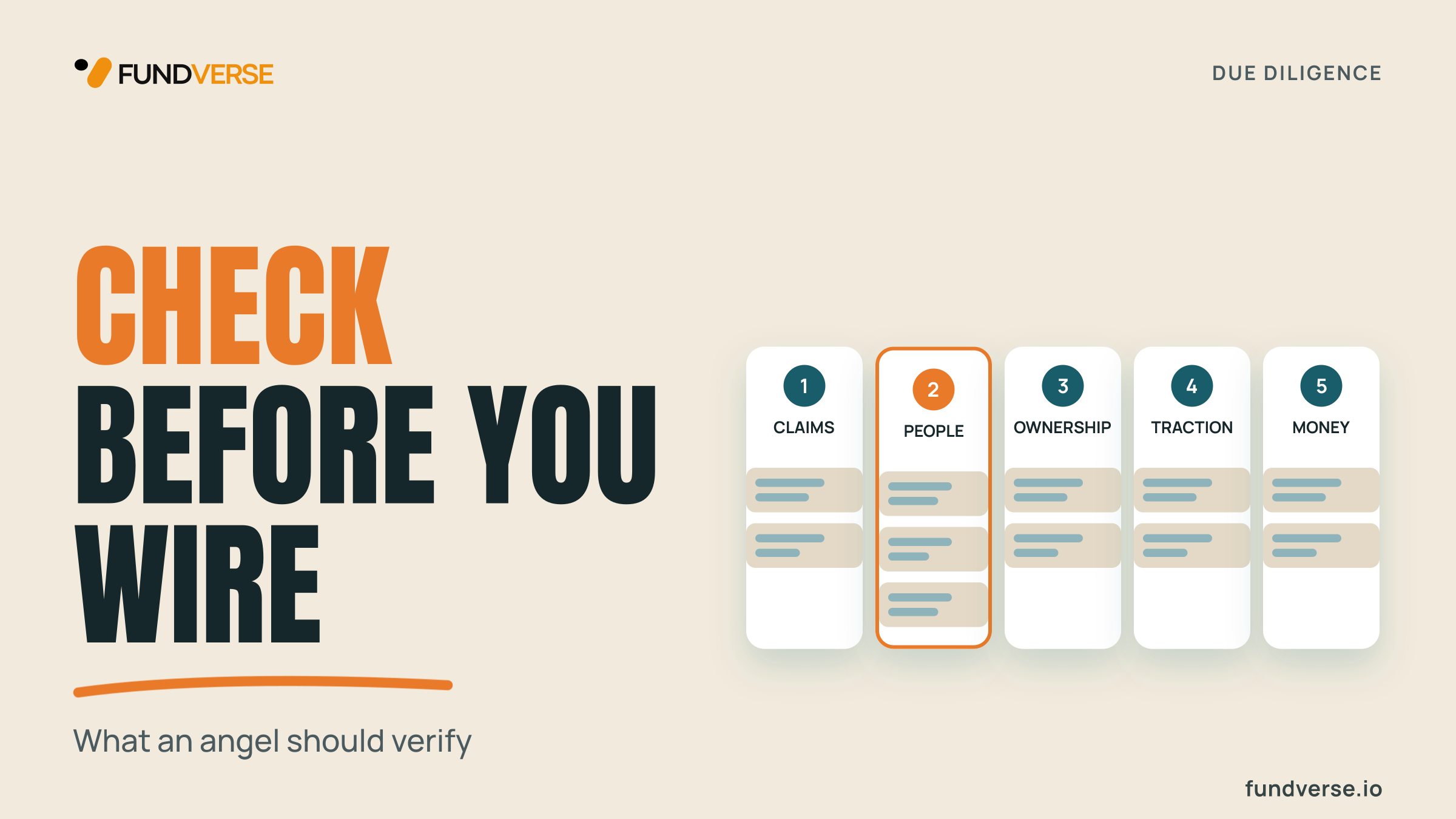

A polished pitch is a set of claims. Here is how an angel investor without analysts can check the few facts that matter, covering people, ownership, traction, cash and terms, before sending money.
A pitch is a set of beliefs. The founder believes the market is large, the team is the right one, the customers are happy and the money will last. Some of those beliefs are facts nobody has checked yet, and others are predictions nobody can check. Due diligence is the work of telling the two apart and confirming the first kind before any money moves.
Institutions do this with analysts, lawyers and accountants. An angel writing a check alone, with a few free evenings, can't copy that and doesn't need to. A handful of checks, each aimed at a claim that would change the decision if it were false, catches most of what goes wrong. The order below is the one that tends to work, and each step says what a bad answer looks like.
Sort the claims first
Read the deck once with a pen and mark every sentence that states something as true: "we have 40 paying customers", "the two founders own 80 percent", "we have 14 months of cash", "we own the technology". Skip the adjectives. What remains is a list of claims, and each is a fact about the past, a fact about the present, or a forecast.
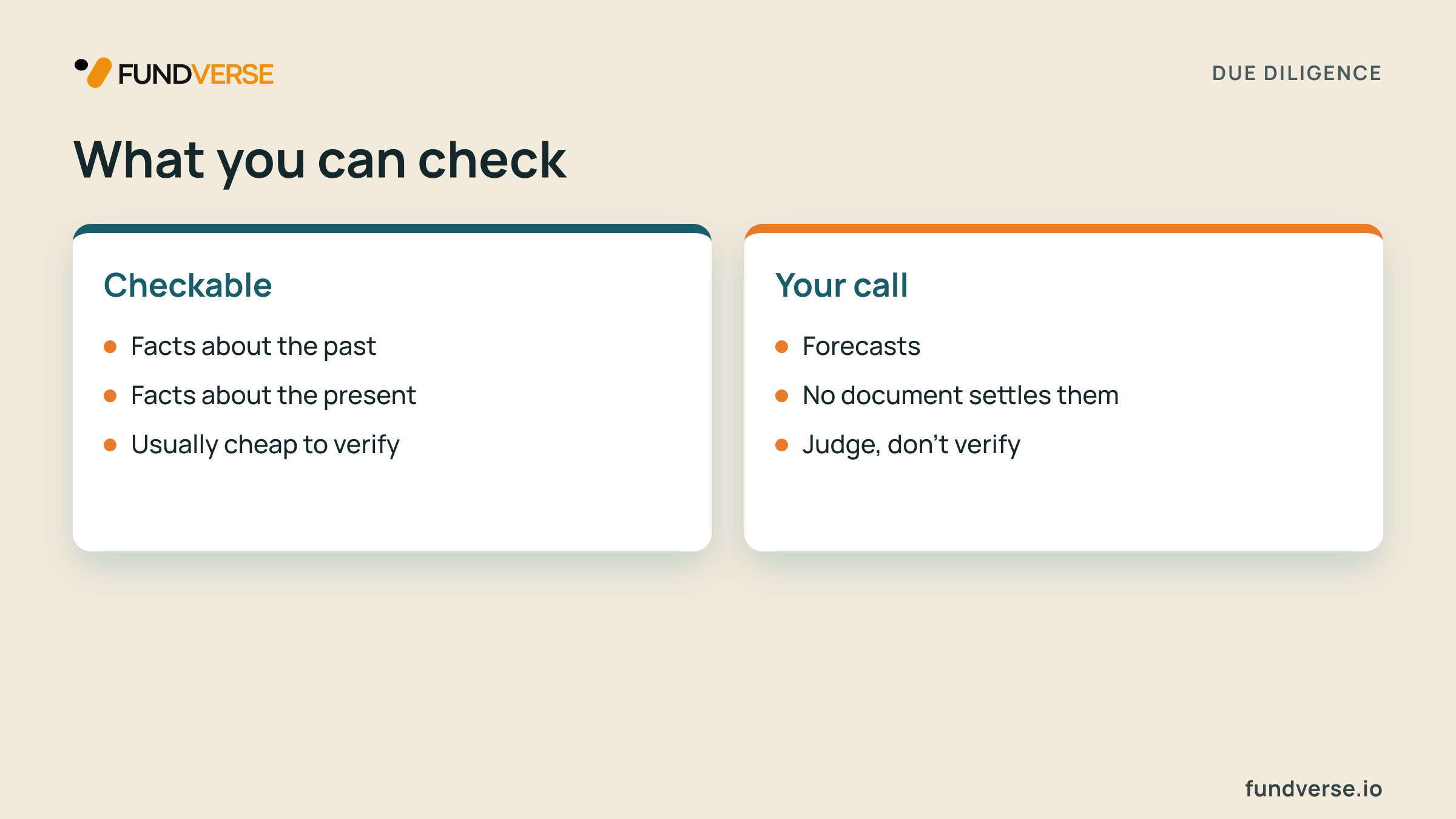
The first two can be checked, usually cheaply. Forecasts can't. Whether a market will emerge, whether customers will keep choosing the product, whether the team will still get along in three years: no document settles these, and they are your call. Holding that line keeps you from spending evenings trying to verify something unverifiable, and from mistaking a confident forecast for a confirmed fact.
Of the checkable claims, pick the ones the investment rests on, meaning the ones that would make you walk away if false. If the story is proven demand, traction deserves the hardest test. If it is a technical product with no revenue yet, the ownership of the technology matters most. In a young company the list almost always starts with the people, because there is little else to examine.
Check the people
At seed stage you are backing a few individuals more than a business. Checking them means confirming that they are who they say, that their experience is what the deck implies, and that they are committed to this company.
Reference calls, including back-channel ones
Start with the profile claims. A founder who says they led an engineering team at a previous employer can be checked through a professional network profile, a mutual contact or a short call with someone who worked with them. You are testing a specific claim: did they lead, what did they build, and would that person work with them again?
The references a founder offers are the people most likely to speak well, so treat those calls as a first pass. A back-channel reference is a call to someone the founder did not name: a former colleague, an earlier investor, a past customer, or a person you know who knows them. Be discreet, and be honest that it is diligence if asked. A bad answer is not always a negative story. Vague praise, hesitation when you ask how they handle disagreement, or "I only worked with them briefly" about someone presented as a long-time collaborator are all reasons to ask more.
Full-time commitment and identity
Ask each founder whether this is their only job, and listen to how they answer. A co-founder who is still employed elsewhere "until the round closes" is a risk to weigh in your decision, and you can often see it yourself if their professional profile still lists the old employer. Also confirm that the people in the deck are the people you met and that they appear in the company's records as directors or shareholders. A name in the pitch that appears nowhere in the company's paperwork needs an explanation.
Check who owns what
Once you are comfortable with the people, the next question is what you would be buying. Your return depends on the share of the company your money becomes, and that depends on who else already has a claim.
The cap table against the registry
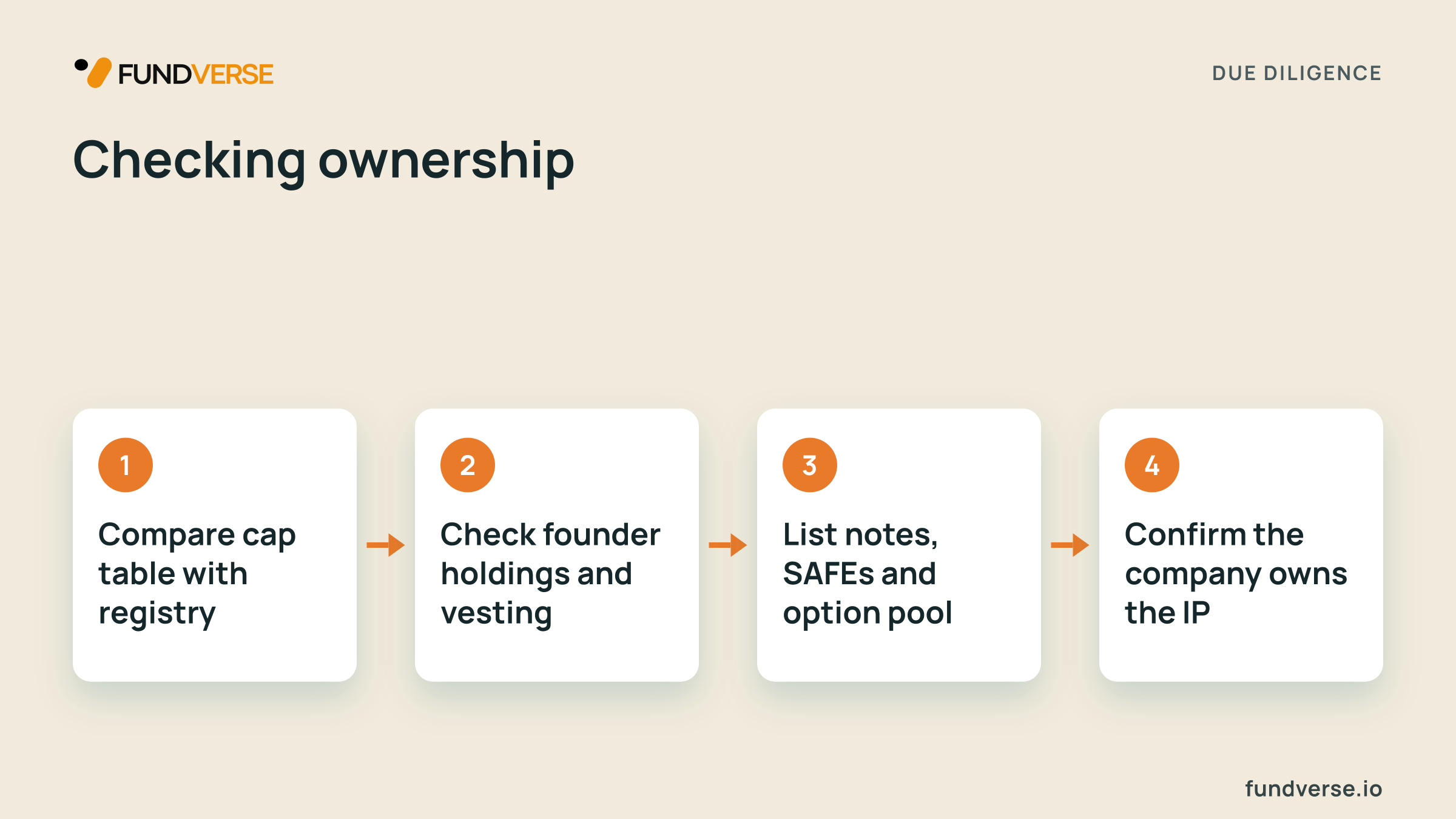
The cap table is the list of who owns how many shares. Founders usually send it as a spreadsheet, and a spreadsheet is only a claim. Where the country has a company registry, look the company up yourself: its registered name, directors, incorporation date and, often, its share capital or shareholders. In many markets this is public or available for a small fee, though how much detail it shows varies a great deal. Compare the registry with the spreadsheet. If the registry shows two shareholders and the cap table shows five, or the company is registered under a different name or in a different country than the pitch implied, ask why before going further.
Then look at the founders' own holdings. One founder holding most of the shares and the others very little may be fine, or may be a retention problem. Ask whether the founders' shares vest, meaning they are earned over time, so that a founder who leaves in six months does not keep a large stake in a company they no longer work for.
Dilution waiting in notes and SAFEs
A cap table can look clean and still hide future dilution. A convertible note is a loan that converts into shares at a later funding round, and a SAFE is a similar promise of future shares that is not a loan. Neither shows up as shares today. Suppose earlier investors put in money on terms that convert at a discount to the next round's price. When that round happens they receive more shares than their cash alone would buy, and everyone else, you included, owns a smaller slice. An option pool, shares set aside for future employees, works the same way.
So ask for every instrument the company has issued or promised, with amounts and terms, and for the size of the option pool. A good answer is a short list the founder can produce in one email. A bad answer is "a couple of friends put in a bit" with no paperwork behind it.
The IP and the name
Finally, confirm that the company, not an individual, owns what it claims to own. If a founder built the product before the company existed, or a freelancer wrote part of it, the code may still belong to that person unless something in writing moved it to the company. Ask who wrote the core product and whether a signed assignment, or an employment or contractor agreement, covers it. Search the company name and domain in the relevant trademark register and on the web to see whether another business already uses it. What counts as proof of ownership varies by country, so this is a good place for a short professional opinion.
Test the traction
With ownership clear, you can look at what the company says it has achieved. Revenue and user numbers are the claims most often rounded upward, sometimes innocently: a "customer" who only signed a pilot, "revenue" that is really invoices sent but not yet paid, "users" that counts every sign-up ever made.
The test is to follow the money. Ask for the business bank statements for the last several months, or the payment processor dashboard if customers pay by card or online. Money that arrived should show up in one of them. Then ask for a few invoices and match each to a deposit. As an illustration of how this works, say the deck claims recurring revenue of 20,000 a month, but deposits average 12,000. The founder explains that the rest comes from annual contracts billed in advance last quarter. That may be true, but 20,000 is then an average of cash collected earlier, not a current monthly run rate, and you should know which of the two you are paying for.
Also ask what share of revenue comes from the largest customer. If one customer is most of the revenue, losing them changes the company, and revenue from related parties, one-off projects or heavy discounts reads differently once you see it.
Then speak to one or two real customers. Take the founder's introductions, and if you can, find one they did not suggest. Three questions are enough: what problem were you solving, what would happen if you stopped using it, and what do you pay? A customer who says "we'd be annoyed if it disappeared" is stronger evidence than any chart. One who struggles to say what the product does is telling you about retention before the numbers show it.
Read the money
Traction shows what the company earns. The next step is what it spends and what your check will do. The same bank statements give you most of the answer.
Start with the current balance and the burn, the net cash the company loses each month. Look at the last three to six months and see what actually left the account, not what the budget says. Divide the balance by the monthly burn and you have runway in months. With a balance of 90,000 and losses of 15,000 a month, the company has about six months, whatever the deck says about a "long runway".
Then ask what is owed. Loans, overdrafts, unpaid taxes, salaries owed to founders and money promised to suppliers all claim cash before you see any benefit. If a founder loan will be repaid out of your check, part of your money goes straight back out. Ask for a written list of debts and obligations, and whether any lender has security over the company's assets.
Finally, confirm the use of funds. Ask the founder to say in a few lines what the money will pay for and what the company will have achieved when it is spent. Then add your check and the rest of the round to the balance and divide by the expected burn after any hiring. If the round runs out before the company can show something new, it will have to raise again on weak terms, and you want to know that before you invest.
Read the terms against the pitch
The documents are where the pitch becomes a contract. What the founder said in the room carries little weight until it is written down, and what the documents say is what you actually own. Read the investment agreement, whether it is a share subscription, a convertible note or a SAFE, with one question in mind: does this match what I was told?
Check the amount, the price or valuation cap, the discount if there is one, and the percentage of the company you expect to own. If you were told two percent and the document's arithmetic gives less, find out why. Then look at your rights: information rights, which entitle you to regular updates and accounts; any preference over other shareholders if the company is sold or closed; and what happens to your stake when new shares are issued. Small checks often come with few rights, and that is normal, but you should know what you have and what you lack.
Mismatches are the signal. Simple terms in the pitch and unusual conditions in the paperwork, extra preferences for other investors, or a company name different from the one you found at the registry all deserve a pause. Founders sometimes use a template without reading it closely, so ask first. A document that quietly differs from the pitch in the founder's favor, together with reluctance to discuss it, tells you how the founder may treat you after the money is in.
Match the effort to the check
None of this needs full depth every time. Effort should grow with the size of the check and with how much of the company's story rests on a claim. For a small check the core is quick: confirm identities and the registry, get the full list of notes and SAFEs, read the bank statements, speak to one customer and one back-channel reference, and read the document yourself. That is a few evenings of work. For a larger check, or when you lead the round, each step deserves more depth.
Pay a professional when a specific fact would be costly to get wrong and is hard for you to judge. A lawyer earns the fee when terms are unusual, when IP ownership is unclear, when the company operates across borders, or when the check is large relative to your wealth. An accountant helps when the bank statements and the company's accounts do not reconcile and you can't see why. Ask for a defined task and a quoted price rather than a general review.
Practice also varies by country. Company registries differ in what they publish and how easy they are to search. Rules on investor protection, who may invest, what counts as a valid transfer of IP and how convertible instruments are treated are not the same everywhere. Treat this article as a guide to what to ask, and take advice from a local professional on the specifics where the company is based.
If you review deals regularly, Fundverse gives investors one place to keep deal documents, notes and follow-up questions for each company in your pipeline, so the checks above are recorded alongside the deal.
Some risks you can only accept
A company that passes every check can still fail. Diligence tells you the founders are who they say, you will own what you were promised, the revenue is real and the cash will last as long as claimed. It can't tell you whether the market will arrive, whether customers will keep choosing the product or whether the team will cope when things go badly. Those are forecasts, and your own judgment is the only tool for them.
So the aim of the work is not to remove risk but to make sure the risk you take is the one you meant to take, the bet on the future, and not a hidden one about a share count or a bank balance. Once the facts check out, the decision that remains is yours, and you can make it knowing what you are betting on.
Frequently asked questions
Topics
angel investor due diligence
what to verify before investing
startup due diligence checklist
cap table verification
reference calls founders
verify startup traction
SAFE dilution
angel investing
Raising or investing?
Find the right people on the other side of the table, and run the round in one place.