
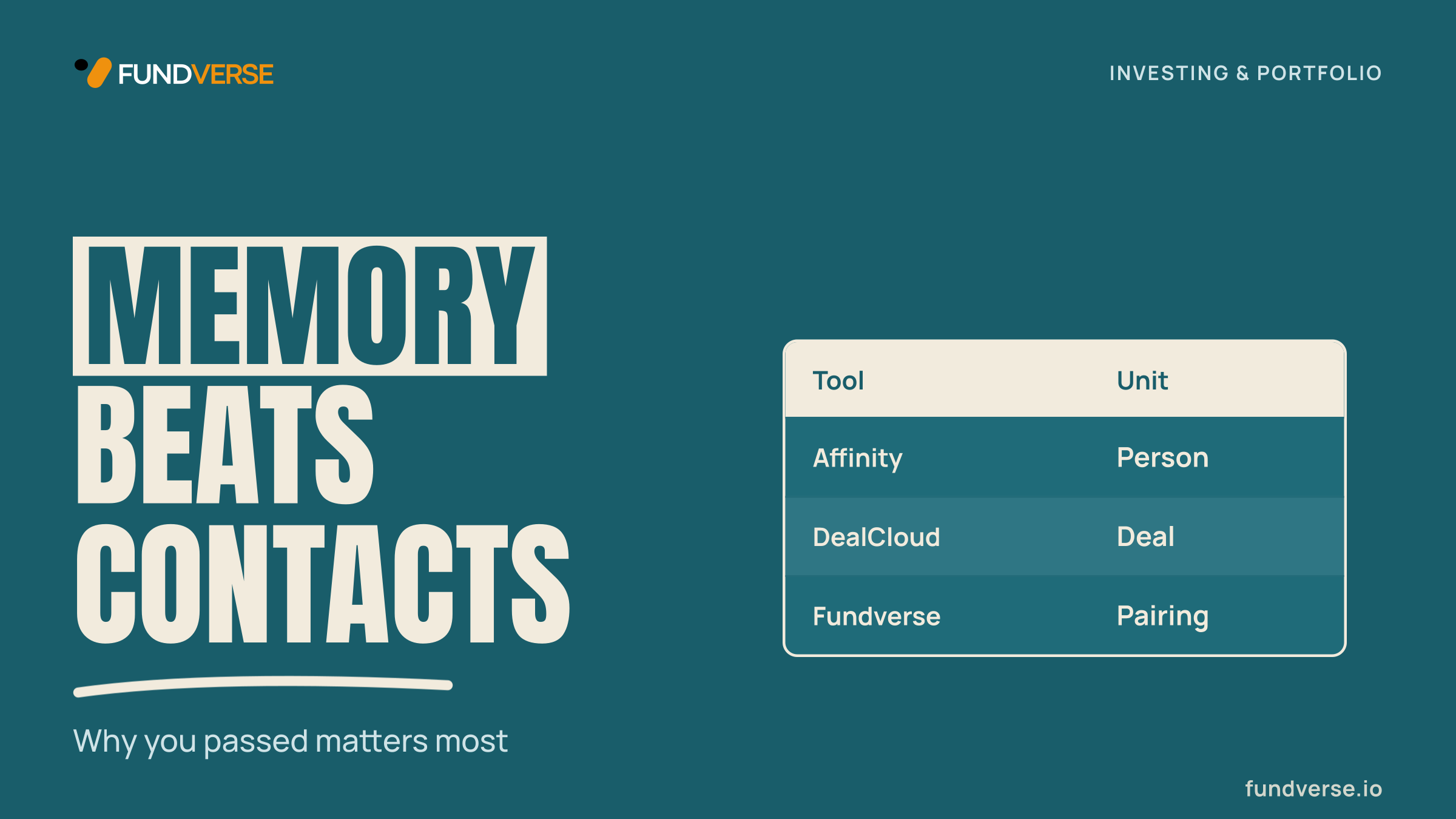

Affinity, DealCloud and Fundverse each assume a different kind of capital relationship. Which fits depends on where your firm's memory breaks down, not on who has the longer feature list.
Most investment firms can tell you who their partners know. Far fewer can tell you why they passed on a company three years ago, what would have changed their mind, and who inside the firm held that view. The first kind of knowledge sits comfortably in a contact database. The second lives in people's heads, in scattered notes, and in the half-remembered end of a Tuesday meeting.
That gap is why choosing a system for capital relationships is harder than choosing an ordinary CRM. Affinity, DealCloud and Fundverse are often mentioned together, but they answer a basic question differently: what is a relationship, in this business? A network to be mapped, a process to be governed, or an exchange between two sides that each have something to offer. The right tool follows from where your firm's memory fails, and a feature checklist will not reveal that.
Three theories of a relationship
Affinity is best understood as relationship intelligence. Its premise is that the raw material of a relationship is already being generated: every email sent, every calendar invite accepted, every thread a partner forgot about. A tool that reads that exhaust can build a picture of who knows whom, how recently and how strongly, without anyone typing anything in. For a firm whose edge is access, that is an attractive idea. The unit of the system is the person and the connection between people. How much it captures and enriches depends on the plan and changes over time, so test it against your own inboxes before trusting it.
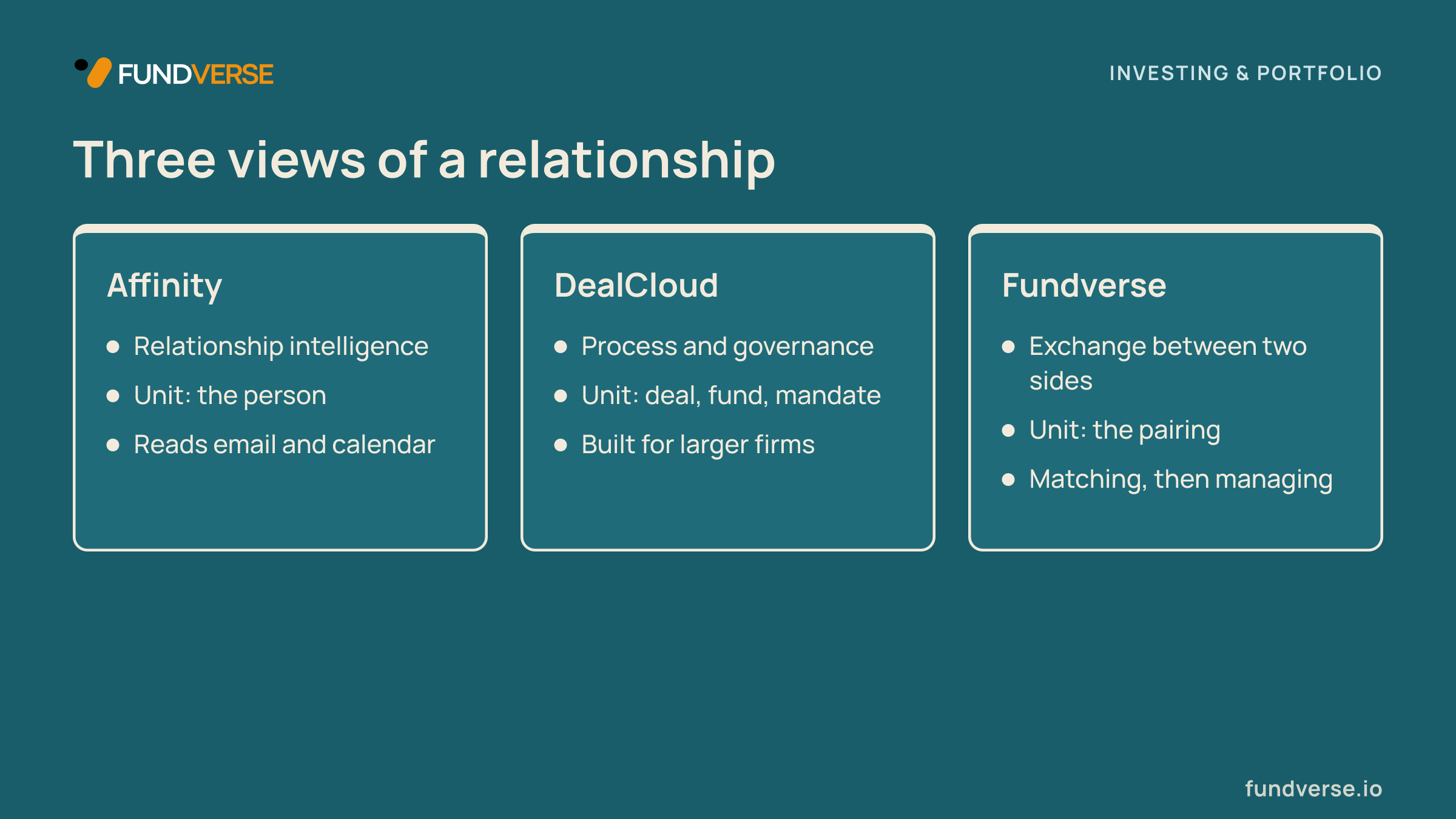
DealCloud starts from the opposite end. Its idea is that a firm's most valuable asset is its process, and that process needs structure: stages, fields, approvals, fund-level views, reporting that rolls up cleanly. It is a configurable platform, generally aimed at larger firms with enough complexity to justify building a system around their own way of working. The unit here is the deal, the fund or the mandate, and relationships are records attached to those things. The strength is governance. The cost is the effort of keeping that structure alive, which we will come back to.
Fundverse takes a third view. It treats a capital relationship as something that exists between two sides: a company or project seeking capital and a provider deploying it, each with stated needs, criteria and history. Its approach centers on matching the two and then managing what happens afterward, so the unit of the system is the pairing rather than the contact or the deal. It is closer to an exchange than to a ledger of your own network. The how it works page explains the mechanics, and Fundverse for investors covers the capital-provider side.
Each theory suits a different question. Who can get me to this founder? Where is every live deal, and what has committee said about each? Which companies are looking for what we deploy, and where does each conversation stand? A firm that asks the wrong question of a tool will conclude the tool is poor, when it has simply been pointed at someone else's problem.
What a relationship means to you
For a venture firm, a relationship is mostly optionality over time. The founder you meet at pre-seed may be the one you back at Series A, or the one whose company you pass on and whose next company you back. Contacts are long-dated, many sit dormant for years, and the useful signal is often a change: a founder left a job, a company hit a milestone, a mutual contact moved. Nobody has time to log four hundred conversations a quarter, so venture stresses a system on breadth and on how well it captures passively.
A private credit fund lives in a different rhythm. Its relationships are with sponsors, intermediaries and borrowers who may return repeatedly, and the memory that matters is structural: how a sponsor behaved in a tight covenant negotiation, how a borrower performed against its reporting obligations, what terms were conceded last time. The relationship is inseparable from the deal terms and the monitoring file. A contact graph captures the people but not the behavior, and in credit, behavior is the information.
A family office is often a small team serving a principal whose preferences are the real product. Relationships are personal and sometimes inherited, spanning managers, co-investors, advisers and operating businesses. What breaks here is rarely scale. It is continuity and context: why the family declined a fund, which co-investor is trusted, which introduction came with a favor attached. The system must be light enough for a few people to maintain and flexible enough to hold facts that fit no standard pipeline.
Development finance institutions and grant makers have relationships that are also obligations, to applicants, governments, co-funders and intermediaries. An audit trail matters as much as the connection, because the institution must show why a decision was made, who was consulted and what conditions attach. That leans toward governed workflow. A fund raising from limited partners has the mirror-image problem: a long, uneven courtship in which someone must remember who has seen the deck, who asked what in diligence, and who said they would revisit after the next close. It needs stage tracking and follow-up discipline, but also relational texture, because an LP who felt ignored at the first meeting remembers it at the second.
Where institutional memory leaks
The most dramatic leak is a partner leaving. They take not just a contact list, which is partly in the firm's email anyway, but the interpretation of it: who is reliable, who oversells, which introductions are real and which are courtesy. A tool that captured the interactions has preserved the facts. Only a tool, and a habit, that captured the judgment has preserved the value.
The quieter leak is the passed deal. Most firms say no far more often than yes, and a pass is not a closed door. Imagine a firm that declines a logistics software company because two customers account for most of its revenue. Eighteen months later the company returns with a broader customer base. If the reason lived only in a partner's memory, or in one line of a meeting note, a new associate starts from zero and the firm repeats diligence it has already done. If the reason was recorded, along with what would reopen the conversation, the concern becomes a checklist item and the second look takes days instead of weeks.
Warm-intro paths decay faster than anyone admits. A map of connections is a snapshot. The person who was a close colleague of a target founder may have changed jobs, drifted away, or never been that close. A graph built from communication data can show who talked recently, which helps, but it cannot know whether the exchange was warm or a perfunctory scheduling email. A path that looks strong on a diagram can fail the moment someone asks for a favor.
Underneath all of this is unmaintained data, the most common failure and the least discussed. Fields nobody owns drift out of date, statuses sit at the stage they reached six months ago, and duplicates accumulate. Every firm has a system that was accurate the day it was configured and has been diverging from reality since. Each leak calls for a different remedy, which is why the choice depends on which one is hurting you most.
The real cost is upkeep
The sticker price is a small part of what a system costs. The larger part is human attention. A passive-capture tool charges little attention up front, because data accrues from work people already do, but its model of relationships is only as rich as email and calendar signals, and it will not hold the reasoning behind a decision unless someone writes it down. Its cost is in what it cannot know.
A deeply configurable platform reverses the trade. It can hold almost anything, but someone has to decide what anything means. Fields must be designed, stages defined, permissions set, reports built, and all of it maintained as the firm's practice changes. That usually takes an administrator, internal or external, and a team willing to enter data consistently. A firm with the scale and discipline gets a great deal for that effort. A firm without them gets an expensive set of empty fields.
This is the point easiest to lose in a vendor demo: a powerful system nobody updates is worse than a simple one used daily. The simple one is incomplete but trusted. The powerful one is complete in theory, stale in practice, and looks authoritative, so people stop checking it, then stop contributing, and a shadow system of spreadsheets and inboxes becomes the real source of truth. A system's value is bounded by the least disciplined person who needs to feed it.
A platform that matches two sides has its own cost profile. Because it is organized around counterparties who maintain part of their own information, some upkeep is shared. That only helps if the firm's relationships actually run through it. A relationship that lives mostly offline, in a long-standing network of introductions, will not be fully captured by a marketplace-style tool, however well designed.
Matching tools to firms
The table summarizes fit by firm type. It is a starting point for a conversation, not a verdict, and it assumes a firm that is honest about its own discipline.
| Firm type | Where memory breaks | Strongest fit | Main caution |
|---|---|---|---|
| Early-stage venture, small team | Dormant contacts and forgotten intro paths | Passive relationship capture, as in Affinity's model | Reasons for passes still need a human habit |
| Large venture or growth equity | Process consistency across many partners | Configurable workflow, as in DealCloud's model | Needs admin capacity and enforced data entry |
| Private credit fund | Counterparty behavior and terms over time | Governed workflow with structured fields | Contact graphs alone miss what matters |
| Family office | Context and continuity across a tiny team | Lightweight tool, possibly passive capture | Heavy platforms are overkill and go stale |
| DFI or grant maker | Audit trail and decision rationale | Governed workflow | Relationship mapping is secondary |
| Fund raising from LPs | Follow-up and LP-specific history | Pipeline-style tracking with relational notes | Easy to under-log soft signals |
| Capital provider seeking new counterparties | Sourcing beyond the existing network | Matching, as in Fundverse's model | Not a replacement for a private deal archive |
The table names no single winner, deliberately. Size matters only because size changes who can pay the upkeep. A twelve-person firm with a dedicated operations hire can run a configurable platform well; a forty-person firm without one can fail with the same software.
Where Fundverse is not the answer
Fundverse connects and helps manage relationships between people raising and deploying capital. It is not designed to be a firm's private system of record for every internal note, a fund-accounting platform, or an archive of a proprietary network built over decades. If your problem is that partners cannot see each other's interactions, or that approvals and fund-level reporting are inconsistent, a tool built around internal process or internal relationship capture is the more natural answer.
Fundverse makes more sense where the weak point is the edge of the network: finding counterparties you do not already know, and keeping the exchange organized once a conversation starts. Many firms will reasonably use more than one kind of tool, one for what they already know and one for what they are trying to find, provided the handoff is clear and someone owns it.
If your pipeline depends on finding counterparties beyond your existing network, see how investor matching works on Fundverse and whether it complements the system you already keep.
Choose by where you forget
Start with a diagnostic rather than a demo. Pick the last five deals you passed on and ask whether a new team member could find out why within ten minutes. Pick the last two people who left and ask what the firm lost beyond their contact list. Pick the ten warm intros you relied on last year and ask how many you could have verified as strong in advance. The answers show whether your problem is network visibility, process consistency or reach.
If visibility is the problem, favor the tool that captures passively, and make a rule that every pass gets a two-line reason. If consistency is the problem and you have people to administer it, favor structure, and design the fewest fields you can actually enforce. If reach is the problem, favor matching. And if you are a small team that cannot name an administrator, take the simplest option people will open every morning, because the discipline of daily use is worth more than any capability you will not feed.
Whatever you pick, the most practical step costs nothing: require a short written reason, in the same place, every time the firm declines a deal, with a name against who held the relationship. That single habit does more to preserve deal memory than any software choice, and every one of these systems depends on it to be worth the money.
Frequently asked questions
Topics
Affinity vs DealCloud
relationship CRM for investors
deal memory
institutional memory venture capital
private equity CRM
family office deal tracking
investor relationship management
deal flow software
Raising or investing?
Find the right people on the other side of the table, and run the round in one place.