

More startups improve an angel's odds of owning a big winner but shrink each check and stretch your time. Here is how to reason from budget, reserves and hours to a sensible number.
Spread a $50,000 angel budget across two startups and each check is large, but the result rides on two companies. Spread it across forty and the odds of owning a standout improve, yet each check is tiny and you cannot possibly follow all forty. Every extra company buys something and costs something, and the right number of investments sits where those two meet for you in particular.
Advice on the question usually arrives as a single number, which is easy to repeat and hides the three things behind it: how startup returns are distributed, how much money you can afford to lose, and how much time you can give each company. This article works from those three to a range you can defend. Every figure below is an illustration made up to show a mechanism, not a benchmark or a research finding.
1. Why one or two checks is a bet
Most startup investments return little or nothing. A smaller group returns roughly what was put in, and a very few return many times it. Returns shaped like this are called a power-law distribution: a handful of outcomes account for most of the total result, and the rest barely move it. You cannot tell in advance which investments will be the few, so the result of your whole angel activity can hinge on whether one of them happened to be in your portfolio.
With one or two investments, that makes the exercise closer to a bet than a portfolio. If both companies turn out ordinary, little comes back however careful your diligence was. More investments do not make any single company better. They raise the chance that the rare outcome is among the ones you own.
A simple illustration
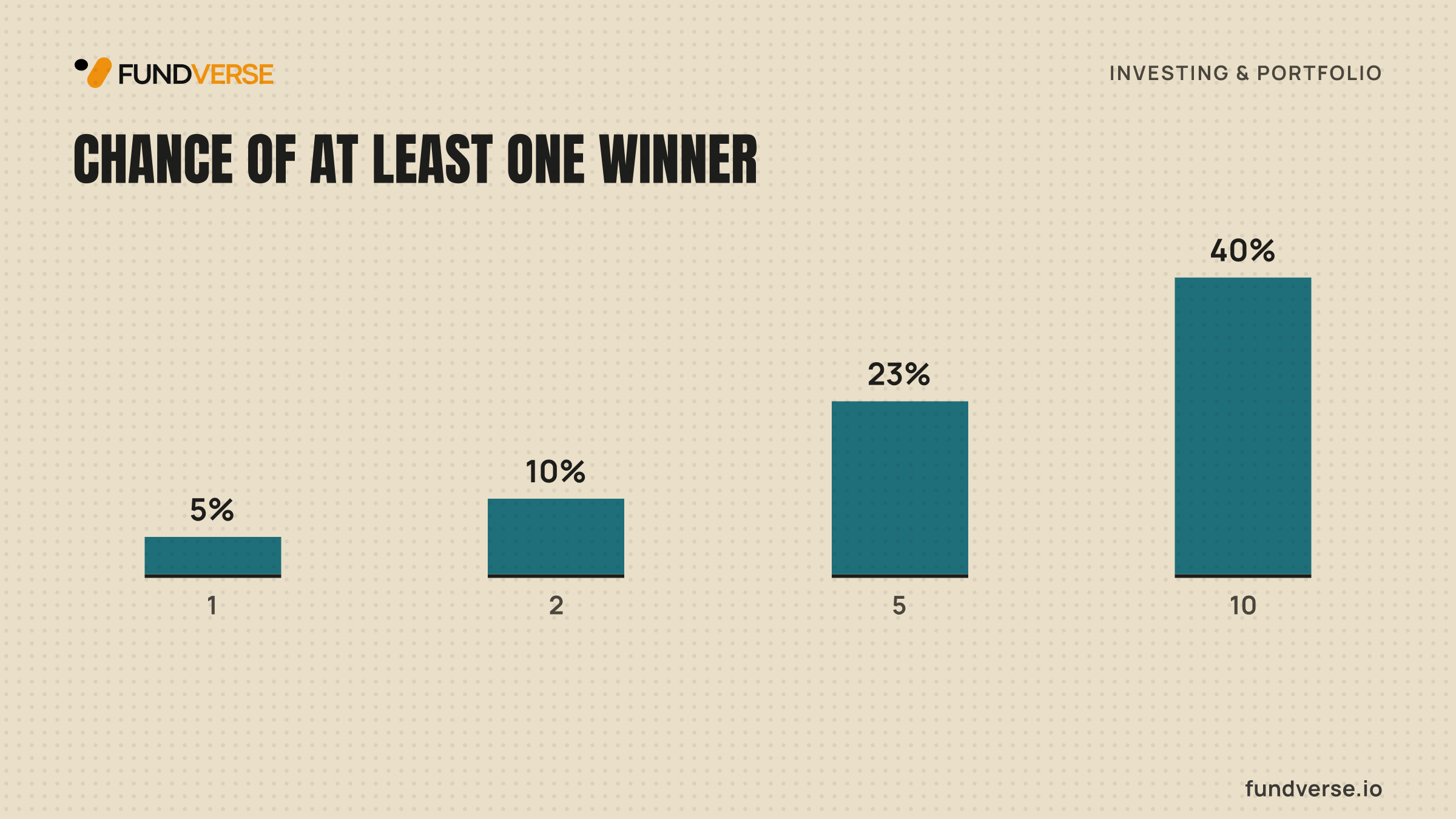
Suppose each investment has a 5% chance of becoming a big winner, one that returns enough on its own to repay your entire budget, and suppose outcomes are independent. The chance of owning at least one winner after n investments is then 1 minus 0.95 raised to the power n. Add a $50,000 total budget split evenly with nothing held back. These assumptions are invented for the purpose.
| Number of investments | Check size | Chance of at least one winner |
|---|---|---|
| 1 | $50,000 | 5% |
| 2 | $25,000 | about 10% |
| 5 | $10,000 | about 23% |
| 10 | $5,000 | about 40% |
| 20 | $2,500 | about 64% |
| 40 | $1,250 | about 87% |
Two things stand out. First, each added company contributes less than the one before: going from one investment to two adds about five points of probability, while going from 20 to 40 adds roughly a point per company at best and much less per company at the top. Second, the definition of a winner quietly gets harder as checks shrink. A $10,000 check needs a 5x outcome to repay the $50,000 budget, while a $1,250 check needs 40x. Spreading wider improves your odds of owning a winner, but it raises the bar that winner has to clear.
What the illustration leaves out
Change the assumption and the table moves. At a 2% chance per investment, twenty investments give roughly a one-in-three chance of a winner; at 10%, nearly nine in ten. Nobody knows the right figure for a particular angel, and it depends on the deals you can see, the stage and the sector. Real outcomes are also not independent. Companies in the same market, at the same stage, in the same years tend to rise and fall together, so twenty similar investments diversify you less than the arithmetic implies. And owning a winner is not the same as making money after dilution, fees and a long wait. The table shows the shape of the trade-off. It is not a forecast.
2. The budget comes first
Money you can afford to lose
The odds only matter once you know how much you are playing with, so set the total before looking at any deal. Startup investments are high risk and illiquid: the money is typically locked up for many years and may never come back. A sensible budget is an amount you could lose entirely without changing your life, your plans or the rest of your finances, and that you will not need for a long time. That depends on your income, dependents and other assets, and no percentage fits everyone. Fixing it in advance also keeps you from deciding how much you can afford in the middle of a persuasive pitch.
The budget then divides into checks, and the division runs both ways. Dividing the budget by the number of investments gives an average check. But deals come with minimum amounts, so the check size you are offered also limits how many companies you can back.
Reserves for the best companies
Many angels hold back part of the budget for follow-on reserves: money kept for later rounds in the companies that are doing well. The reason is dilution. When a company raises new money it issues new shares, so every existing holder owns a smaller slice. If you do not buy into later rounds, your stake shrinks with each one. Some investment terms give investors a right to take up their share of a new round, called a pro-rata right, though whether a small angel receives one varies from deal to deal. Reserves let you keep your percentage in the companies that have earned it.
The cost is fewer first checks. Take the same $50,000 and, as an invented split, hold back 40%. That leaves $30,000 for first checks, so at $2,500 each you make 12 investments instead of 20. Reserves are also spent later, once a company has shown evidence, so you pay a higher price for a business you now know better. Whether to hold reserves at all is personal preference. The math only says that reserves and the number of companies come out of the same pot. An angel who will not follow on can skip reserves, and should expect to be diluted.
3. Time sets the other ceiling
Small checks push toward more companies, and time pushes back. Each investment needs diligence beforehand: reading the materials, talking to the founders, testing their claims and understanding the terms. Afterward come updates to read, founders who want advice or introductions, and later rounds to judge. None of that shrinks with the check. A $1,250 investment needs nearly as much reading of the terms as a $10,000 one.
Take another illustration. Suppose you can give five hours a week, about 250 hours a year, and a proper look at one deal takes around 15 hours. If you examine four deals for every one you back, each investment costs about 60 hours before any money is sent. On those assumptions you can make about four new investments a year, and that already uses the whole allowance, leaving nothing for the companies you own. Holding periods make this worse, because companies pile up: four a year for five years leaves around twenty to follow. A part-time angel cannot meaningfully track dozens of companies, and past a certain point you become a passive holder who cannot tell which ones need help or deserve a follow-on. The ceiling is set by your pace and your holding period together, not by one year's activity. Building the portfolio over several years also spreads your entry across different market conditions.
4. How access changes the math
Syndicates, networks and groups
Not every angel can reach good deals alone, and group routes exist partly to solve that. In an angel network, members share the screening and often some of the diligence, and each invests their own check. In a syndicate, an experienced lead investor brings a deal and others back it alongside, usually through a special purpose vehicle, a single entity that holds the stake on behalf of the group. Either way, you can write a smaller check, someone else carries part of the diligence hours, and you may see deals you would never have been shown. The same budget and the same time can therefore stretch across more companies than going direct would allow.
Fees and control
The trade-offs are real. Leads and platforms commonly charge fees, a share of profits, or both, and the terms vary widely. A fixed fee weighs more on a small check, and any cost reduces what you eventually keep. Control also changes: you often sit behind the vehicle rather than on the company's own register, so information arrives through the lead, and pro-rata rights depend on how the vehicle is set up. You are relying on the lead's judgment, so you still have to judge the lead, and several deals from one lead share one set of tastes, which diversifies your companies more than your judgment. If the deals you can reach are weaker than average, the odds in the earlier illustration fall, which is a reason to be more selective, not to buy more.
5. Working out your own number
With the three forces in view, you can reach a number by answering a short sequence of questions in order.
- What is the most I can afford to lose and leave locked up for many years? That is the total budget.
- Will I hold follow-on reserves, and what share? Subtract them to get the pool for first checks.
- What is the smallest check offered in the deals I can actually reach, directly or through a group? Divide the pool by it to get a ceiling set by money.
- How many hours a week can I give, and what do diligence and holding one company cost me? Turn that into new investments per year, then multiply by the years over which I will build the portfolio to get a ceiling set by time.
- Take the lower of the two ceilings, then check it against the odds: is it high enough that I am not simply making a bet on two or three companies?
Run the illustration through it. A $50,000 budget with 40% in reserves leaves $30,000; at a $2,500 minimum, money allows 12 companies. At about four new investments a year, 12 companies takes three years and stays manageable to follow. Against the earlier assumption of a 5% chance per investment, 12 companies gives roughly a 46% chance of at least one winner. That imagined investor lands near a dozen. Someone with $200,000 and fifteen free hours a week, or someone with $15,000 and a demanding job, would land somewhere else. If your own pass leaves you at two or three, that is a signal to widen access through a group, raise the budget, or accept that you are making a bet and size it accordingly.
Once you follow more than a few companies, keeping the pipeline, notes and holdings in one place saves real hours. Fundverse gives investors tools to organize deal flow and track a portfolio, which you can try when a spreadsheet starts to strain.
6. Why your range may differ
The worked numbers above belong to an imagined investor, and yours will differ for reasons the arithmetic cannot capture. Wealth decides how large a budget you can lose without harm, and so how many companies fit at a meaningful check. Deal access shapes both the quality of what you see and the minimums you face. Jurisdiction affects who is allowed to invest as an angel, which structures are available and what protections apply. Tax treatment can change the true cost of each check: some countries offer relief for early-stage investment or for losses, and others offer none.
Nothing here guarantees a good result. More investments lower the chance that you miss a winner and reduce your dependence on any one company, but they do not remove the risk that angel investing as a whole loses money. Treat any range as a starting point and take professional advice from a financial advisor and a tax advisor in your own jurisdiction before committing capital.
After your first few checks are out, the number will be tested by experience. Watch how many hours the companies you already own actually take, and whether your appetite for follow-ons matches the reserves you set. Revisit the count after a year, and adjust the pace of new investments rather than the commitments already made.
Frequently asked questions
Topics
angel investor portfolio size
how many startups should an angel invest in
angel investing diversification
follow-on reserves
angel syndicates
power law returns
angel investing budget
Raising or investing?
Find the right people on the other side of the table, and run the round in one place.