

Carta, Juniper Square and Fundverse were built for different jobs: equity records, LP operations and the investment workflow. Here is how a fund manager can choose by where the operation breaks.
A system of record and a system of work are not the same thing, and venture funds tend to discover the difference only after buying one and expecting the other. A system of record is the place where a fact is held authoritatively: who owns what, who owes which capital call, what the fund's books say. A system of work is the place where people do their jobs: screening a deal, chasing a founder for numbers, preparing for an investment committee. Much of the confusion in comparing Carta, Juniper Square and Fundverse comes from treating all three as one kind of tool.
A fair comparison therefore asks which job each tool was built to do, and which of those jobs is currently costing your fund time or creating errors. One note on candor: Fundverse is the publisher's own product. This article says plainly what it is designed for and where the other two are stronger, and it describes each tool by its established core purpose, not by pricing or a feature list that may have changed.
Why one tool never covers a fund
A venture fund is really several businesses running at once. It is a deal-sourcing operation that needs to remember every conversation. It is an investor in dozens of companies that each hold a legal claim on equity. It is a pooled vehicle with limited partners (LPs), the outside investors whose money it manages and who are owed notices, reports and distributions. And it is a set of books that an auditor will examine. Each of those businesses produces different data, is read by different people and carries different consequences if it is wrong.
That is why feature-by-feature comparison misleads. A grid showing that one product has a data room and another has an investor portal says nothing about whether either is the place your fund should trust for that record. Two products can both mention reporting and mean different things: one means a company-by-company view of portfolio performance, the other a quarterly package that an LP and an auditor will rely on. The useful comparison is by core job, because depth in one job usually comes at the expense of breadth in the others.
Using the fund lifecycle as the map
The cleanest way to organize the comparison is to follow a fund through its life. It begins with sourcing and screening: finding companies, logging inbound deals and deciding quickly which deserve time. It moves to investing: diligence, documents, closing and recording the resulting ownership. Then comes portfolio monitoring: collecting metrics from companies, tracking follow-on needs and watching for trouble. Alongside runs LP reporting and fund accounting: capital calls, valuations, financial statements and quarterly updates. Finally come exits and distributions: realizing value and returning cash to LPs in the right proportions.
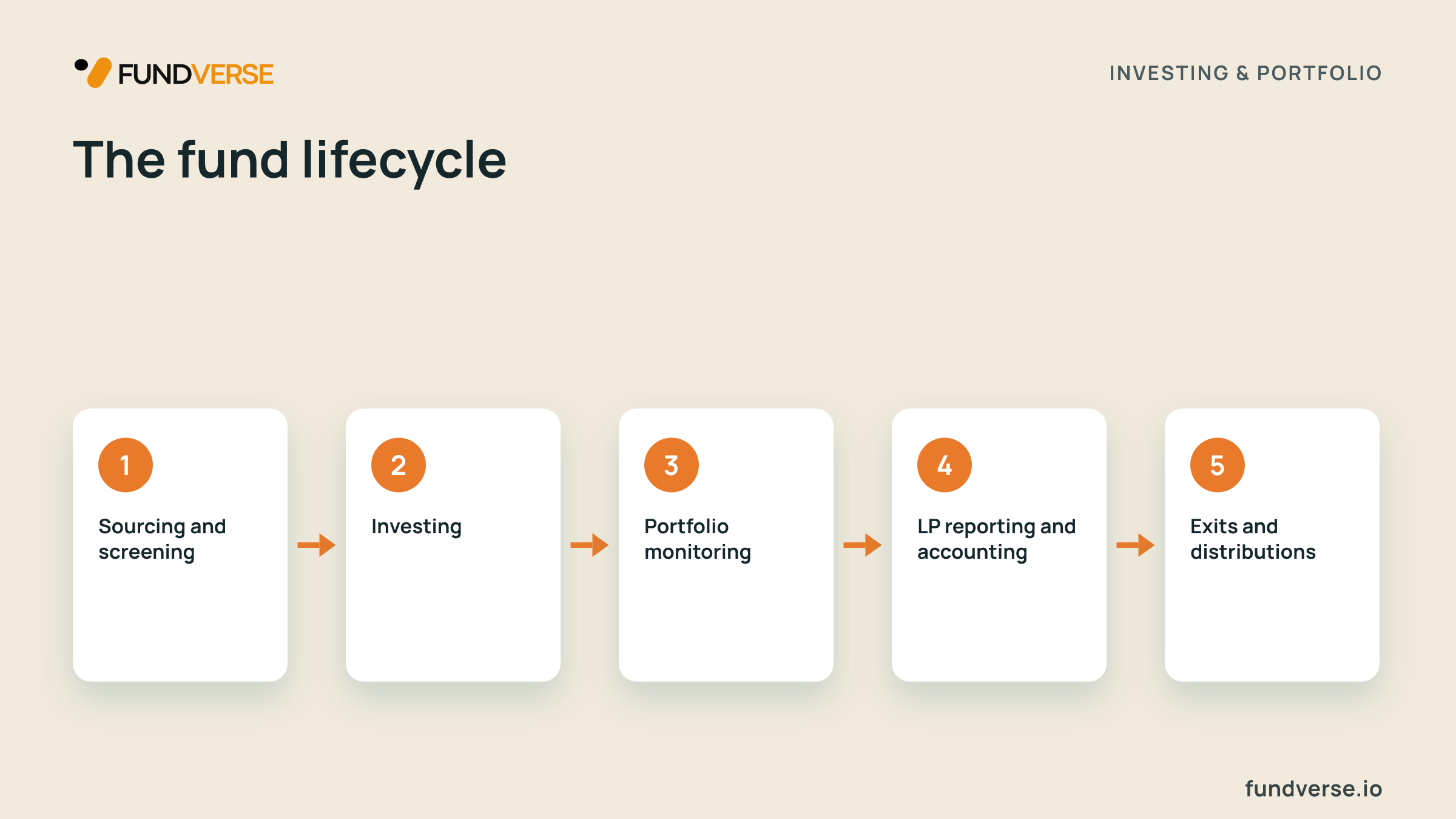
The stages feed each other, which is why a weakness early in the chain surfaces late. A deal screened carelessly produces an investment with a thin file. A thin file leaves monitoring without a record of what was promised. Weak monitoring yields valuations that are hard to defend in the LP report, and a report that cannot be traced to the underlying records makes distributions slower and more contentious. The three tools sit at different points along this chain.
Three tools, three core jobs
The equity record
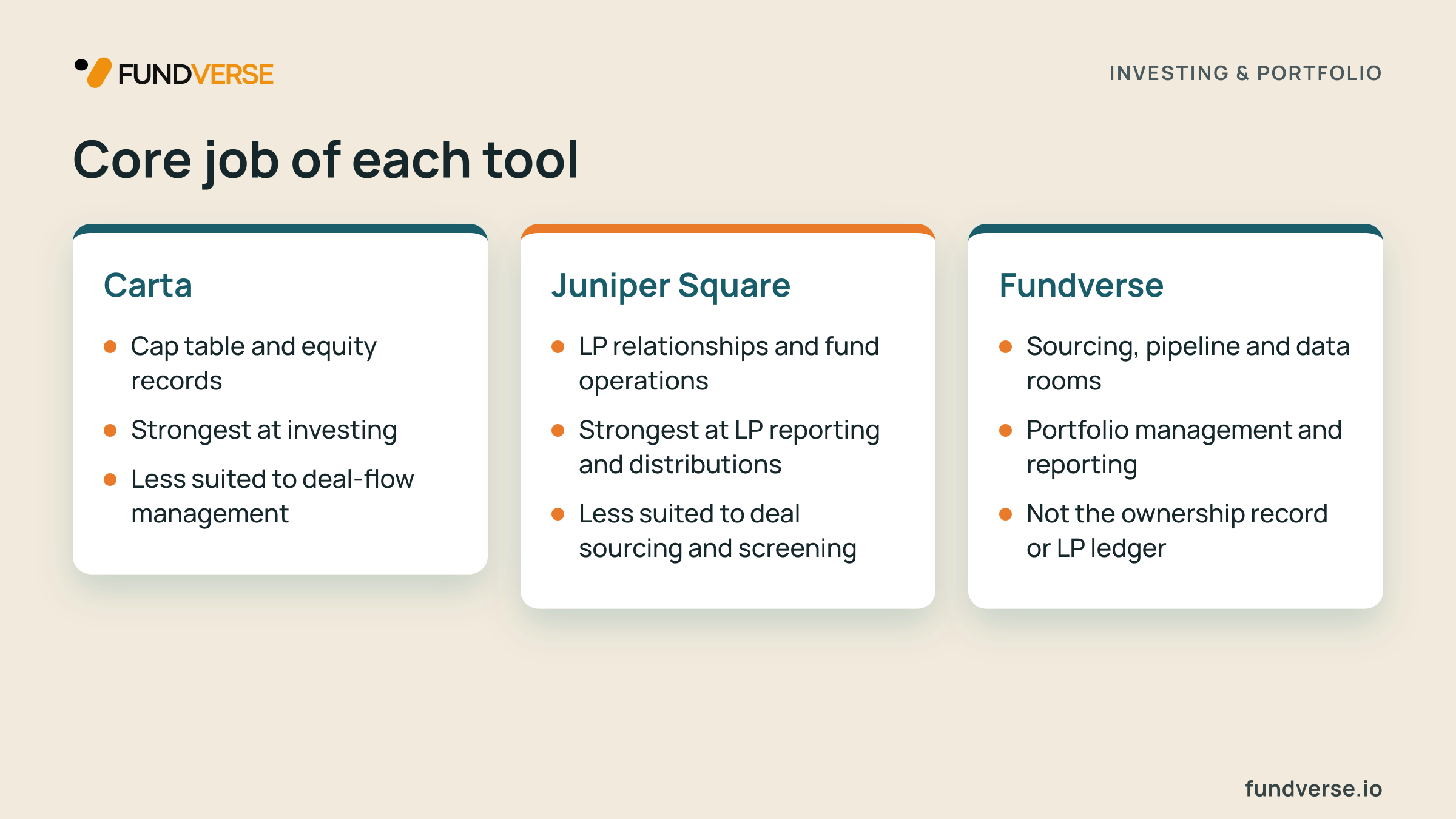
Carta is best known for cap table management. A capitalization table is the record of who owns what in a company: founders, employees with options, and each investor by share class. Companies use it to issue equity, model rounds and keep the legal ownership record clean. Because so many startups keep their cap tables there, it has a natural position for investors, since the stake a fund holds in a portfolio company is ultimately a line on that table. Carta has also extended into fund administration and fund-side tooling for investors, so a manager can sometimes find more than the cap table in one ecosystem. Its center of gravity, though, remains equity records and the data that flows from them.
The LP relationship
Juniper Square is built around the fund's relationship with its LPs: investor onboarding (collecting identity and subscription documents), capital calls and distributions, the investor portal where LPs see their positions and documents, and the reporting a manager sends them. Its roots are in real estate, an asset class with many investors, frequent cash movements and heavy investor communication. That heritage shows in how seriously it treats the mechanics of moving money between a fund and its investors, and venture managers have adopted it for the same reasons. Its center of gravity is the LP ledger and the experience of the people who funded you.
The investment workflow
Fundverse is designed around the work that happens before and after the cap table and the LP ledger: investor and capital-provider discovery, deal sourcing and screening, pipeline management, data room workflows, portfolio management and reporting. Its AI, Marcus, supports analysis, for example by helping a team review materials or structure a first read of a deal, but it supports judgment and does not replace it; the investment decision stays with the partners. Fundverse is not designed to be the authoritative ownership record or the LP ledger. It is designed to hold the history of how a deal was found, assessed and tracked. The how Fundverse works page and the investor page describe the product in more detail.
| Carta | Juniper Square | Fundverse |
|---|---|---|
| Core job | Cap table and equity records | LP relationships and fund operations |
| Strongest lifecycle stage | Investing (recording ownership) | LP reporting, capital calls, distributions |
| Authoritative record of | Who owns what in a company | What each LP has contributed and is owed |
| Typical first buyer | Companies, and funds tracking holdings | Funds with growing LP bases |
| Less suited to | Deal-flow management | Deal sourcing and screening |
Where the records live
Once the core jobs are clear, the most useful design decision is which tool is authoritative for which fact. Ownership in a portfolio company is authoritative where the company's own equity is recorded, which is usually its cap table. What each LP has contributed, what it owes and what it has received is authoritative in the LP ledger, wherever the administrator keeps it. What the fund knew about a company when it invested, who introduced it and what was said in diligence belongs in the deal history. These are three different truths about the same fund.
Duplicated data appears when two tools claim the same fact. If the investment team keeps ownership percentages in a pipeline tool, the finance team keeps different ones in a spreadsheet, and the company's cap table shows a third figure after a later round, nobody can say which is right when an LP asks. The fix is rarely a single mega-system. It is a rule that each fact has one home, and everywhere else it is a copy that refreshes from that home or is clearly labeled as a snapshot.
Administration is a service, software is a tool
Fund administration is the set of back-office duties that keep a fund running: maintaining the books, calculating capital calls and distributions, producing financial statements, handling LP onboarding checks and supporting audits. In many funds an outside administrator or a dedicated finance team performs it as a service. Fund software is the tool people use to do or supervise that work. The distinction changes what you buy. If an administrator already prepares the numbers and statements, you may need little more than a way to receive their output and share it with LPs. If you do the work in-house, you need software that carries the calculations and the controls.
Some platforms blend the two, offering software alongside an administration service, which can be convenient but means your records sit with whoever provides both. Ask who owns the data, how you would export it, and what happens to your history if you change administrator. Professional advice on fund accounting and regulatory obligations in your jurisdiction is essential here, because software does not decide what you are required to produce.
Fund size and stage change the answer
The first-time manager
A first-time manager with a small fund, a few dozen LPs at most and no finance team has one scarce resource, time, and the pain usually sits at the front of the lifecycle: deals arrive by email, notes live in one partner's head and the pipeline is a spreadsheet nobody else updates. Capital calls are infrequent, so spreadsheets and an outside administrator often carry the LP side adequately for a while. For this fund, a workflow tool that keeps deal context and a light portfolio view probably removes more risk than a full LP portal would.
The multi-fund firm
A multi-fund firm with many LPs, several vehicles and a finance team faces the opposite profile. Capital calls across funds, LPs with differing commitments, side letters and recurring audits make errors on the LP side expensive. Here the ledger, the portal and the controls matter most, and a platform focused on fund operations earns its place. The investment team still needs its workflow, but a miscalculated call or a late report costs far more than a lost deal note.
Managing from outside the United States
Many tools were designed around US fund structures and conventions, so managers elsewhere should test assumptions early. A fund investing across several currencies needs to record each investment in the currency it was made, translate it consistently for reporting and explain exchange effects to LPs. Local regulation may dictate what a fund must report and to whom, and LP reporting conventions vary by market. None of this should be assumed to be handled; ask each vendor how it supports your structure and jurisdiction.
The LP base matters too. Development finance institutions and family offices often have their own reporting formats, covenants and review cycles, and a fund that must rebuild a spreadsheet each quarter to satisfy them carries a hidden cost. List the three or four most demanding LPs you expect, collect their reporting requests and check whether a tool can produce them or at least export clean data for them. For an emerging manager outside the US, the practical test is often less feature depth than how little manual rework the tool leaves behind.
Choose by the failure you need fixed
Name the failure that is costing you most and work backward to the tool built to prevent it. Five failures cover most cases:
- Lost deal context: a partner leaves a call and the reasoning disappears. This is a workflow problem, pointing toward a pipeline and deal-history tool such as Fundverse.
- Slow capital calls: notices go out late, amounts need rechecking and LPs ask where to send funds. This is an LP operations problem, where Juniper Square has an established focus.
- Inconsistent portfolio data: every company reports differently and nobody trusts the comparison. This is a monitoring problem, which a portfolio workflow tool addresses.
- Late LP reports: the package is assembled by hand from five sources each quarter. This points to the LP reporting layer and to cleaner upstream data.
- Messy ownership records: the fund cannot say what it owns after follow-on rounds and dilution. This is an equity record problem, and cap table tooling such as Carta is the natural answer.
Two of these, late LP reports and inconsistent portfolio data, are often symptoms of an upstream problem. A report is late because the data feeding it was collected inconsistently, so fixing the report template alone will not help. Diagnose before you buy, and the clearest place to diagnose is portfolio monitoring.
The real work of monitoring
Portfolio monitoring fails quietly. A fund asks each company for revenue, cash and headcount, and the answers come back as PDFs, spreadsheets, email bodies and the occasional verbal update, each with different definitions. One company reports revenue as billings, another as recognized revenue; one gives monthly figures, another quarterly. A team then spends days normalizing the numbers before it can compare anything.
Tools approach this differently. Cap table data tells you ownership and round history but little about operating performance. On the LP side, portfolio data enters mainly to support valuations and reports. A portfolio workflow tool centers on collecting and organizing company metrics so the investment team can see them. In every case the most effective fix is the same: agree a short, standard set of metrics with definitions at the time of investment, and request them on a fixed schedule. Software makes a consistent request easier to send and a consistent answer easier to store, but it cannot make founders define revenue the same way if the fund never asked them to.
Integration, migration and the cost of switching
Because each tool owns different records, the way data moves between them matters more than any single feature. Deal data begins in the workflow tool and, once an investment closes, the terms pass to the ownership record and the finance team. Ownership and valuation data flows into portfolio reporting. LP data stays in the LP ledger, and performance figures flow from the portfolio side into the LP report. Each hand-off should have an owner and a schedule, and be automated or at least exportable in a clean format.
Switching later is costly in a way that is easy to underestimate. Migrating a pipeline is mostly an inconvenience. Migrating an LP ledger or an ownership history is a controlled exercise, because errors become errors in what investors are owed or what the fund believes it owns. Before committing, ask how data can be exported, in what format, with what history, and how long a migration would realistically take. Prefer tools that let you take your data with you, and treat that answer as part of the price.
Where Fundverse is not the answer
If your pain centers on fund accounting, the mechanics of capital calls or the depth of an LP portal, Fundverse is not designed to be your first choice. Those are the jobs where Juniper Square, and Carta in its fund-side offerings, have a stronger established focus. A fund with many LPs, frequent calls and a finance team already struggling with ledgers should look there first, because a workflow tool would leave the most expensive failure untouched.
Equally, if your only need is an authoritative cap table for your own portfolio, a pipeline tool will not replace it. Fundverse can hold a view of your holdings for monitoring and reporting, but it should not be where you settle a dispute about who owns what.
A stack that grows with the fund
These tools can sit side by side without much conflict, provided each has a clear home for its records. A sensible sequence follows the fund's pain. A first-time manager starts with a workflow tool and a light administrator, so deal context and portfolio data are captured from day one. As the LP base grows and capital calls multiply, the fund adds dedicated LP operations tooling or an administrator that provides it. As the portfolio matures and ownership grows complicated through follow-on rounds, equity record tooling becomes central. Adopt in the order that failure becomes costly, not in the order vendors market.
Early choices set the data shape for everything that follows, so even a small fund should define its metrics, naming and record ownership at the start. That discipline costs almost nothing early and a great deal to retrofit. For the underlying material, data room workflows and a structured pipeline are good places to begin.
If your biggest gap is between sourcing a deal and reporting on it, try Fundverse for the deal pipeline and portfolio workflow, and keep your ownership records and LP ledger where they are best maintained.
Questions to ask before you buy
A short set of questions will usually settle the choice faster than a demo. Where does time go each week: chasing deal context, assembling data, or processing LP paperwork? Who sees the data: only the partners, the whole team, LPs, co-investors? What must be auditable: ownership changes, valuations, capital movements, and who made each change? And what will LPs and auditors ask for in the next twelve months, in what format, and could you produce it without a weekend of manual work?
Match the answers to the lifecycle. If time goes into sourcing and tracking, start with the workflow. If it goes into LP processes, start with fund operations. If the worry is ownership accuracy, start with the equity record. Most funds will answer differently as they grow, which is the point: the right stack fits the failure you have now. Vendor features and offerings change, so confirm current capabilities, and security, compliance and data-handling terms, directly with each vendor, and take professional advice on fund accounting and regulatory obligations in your jurisdiction.
Over the next year, watch less for which platform adds a feature and more for how cleanly each lets your data move to the others, because a fund that controls its records will find any future change of tools far cheaper.
Frequently asked questions
Topics
Carta vs Juniper Square
venture capital fund management software
fund administration vs fund software
VC portfolio monitoring software
LP reporting software
emerging fund manager software
Fundverse
Raising or investing?
Find the right people on the other side of the table, and run the round in one place.