
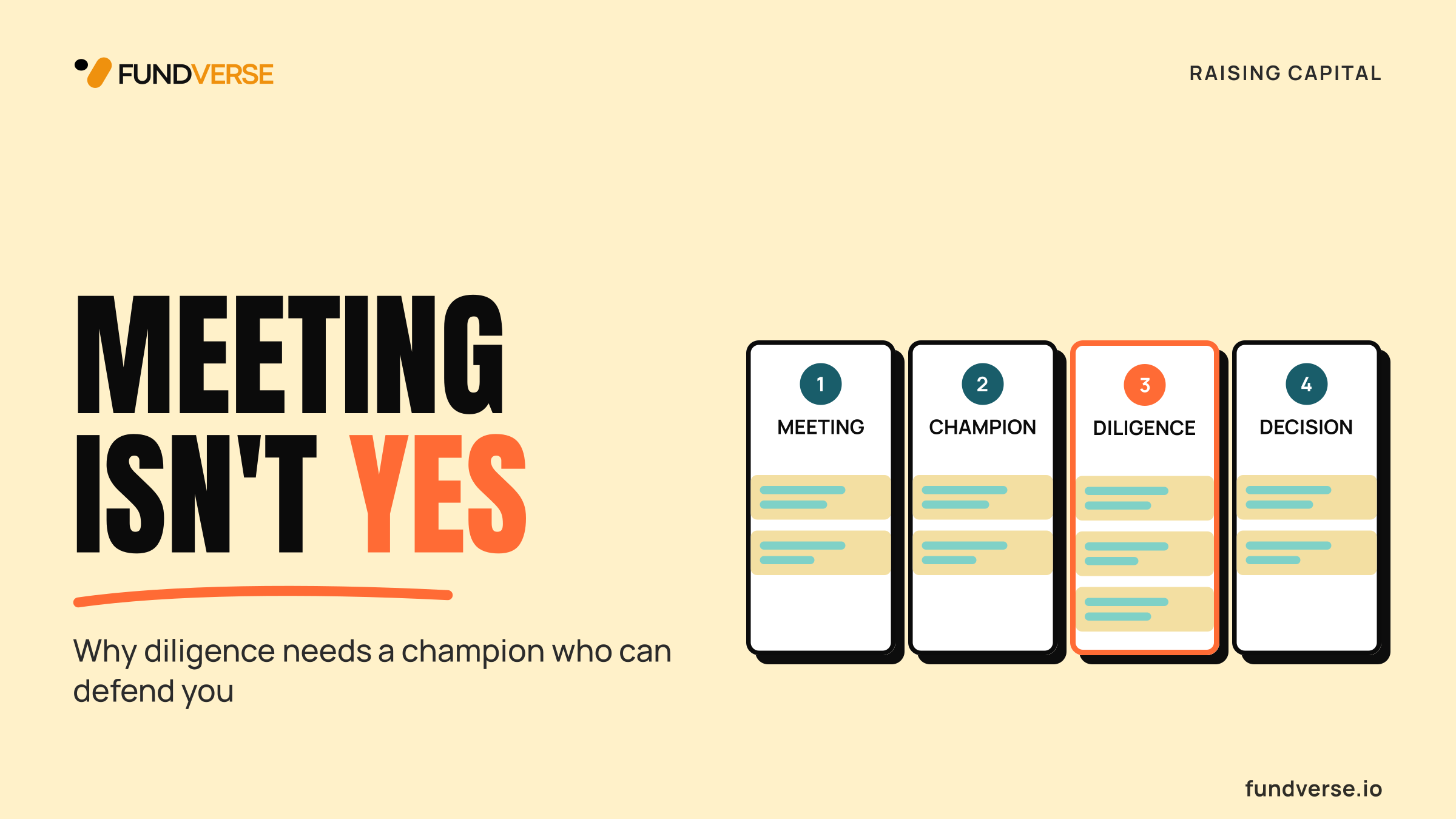

Meetings cost investors an hour; due diligence costs weeks and personal credibility. Here is how to read why your process has stalled and what to do about each cause.
Agreeing to meet and agreeing to examine are different acts. A meeting is a courtesy an investor can extend to almost anyone, because it can be ended politely at thirty minutes and carries no obligation. Due diligence is a commitment: weeks of attention from several people, sometimes outside advisers, and a degree of personal exposure that a friendly conversation never carries. Organizations that treat the two as neighboring steps on one staircase are the ones left puzzled when the calendar fills with meetings and the next stage never arrives.
The puzzle has a plain explanation. Diligence is the point at which the investor spends real resources on your business, and that decision is made against a higher standard of proof than a meeting requires. Understanding that standard, and who has to meet it, is how you work out what is actually stalling your process, whether you are seeking equity, debt, a grant or something in between.
Why a meeting costs so little
Investors take meetings for many reasons that have nothing to do with intending to invest. They want to understand a market, hear what other capital is chasing, stay known to the people who send them deals, repay a favor to whoever made the introduction, or begin a relationship that may matter in a later round. For many of them, being accessible is a professional asset, and declining a meeting can be the more expensive choice because it may damage a referral relationship. Friendliness in the room is therefore a weak signal. It may be genuine, and it may simply be good manners applied at scale.
Diligence reverses that cost structure. It means reading financial statements line by line, speaking to customers, checking contracts and ownership, looking into the people running the business, and testing the commercial or technical claims. A lender runs a credit analysis and values any collateral. A development finance institution or grant maker adds eligibility, compliance and safeguards checks. Lawyers and accountants are often engaged, and the bill lands on either the investor or the company, depending on the structure.
A simple illustration, with invented numbers that are not a benchmark: if a first meeting takes one partner one hour, and diligence takes three people about ten hours each, the same deal now absorbs thirty hours before any outside fees. That is thirty times the commitment, taken from time that would otherwise go to other opportunities or to companies the fund already owns. The lesson is the proportion. An investor who says yes to the hour has not said yes to the thirty.
Time is the smaller part of the cost. Opening diligence tells colleagues that this person believes the deal deserves the team's resources, and if it collapses late for a reason that was visible early, their judgment is questioned. The move from meeting to diligence is therefore the first moment someone attaches their name to you, which is why a quiet 'let's keep in touch' is so often a soft no, or a 'not yet' without a stated condition.
What the champion must defend
The person you meet is rarely the only person who decides. At angel level they may be, but elsewhere you are usually talking to an associate, a principal, a relationship manager or a program officer who must carry the deal to someone else. Call that person your champion. What the champion personally believes (this team is capable, the market is real, I would like to see this work) is a different thing from what they can defend in a room of skeptical colleagues who have never met you.
The defensible version needs answers to questions the champion has not yet been asked: why this business, why now, why this price or structure, how it fits our mandate, what could go wrong and why we can live with that. A credit committee asks where repayment comes from and what happens if the forecast slips by a quarter. A partner meeting asks how large this could become and what evidence shows customers pay. An institutional board asks whether the organization meets eligibility and safeguards criteria. If your meetings left the champion with enthusiasm but not with those answers, they cannot carry the deal, however warmly they spoke. How committee documents are actually built, and why they can mislead, is covered in our piece on the investment committee memo.
Five reasons the process stalls
From the outside, every stall looks the same: polite silence, a delayed reply, a vague promise to get back to you. Underneath, the cause is usually a gap in what the champion can defend, and there are five common versions of that gap, each calling for a different response.
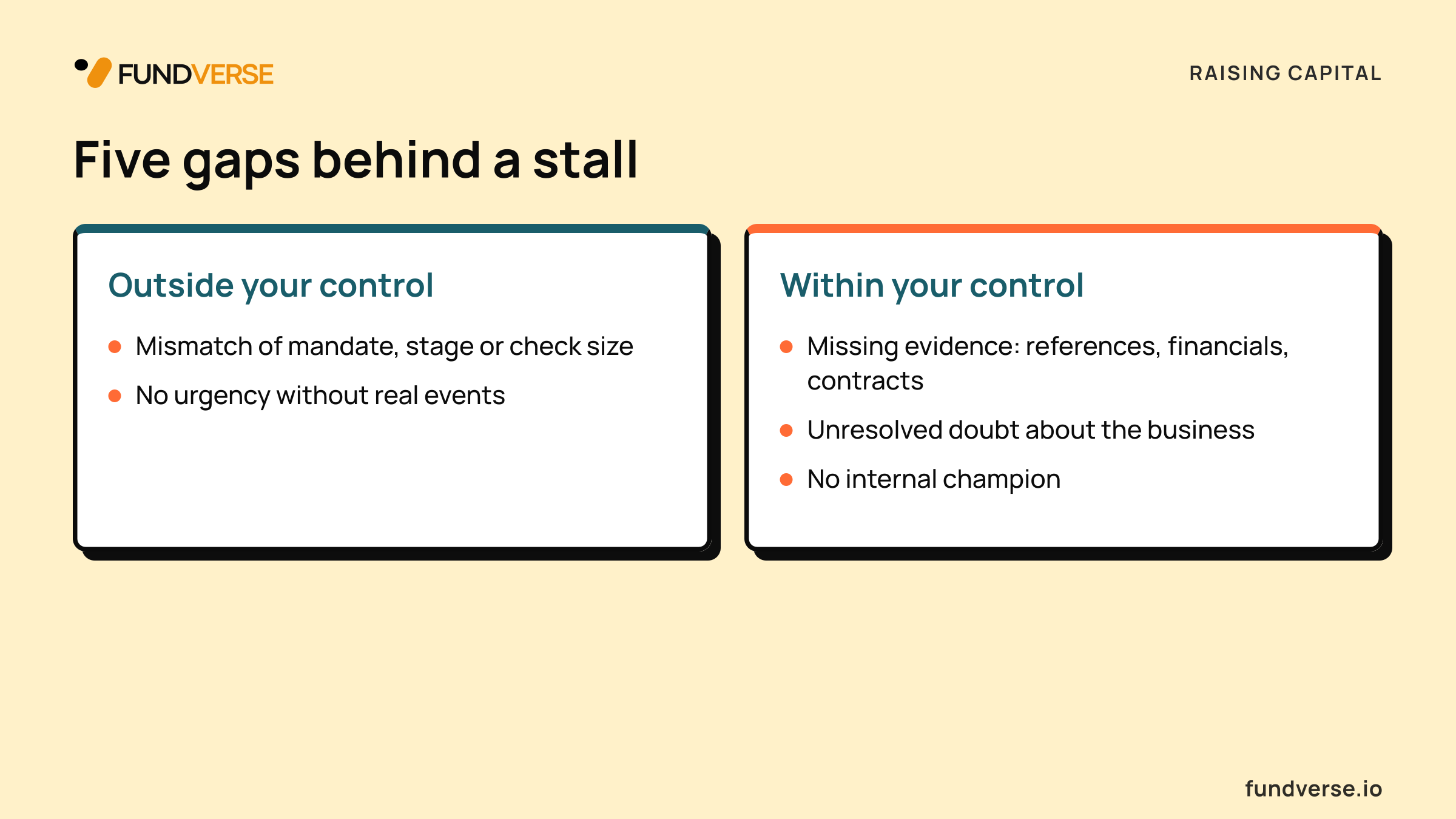
The first is an unresolved doubt about the business itself. It might concern customer concentration, thin margins, reliance on a single contract or supplier, or a gap in the team. Investors seldom volunteer these because saying them aloud is awkward, so the doubt fades into scheduling language instead. This is probably the most common cause and the one founders are least likely to hear directly.
The second is a mismatch of mandate, stage or check size. A fund may write checks much larger or smaller than what you are raising, a lender may have a minimum loan size above your need, or a grant program may target a different sector or geography. Nothing you say can fix this, because the champion could never defend a deal the institution is not set up to do. Such meetings still happen, because an investor can find a company interesting without being able to fund it. The same problem arises when an introduction lands you at the wrong fund, a theme explored in why a warm introduction is not a strategy.
The third is missing evidence. Here the doubt can be answered, but the proof is not yet in the room: no customer references, financials that do not reconcile, unsigned contracts, or accounts below the standard a lender requires. Unlike a mismatch, this one is within your control, and it is the cause where preparation changes the outcome most directly.
The fourth is the absence of an internal champion. The person you met likes the business but lacks the standing, appetite or time to push it through. A useful test is whether they talk in terms of 'we' and next steps, or only of what they will 'see'. If you cannot say who else must be convinced, you probably do not have a champion yet.
The fifth is no urgency. If the investor loses nothing by waiting, deals drift. Real urgency comes from events: competing interest, a contract about to be signed, a program window about to close, a milestone about to be reached. Manufactured pressure is discounted quickly by experienced investors, and it can damage trust.
How providers reach the diligence decision
These five causes carry different weight depending on who you are talking to, because capital providers arrive at the diligence decision by different routes. The table below describes typical patterns, and individual firms and programs vary.
| Capital provider | Who usually decides | What the champion must defend | What tends to trigger diligence |
|---|---|---|---|
| Angels | An individual, or a small group or syndicate | Personal conviction in the founder and a price they can live with | Enough trust in the person, and often other angels or a lead willing to commit |
| VC funds | Partners, typically at a partner meeting | Fit with the fund's thesis, a credible path to a very large outcome, and why this deal over others | A partner willing to sponsor the deal and a clear view of the core risks diligence can test |
| PE firms | A deal team, then an investment committee | Valuation logic, cash flows, a value-creation plan and an exit route | Management information good enough to justify spending on advisers |
| Lenders | A credit officer or credit committee | Ability to repay from cash flow, with collateral or guarantees as secondary protection | A clear request, financials that support repayment, and fit with lending criteria |
| DFIs | An investment team, then an internal committee or board | Mandate fit, development impact, and compliance and safeguards standards | Eligibility confirmed and a project or company that meets standards in outline |
| Grant makers | Program officers, review panels or boards | Alignment with program goals, delivery capacity and responsible use of funds | A formal application within a call, or a program officer's recommendation |
Read across the table, the stalls look different by provider. An angel can decide alone and quickly, so a stall there is usually about personal trust or one specific doubt. At a VC fund, the question is rarely whether the business is good but whether a partner will stake their credibility on it against everything else competing for the fund's limited attention. Private equity decisions lean on cash flows and a documented plan, and the deal team has to justify adviser fees before they are spent. Lenders often blur the line between meeting and diligence, since the information request is the application, so a lender asking for financials is a better sign than a lender saying they are interested. With DFIs and grant makers, eligibility and timing can matter more than how much anyone likes you, and formal calls or committee calendars set the pace regardless of the conversation.
Ask what would need to be true
Once you know what the champion has to carry, the most direct move is to ask. 'What would need to be true for you to take this to your partners?' turns a vague, friendly state into a set of conditions. Follow it with 'Who else has to be comfortable, and what will they ask first?' and 'What happens between now and a decision?' The first gives the champion permission to be candid, the second reveals whether a champion exists, and the third surfaces timing. Listen to the quality of the answer. Specific doubts are good news, because specific doubts can be addressed. Vague answers suggest a mismatch, or a champion without conviction.
Then answer the doubt that was named, not a general one. If the concern is customer concentration, show the pipeline, contract terms and renewal history. If it is repayment, supply a cash flow forecast with a downside case and the assumptions behind it. If it is the team, show how the gap will be closed and by when. Package the answer so the champion can forward it without you in the room, as a short, self-contained note rather than another deck. An organized data room helps because the evidence for each doubt sits in one place and can be shared selectively, rather than being rebuilt each time someone asks.
Put a real clock on it
Urgency cannot be invented, but it can be made visible. Ask when the next partner meeting or committee sitting is, and share your own constraints honestly: when current runway ends, when a supplier contract needs funding, when a program window closes, and when you will need to accept another option. An honest timeline gives the investor a reason either to prioritize you or to decline early, and both are better than drift. Tracking each investor by stage and next dated step, as described in our article on fundraising pipelines, shows at a glance which conversations have a clock and which have only goodwill.
When to stop spending time
Some conversations should end, and the signals are usually clear: the mismatch has been confirmed, the same doubt has survived two rounds of evidence, no champion has emerged after you asked who else must be convinced, dates keep slipping without explanation, or the talk has settled into staying in touch. Stopping does not mean burning the relationship. Ask for a clear answer, ask what milestone would make the investor reconsider, and agree a date to revisit. Every hour spent on a polite no is an hour not spent on an investor whose mandate and appetite fit what you are raising.
If your pipeline is full of pleasant meetings, Fundverse can help you start with capital providers whose mandate, stage and check size fit your raise, and keep the evidence for each investor's doubts organized in one place.
Take the investor you have spent the most time with and finish this sentence on their behalf: 'We should do diligence on this because…'. If you cannot complete it with something specific that they could say to their partners, do you know what is missing, or are you simply hoping the next meeting will supply it?
Frequently asked questions
Topics
investor due diligence
investor meetings no progress
fundraising stalled
investment committee
how to move investors to due diligence
raising capital
investor champion
fundraising process
Raising or investing?
Find the right people on the other side of the table, and run the round in one place.