

A finished product with no paying customers usually gets more features or more marketing. A better first move is to find where buyers stop, because money fixes very few of the reasons they do.
A founder finishes the product after a year of work, shows it to a few dozen prospective customers, and gets the reaction every founder hopes for. People lean in. They ask good questions. A few say they wish they'd had it last year. Then nobody pays, and the conversation quietly stops being about the product at all.
Two explanations arrive almost automatically. Either the product needs more features, or the market needs to hear about it. Both are comfortable because they point to work the team already knows how to do, and both tend to arrive with a request for capital attached. I think the faster and cheaper move is to treat zero revenue as a symptom and ask where, exactly, buyers stop. Surprisingly often the answer sits closer to pricing, packaging or the choice of buyer than to anything the engineers are building.
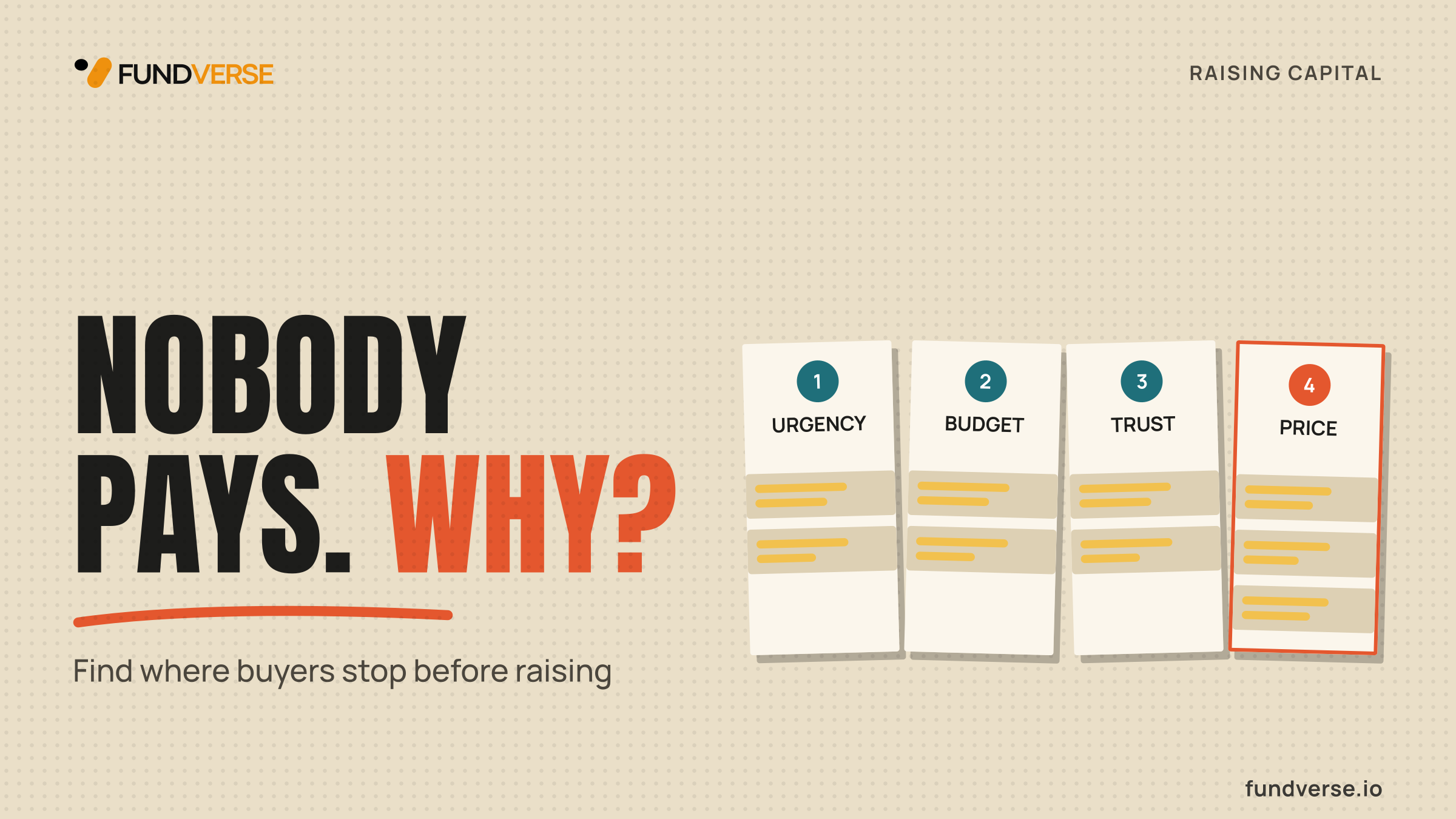
Four places buyers stop
A purchase is a sequence, not a moment. Someone has to feel a problem sharply enough to act. Someone has to hold a budget that could pay for the fix. That person has to trust a young vendor with something that matters. And the price has to look sensible against what the problem costs. Buyers can fall out at any of those steps, and the repairs have almost nothing in common.
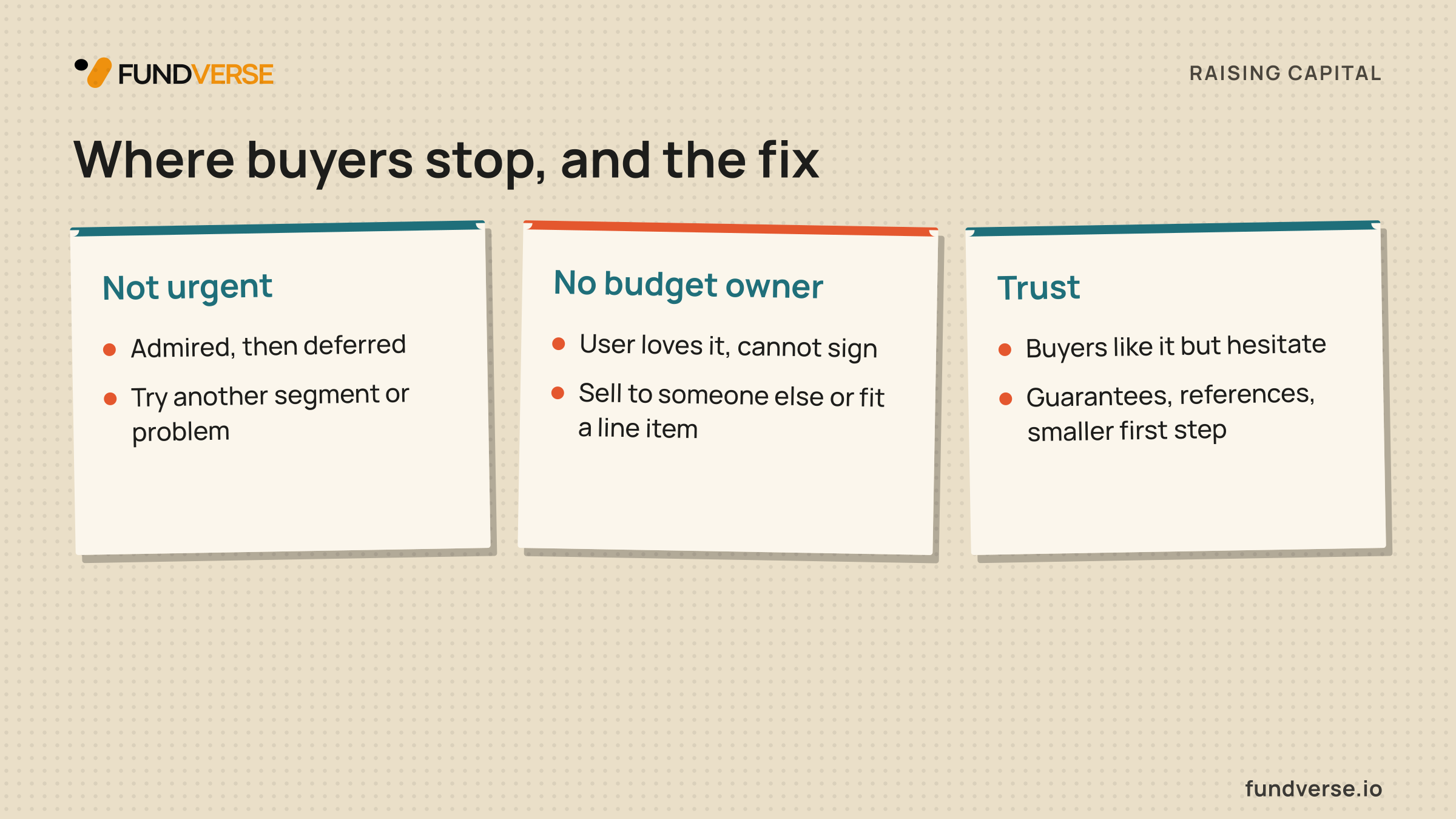
If the problem isn't urgent, people admire the product and defer it indefinitely, and the fix may be a different segment or a different problem. If the user loves it but cannot sign, there is no budget owner, and the fix is to sell to someone else or package the product so it fits a line item that already exists. If buyers like it but hesitate, the issue is trust: a small vendor can vanish, so guarantees, references and a smaller first commitment matter more than a new feature. And if the price is wrong, wrong can mean too low. A price beneath the level at which anyone has to think seriously gets ignored, or read as a toy.
Notice how little of this more features or more awareness touches. Awareness helps only when the stopping point comes before conversations exist, and this founder already has conversations. Features help only when buyers name a missing capability as the reason they won't pay, which is rarer than founders hope and different from asking for it politely.
Interest is not willingness to pay
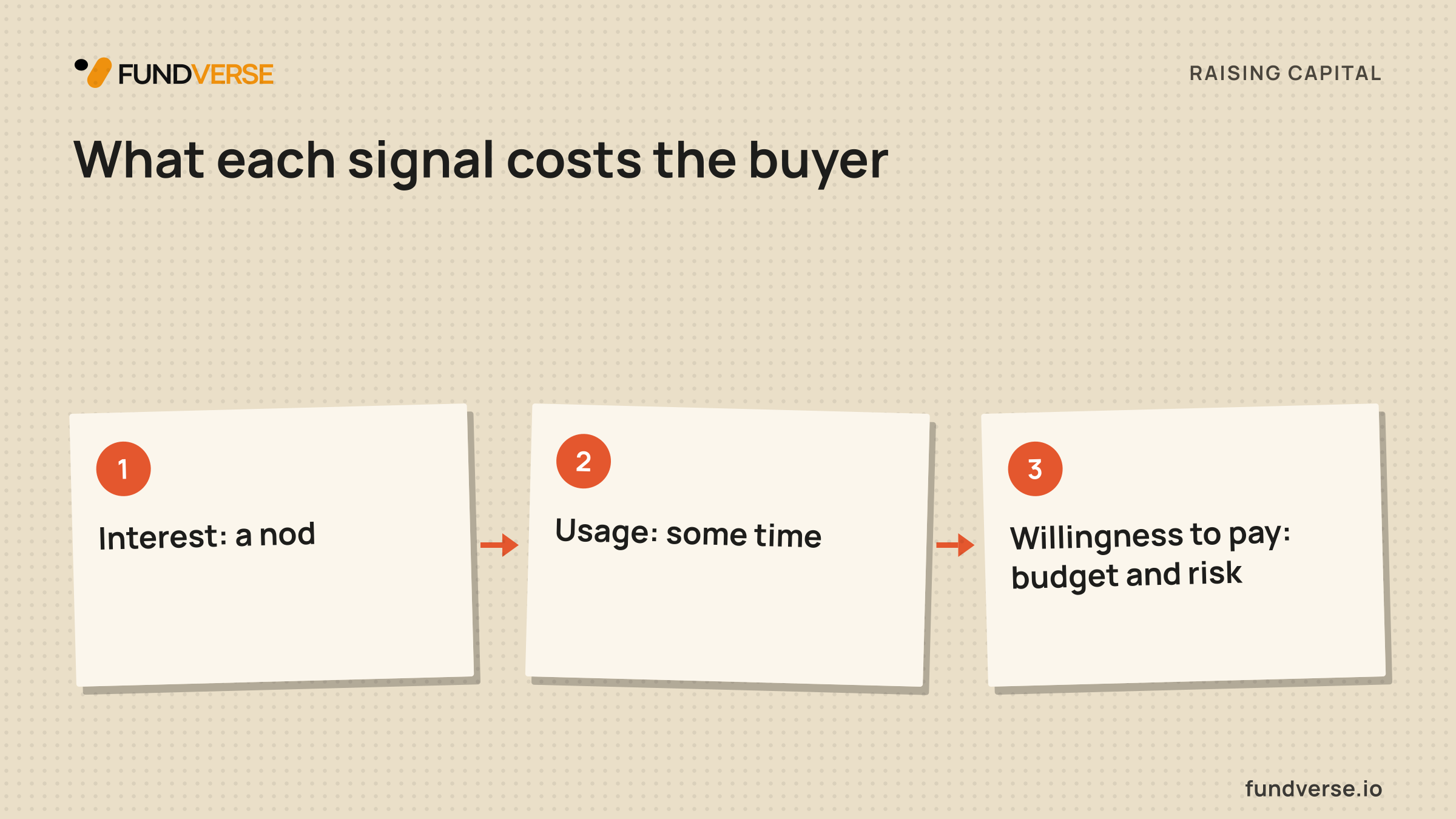
Three things get blurred in early selling. Interest costs the other person a nod. Usage costs them some time. Willingness to pay costs them budget, plus the risk of being the person who chose you if it goes badly. Only the third is revenue, and only the third survives contact with a finance department.
Free pilots measure usage, and they are poor evidence of the rest, because free removes exactly what reveals willingness to pay: an approval, a comparison against alternatives, and a person who must justify the spend. A pilot that is loved and never converts is often a pilot that never met the person with the budget. Polite enthusiasm works the same way. People dislike disappointing someone who has plainly put a year into something, and "send me more information" costs nothing to say. A better test is whether anyone has done something inconvenient on your behalf: introduced you to the budget holder, signed something, moved money, changed a workflow.
A small change, a different business
Take a hypothetical. A small team spends a year building software that checks customs documentation for freight forwarders. It is priced at $49 per user per month and sold to the documentation clerks who would use it daily. Clerks try it, like it, and six branches run a free pilot. Nobody converts. The team's instinct is to spend a quarter on integrations with more shipping systems.
Now ask where buyers stop. The clerks have no budget, and even a small seat charge needs a manager's approval. To a branch manager, $49 is too small to deserve attention and too unfamiliar to trust. Meanwhile what that manager worries about is penalties. Suppose, purely as an assumption, that a documentation error costs a branch about $2,000 in storage and late fees, and that a typical branch makes three a quarter. That is roughly $2,000 a month of avoidable loss, yet the product is priced as a clerk's convenience rather than a manager's insurance.
So the team returns with three changes and no new code. The buyer becomes the branch manager. The price becomes a flat $1,500 a month per branch, large enough to be a real decision and framed against a loss the manager already recognizes. The packaging becomes a paid 60-day onboarding with a clear exit, which speaks to the trust problem. Every figure here is invented, and the managers might still say no. But each change tests a stopping point directly, within weeks, while the integrations would have tested none of them in a quarter.
What the money would actually buy
Raising before diagnosing buys more of what you are already doing. If the cause is the buyer or the price, the capital funds features nobody was blocked on, or advertising that sends more people to the same closed door. It also spends the cleanest runway you will ever have on an untested guess. The question of what the money would change that the business cannot already do applies with extra force here, and our piece on asking what the money would change goes further on it.
Capital providers also read zero revenue differently from how founders hope. An equity investor can tolerate no revenue before launch, but a finished product with months of selling behind it is information: you asked the market and it did not say yes, so the first question will be what you learned. A lender underwrites repayment from cash flow, and zero revenue leaves nothing to underwrite except collateral or a guarantor, which makes debt both hard to get and dangerous to take. A grant maker wants to know the work will outlive the grant, and zero revenue after launch invites doubt about whether beneficiaries value it enough to keep it going. In every case, a founder who can say where buyers stopped and what was tested sounds far stronger than one asking for money to try harder.
The best case for the other view
Sometimes it really is the product. Some products solve no problem anyone has, and no price rescues them. Some markets also move slowly by nature: enterprise software with long procurement cycles, regulated sectors, deep technology, marketplaces that need both sides before either is useful. In those settings, zero revenue early on is expected, and raising against technical or regulatory milestones is entirely rational. There is a second risk too. Cutting the price until someone says yes can masquerade as a pricing fix when it is really a finding that only free works.
I accept all of that, and it narrows the argument rather than defeating it. In slow markets the absence of revenue is planned and the milestones are defined. The case I mean is different: the product is finished, selling was supposed to have started, and nobody has separated the reasons it hasn't. Even the founder who concludes it is the product should reach that conclusion by locating the stopping point, not by default.
Sixty days to a diagnosis
The aim is a clear answer, not a rescue. A workable sequence looks like this:
- Week one: list every serious conversation so far and mark where each one stopped: no urgency, no budget owner, no trust, or no price fit. Use what people actually said, not what you wish they meant.
- Weeks one to three: go back to ten stalled or lost prospects and ask what would have had to be true for them to buy, and who would have had to approve it. Ask about money and process, not features.
- Weeks two to four: change the buyer or the price for a fresh batch of prospects, one change at a time if you have enough conversations to tell which mattered.
- Throughout: ask for something that costs the other side, such as a deposit, a signed paid pilot or a purchase order, rather than another meeting.
- By day 60: if one segment responds and the others stay silent, decide whether to narrow, reprice or stop.
Narrow when the same stopping point repeats across most segments but one group clears it, which suggests your real market is smaller and sharper than the one you pitched. Reprice when conversations reach the budget holder and die on the number, or when low prices draw shrugs. Shelve the product when urgency is missing in every segment you can reach, when the only people who pay see it as a favor to you, or when the price buyers will accept cannot cover the cost of serving them. Shelving is a result, not a failure, and it stops you from persuading someone to fund a product that would have consumed the money without teaching anything. If the diagnosis does show that capital is the right remedy, say for a build that genuinely needs it, you will be raising with evidence, which is what promising businesses often lack when they go to investors.
If your diagnosis points to a real funding need, Fundverse for founders can help you prepare the evidence and reach investors who fit your stage.
So here is the question to settle before any investor sees your numbers: who was the last person with a real budget that you asked to pay, and what exactly did they say no to?
Frequently asked questions
Topics
no paying customers
startup pricing
willingness to pay
product market fit
free pilots
raising capital
startup diagnosis
zero revenue
Raising or investing?
Find the right people on the other side of the table, and run the round in one place.