
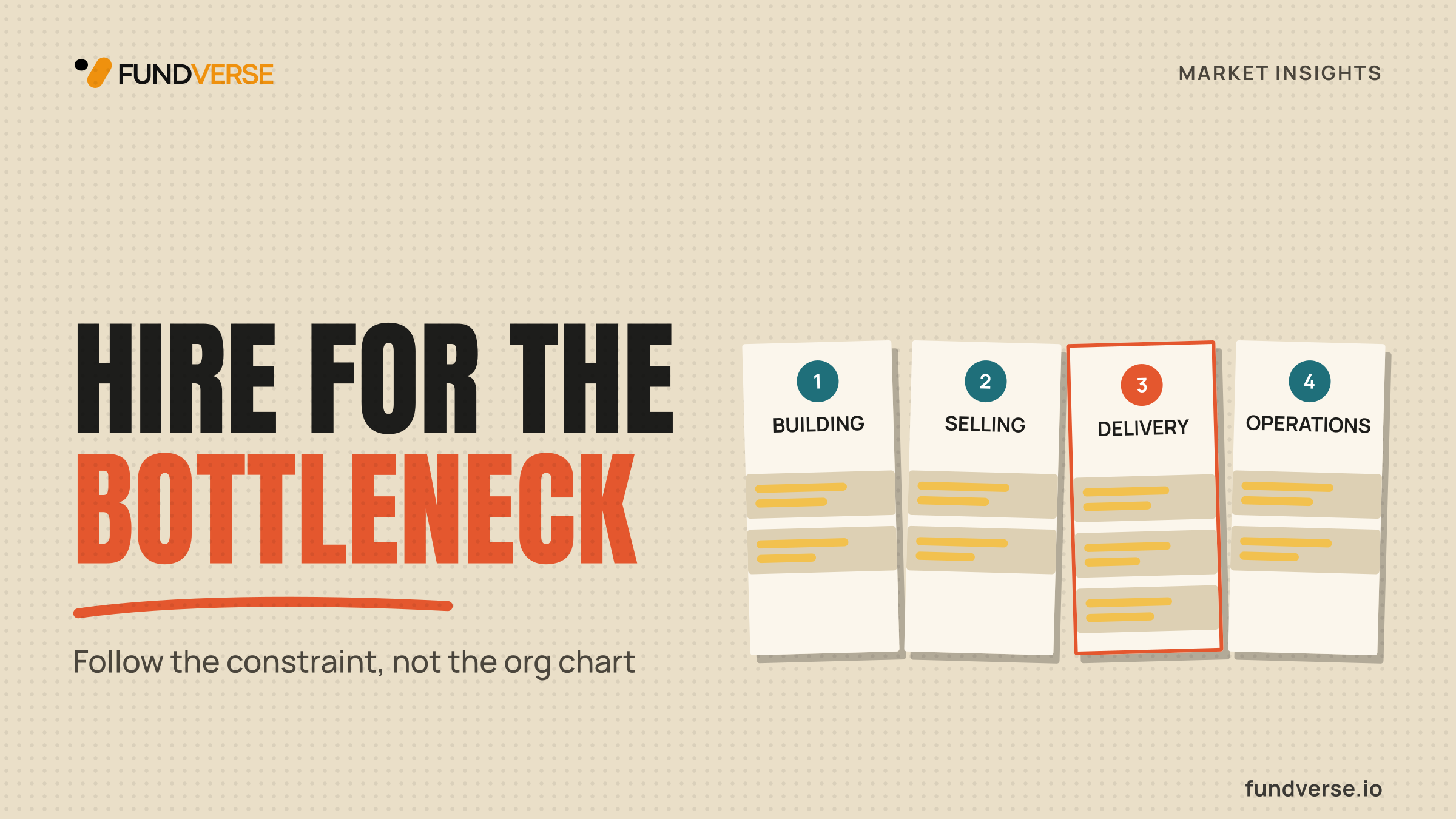

Early hires work best when they follow the constraint holding the business back, not a template org chart. Here is how to spot the right hire, price it honestly and time it.
Most founders learn what their first hire should have been about six months after they made it. One company hires a marketing manager because the business ought to look like it is growing, then discovers that nobody has worked out what the product does for customers well enough to market it. Another founder, up late with invoices and support emails, keeps putting off hiring because every salary looks like a month of lost runway, and by the time help arrives the best customers have drifted away.
The usual advice is a sequence: a head of sales, a marketer, a finance lead, an operations manager, copied from the structure of funded companies. Those companies have that structure because they have the cash and the volume to justify it. A business with two or three founders and limited money is better served by a narrower question: what single thing limits how much this business can earn or deliver right now, and what is the cheapest dependable way to remove it? A hire is a way of turning something the founders do by hand into a function that runs without them, and it should follow that constraint.
Why the org chart misleads
An org chart describes a business that has already solved its earlier problems. A finance department exists because transactions are numerous, and a people function exists because headcount is large. Copying the chart backward gives a young business roles for problems it does not yet have, while the problem it does have goes unstaffed.
A young business is lopsided. At any moment one of four things holds it back: building the product, selling it, delivering it to customers, or operating the business behind it. Output is set by the tightest point, so improving anything else changes little. If selling is the limit, a talented operations manager simply processes orders that do not exist more efficiently.
To see how this works, take a hypothetical company, Tallyline, which makes scheduling software for independent physiotherapy clinics. The company and its numbers are invented for illustration. It has two founders: one writes the code and the other handles customers. A template would tell them to hire a marketing lead and a people manager early. Watching where their week actually goes suggests something different.
Following the constraint as it moves
In Tallyline's first months the binding constraint is building. Clinics in the pilot keep asking for the same handful of features, and the technical founder can ship roughly one a week while also fixing bugs. Revenue is waiting on the product. The right first move is extra engineering capacity, probably a contract developer working through a defined list of features, because that converts the founder's backlog into work someone else can do while she keeps ownership of the architecture.
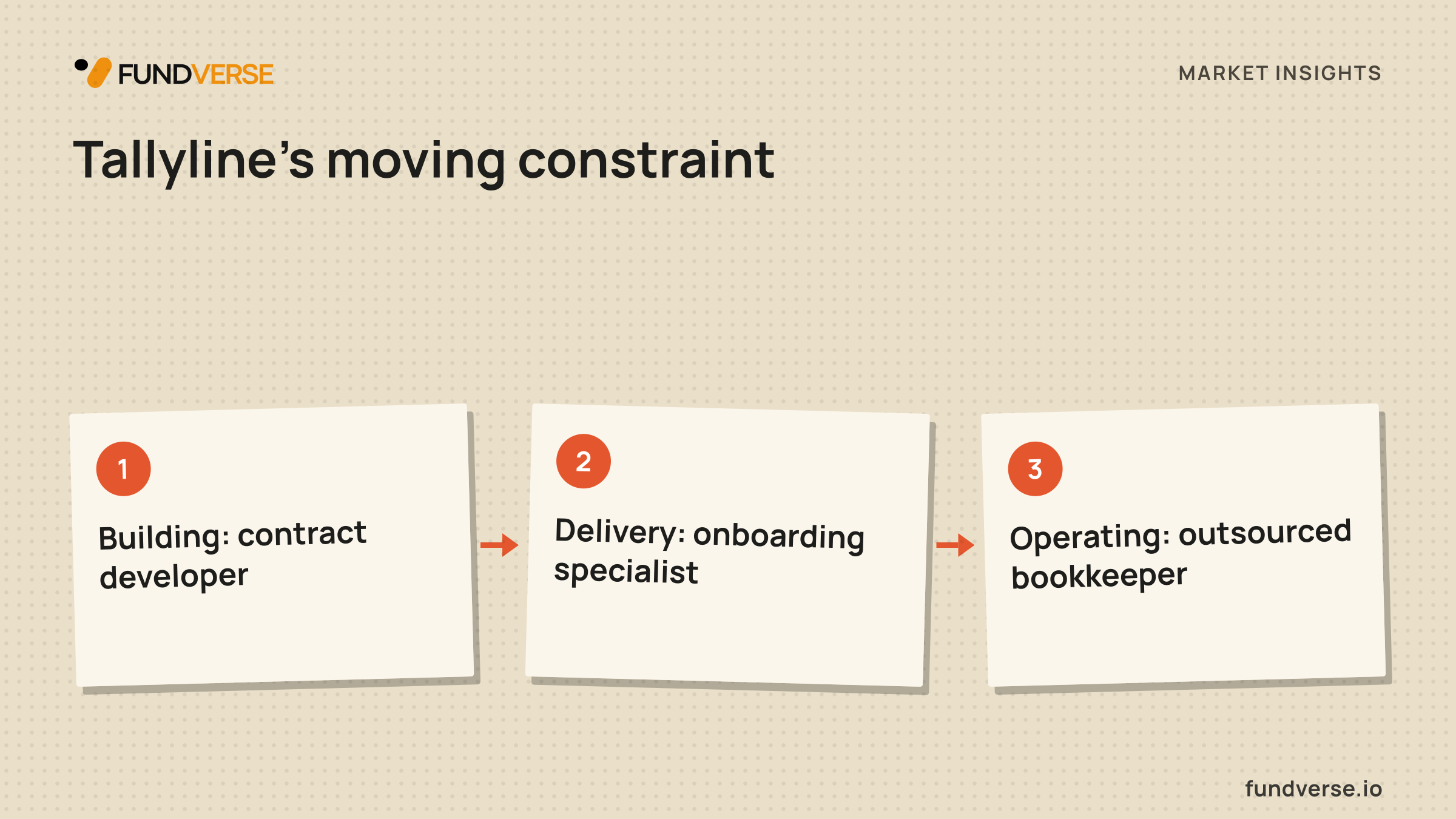
A few months later the product is stable and clinics are signing up, and the constraint quietly moves. Every new clinic needs its patient data imported and its staff trained, and each takes the commercial founder most of a week. While she is onboarding she is not selling, so delivery now limits growth. The next hire is an onboarding specialist, perhaps part-time at first. It is neither a marketer nor a salesperson, because the problem is no longer finding clinics; closing a sale has begun to create work that stops the next one. How the first customers are found is its own subject, and we have written about it separately.
Later still, invoicing happens in a spreadsheet, late payments are chased on weekends, and nobody is sure what it truly costs to serve a clinic each month. The constraint is now operating the business, and the answer is an outsourced bookkeeper rather than a finance director. Three hires answered three different constraints, none in template order. Because the constraint moves, any hiring plan drawn up in advance is a guess to be revised.
How to tell a hire is due
Knowing the constraint tells you where to look, not whether a hire is the right response yet. Three conditions together make a good signal. The founder does the work every week, not in occasional bursts. The work can be described as a clear role, with outputs someone else could be held to. And it is blocking revenue or delivery, not merely irritating.
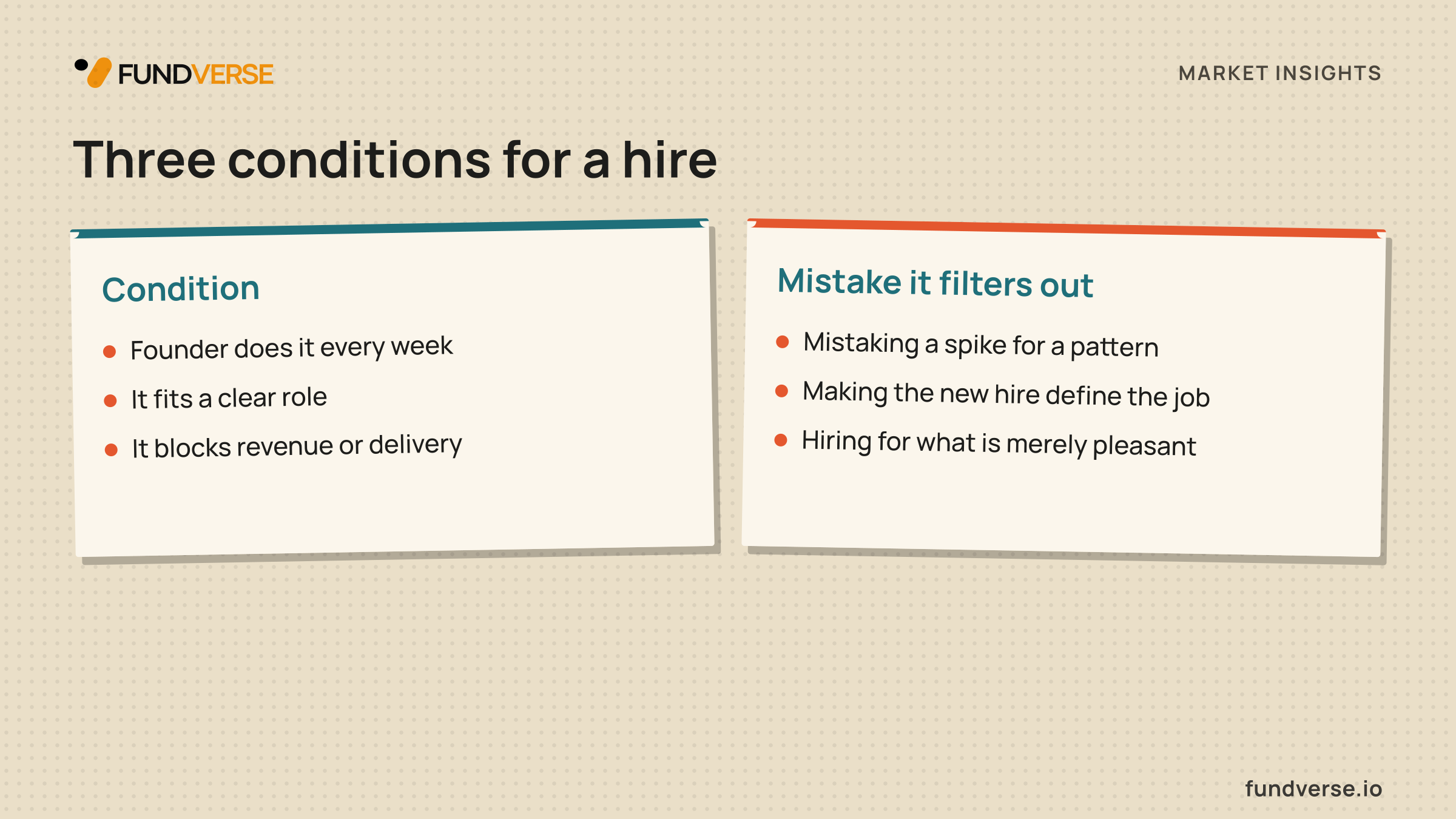
Each condition filters out a different mistake. Weekly repetition separates a pattern from a spike: a founder who spent one miserable fortnight on a data migration has not necessarily found a job. A clear description matters because a role the founder cannot define is one the new person must define alone, and founders rarely have spare time to guide someone through ambiguity. Blocking revenue or delivery separates what is needed from what would be pleasant. Tallyline's onboarding work passes all three. A vague wish for someone to help with marketing fails the second at once, and probably the third.
What a hire really costs
Salary is only the visible part of the bill. Employers usually also carry payroll taxes or social contributions, benefits, equipment, paid leave and, in many jurisdictions, notice and severance obligations that make a mistaken hire expensive to undo. These vary widely by country and contract type, so a founder should check local rules before assuming a figure. Beyond cash there is time: recruiting, then weeks or months of onboarding before the person is fully productive, then ongoing management from the same founders whose hours are the scarcest resource in the company.
Set against runway, the effect is direct. Suppose, purely as a hypothetical, that Tallyline's specialist costs the business the equivalent of a few thousand dollars a month all in, and takes a quarter to become reliable. Runway shrinks by that amount every month from day one, while the benefit arrives late. The founders need to be confident they can survive that quarter. Calculating runway before committing turns a hopeful bet into a deliberate one, and the founders' own pay belongs in the same arithmetic, as the founder salary problem shows.
That is why the first step is often not an employee. A contractor suits work with a defined end, like Tallyline's feature backlog. A part-timer suits work that is real and recurring but does not fill a week. Outsourced finance suits specialized, regular work such as bookkeeping and payroll filings, where an expert for a few hours a month beats a generalist full-time. The trade-offs are real: contractors carry their knowledge away when they leave, rules for classifying them differ by jurisdiction, and work at the core of what makes the business distinctive usually deserves an employee invested in it. For peripheral, definable work, though, flexible arrangements keep the commitment proportionate to the evidence.
Business type changes the first hire
Tallyline's sequence suits a software company, where building comes first and the work scales without much new labor. Other businesses hit different walls. In a service SME, such as a small accounting practice or design studio, revenue is limited by the founder's own billable hours, so the first hire is delivery capacity, a second practitioner, which frees the founder to sell. For a manufacturer the binding constraint is often operations, meaning production, quality control and procurement, so the first hire is more likely a skilled production lead than anyone in sales.
| Business type | Usual binding constraint | Common first hire |
|---|---|---|
| Software startup | Building, then delivery to new customers | Contract developer, later an onboarding specialist |
| Service SME | The founder's billable hours | A second practitioner or delivery associate |
| Manufacturer | Production and quality | A production lead or skilled operator |
The source of capital shapes what a business will be expected to justify. Equity investors typically back a plan, so they ask what the money hires and what each hire is meant to unlock; they tend to be wary of a team built far ahead of evidence, and of founders doing everything with no path to delegation. Lenders think about repayment: a new salary is a fixed cost that competes with debt service, so they favor hires that protect or add cash flow. Grant makers focus on delivery and ask who will carry out the funded work, which is why execution ability matters so much in grant vetting. A grant-funded role may also be stranded if the funding ends, so it should be able to survive without it. How these sources differ is covered in our guide to equity, debt and blended capital.
Warning signs on both sides
Hiring too early looks like a role description that keeps changing, a new person waiting to be told what to do because the founders have not settled it themselves, and a payroll that grew while revenue did not. Motive is another tell: if a hire is meant mainly to make the company look serious to investors, it is probably the wrong hire.
Hiring too late is quieter. Founders repeat the same task month after month, customers wait longer for answers, deals slip because nobody had time to follow up, and basic records fall behind. The deeper danger is dependence: if one founder's illness or burnout would stop the business, the missing hire is already costing something, just not on the income statement. Exhaustion also distorts judgment, so founders who delay too long tend to hire in a panic and badly.
If a hire is part of what you plan to raise for, Fundverse can help you get your fundraising readiness, runway assumptions and financial analysis in order, so you can show investors or lenders exactly what each role is meant to change.
A test before opening a role
Because both errors are costly, a simple test helps before any job is posted. Founders can ask three questions:
- Can I state this role as an outcome in one sentence, and say which revenue or delivery problem it removes?
- Could a contractor, part-timer or outsourced service handle it for the next quarter at lower cost and commitment?
- Could we carry the full cost of this person for a year without relying on the revenue the role is meant to unlock?
A yes to the first and third, and a no to the second, means the hire is due. Tallyline's onboarding specialist passes: the outcome is faster launches for new clinics, no contractor could hold the knowledge of its customers, and the founders can fund the role through a slow first quarter. A head of marketing fails at the first question. If the answers are mixed, the founder has found either work to define further or a flexible arrangement worth trying first. The business is better served by that patience than by an org chart borrowed from a company with different problems.
Before the next hiring decision, write down the one constraint currently limiting your business and check that your plan addresses it. Expect it to move as you grow, so revisit the plan whenever customers, products or cash change meaningfully. If you are raising, expect capital providers to ask what each hire will change, and that question is worth answering for yourself first.
Frequently asked questions
Topics
first hires for startups
early-stage hiring
when to hire first employee
startup hiring plan
hiring and runway
small business hiring
contractor vs employee
fundraising and headcount
Raising or investing?
Find the right people on the other side of the table, and run the round in one place.