

AI is cutting the cost of building software and the number of seats needed to use it. Here is which SaaS advantages still hold, which are eroding, and what founders and investors should reassess.
A software subscription has never really been a payment for software. It has been a payment for avoided effort: the effort of building a tool, hosting it, maintaining it, training staff to use it and keeping its data consistent. For two decades B2B SaaS priced that avoided effort per user per month, and the arrangement proved so dependable that investors came to treat the resulting revenue as some of the most predictable income in business.
AI puts pressure on nearly every link in that chain at once, which is why the usual debate, whether software is dead or AI is just another feature, asks the wrong thing. The more useful question is which parts of a SaaS company were genuinely scarce, and which of them still are. Along the way it helps to sort the evidence into three piles: what is already happening in the market, what is emerging but uneven, and what remains speculation.
What the subscription was really selling
The classic SaaS model rested on a few economic facts. Writing good software was expensive and slow, so a vendor could build once and sell the same product to thousands of customers at a low marginal cost, which produced high gross margins. Customers paid every month because the vendor kept hosting, fixing and improving the product, and because leaving meant migrating data and retraining people. Pricing per seat made the bill grow as the customer grew, and since each seat represented a human doing a job, the vendor's revenue tracked the customer's headcount.
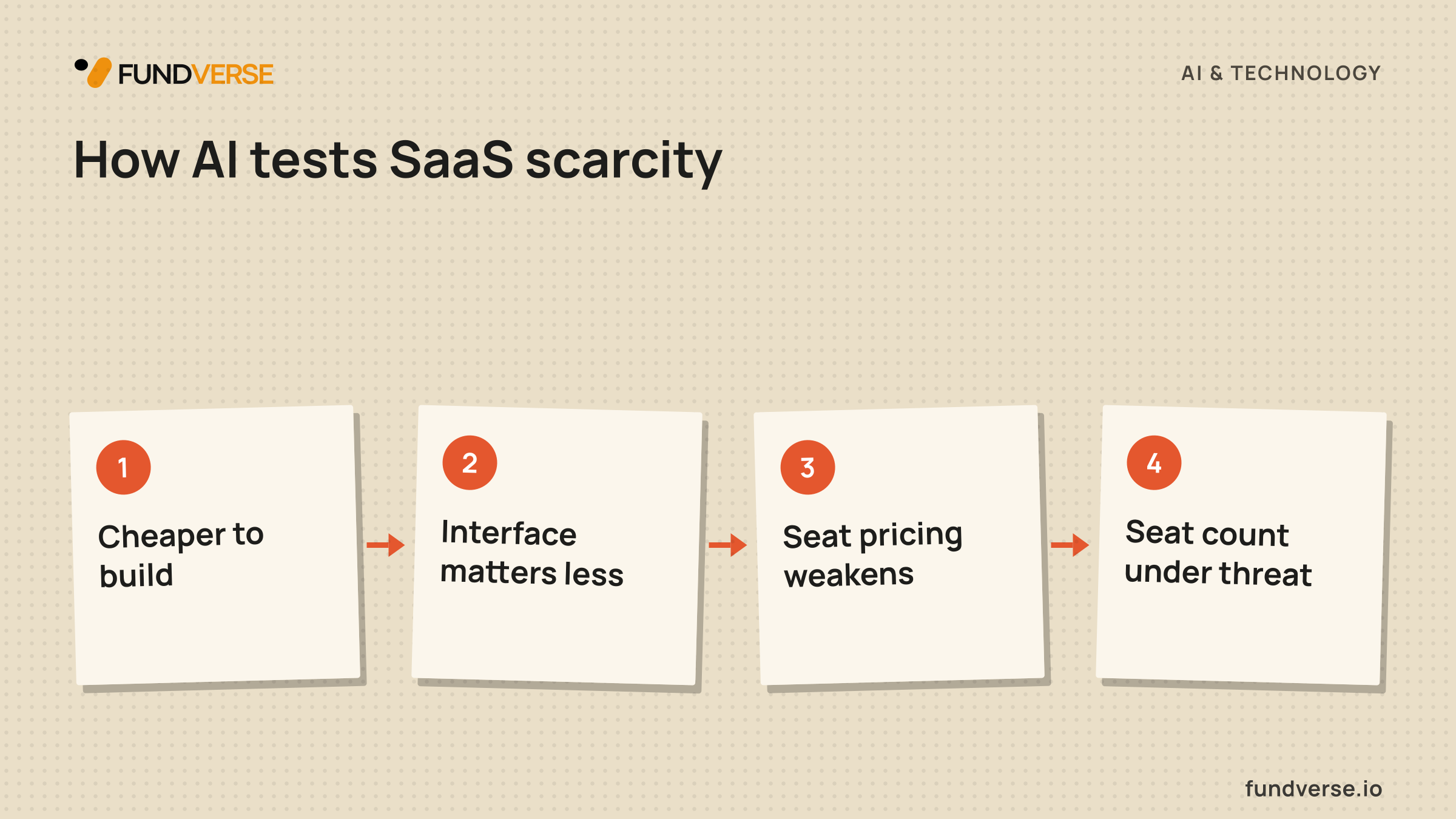
Each of those facts is a source of scarcity, and AI tests them in a particular order. First it lowers the cost of building. Then it reduces the importance of the interface, because software can now be operated by other software. Then it weakens the pricing unit, since a seat is a poor measure of value when work is done by agents, meaning programs that take a goal, break it into steps and carry them out using other tools. Finally it threatens the seat count itself. Investors valued SaaS on the durability of the recurring revenue that sat on top of these facts, so if the facts shift, the valuation logic has to shift with them. That makes this an investment question as much as a product one.
Cheaper to build, harder to defend
Coding tools shrink the build moat
AI coding assistants and coding agents can now draft, test and revise a substantial amount of working code from a plain-language description. This is already happening: small teams ship products that once needed much larger engineering groups, and some customers build simple internal tools themselves rather than buying them. The direct effect is a lower cost and shorter time to a working version of almost any workflow application, such as a basic approvals tool, a reporting dashboard or a simple customer portal.
A vendor's code was never the whole product, but it was a barrier: a competitor needed years and capital to catch up on features. When that barrier drops, features stop being a durable differentiator and the competitive set widens, because a well-funded rival, a nimble startup or a customer's own engineers can reproduce the visible surface of a product quickly. Feature parity becomes a short-lived condition rather than a lead.
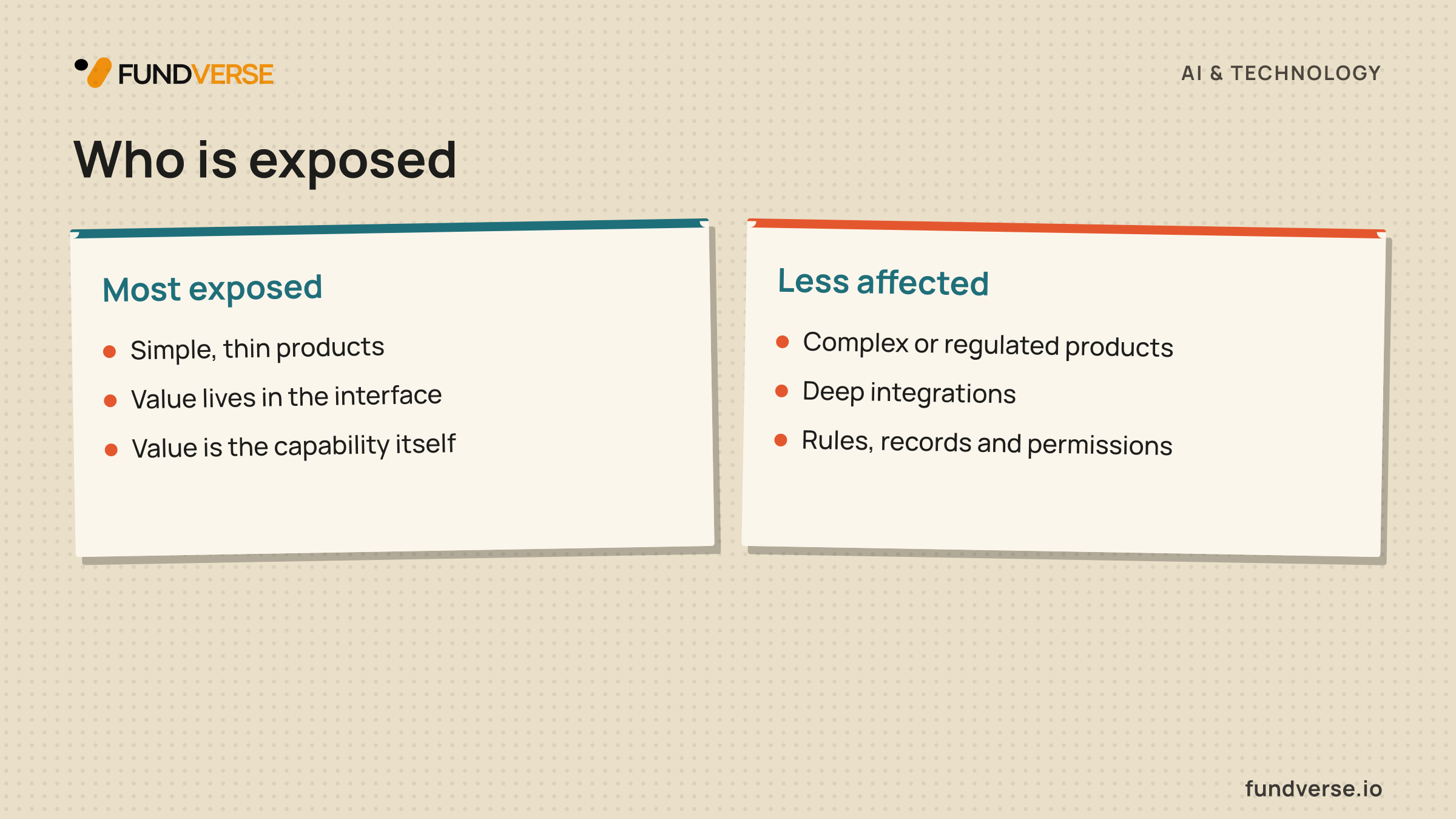
There is a counterweight. Writing code was only one cost of running software. Reliability, security reviews, compliance, uptime, support and the slow work of handling edge cases in real customer environments remain expensive, and they are why many buyers prefer paying a vendor over maintaining a homemade tool. A company that builds its own expense approval app has also bought itself a maintenance obligation and someone whose job is to keep it working. Cheaper building therefore pressures simple, thin products hardest and leaves complex, regulated or deeply integrated ones less affected. How far self-built software spreads inside large organizations is still open; the direction is clear, the scale is not.
When the interface stops mattering
Much of what customers paid for was a well-designed screen: forms to fill in, dashboards to read, buttons that triggered the right steps. That value assumed a person sat in front of it. When an agent can read the data, call the right functions and complete the task without anyone opening the product, the screen becomes optional. A product whose worth lies mostly in its interface loses the thing it charged for, while a product whose worth lies in the rules, records and permissions behind the screen keeps it. This is the bridge from the build question to the next one: if neither code nor interface is scarce, what is left is whatever sits behind them.
When a product becomes a feature
The second pressure comes from above. Large AI platforms and the major productivity suites can add capabilities such as drafting documents, summarizing meetings, analyzing spreadsheets and answering questions across a company's files, and they do so to a user base they already own. A standalone product that does one of those things well can find that its core function has become a menu option elsewhere. This is already visible in categories like note-taking, transcription and basic writing assistance, where the dedicated tool must justify itself against something the customer already pays for. Chegg, whose homework-help business lost ground as general-purpose models answered the same questions for free, is a commonly cited case of a product value that lived mostly in the capability itself.
Whether a product turns into a feature depends on how much of its value lives inside the capability and how much lives around it. A summarization tool whose value is the summary is exposed, because a general model can produce a comparable one. A tool that holds a customer's contracts, approvals history and audit trail has something the platform lacks, however good the platform's model is. The question to ask of any product is whether a customer would still need it if the model inside it were free and equally good everywhere.
The platforms also have limits. A general assistant needs access to a company's systems to be useful, and that access is granted by the systems that hold the data, usually with their own permissions, rules and commercial terms. Platforms depend on integrations they do not own, which gives the owners of those systems leverage. Whether platforms ultimately absorb many standalone products or mostly sit above them as a coordinating layer is not settled, and anyone claiming certainty is forecasting.
Pricing when the user is software
Why seats start to leak
Per-seat pricing works when value scales with the number of people using the tool. Take a support platform that charges for each human agent. Purely as arithmetic, if a customer has 100 agents and AI resolves enough routine tickets that 70 can handle the rest, the vendor's seat revenue falls by 30 percent at the moment its product is performing best. The better the AI works, the fewer seats are sold. That is a structural conflict between the pricing unit and the value delivered, and it is arguably the most important commercial change in the sector.
Evidence of this is mixed and early. Some customers have reduced headcount in support-heavy functions, and some vendors have begun experimenting with new pricing because of it. Many seat-based vendors have not yet seen seat counts fall materially, partly because adoption inside large companies is slow and partly because AI has often expanded work rather than replacing workers. Seat compression is an emerging mechanism, strong in some functions such as customer support and certain kinds of coding and content work, and unproven in others.
Usage and outcome pricing, and their costs
The obvious response is to charge for what the software does rather than for who logs in. Usage-based pricing bills for consumption, such as tasks completed, documents processed or messages handled. Outcome-based pricing goes a step further and bills when a defined result occurs, such as a resolved ticket or a qualified lead. Both align price with value, and both are easier to sell to a customer that expects to employ fewer people.
They also change the economics in ways that are easy to underestimate. Revenue becomes variable, so forecasting is harder and the customer can scale spending down as readily as up. AI also carries real marginal cost: each task consumes computing resources paid for per use, so gross margins are no longer the near-pure software margins investors grew used to. A vendor charging a flat seat fee while its heaviest users run expensive AI workloads can find its margin squeezed by its most enthusiastic customers. Outcome pricing adds a measurement problem, because someone must agree on what counts as a resolved ticket and who decides when the AI got it wrong. A company adopting these models is trading predictability for alignment, and should price that trade deliberately.
What happens to recurring revenue
Recurring revenue does not disappear when fewer humans are needed; it changes character. Under seats, it was contractual and tied to headcount. Under usage or outcomes, it recurs only if the customer keeps sending work through the product, which depends on the product staying embedded in how the work gets done. A hybrid structure, a platform fee that secures the relationship plus variable charges for consumption, keeps some of the old predictability while sharing in growth. Pure consumption models behave more like infrastructure businesses, with revenue that rises and falls with customer activity.
For investors, measures such as annual recurring revenue now need more interpretation. Two companies reporting the same figure can have very different quality of revenue, depending on whether it is committed, usage-linked or exposed to seat reductions. Retention should be read along two lines: whether customers stay, and whether what they spend holds when their staffing changes. Net revenue retention that depends on seat expansion deserves more scrutiny than it once did.
Which advantages actually hold
If building, interfaces and seats are less scarce, what remains scarce? Five candidates are usually named, and they are not equally strong. Proprietary data matters when a product accumulates information that cannot be obtained elsewhere and that improves outcomes, such as transaction histories, domain-specific records or feedback from real decisions. Data that merely sits in the product but could be exported and loaded into a competitor's tool is a weaker advantage than it looks. Data that is both unique and continuously refreshed by the product's use is strong.
Integrations connect a product to the other systems a business runs on, and each connection is slow to build, needs maintenance and carries trust. Agents raise their importance, since an agent is only as useful as the systems it can act within. Distribution, the ability to reach and sell to customers cheaply, grows more valuable as building gets easier, because when anyone can make a product, attention and trust become the bottleneck. Customer relationships matter most where buyers depend on a vendor for compliance, security or accountability and are reluctant to hand critical work to an unknown newcomer.
The one that ties the others together is workflow ownership: being the place where work is started, approved, recorded and audited. A system of record, such as the ledger, the customer database or the employee file, is hard to displace because the business's rules, history and permissions live inside it. AI tends to weaken tools that sit beside the work and strengthen those that sit underneath it. An agent can do the job of an interface, but it still needs a trusted place to read from and write to.
All of these are advantages only if customers value them enough to pay. Integrations that a customer could rebuild with an agent in an afternoon, or data the customer owns and can take elsewhere, offer less protection than the vendor assumes. The test is switching cost in practice: how much risk, time and disruption would a customer face if it moved to a cheaper AI-built alternative?
Applied across the market, the pattern is a spectrum rather than a verdict. Thin workflow tools, single-task utilities and content or reporting products without unique data are most exposed, because their value sits in the interface or in output a general model can generate. Seat-priced software for high-volume routine work, such as support, has real value but a revenue model that shrinks as it succeeds. Software that holds the record, carries regulatory responsibility or sits in the flow of money, such as finance, HR, compliance and vertical platforms with embedded payments, is more likely to become more valuable, because agents increase the amount of work routed through it. Within any category, a single company's position depends on whether it owns the data and workflow or only decorates them. This is editorial judgment, not measurement.
Adapting, and what capital should ask
Beyond bolting on a chatbot
Adding an AI assistant to an existing product is the easy response, and it is rarely enough. If every competitor can add the same assistant using the same underlying models, it becomes table stakes. More meaningful adaptation changes what the product does. It can move from helping a person do a task to completing the task, which requires redesigning the workflow, handling errors and defining when a human must step in. It can expose the product to other software through open interfaces, so that agents can use it rather than bypass it. And it can change what the company sells, from access to a tool to delivery of a result.
Evidence from real companies is uneven and still developing, so conclusions should stay modest. Salesforce and Intercom have both introduced agent products and moved toward charging by task or resolution rather than by seat alone, which shows the strategic direction even where the results are not yet clear. Microsoft has packaged its AI assistant into its productivity suite, using the distribution it already owns, which defends renewals and tests how much customers will pay for the added capability. Some collaboration, design and education tools have faced visible pressure from AI-native entrants and from general models. Companies that reshape their pricing also tend to discover the margin and forecasting issues described above. These are indications of direction, not proof of which strategy wins.
Weaker adaptations tend to share a pattern: AI is added as a surface layer without changing pricing, data strategy or the workflow, and customers come to expect the new capability for free. The stronger ones are those where the vendor already owned data or a system of record and used AI to make that position more useful. That is consistent with the earlier argument, though the sample is small and many bets are still unresolved.
Startups, investors and valuations
For startups, the lower cost of building cuts both ways. A small company can reach a working product with less capital, which can shrink early funding needs and make ideas cheaper to test. But a product that is easy to build is easy for others to build, so early traction proves less than it used to. Investors who once treated a working product and fast early growth as meaningful signals now need to ask what stops a competitor from reaching the same place within months. For founders raising capital, the case should rest on evidence of retention, data and customer embedding rather than on features shipped.
Valuation follows from margins and durability. Classic SaaS multiples assumed high gross margins and long customer lifetimes. AI-heavy products carry computing costs that reduce margin, and uncertain defensibility shortens how long future cash flows can be trusted. Investors may reasonably apply lower multiples to companies whose margins look more like services or infrastructure, and higher ones where data or system-of-record position is strong. How the market resolves this is not known, but a standard recurring-revenue multiple hides the very differences that now matter most. A founder can test how growth and margin assumptions affect value with the startup valuation calculator, and should expect investors to push on the same assumptions. The mistakes that make investors question a financial model are especially costly when pricing and margins are in flux.
Diligence questions should adapt as well. How much revenue depends on seats, and what happens if customers need a fifth fewer staff? What share of cost is variable AI usage, and how does it move with volume? Which data does the company hold that customers cannot simply export? How hard would it be for a customer to replace the product with an agent and internal tooling? How much of the product's value would survive if the underlying model became a commodity? These questions apply equally to equity investors, lenders assessing recurring revenue as repayment capacity, and acquirers.
Founders building B2B software and investors assessing it can use Fundverse to prepare and evaluate the evidence these questions call for, from financial analysis and valuation tools to data room management and investor matching.
Sorting fact from forecast
Already happening: coding tools lower the cost of building, platform vendors absorb simple capabilities, pricing experiments are underway and AI usage costs are changing margins. Emerging: seat compression in support-heavy and content-heavy functions, a shift toward hybrid and usage pricing, and the growing importance of systems of record as agents act on them. Speculation: that most standalone software will be absorbed by AI platforms, that seat pricing will disappear, or that custom-built software will replace large vendors. Each could prove partly right, and none has been demonstrated at scale. The sensible posture is to plan for a range: assuming nothing changes risks surprise from falling seats and cheap competitors, while assuming everything changes risks abandoning durable franchises or paying for AI-washed growth stories. The mechanisms are clear enough to act on, even where the timing is not.
Rebuild around the work, not the seat
For founders building B2B software, three things deserve reconsidering. On the product, ask whether it owns something an agent needs, such as the record, the data or the approval step, or whether it is mainly an interface a model could replicate. On pricing, ask what the customer actually values and price near it: if your product's success reduces the customer's need for people, a per-seat model punishes you for working. Test hybrid structures, understand your cost per task, and make sure your margin survives your heaviest users. On competitive advantage, invest early in the things that compound, meaning proprietary data, integrations, distribution and the customer's trust, rather than features a rival can match within a quarter.
Take your own product and imagine a customer who has an AI agent, an engineering contractor and a free month: what would that customer still have to come to you for, and would they pay for it by seat, by use or by result?
Frequently asked questions
Topics
B2B SaaS
AI disruption
per-seat pricing
usage-based pricing
SaaS valuations
software moats
AI agents
systems of record
Raising or investing?
Find the right people on the other side of the table, and run the round in one place.