
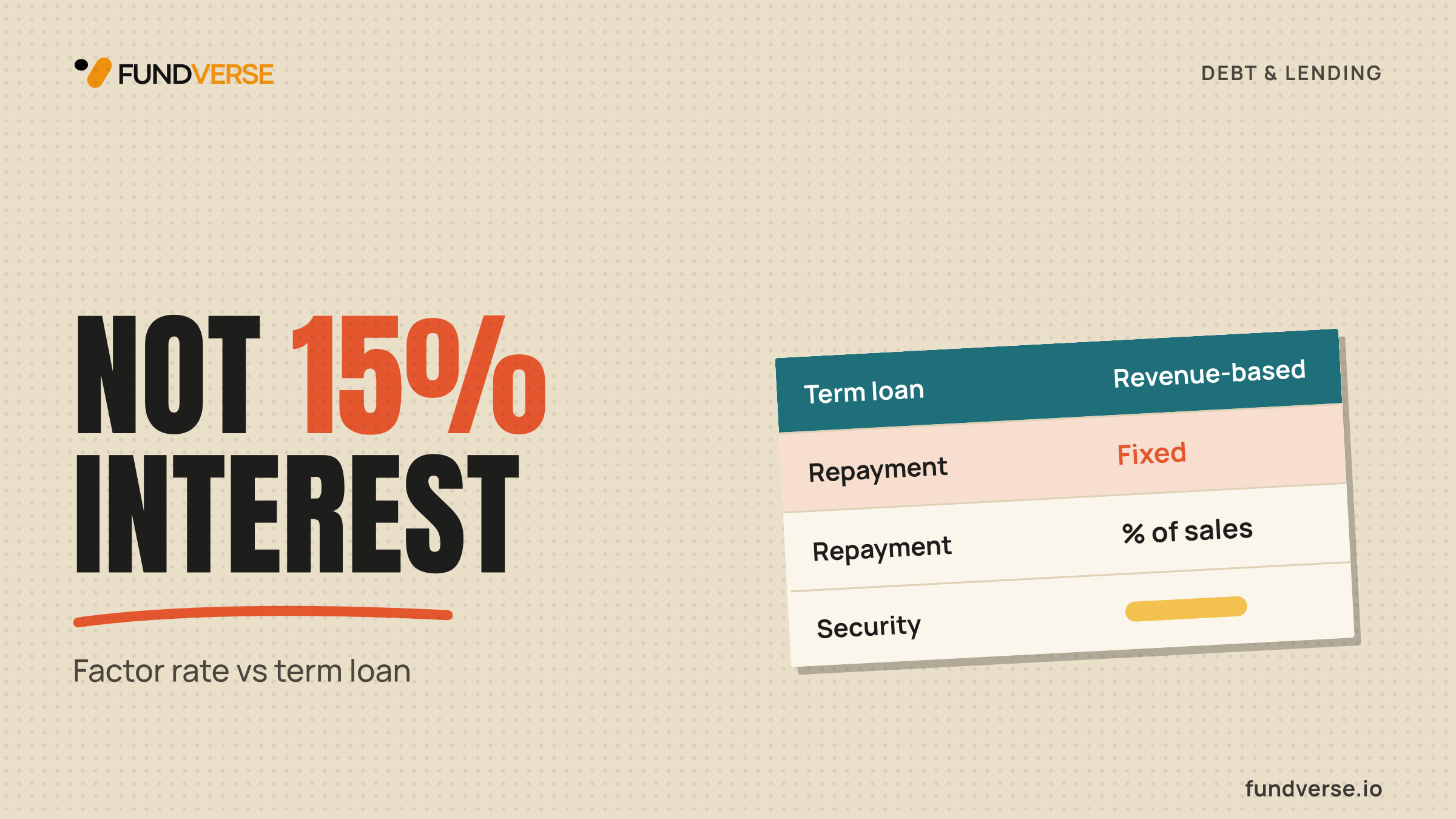

A factor rate is not an interest rate. See how revenue-based financing and term loans behave on the same hypothetical business, and how revenue, margin and growth should decide which fits.
A factor rate of 1.15 is not a 15% interest rate, and treating it as one is the most common way owners misjudge revenue-based financing. A factor rate is a multiplier applied to the amount advanced to fix the total that must be repaid: take $100,000 at 1.15 and the business owes $115,000, however long that takes. Whether 15% is cheap or expensive depends on how quickly the money comes back, and that depends on the company's revenue, not on anything written in the contract.
That dependence is what separates revenue-based financing from a conventional term loan. They are not two prices for the same money; they are two repayment mechanisms. A term loan tests, before any money moves, whether the business can carry a fixed schedule in a bad month as well as a good one, and it backs that test with security. Revenue-based financing skips most of that test and lets repayment follow sales, which is why it usually costs more once annualized. Comparing the two properly therefore means asking how and when each is repaid, and what that does to the business's cash.
How a bank decides to lend
The core difference is simple to state. A term loan is repaid on a fixed schedule out of the business's general cash flow, whatever its revenue did that month. Revenue-based financing is repaid as a percentage of revenue until a fixed total has been paid. Because the first obligation does not bend, the lender's whole assessment is built around one question: in a poor year, will this business still make every payment?
The main measure is debt service coverage, usually expressed as a ratio (DSCR): the cash the business generates before debt payments, divided by the scheduled payments of principal and interest. A ratio of 1.0 means every unit of cash goes to the lender. Lenders want a cushion above that, and the level they set varies by institution, sector and country. They also look at trading history, because a few years of accounts show how the business behaves when conditions turn, and they ask what stands behind the loan if cash flow fails. That second answer comes in two forms. Collateral is an asset the lender can claim and sell if the loan goes unpaid. A personal guarantee is the owner's own promise to repay from personal assets if the company cannot.
Why young companies often fall short
Each of those tests is hardest on a young or asset-light company. Software, services and online retail businesses may have little to pledge beyond receivables and equipment. A short history gives a credit analyst few downturns to examine. And a company reinvesting its profits into growth reports thin cash flow after costs, so coverage looks weak even when the business is healthy. The usual outcomes are a decline, a smaller loan, or an approval that depends on a personal guarantee or on property outside the company. In some countries, government-backed guarantee schemes soften this, but their availability and terms differ widely.
What each product looks like on paper
The structure of a term loan
A term loan is priced with an interest rate, which may be fixed or floating (moving with a benchmark rate), plus fees such as arrangement or commitment charges. The tenor is the length of the loan, and amortization describes how it is repaid: each equal payment is part interest and part principal, so the balance falls month by month. Loans also carry covenants, which are promises the borrower makes. Financial covenants are tests such as a minimum DSCR, and operating covenants restrict things like taking on more debt or paying dividends. Our article on covenants, security and guarantees goes through these clauses in detail.
A missed payment starts with late charges and often a higher default rate of interest. If it is not cured, it can become an event of default, which typically lets the lender demand the entire balance at once (acceleration) and enforce its security and any guarantee. Through all of this the schedule stays the same however the business is trading.
The structure of revenue-based financing
In revenue-based financing, the provider advances a lump sum. In return, the business agrees to remit a fixed percentage of its revenue, typically weekly or monthly, until a repayment cap is reached. The cap is the total repayable, set at the outset as the advance multiplied by the factor rate. No interest accrues on a declining balance, and the total does not change with speed. What changes is the duration: faster sales mean a quicker payoff, and slower sales mean a longer tail. The category is loosely defined. Some products add minimum payments or a final maturity date, and some sold under similar labels behave more like merchant cash advances, which are repaid from card sales. Read the actual mechanics of any offer, not its label.
Because there is little collateral to examine, these providers underwrite the revenue stream itself. They look at how consistent it is month to month, at gross margin, at customer churn (how many customers leave) and at concentration (how much revenue rests on a few buyers). They usually verify it by connecting to accounting software, bank accounts or payment processors instead of relying on a summary the owner prepares.
One business, two products
The assumptions
The following is a hypothetical illustration, not a market benchmark: real rates, factor rates and revenue shares vary by provider and country. Take a business with revenue of $100,000 a month that wants $100,000 to fund marketing and stock. The term loan runs at 12% a year over 24 months with equal monthly payments, and fees are ignored to keep it simple. That gives a payment of about $4,707 a month and about $112,980 repaid in total. The revenue-based offer has a factor rate of 1.15, so the cap is $115,000, repaid as 8% of monthly revenue.
Steady, fast and weak revenue
If revenue stays flat at $100,000, the revenue share is $8,000 a month and the cap is reached in about 14 to 15 months. If revenue grows 5% a month, payments rise each month and the cap is reached in roughly 11 months. If revenue drops to $50,000 and stays there, the payment is $4,000 and repayment takes nearly 29 months. In every case the business repays $115,000. The term loan repays about $112,980 on any revenue path, but it demands the same $4,707 whatever happens.
The totals alone would suggest the two are close in cost, with revenue-based financing about $2,000 higher. The timing says otherwise. The term loan keeps the money for two years, while the revenue share returns it in about 14 to 15 months in the flat case and about 11 in the fast case. The same $15,000 premium buys a much shorter period of borrowing, and that raises its annual cost.
Converting a factor rate to annual cost
A rough method makes the comparison fair. Take the cost as a share of the advance, here 15%, and divide it by the average time the money was outstanding, in years. Because the balance falls as payments are made, that average is roughly half the repayment period. In the flat case, 15% over about 7.2 months comes to around 25% a year. In the fast case it is around 30% or more, and in the weak case, with payoff stretched to nearly 29 months, it falls to about 12%. A precise internal-rate-of-return calculation for the flat case also lands at about 25%, so the shortcut is close enough to compare offers. The term loan's stated 12% comes to about 12.7% with monthly compounding, before fees.
That is why setting 1.15 beside 12% misleads: the two numbers measure different things, one a fixed premium and the other a rate per year. It also explains a point many owners find counterintuitive. Faster growth makes revenue-based financing more expensive in annual terms, because the same fixed premium is earned over fewer months, while slower growth stretches repayment out and lowers the annualized cost at the price of diverting revenue for longer. Fast growth is not a bad outcome, since the money is earning its keep, but the business should know what it is paying for.
Cash flow, security and margin
The cash effect is where the mechanisms diverge most. In a weak month the term loan still takes $4,707, while the revenue share falls with sales. For a seasonal business the difference is sharper: the revenue share takes more in the peak and almost nothing in the trough, whereas the loan needs a cash reserve built in the busy season to cover the quiet one. The flexibility is a deferral, not a discount, because the cap must still be paid and a weak season simply pushes the payoff date back. In strong months the revenue share can also exceed the loan payment: in the flat case, $8,000 is nearly double $4,707. Owners often underestimate that monthly cash impact.
Coverage tests show the other side of fixed payments. The loan costs about $56,500 a year in total payments. If the business generates $70,000 of cash before debt service, coverage is about 1.24. If that falls to $55,000 in a bad year, coverage drops just under 1.0, which can breach a covenant before a single payment is missed. A revenue share has no such test, because the payment shrinks as the cash does.
Security follows the same logic. A term loan typically comes with a charge over business assets, which is a legal claim the lender can enforce, and often a personal guarantee. Revenue-based financing is usually unsecured or lightly secured, and many deals do not ask the founder to guarantee repayment. Even so, agreements commonly make the owner personally liable for narrow conduct such as fraud, misstating revenue or diverting sales away from the accounts the provider monitors, so the documents must be read, not assumed.
Gross margin, the share of revenue left after the direct costs of producing the goods or service, decides whether the revenue share is bearable. The 8% in our example comes off revenue before any other cost. For a business with a 70% gross margin it is about 11% of gross profit. For a business with a 30% margin it is about 27%, leaving far less to pay wages, rent and marketing. A revenue share paid from a thin-margin business can crowd out the operating cash it was meant to support, which is why providers look at margin as closely as at revenue.
Fit, friction and the equity question
Use of funds is the most practical guide. Money that pays back quickly, such as marketing with a measured payback, inventory that turns over fast or short-term working capital, suits a revenue share, because the revenue it generates funds its own repayment. Long-lived assets such as equipment or property suit term debt, where the tenor can be matched to the asset's useful life and the asset itself can serve as security. Using a high-cost, fast-repayment product for a ten-year asset forces the business to pay for it out of unrelated sales. Using a fixed loan for an untested marketing experiment saddles the business with payments whether or not the experiment works.
Both products carry friction that headline pricing leaves out. There may be arrangement, legal and monitoring fees. Early repayment is another point to check: on a loan it may trigger a prepayment charge, while on revenue-based financing the total is fixed, so paying early saves nothing unless the contract offers a discount. Reporting duties can include monthly accounts or ongoing access to bank and sales data. Cross-default clauses let a default on one debt trigger a default on others. Existing obligations also affect future borrowing, since a bank will count a revenue share as a claim on cash and may restrict a second lender taking security or a share of revenue.
Neither product replaces equity. Debt of either kind does not absorb losses or cure a business that has not found its market; it adds a claim on cash that ranks ahead of shareholders. An equity investor reviewing a later round will see the repayment obligations, will ask whether new money is being used to repay the lender instead of growing the business, and may count a large revenue share as a drag on the cash the round is meant to fund. Modest debt used productively can be viewed neutrally or even favorably, but the repayment schedule should be part of the financial model investors review.
Geography changes all of this. Where banks lend readily against modest collateral and rates are low, a term loan is often the cheaper route and revenue-based products have to justify their premium. In many emerging markets the picture reverses: local lending can be expensive and collateral-heavy, sometimes demanding security worth well above the loan, and many businesses cannot meet those conditions. Revenue-based providers are fewer in those markets, and some fund in hard currency, which adds currency risk when revenue is local. Availability, pricing and the legal treatment of security all vary by country and by provider.
Choosing between the two
Everything above reduces to a short set of questions, and the answers tend to point in one direction:
- How predictable is revenue? Steady, recurring revenue supports a fixed schedule. Lumpy or seasonal revenue favors a payment that flexes.
- How wide is the gross margin? A high margin can absorb a revenue share. A thin margin is better served by a loan with a known payment, if you can qualify for one.
- How fast is revenue growing? Rapid growth makes revenue-based financing costlier in annual terms. Slow or uncertain growth lengthens its payback and lowers its annualized cost.
- What is the money for? Quick-payback working capital leans toward revenue-based financing. Long-lived assets lean toward term debt.
- What security can you offer? If you have assets and a track record, a bank loan may be available and cheaper. If not, a revenue-based deal may be the only non-equity option.
- Could you use both? A term loan for equipment alongside a revenue share for marketing can work, provided the agreements permit it and combined payments stay affordable.
Four mistakes recur when owners skip this reasoning. The first is comparing only headline rates, such as a factor rate against an interest rate. The second is ignoring how growth changes payback and annual cost. The third is borrowing against revenue that is not recurring: a revenue share assumes the sales will keep arriving, and one-off projects or a single large customer make that assumption fragile. The fourth is underestimating monthly cash impact, in particular what the payment looks like in the strongest months as well as the weakest.
Avoiding them means modeling the repayment before signing: running the loan schedule, the revenue share and the DSCR under steady, fast and weak revenue, and checking the gross margin left after each payment. Without that, the offers cannot be compared on the same footing.
Fundverse's financial analysis tools, and Marcus, our AI, can help you model repayment under different revenue scenarios and prepare the lender-ready financials a bank or revenue-based provider will ask for. Try them on your own numbers before you compare offers.
Terms, regulation and lender practice vary by jurisdiction and by provider, and the figures above are illustrations rather than benchmarks. Revenue-based financing in particular covers products with quite different structures. Take legal and financial advice before signing either kind of agreement, and read the repayment, security, default and reporting clauses as closely as the price.
The next step is practical: ask each provider for the full repayment mechanics in writing, put both offers through the same three revenue scenarios, and see which one still leaves enough cash after payments in your weakest plausible month. If an equity round is on the horizon, check how investors will read the schedule before you commit to it.
Frequently asked questions
Topics
revenue-based financing
revenue-based financing vs term loan
business loan alternatives
factor rate
debt service coverage ratio
non-dilutive funding
SME financing
Raising or investing?
Find the right people on the other side of the table, and run the round in one place.