

Rate and tenor are the visible price of a loan. Covenants, security, guarantees, default triggers and cash sweeps decide who is in control when trading gets harder. Here is how to read them.
A loan has a price and it has conditions, and the two are easy to confuse because only one of them fits in a headline. The price is the interest rate, the fees and the repayment schedule. The conditions are everything else in the document: the tests the business must pass, the assets the lender can claim, the people who must stand behind the debt, the events that let the lender demand its money back early, and the limits on what the owner can do with the company's own cash.
First-time borrowers usually compare offers on price because price is the part that compares neatly. Two term sheets sit side by side, one with a lower rate and a longer tenor, and the cheaper one wins. Yet a loan that damages a business rarely does so because the rate was half a point too high. It does so because a clause nobody examined gave the lender a right to act when the business was least able to absorb it. A facility is better read as an agreement about who controls the business when conditions worsen.
How a lender thinks
The restrictions in a loan make sense once you see the lender's position. Its upside is capped: the best outcome is repayment with interest. Its downside is losing principal. Because it cannot share in a business's extraordinary success, it cares almost entirely about avoiding failure, so its first question is whether the business can repay out of its own cash flow. Security, meaning claims on assets, is the fallback if cash flow fails, not the plan.
Nearly every clause serves one of two jobs: detecting early that cash flow is weakening, or protecting the lender's position once it is. A reporting obligation lets the lender see trouble sooner. A limit on further borrowing stops another creditor from claiming the same cash. A dividend restriction keeps cash in the business rather than leaving through the owner's pocket. The lender is managing a risk it cannot share, and each restriction removes some freedom the business would otherwise have had. That cost never appears in the interest line, but it shows up in decisions the owner can no longer make alone. The borrower's task is to find where protections go further than the risk justifies.
Counting the all-in cost
Money is the part that can be compared properly, and the headline rate usually sits beside several other charges. An arrangement fee is paid up front for setting up the loan, often deducted from the amount advanced, so the business receives less than it borrows. A commitment fee is charged on money the lender has agreed to make available but the business has not yet drawn. A prepayment penalty is a charge for repaying early, which lenders include because they price a loan on expected interest income. Then come monitoring or agency fees, the lender's legal costs (often passed to the borrower), valuation or inspection fees, and your own advisers' bills.
To compare offers fairly, put them on one basis: add every fee and every expected interest payment, then set that total against the net cash that actually reached your account. A loan of 100,000 with a 3,000 fee delivers 97,000, so interest is effectively being paid on money the business never received. Where a loan may plausibly be repaid or refinanced early, run that case too, because a prepayment penalty can turn the offer that looks cheapest on paper into the most expensive in practice. A lower rate with a heavy up-front fee and a stiff exit charge can cost more than a higher rate with neither.
How repayment is structured
Tenor, the length of the loan, says little about how the money comes back. With amortizing repayment, each installment covers some interest and some principal, so the balance shrinks steadily and nothing large remains at the end. With a bullet repayment, the business pays interest only and returns the whole principal on the final day. Bullets keep payments low along the way, which makes them attractive, but they move the entire risk to maturity. A grace period is a window at the start, often during construction or ramp-up, when only interest or nothing is paid. It helps before new capacity earns, but the repayments that follow are heavier because the same principal is repaid over a shorter remaining period.
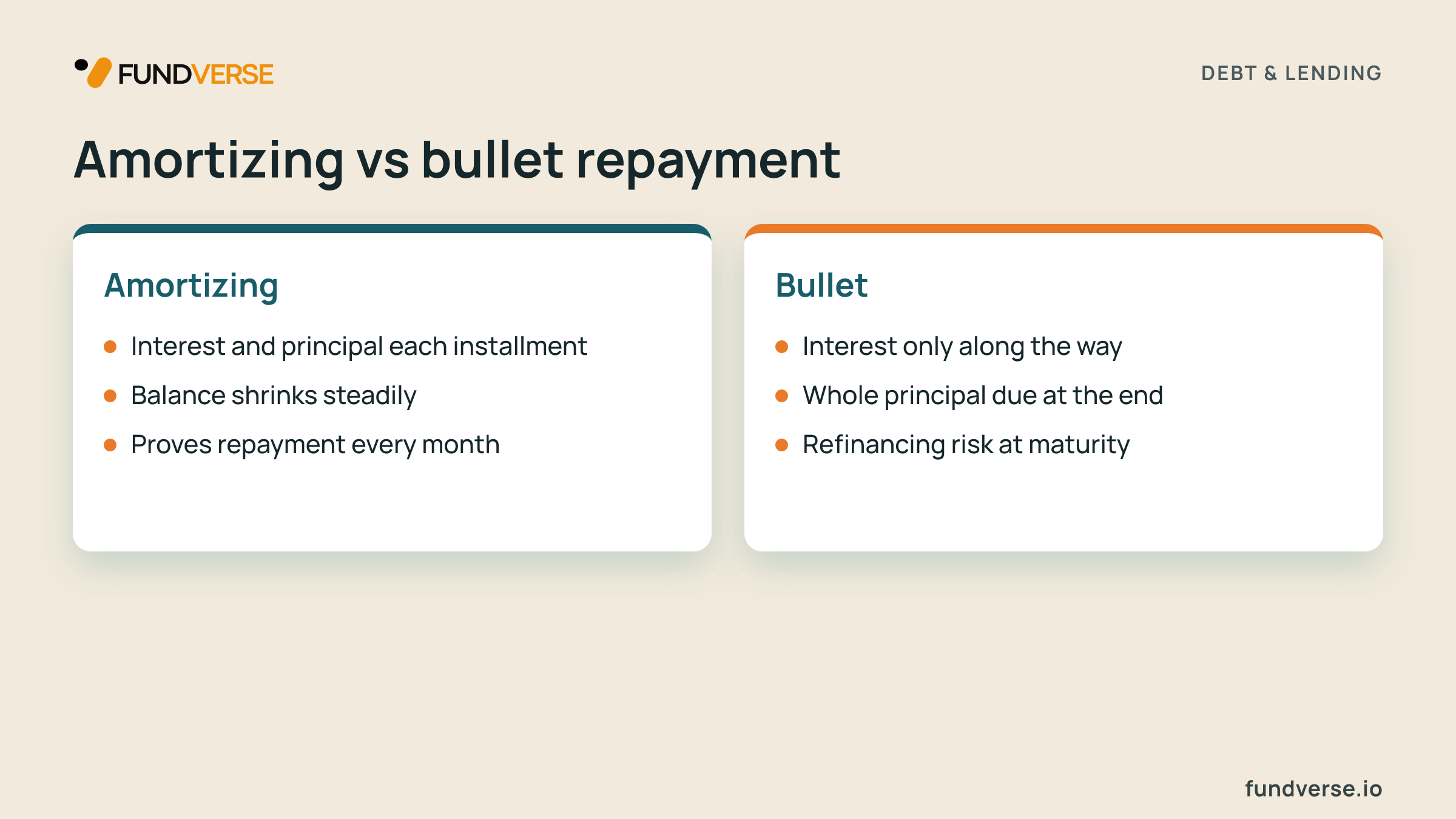
The danger in a bullet or a large final installment (a balloon) is refinancing risk: the business is betting that on the maturity date a lender will lend again on acceptable terms. If trading has softened, credit markets have tightened or the business's assets have lost value, that bet can fail exactly when the money is due. An amortizing loan makes the business prove its ability to repay every month, while a bullet defers that proof. Ask honestly where the final payment would come from if refinancing were unavailable.
Financial covenants and how they bite
A covenant is a promise the borrower makes in the loan agreement, and breaking it is a breach of contract even if every payment has arrived on time. Financial covenants are promises about numbers, tested at set dates, usually quarterly, using figures from the accounts. They work as the lender's early-warning system, designed to trip before the money runs out so the lender can act while there is still something to protect.
The three common tests
The debt service coverage ratio (DSCR) divides the cash available to service debt by the debt service due, meaning interest plus scheduled principal, over a period. A ratio of 1.0 means the business generates exactly enough to meet its payments, and lenders typically require a cushion above that. Leverage tests compare total debt with earnings, often debt divided by EBITDA (earnings before interest, tax, depreciation and amortization), and fail when borrowing grows or earnings shrink. A minimum liquidity covenant requires the business to hold a set amount of cash or available credit at all times. Each looks at the same question from a different angle: is the business still safely able to repay?
Definitions carry as much weight as thresholds. Whether "cash available" is measured before or after tax, whether one-off costs can be added back to earnings, and whether the test looks at the latest quarter or the trailing twelve months can each decide whether a given quarter passes. Experienced borrowers read the definitions section as closely as the covenant itself.
A worked DSCR test
The figures below are an illustration of the mechanics, not a benchmark; real covenants vary by lender, sector and facility. Assume a loan whose annual debt service (interest plus scheduled principal) is 400,000, with a covenant requiring DSCR of at least 1.25, tested on the trailing twelve months. The plan assumes cash available for debt service of 560,000, a ratio of 1.40, so the business passes with room to spare.
| Scenario | Cash available for debt service | Debt service | DSCR | Result vs 1.25 minimum |
|---|---|---|---|---|
| Plan | 560,000 | 400,000 | 1.40 | Pass |
| Revenue dips so cash falls 10% | 504,000 | 400,000 | 1.26 | Pass, barely |
| Delayed receivables cut cash 15% | 476,000 | 400,000 | 1.19 | Breach |
The third row carries the lesson. Suppose a large customer pays ninety days late, so part of the year's sales sits in receivables instead of cash. The business has not lost the sale and has not missed a payment, yet measured cash drops 15% and the ratio falls to 1.19. It is in breach while paying on time. Depending on how the agreement defines cash and what the lender then chooses to do, a timing problem has become a contractual one. Headroom, the gap between expected performance and the covenant threshold, therefore matters more than the threshold itself: here, a dip of only about 10% from plan leaves the ratio at 1.26, a hair above the line.
Information and operating covenants
Not every covenant is a ratio. Information covenants oblige the business to deliver management accounts, audited annual statements, budgets and sometimes compliance certificates by fixed deadlines. They look administrative, but a late or missing report is itself a breach, and a business with thin finance staff can trip one without any trading problem at all. Operating covenants restrict what the business may do without consent. Common ones limit additional borrowing, because new debt competes for the same cash; cap or ban dividends and owner withdrawals; restrict sales of key assets, because those assets back the loan; and prohibit changes of ownership or control, so the people the lender assessed remain the people running the company.
These bite hardest when the business wants to move. A growth-stage company planning to bring in an equity investor, buy a competitor or sell a subsidiary may find that each step needs lender consent, so a loan that was cheap has quietly become a veto over strategy. Reading operating covenants against your own plans for the next three to five years is one of the most useful exercises a borrower can do.
Security, guarantees and what is at stake
Security means the lender holds a legal claim over assets that it can enforce, meaning sell or take control of, if the loan is not repaid. A fixed charge attaches to a specific, identifiable asset such as a building, a vehicle or a machine, and the business cannot sell it without the lender's release. A floating charge covers a changing pool of assets, such as inventory or receivables, which the business can keep trading with until a trigger event causes the charge to crystallize and lock onto whatever is there. Lenders may take security over receivables, stock, equipment or property, or all of them together through a general claim over the business. Terminology and the way charges are registered and enforced differ by country.
Pledged assets limit future financing, because most lenders will not lend against what is already pledged. A business that has charged all its receivables to one bank cannot easily use invoice finance with another. Lenders also rank: a senior lender is repaid first from enforcement proceeds, and a later lender only from what remains. Pari passu, Latin for "on equal footing", describes lenders who share proceeds proportionally rather than in a queue. Where the same asset secures several loans, check who ranks where, since it affects both your ability to borrow again and what each lender will tolerate.
A guarantee adds a person or another company as a second source of repayment. A corporate guarantee comes from a related company, linking the fortunes of a group. A personal guarantee comes from the founder or owners and makes them individually liable if the business cannot pay, so their home, savings and other assets may be reachable. It moves risk from the company, a legal shield, to the person. Customs differ: small-business bank lending in many markets routinely demands personal guarantees from owners, debt funds and development lenders often lean more on asset and cash-flow security, and some jurisdictions limit how guarantees can be enforced. Where one is required, ask whether it can be capped at a set amount, limited in time or released once the loan has been repaid down to a defined level.
Defaults and the day after a breach
An event of default is a defined circumstance that lets the lender cancel undrawn amounts, demand early repayment of the whole outstanding loan (called acceleration) and enforce its security. Missing a payment is the obvious trigger, but technical breaches usually qualify too: a failed covenant test, a late report, an inaccurate statement in the original application. A cross-default clause extends this: if the business defaults on another loan, lease or significant contract, that counts as a default here as well, even if this lender has been paid in full. A problem with one supplier finance line can become a call on the entire borrowing structure.
Lenders seldom accelerate over a first minor breach, because enforcing against a struggling business often recovers less than working with it. But the right exists, and its existence shapes the conversation that follows, in which the lender holds the leverage. The borrower can ask for a waiver, a one-time agreement not to act on the breach. Many agreements give a cure period, a window to fix the problem, sometimes by injecting equity to restore a ratio. Lenders commonly charge an amendment fee for waivers or changes, and may reprice the loan to a higher margin or tighten covenants going forward. Whether any of this is offered is a matter of lender discretion, not entitlement, so both the relationship and the drafting count.
Control over your own cash
Some of the most practical restrictions concern cash itself. A cash sweep requires a share of surplus cash, or proceeds from asset sales or new financing, to be applied automatically to repay the loan early, so a strong quarter shortens the loan instead of building the business's reserves. A reserve account, often a debt service reserve, requires the business to keep a set amount, commonly a few months of payments, in a separate account it cannot spend freely. Account control goes further: the lender may require revenues to be paid into an account it can monitor, or even operate, and may be able to block withdrawals after a breach.
These mechanisms separate profit from usable cash. A business can be profitable and still starved of working capital if a sweep takes the surplus and a reserve holds back the rest, and trapped cash may not count toward a liquidity test, compounding the squeeze. Ask exactly when sweeps apply, whether any amount is excluded for working capital, and what happens to reserve balances once the business is back in compliance.
Different lenders, different tolerance
The same clause can be applied very differently depending on who wrote it. A bank is generally the cheapest source and the most standardized. It is also regulated, so credit policy can limit its flexibility, and it often takes broad security and personal guarantees from smaller companies. A debt fund, a pooled investment vehicle that lends, usually charges more but often accepts more complex situations, structures terms individually and may be more willing to talk through a breach, though it may also reprice sharply. A development finance lender, which lends to support economic or social objectives, tends to move slowly, require thorough documentation and environmental or governance standards, and offer longer tenors; its patience can be real but its processes are rigid. Revenue-based financing repays through a percentage of monthly revenue until a fixed total is returned. It usually has few financial covenants and flexes with sales, but the total cost can be high and repayments can take a large share of cash in good months.
What a smaller borrower can negotiate
A small borrower asking a bank to rewrite its standard documents will mostly be told no. Credit committees approve standard forms, and a lender processing many small loans cannot customize each. The useful skill is knowing where flexibility usually exists. Commonly negotiable are the amount of covenant headroom, the definitions (what counts as cash, which one-off costs can be added back), testing frequency, cure rights, caps or release conditions on a personal guarantee, consent thresholds for small asset sales, and sometimes fees. Typically fixed are the core security package, standard events of default, the lender's credit policy and any requirement that comes from regulation rather than preference.
That last distinction is worth asking about directly. Some requirements are legal or regulatory: identity and anti-money-laundering checks, sanctions screening, mandatory registration of security, and capital rules that influence how a bank can lend. A lender cannot waive those. Others are preference: a particular guarantee, a house-style covenant, a standard fee. Those are where you have a case. Asking "Is this a regulatory requirement or a credit policy?" often changes the conversation and shows where to spend your effort.
Questions to ask before signing
Before accepting a term sheet, read it against the points below and get clear answers in writing rather than reassurance in conversation.
- What is the all-in cost, including arrangement, commitment, monitoring and legal fees, and what net cash do I receive?
- What does early repayment cost, and does a sweep trigger repayment automatically?
- How is each financial covenant defined, how often is it tested, and how much headroom does my base case leave?
- What happens on a breach: cure period, waiver process, amendment fee, repricing?
- Which assets are pledged, are they fixed or floating, and what future financing does that block?
- Is a personal or corporate guarantee required, and can it be capped, time-limited or released?
- What triggers a cross-default, and which of my other contracts could set it off?
- Which actions need lender consent: new debt, dividends, asset sales, a new investor, a change of control?
- Are there account control, reserve or cash trapping provisions, and when are they released?
- Which requirements are regulatory and which are the lender's preference?
Testing the loan against a downside
A lender tests a loan against a downside case, and the borrower should do the same before signing. Build the base plan first, then deliberately damage it: revenue falls by a set percentage, key customers pay thirty or sixty days later, costs rise, a seasonal trough lasts longer than expected. For each scenario, compute every covenant at every test date using the lender's own definitions, and see where and when a breach appears. Then add the cash mechanics: if a sweep or reserve would capture cash in that scenario, how much is left for operations?
The aim is not to prove the business will fail but to learn how large a shock the structure can take before control passes to the lender, and to use that number in negotiation. If a ten percent dip trips the covenant, ask for wider headroom, an equity cure right or a different test. If no reasonable adjustment is available, you have learned that the loan fits the plan but not the business.
Fundverse's financial analysis tools, along with Marcus, our AI, can help you set cash flow forecasts against covenant thresholds and see how revenue dips or late receivables change your headroom before you commit to a facility.
One caution applies to everything above. Debt terms, the way security is registered and enforced, and the rules on guarantees all vary by jurisdiction and by lender, and protections or restrictions that exist in one country may not exist in another. Nothing here substitutes for tailored legal and financial advice, and a lawyer who reads the facility agreement before you sign is a small cost against what a clause can do later.
So take the offer you were about to sign and run your own worst realistic quarter through it. At which test date does a covenant first fail, who then decides what happens next, and are you willing to hand them that decision?
Frequently asked questions
Topics
debt financing
loan covenants
debt service coverage ratio
personal guarantee
term sheet checklist
cross-default
SME loan terms
cash sweep
Raising or investing?
Find the right people on the other side of the table, and run the round in one place.