

Many founders underestimate how dramatically due diligence expectations evolve as startups move from pre-seed to later-stage funding. What investors ask for at seed is very different from what they expect at Series B or C. Understanding these expectations early can save founders months of friction and dramatically improve fundraising outcomes.
The Hidden Barrier in Fundraising
Many founders assume that fundraising success depends primarily on storytelling, vision, and the strength of their pitch deck. While those elements matter, they represent only the beginning of the investment process.
Once investors become seriously interested, the conversation quickly shifts toward due diligence.
Due diligence is the process investors use to verify that the opportunity they see in your pitch aligns with reality. It is where narratives meet data, assumptions meet evidence, and potential risks become visible.
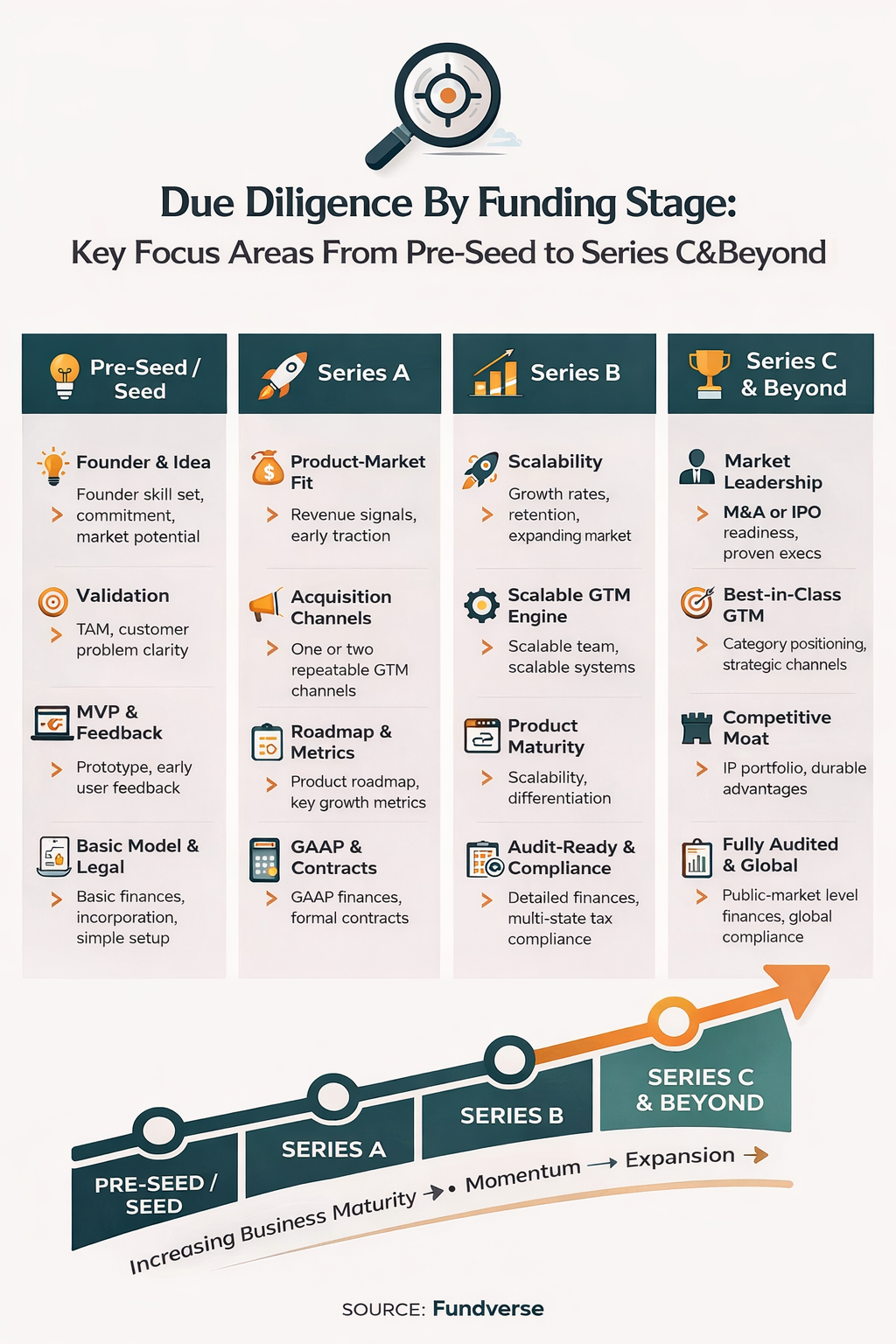
A pre-seed investor may accept rough models and early prototypes. A Series B investor, however, expects audited financials, scalable systems, and clear operational maturity.
Understanding these differences can make the difference between a smooth fundraising process and months of stalled conversations.
Once investors become seriously interested, the conversation quickly shifts toward due diligence.
Due diligence is the process investors use to verify that the opportunity they see in your pitch aligns with reality. It is where narratives meet data, assumptions meet evidence, and potential risks become visible.
What most founders do not realize is that due diligence is not static. The level of scrutiny increases dramatically with each funding stage.
A pre-seed investor may accept rough models and early prototypes. A Series B investor, however, expects audited financials, scalable systems, and clear operational maturity.
Understanding these differences can make the difference between a smooth fundraising process and months of stalled conversations.
Why Due Diligence Changes at Every Stage
Startups evolve through phases of uncertainty. Early investors accept greater risk because the capital required is smaller and the upside potential is larger.
As companies raise larger rounds, however, the expectations change. Investors need stronger evidence that the company can scale sustainably and manage larger capital allocations responsibly. This is why diligence requirements expand across several dimensions:
As companies raise larger rounds, however, the expectations change. Investors need stronger evidence that the company can scale sustainably and manage larger capital allocations responsibly. This is why diligence requirements expand across several dimensions:
- Leadership maturity
- Market validation
- Financial transparency
- Operational structure
- Legal and regulatory readiness
Each funding stage represents a different level of business maturity, and investors evaluate companies accordingly.
Pre-Seed and Seed: Betting on the Founder
At the earliest stages of funding, investors are primarily betting on the founding team rather than on proven business performance.
The core diligence questions revolve around three themes: founder capability, market potential, and early signals of demand.
At this stage, investors look closely at the founders themselves. They want to understand the team's experience, execution ability, and long-term commitment. Because there is little operational data available, founder credibility becomes a major signal.
Investors typically evaluate:
The core diligence questions revolve around three themes: founder capability, market potential, and early signals of demand.
Founder Capability and Commitment
At this stage, investors look closely at the founders themselves. They want to understand the team's experience, execution ability, and long-term commitment. Because there is little operational data available, founder credibility becomes a major signal.
Investors typically evaluate:
- Founder skill sets
- Industry knowledge
- Execution track record
- Commitment to solving the problem
Strong founding teams can often secure funding even when the product is still evolving.
Market Validation and Problem Clarity
Market validation at this stage is usually qualitative rather than quantitative. Investors want evidence that the problem being solved is meaningful and widespread. Common validation signals include:
Market Validation and Problem Clarity
Market validation at this stage is usually qualitative rather than quantitative. Investors want evidence that the problem being solved is meaningful and widespread. Common validation signals include:
- Market size estimates
- User interviews
- Early customer feedback
- Pilot programs
The objective is not perfect accuracy but a clear understanding that the market opportunity exists.
Product Development
At pre-seed and seed stages, the product is often an MVP or prototype. Investors want to see early user interaction with the product and signs that feedback is shaping development.
Key signals include:
Product Development
At pre-seed and seed stages, the product is often an MVP or prototype. Investors want to see early user interaction with the product and signs that feedback is shaping development.
Key signals include:
- Early user testing
- Product iterations
- Initial engagement patterns
The emphasis is on learning velocity rather than product perfection.
Financial and Legal Structure
Financial models at this stage are typically simple. Investors mainly want to understand how capital will be used and how long it will extend the company's runway.
Founders should prepare:
Financial and Legal Structure
Financial models at this stage are typically simple. Investors mainly want to understand how capital will be used and how long it will extend the company's runway.
Founders should prepare:
- A basic financial model
- Burn rate projections
- A clean cap table
- Proper incorporation documents
Maintaining clean legal structures early prevents complications in later rounds.
Series A: Proving Product-Market Fit
Series A represents a turning point in the startup journey. Investors at this stage expect evidence that the company has moved beyond experimentation. The primary focus becomes product-market fit and early traction.
Revenue and Demand Signals
By Series A, investors expect measurable traction.
This typically includes:
Revenue and Demand Signals
By Series A, investors expect measurable traction.
This typically includes:
- Revenue growth
- User engagement metrics
- Customer retention data
These indicators demonstrate that the market is responding positively to the product.
Go-to-Market Effectiveness
Another critical focus is the company's ability to acquire customers systematically.
Investors want to see at least one working acquisition channel supported by customer acquisition cost (CAC) data. This proves that the company can scale its customer base without relying entirely on organic discovery.
Leadership Expansion
As the organization grows, founders must begin building a broader leadership team. Series A diligence often evaluates:
Go-to-Market Effectiveness
Another critical focus is the company's ability to acquire customers systematically.
Investors want to see at least one working acquisition channel supported by customer acquisition cost (CAC) data. This proves that the company can scale its customer base without relying entirely on organic discovery.
Leadership Expansion
As the organization grows, founders must begin building a broader leadership team. Series A diligence often evaluates:
- Hiring quality
- Organizational structure
- Leadership depth
A strong management team reduces operational risk and improves scalability.
Operational and Financial Discipline
Financial reporting becomes more formalized at this stage.
Investors expect:
Operational and Financial Discipline
Financial reporting becomes more formalized at this stage.
Investors expect:
- Structured financial statements
- Unit economics analysis
- Growth projections
Operational discipline signals that the company is ready to manage larger capital inflows.
Series B: Scaling the Machine
Series B investors typically fund companies that have already demonstrated strong product-market fit.
The focus now shifts toward scaling efficiency and market leadership.
Market Expansion and Growth Metrics
At this stage, investors expect significant growth momentum.
Key metrics often include:
The focus now shifts toward scaling efficiency and market leadership.
Market Expansion and Growth Metrics
At this stage, investors expect significant growth momentum.
Key metrics often include:
- Revenue growth rates
- Customer retention
- Market share expansion
These indicators show whether the company can compete effectively at scale.
Scalable Go-to-Market Systems
Unlike earlier stages, where a single acquisition channel may suffice, Series B companies must demonstrate a scalable and repeatable growth engine.
Investors evaluate:
Scalable Go-to-Market Systems
Unlike earlier stages, where a single acquisition channel may suffice, Series B companies must demonstrate a scalable and repeatable growth engine.
Investors evaluate:
- Sales infrastructure
- Marketing performance
- Pipeline reliability
Predictable revenue generation becomes essential.
Product Maturity
The product should now be robust enough to support large customer bases.
Investors examine:
Product Maturity
The product should now be robust enough to support large customer bases.
Investors examine:
- Platform scalability
- Infrastructure reliability
- Feature differentiation
A mature product reduces the risk of growth bottlenecks.
Legal and Compliance Expansion
As companies grow internationally, legal complexity increases.
Series B diligence may involve:
Legal and Compliance Expansion
As companies grow internationally, legal complexity increases.
Series B diligence may involve:
- Employee agreements
- Compliance frameworks
- Litigation risk assessments
Strong governance structures are increasingly important.
Series C and Beyond: Preparing for Market Leadership
By Series C, startups are no longer early-stage ventures. They are emerging industry leaders preparing for large-scale expansion, acquisitions, or public offerings.
Due diligence becomes highly rigorous and institutional.
Executive Leadership
Investors expect a seasoned executive team with experience managing large organizations.
Leadership evaluation often includes:
Due diligence becomes highly rigorous and institutional.
Executive Leadership
Investors expect a seasoned executive team with experience managing large organizations.
Leadership evaluation often includes:
- Experienced C-suite executives
- Strategic leadership capability
- M&A or IPO readiness
Competitive Positioning
At this stage, investors focus on long-term defensibility.
They assess:
At this stage, investors focus on long-term defensibility.
They assess:
- Market leadership
- Competitive advantages
- Brand strength
The company must demonstrate durable differentiation.
Institutional-Grade Financial Reporting
Financial transparency becomes critical.
Series C companies are expected to maintain:
Institutional-Grade Financial Reporting
Financial transparency becomes critical.
Series C companies are expected to maintain:
- Audited financial statements
- EBITDA analysis
- Public-market level reporting standards
This level of transparency prepares companies for potential IPOs or acquisitions.
Advanced Compliance and Governance
Regulatory compliance expands significantly.
Companies may need:
Advanced Compliance and Governance
Regulatory compliance expands significantly.
Companies may need:
- Multi-jurisdiction tax compliance
- Board governance structures
- Audit processes
These systems reduce institutional investment risk.
How Founders Can Prepare for Due Diligence Early
The most successful founders treat due diligence preparation as an ongoing process rather than a last-minute task.
Several habits can dramatically simplify future fundraising rounds.
First, maintain organized documentation from the beginning. Even early-stage startups benefit from structured records of legal documents, financials, and key metrics.
Second, track operational metrics consistently. Growth, retention, and customer acquisition data become increasingly important with each funding stage.
Third, build scalable processes early. Strong operational systems signal maturity and reduce investor concerns.
Finally, maintain transparency with potential investors. Clear communication builds trust and accelerates diligence timelines.
Several habits can dramatically simplify future fundraising rounds.
First, maintain organized documentation from the beginning. Even early-stage startups benefit from structured records of legal documents, financials, and key metrics.
Second, track operational metrics consistently. Growth, retention, and customer acquisition data become increasingly important with each funding stage.
Third, build scalable processes early. Strong operational systems signal maturity and reduce investor concerns.
Finally, maintain transparency with potential investors. Clear communication builds trust and accelerates diligence timelines.
Conclusion: Due Diligence Is a Reflection of Business Maturity
Due diligence is not merely a bureaucratic process. It reflects the level of confidence investors require at each stage of company growth.
Early investors accept uncertainty but demand strong founders and compelling market opportunities.
Later investors require operational excellence, scalable growth engines, and institutional-level governance.
Founders who understand these evolving expectations gain a strategic advantage. They prepare the right data, build the right systems, and enter fundraising conversations with credibility.
In a competitive startup ecosystem, that preparation can be the difference between a stalled round and a successful raise.
Early investors accept uncertainty but demand strong founders and compelling market opportunities.
Later investors require operational excellence, scalable growth engines, and institutional-level governance.
Founders who understand these evolving expectations gain a strategic advantage. They prepare the right data, build the right systems, and enter fundraising conversations with credibility.
In a competitive startup ecosystem, that preparation can be the difference between a stalled round and a successful raise.
Frequently Asked Questions
Topics
startup due diligence
fundraising preparation
venture capital diligence
pre-seed fundraising
series A due diligence
startup investor requirements
venture capital process