

A general AI assistant and an investment platform do different jobs. Here is what Claude and Fundverse.io each do well in financial analysis, where each needs checking, and how to use both.
A figure in a draft investment memo can read perfectly well and still come from nowhere. The sentence is fluent, the growth rate looks plausible, and nothing on the page says whether the number was read from a document, calculated from one, or produced because a number seemed to belong there. That gap between reasoning about a number and verifying it sits underneath any comparison of a general AI assistant such as Claude with a purpose-built platform such as Fundverse.io.
The two are often compared as if they compete for the same job. They do not, and most of the confusion comes from treating them as substitutes. Fundverse is the publisher's own product, so its limits are described here as plainly as the assistant's. Features, data terms and pricing change, so confirm current details with each provider.
1. Two tools, two jobs
A general-purpose assistant is built to reason about whatever text or numbers you give it. Paste in a contract, a set of management accounts or a business description, and it will read, explain, compare and draft. An investment platform starts from the other end. It is built around structured deal and portfolio data, meaning companies, investors, documents, stages and notes held as organized records, and around a defined workflow that takes a deal from first look to decision to reporting.
That difference shows up most clearly around three ideas. Source data is the original material a figure comes from: filed accounts, bank statements, signed contracts, a cap table. A hallucinated figure is a number that sounds right but traces back to nothing you supplied, which happens when a language model fills a gap with something plausible. An audit trail is the record of where each figure came from and who entered or changed it and when, so someone else can retrace the work months later. A tool can be excellent at the first and silent on the other two.
So the useful question is not which tool is smarter. It is which parts of an analysis each can be trusted for, and where a person has to take over. The assistant is the easier place to start, so start there.
2. What Claude does well
Reasoning over what you supply
Claude is strong at the thinking-heavy parts of analysis. It can explain a business model in plain language, which helps an analyst entering an unfamiliar sector or a lender looking at an industry it rarely sees. It can stress-test assumptions: ask what happens to cash if customers pay thirty days later than the model assumes, or if churn doubles, and it will walk through the consequences and point to the lines most exposed. It can summarize a long document, draft an investment memo from your notes, and write diligence questions tailored to what the material does and does not say.
It is also useful on a financial model's logic when you supply the model. Paste the formulas or describe the structure and it can flag a growth rate that compounds twice, a cost line that never scales, or a balance that does not reconcile. For founders, that makes it a good sparring partner before investors see the model, since the mistakes that make investors doubt a whole business are often the kind a patient reader catches.
Where it runs out
The limits come from the same design. An assistant can only analyze what it is given or can access, so anything outside the conversation is invisible to it: the earlier deal, the investor's last reply, last month's version of the model. Where information is missing it may still give a confident answer, such as a market size or a typical margin, that has no support, and it can misread a table in a document it was actually given. A conversation is also not a system of record. It does not keep a persistent, auditable view of a pipeline or portfolio that a colleague can open and trust. That missing record is what a platform is for.
3. What a purpose-built platform adds
Fundverse.io is built around the records rather than the conversation. Investor and deal data sit in one place. Pitch deck review and deal screening with Marcus, Fundverse's AI, run against the deal in front of you. Valuation and financial analysis tools, a data room, pipeline management and reporting all attach to that same record. The payoff is continuity: a note made at screening is still there at committee, and a document reviewed once is the same document everyone else opens.
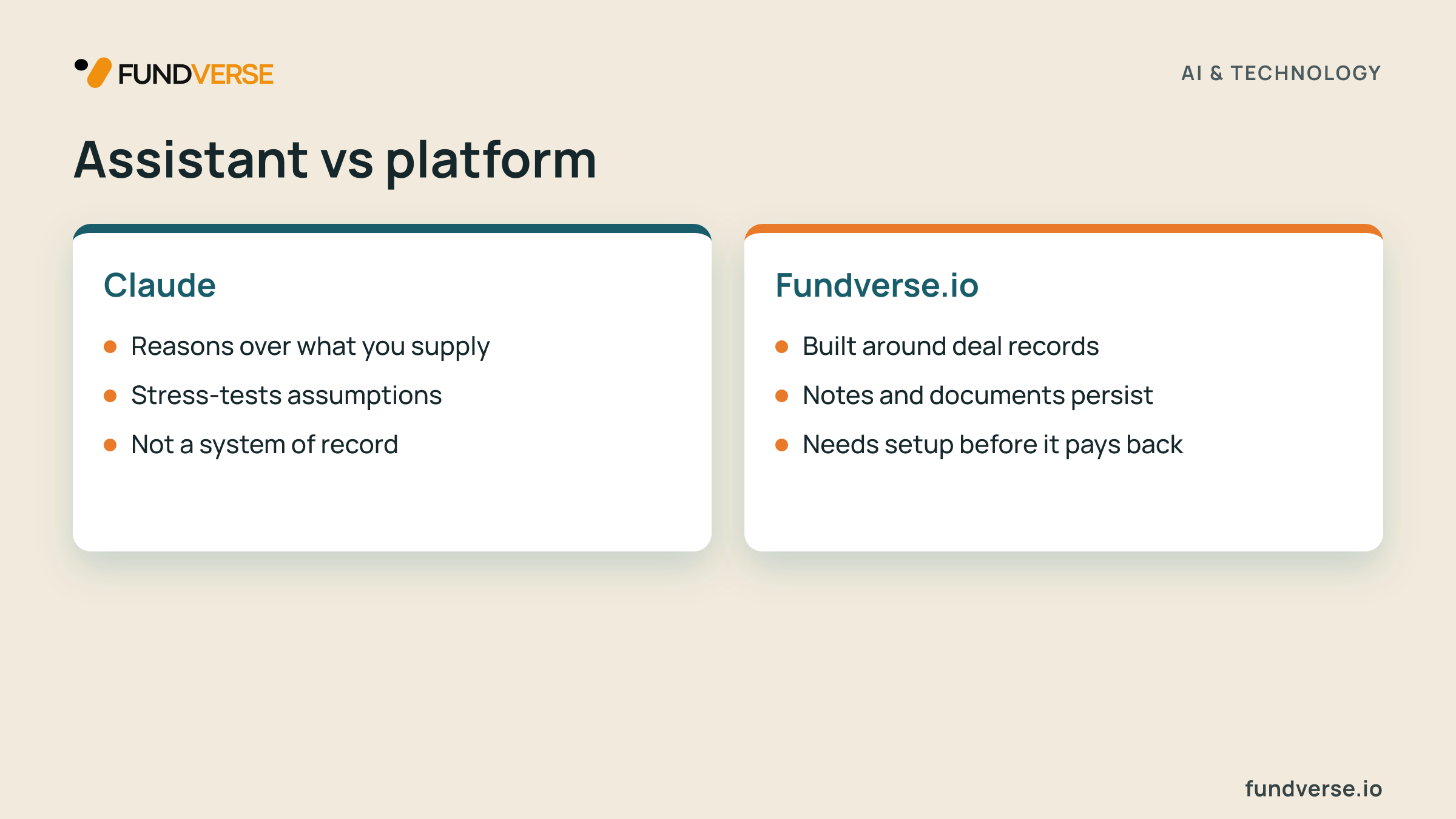
The trade-offs are real. A defined workflow is less free-form than a blank conversation, so an unusual question can fit awkwardly. A platform knows only what has been uploaded or entered, so its analysis is only as complete as the records. Marcus's output needs checking against source documents just as any AI's does. And a platform asks for setup before it pays back: importing deals, agreeing stages and deciding who owns what.
4. One review, two tools
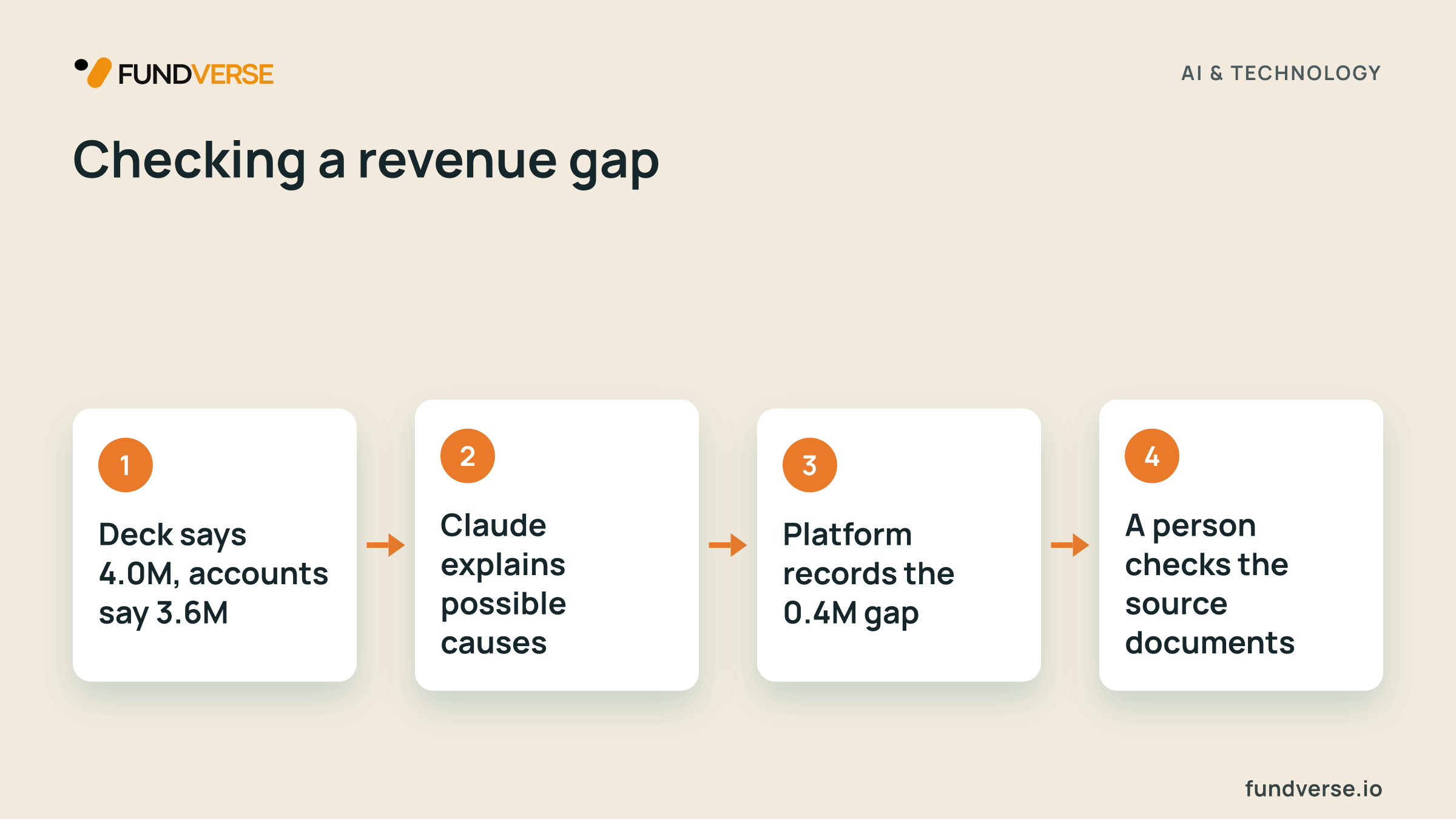
Take a routine task: reviewing a company's financials before an investment or lending decision. As an illustration, say the pitch deck states annual revenue of 4.0 million while the latest accounts show 3.6 million. The figures are invented for this example, but the situation comes up constantly.
What suits the assistant
Paste both extracts into Claude and ask why they might differ. It can set out the usual explanations: a different period, bookings counted instead of recognized revenue, a deck figure that includes a pending contract, or a currency conversion. It can then draft the questions to send the company. That is reasoning over supplied material, and it is fast and useful. What it cannot tell you is which number is right, because it has not seen the bank statements and cannot confirm the accounts are genuine.
What suits the platform, and the human check
On a platform, the accounts and deck sit in the deal's data room. Marcus's screening and the financial analysis tools work from those documents, the 0.4 million gap is noted on the deal record, and the follow-up questions sit beside the answers when they arrive. Anyone who reviews the deal later can see what was flagged and what was resolved.
In both cases the last step is the same and belongs to a person. Someone has to open the filed accounts or bank statements and confirm the figure against the source. The lesson of the example is that each tool helped with understanding the gap, one by explaining it and the other by recording it, and neither closed it. Closing it is the point where reasoning about a number becomes knowing it.
5. Differences that show up later
One deal on one afternoon hides most of the difference between the tools. It widens with volume and time. The first gap is source traceability. When an analysis lives in a chat, the link between a statement and its document exists only if you preserved it. Where documents and notes share a record, tracing a figure back is easier, though still not automatic. The second is repeatability. Run twenty deals through ad hoc prompts and each review may be framed a little differently, which makes the deals hard to compare. A defined workflow applies the same stages and questions to every deal.
Two practical matters follow from that. Confidential documents need care with either tool: financials, cap tables and investor lists are sensitive, so read the provider's data terms, your plan's settings and your own confidentiality obligations before uploading anything, and don't assume one option is safer without checking. Team collaboration is the other: shared records let colleagues see the same deal history, while a chat is usually one person's working notes.
The one area where the assistant clearly wins is cost of setup. You can start in minutes with whatever text you have. A platform needs configuration, and that effort pays off only when there are enough deals, or enough people, for continuity to matter.
6. Choosing, or using both
For a founder preparing a raise, the assistant is a good first reader. Have it challenge your assumptions, explain your model back to you and rehearse the questions an investor is likely to ask. Then make sure the figures in your deck match your model, the problem covered in this piece on pitch decks and cash need. The startup valuation calculator and a data room help you present the same numbers consistently, and the founder tools cover the rest of the preparation.
For an investor, lender or analyst running a pipeline, the weight shifts to the platform. Once there are many deals, a shared record, consistent screening and reporting matter more than any single clever answer, and the investor side of Fundverse is built around that. An assistant still earns a place beside it as a thinking partner on individual documents, provided your confidentiality rules allow it. If you screen only a handful of deals a year, an assistant and a well-kept folder may be all you need.
If you are preparing a raise or running a pipeline, see how Marcus, the data room and pipeline tools work from the same records on Fundverse, and try it on a real deal.
Whichever combination you choose, let the tools reason, organize and draft, and keep a person responsible for checking the source and making the decision. Neither an assistant nor a platform carries accountability for the outcome, and no tool replaces professional judgment. When you test any tool, ask where a figure came from and see how quickly it can show you.
Frequently asked questions
Topics
Claude vs Fundverse
AI for financial analysis
investment research tools
AI due diligence
deal screening software
AI financial model review
investment pipeline software
Raising or investing?
Find the right people on the other side of the table, and run the round in one place.