

Affinity, DealCloud and Fundverse each assume a different kind of pipeline: a network to mine, a system of record to configure, or a deal workflow. Here is how to choose for your firm.
Venture firms run on relationships, yet the working record of those relationships is often scattered across inboxes, personal spreadsheets, calendar invites and the memories of the partners who happened to take the meeting. A firm can see a founder's name arrive three times in two years and have no shared answer to the simple question of what it thought the last time. When a firm decides that this is no longer good enough, the shopping list usually starts with features, and that is where the confusion begins.
The more useful question is what kind of system fits how the firm really works. Affinity, DealCloud and Fundverse are often listed side by side, but they are built on different beliefs about what a pipeline is. Fundverse is the publisher's own product, so this comparison states its weaknesses as plainly as the others'. Where the text characterizes a tool rather than quoting it, that is a description of its general design and positioning, and any detail that matters to your decision should be confirmed with the vendor.
Three jobs hiding in one phrase
'Relationship management' covers at least three separate jobs, and tools tend to be strongest at one of them. The first is capturing who knows whom: which partner has history with a founder, which advisor worked with the CTO, who at the firm last spoke to a co-investor. This is what vendors call relationship intelligence, meaning software that infers the strength of connections from communication patterns rather than waiting for someone to type them in.
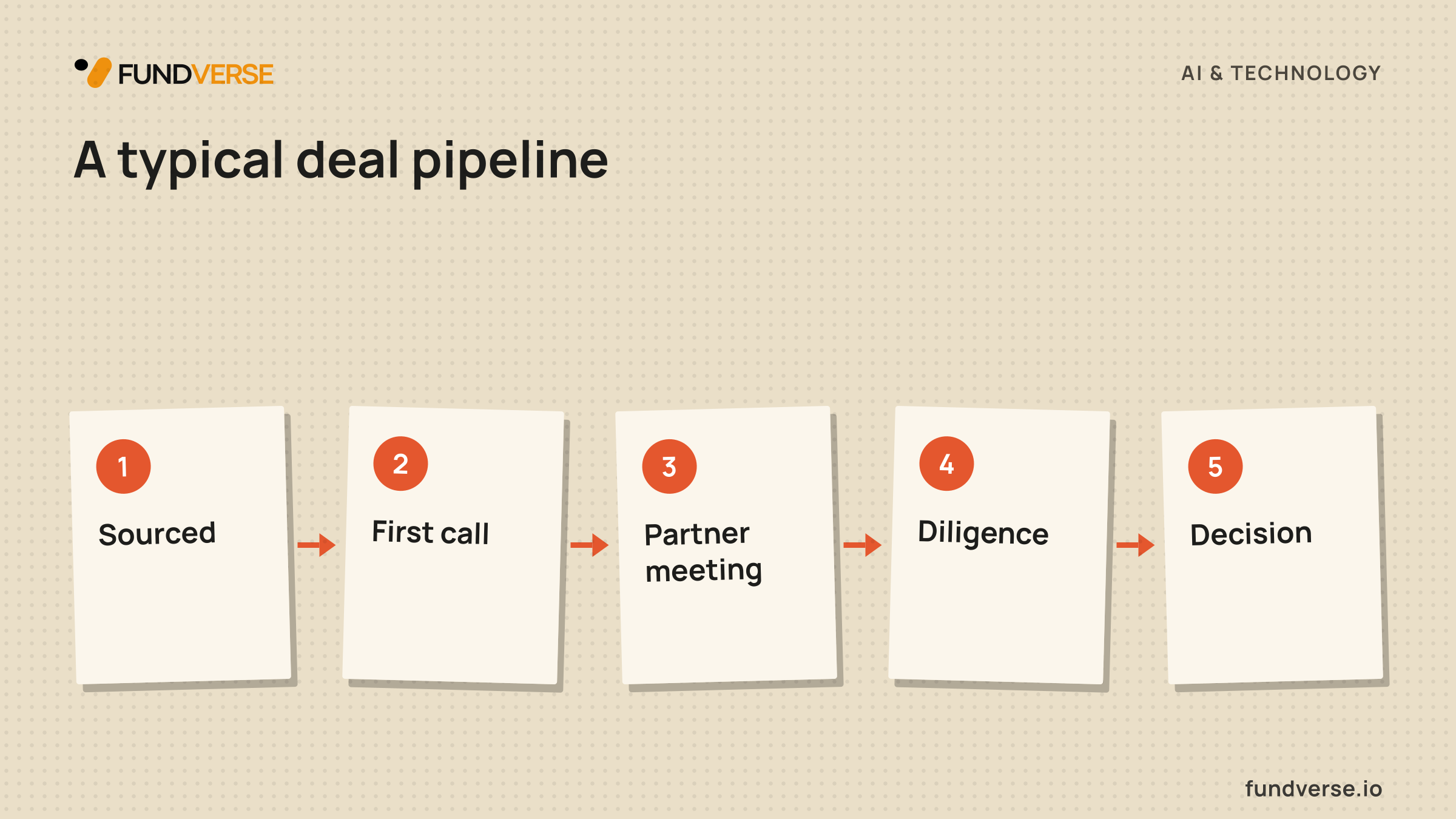
The second job is tracking deals through stages. A deal pipeline is simply the list of companies the firm is considering, each sitting at a stage such as sourced, first call, partner meeting, diligence, decision. It answers what is live, who owns it and what happens next. The third job is retaining what the firm learned about a company over time: the thesis fit, the concerns, the references, the reason for a pass and what would make the firm look again. A system of record is the place the firm agrees is the authoritative version of all this, the one people consult instead of asking around.
The three jobs pull in different directions. Capturing relationships rewards passive collection. Tracking stages rewards discipline about who moves a deal and when. Retaining learning rewards writing things down at the moment it feels least urgent. A tool built around one will help with the others only as far as people are willing to bridge the gap by hand.
Three design philosophies, stated plainly
Affinity is generally positioned as relationship intelligence. Its core idea is that a firm's most valuable data is already being created in email and calendars, so the software should mine that activity to map the network, rather than ask investors to log it. The pipeline sits on top of that map.
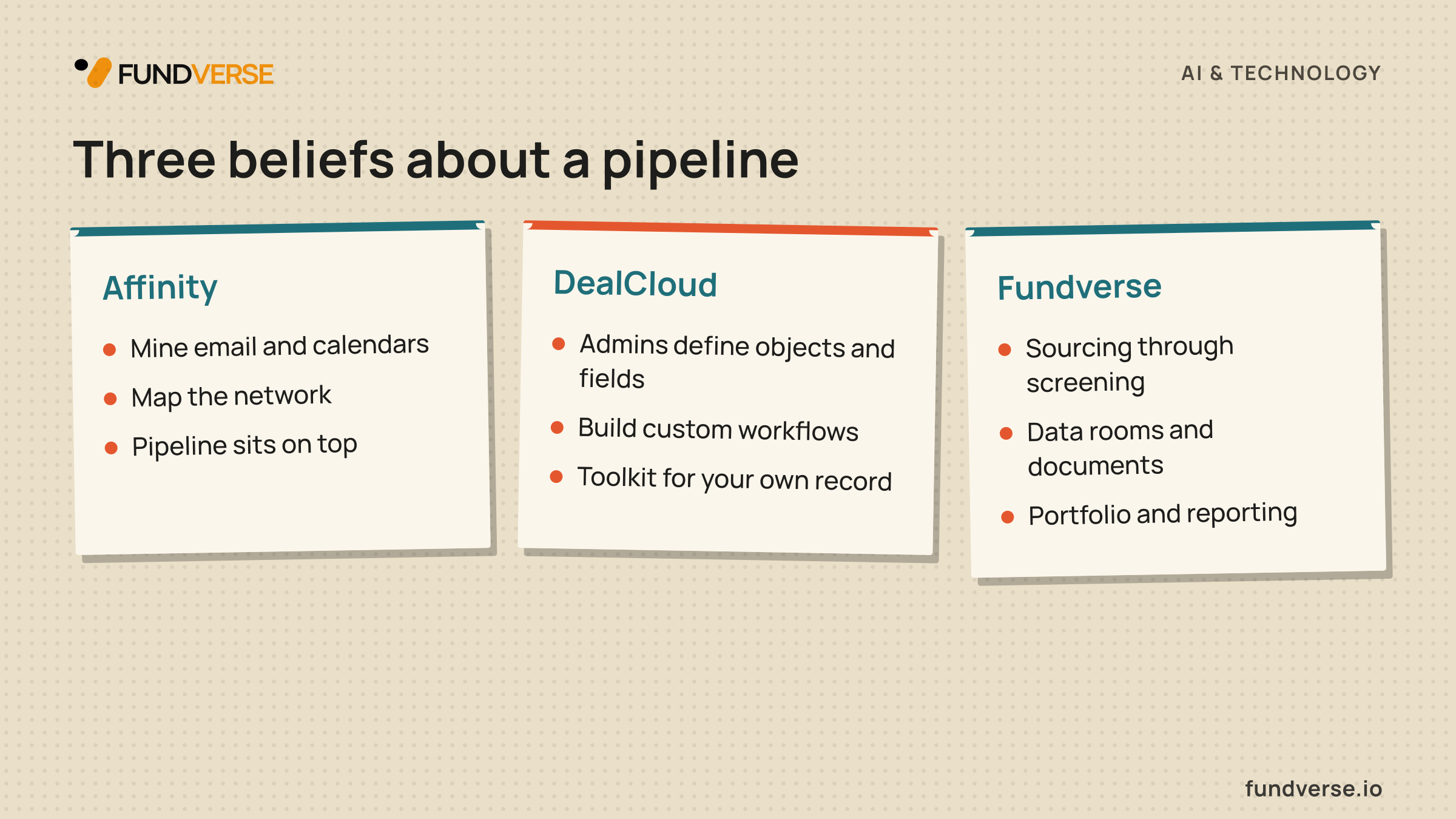
DealCloud is generally described as a highly configurable platform that grew out of the needs of financial services deal teams. Its core idea is that every firm tracks something slightly different, so the software should let administrators define their own objects, fields, workflows and reports. It is closer to a toolkit for building a firm-specific system of record than to a finished opinion about how venture works.
Fundverse treats the pipeline as a deal workflow that runs from sourcing through screening and the pipeline itself to data rooms and, after an investment, portfolio and investment reporting. Its core idea is that the work does not stop at the relationship or at the stage label: the firm also needs to evaluate the material, exchange documents and report on what it owns. Each philosophy implies a different answer to what the firm must already be good at.
How Affinity's approach plays out
What automatic capture buys
In practice, the system connects to partners' mailboxes and calendars and builds a contact and company database from the traffic. It records that interactions happened, estimates how strong a relationship is from recency and frequency, and lets anyone at the firm search for the best warm path to a person, meaning the colleague most likely to get a reply. The appeal is that the database fills itself. A partner who never opens a CRM can still contribute to it just by doing the job.
This approach quietly assumes things about the firm. It assumes sourcing is driven by the network, so that knowing the path to a founder is the scarce asset. It assumes partners conduct their work in email and calendars rather than in messaging apps and phone calls. And it assumes the firm is comfortable with its communications metadata being visible, at least in summary, across the team.
Where automatic capture runs out
Partners often have reasonable concerns about privacy and consent. Some correspondence is personal, some involves other firms' confidences, and some contacts are sensitive. Most tools in this category offer controls over what is shared, but those controls need to be set deliberately, and a firm should agree its norms before turning anything on. The people who are emailed also never opted in, which matters in jurisdictions with strict data protection rules.
Passive data is also noisy. A thread with a recruiter, a newsletter reply or a scheduling assistant can inflate apparent relationship strength, and an investor who talks by phone looks like a stranger. Above all, knowing who knows a founder does not record why the firm passed. Interaction history says that three conversations took place. It does not say what the firm concluded from them, and that gap is the subject of a later section.
How DealCloud's approach plays out
In a configurable platform, the firm decides what a deal is, what a company is, how they relate to funds, contacts and co-investors, and what happens at each stage. Workflows can enforce that certain fields are completed before a deal advances, and reporting can be built to answer the questions the firm actually asks, such as pipeline by sector, by fund or by source. For a larger or multi-strategy manager, with venture alongside growth or credit, this flexibility is the point: one system can model different processes without forcing them into one shape.
The price of that flexibility is effort. Someone has to design the data model, build the workflows, migrate the history and train the team, which commonly involves an implementation project and often outside help. After launch, the model needs ongoing administration as strategies, funds and reporting requirements change.
The hidden cost of configurability
Configurability moves design decisions from the vendor to the customer. That is valuable when the customer has a person who can make them well, and costly when it does not. A firm without an operations lead can end up with an elaborate system nobody updates: too many required fields, stage definitions that only the person who wrote them understands, and reports built for questions nobody asks. Partners then go back to their inboxes and the system becomes a record of what the administrator wanted rather than what the firm does. The question to ask is not whether the tool can be configured to fit, but who will own the data model in year two.
How Fundverse's approach plays out
On the investor side, Fundverse is organized around the deal rather than the contact. A firm keeps an investment pipeline, runs deal screening and analysis on the companies in it, and uses data rooms to receive and share diligence material. Marcus, Fundverse's AI, can assist with pitch deck review, giving the team a structured first read that a person then confirms or overrules. After an investment, the same environment supports portfolio management and investment reporting, so what the firm learned during diligence sits in the same place as how the company later performs. More on the investor side is on the Fundverse for investors page.
There is also an inbound dimension. Through founder and investor matching, companies can find firms whose stated focus fits them, which gives a firm a source of deal flow beyond its personal network. That inbound is only a source of candidates; it does not guarantee deal flow, and the firm still decides what deserves attention. The trade-off against the other two is that Fundverse is less about mapping a network from email and less about unlimited bespoke design. It offers a defined workflow, and a firm adopts it more than it builds it.
One founder, three systems
Consider the same event in each tool: a founder reaches a partner through that partner's former colleague, who sends a short email introduction. The firm takes a first call, has a second meeting with another partner, and eventually either passes or invests. What the system records, surfaces and leaves out differs sharply.
In Affinity, the introduction email and the calendar invite create the founder and company records automatically. The system shows that the partner and the former colleague have a long, strong connection and that the founder is now linked to the firm through them. A second partner searching the founder's name sees the interaction history and who has been in touch. As the deal progresses, the stage can be moved on the pipeline view. What it surfaces is the path and the contact activity. What it leaves out, unless someone writes it, is the first-call impression, the concern about the market and the reason the firm eventually said no.
In DealCloud, nothing happens until the firm's configuration says so, either through a person creating the record or through whatever intake the administrator has set up. If the workflow requires a source, the partner or an associate records that it came through a named contact. If it requires a pass reason from a defined list before a deal can be closed out, that reason is captured and reportable later. The system surfaces exactly what the firm's model asked for, and it leaves out anything the model did not anticipate, such as the nuance that does not fit a dropdown.
In Fundverse, the founder enters the pipeline as a deal at a stage. The team can run its screening and analysis on the founder's materials, with Marcus giving a first read of the deck, and the founder can share documents through a data room. If the firm invests, the company moves into portfolio tracking and reporting rather than being re-created elsewhere. What it surfaces is the deal's progress and material. What it handles less richly is the mapping of the introduction path itself: the fact that the former colleague is a strong tie is something the partner would note rather than the system infer.
Deal memory decides whether the system learns
The scenario ends with a pass or an investment, and the pass is where systems succeed or fail. Deal memory is the firm's retained reasoning: the notes from calls, the stated reason for declining, and the conditions under which it would look again, such as a traction milestone or a change in a competitor. Without it, a firm re-diligences the same company from scratch, forgets that a concern was resolved, and cannot tell whether its pass reasons were later proven right.
None of the three tools produces good deal memory on its own, because reasoning has to be written by someone. They differ in how much they help. An interaction-led tool records that conversations happened, so notes are an additional discipline layered on top. A configurable system can make a pass reason and a revisit trigger mandatory fields, which is powerful but only as good as the firm's willingness to fill them honestly. A workflow-led tool keeps the analysis, the documents and the decision in one place, so the reasoning sits next to the evidence it was based on. In every case, the habit matters more than the product: a short pass note written the same day beats a perfect schema nobody uses.
Which firm fits which tool
| Firm situation | Affinity | DealCloud | Fundverse |
|---|---|---|---|
| Network-driven early-stage fund | Strong fit: warm paths and passive capture suit referral-led sourcing | Workable, but heavy if the process is simple | Good fit if you also want screening and inbound candidates |
| Large multi-fund or multi-asset manager | Likely thin on its own for complex process control | Strong fit: configurable models, workflows and reporting | Weaker fit if deep bespoke configuration is needed |
| Emerging manager or angel group with a small team | Light to adopt, but depends on partners' email habits | Often more than a small team can administer | Strong fit: a defined workflow with little setup |
| Firm managing a portfolio and LP reporting | Typically paired with other tools for reporting | Possible through configuration, at the cost of design effort | Strong fit: pipeline, portfolio and reporting in one place |
The table compresses a judgment, and the reasoning is worth stating. A network-driven early-stage fund gets the most from knowing who can introduce whom, which is Affinity's strength. A manager with several strategies, many stakeholders and compliance-driven reporting needs the process control that configuration offers, which is DealCloud's. A small team with no operations hire needs something that works without a design phase, and a firm that must report to limited partners on what it owns needs the pipeline connected to the portfolio.
Where each is the weaker choice
Affinity is the weaker choice for a firm whose sourcing is inbound or process-led rather than network-led, for partners who object to mailbox access, and for firms that need the system to enforce stages and capture reasons. DealCloud is the weaker choice for a small firm with no one to own the data model, and for any team that wants to be productive within days rather than after an implementation. Fundverse is the weaker choice for a large firm that needs heavy bespoke configuration, for a firm that depends on a very established ecosystem of third-party integrations, and for one whose main need is deep, automatic relationship mapping from email. Fundverse is also a younger and narrower proposition on those dimensions, and a firm should test them rather than assume.
Adoption, ownership and the exit door
Adoption, more than capability, determines the outcome. A system is only a system of record if partners put things in it and trust what comes out. A simpler tool used consistently by the whole team beats a richer one used by half of it, because a half-used pipeline is worse than none: it looks authoritative and is quietly wrong. Three conditions make the difference: partner buy-in, starting with the most senior person using it visibly; minimal required fields, limited to what the team will genuinely fill at the moment of the call; and a clear owner, whether an operations lead or a named associate, who keeps the data clean and the stages meaningful.
Data ownership deserves attention before signing, because switching later is harder than it looks. Contacts export easily. What is harder is the structure around them: notes attached to the right company, pipeline history with stage dates, pass reasons, and relationship scores that depend on the vendor's own inference and may not move at all. A firm that exports only a contact list loses its institutional memory. Before committing, ask what can be exported, in what format, whether notes and stage history come with it, and whether you can test an export during the pilot rather than at departure.
Evaluating by use, not by demo
A demo shows what a tool can do under ideal conditions. A useful evaluation shows what your team will do with it. Four steps keep it honest:
- Map where your deals actually come from over the past year: partner referrals, founders' cold outreach, co-investors, events, inbound platforms. The mix tells you whether you are buying a network tool, a workflow tool or both.
- List the three or four decisions the system must support, such as who should take this intro, which deals need attention this week, why did we pass last time, and what do we report to LPs.
- Run a short pilot on live deals, not sample data, with the people who will really use it, including the skeptical partner.
- Score by use: how many deals were logged, how many notes were written, how often the team opened it unprompted, and whether it answered the decisions you listed.
Put the same questions to every vendor, Fundverse included. How is data encrypted and who at the vendor can access it? Where is it stored, and can the firm choose a region if its LPs or regulators require one? Does the vendor's AI use the firm's data, and is that data used to train models or shared with other customers? What controls exist for what each user can see? And what happens to the data, in what format and on what timeline, if the firm leaves? A confident vendor answers these in writing.
If your gap is deal workflow and portfolio reporting rather than relationship mapping alone, you can see how Fundverse handles screening, data rooms and reporting for investors, and test it against your own deals.
Match the tool to how deals arrive
The three tools are less rivals than answers to different questions. If your best deals come through people, a network tool earns its place. If your firm is large enough that consistency across strategies is the problem, a configurable system is justified, provided someone owns it. If you are a smaller team that wants one place for the pipeline, the analysis, the documents and the portfolio, a workflow tool fits better. Before you pick, decide who will keep the thing current, because that answer rules out more options than any feature list.
For readers whose real gap is turning sourced companies into screened, documented and reported investments, Fundverse is worth a measured look, with the caveats above on bespoke configuration and integrations. It does not replace a partner's judgment or the relationships that bring deals in; it is meant to give that judgment a consistent place to work and to remember.
Frequently asked questions
Topics
Affinity vs DealCloud
venture capital CRM
relationship intelligence
VC deal pipeline software
deal flow management
investor CRM
DealCloud alternative
Affinity alternative
Raising or investing?
Find the right people on the other side of the table, and run the round in one place.