

AI coding tools, agents and platform bundling are squeezing the old SaaS model of per-seat pricing and easily defended features. Here is what weakens, what strengthens and how capital should read it.
A software subscription has never really been a payment for software. It has been a payment for avoided effort: the effort of building a tool, hosting it, maintaining it, training staff to use it and keeping its data consistent. For two decades B2B SaaS priced that avoided effort per user per month, and the arrangement proved so dependable that investors came to treat the resulting revenue as some of the most predictable income in business.
AI puts pressure on nearly every link in that chain at once, which is why the usual debate, whether software is dead or AI is just another feature, asks the wrong thing. The more useful question is which parts of a SaaS company were genuinely scarce, and which of them still are. Some of the answer is already visible in the market, some is emerging, and some is speculation; I will mark which is which, and where I am interpreting rather than reporting.
What the subscription was really selling
The economics of classic SaaS rest on an asymmetry. Building a good product was expensive and slow, but once built it could be sold again and again at almost no extra cost. That gave the industry its profile: heavy upfront engineering and sales spending, then high gross margins, then revenue that renews each year and, in the best cases, grows inside each customer as more employees are given seats. Investors learned to read that profile through a few metrics, among them annual recurring revenue, net revenue retention (how much a customer cohort spends this year relative to last, after churn and expansion) and customer acquisition cost payback.
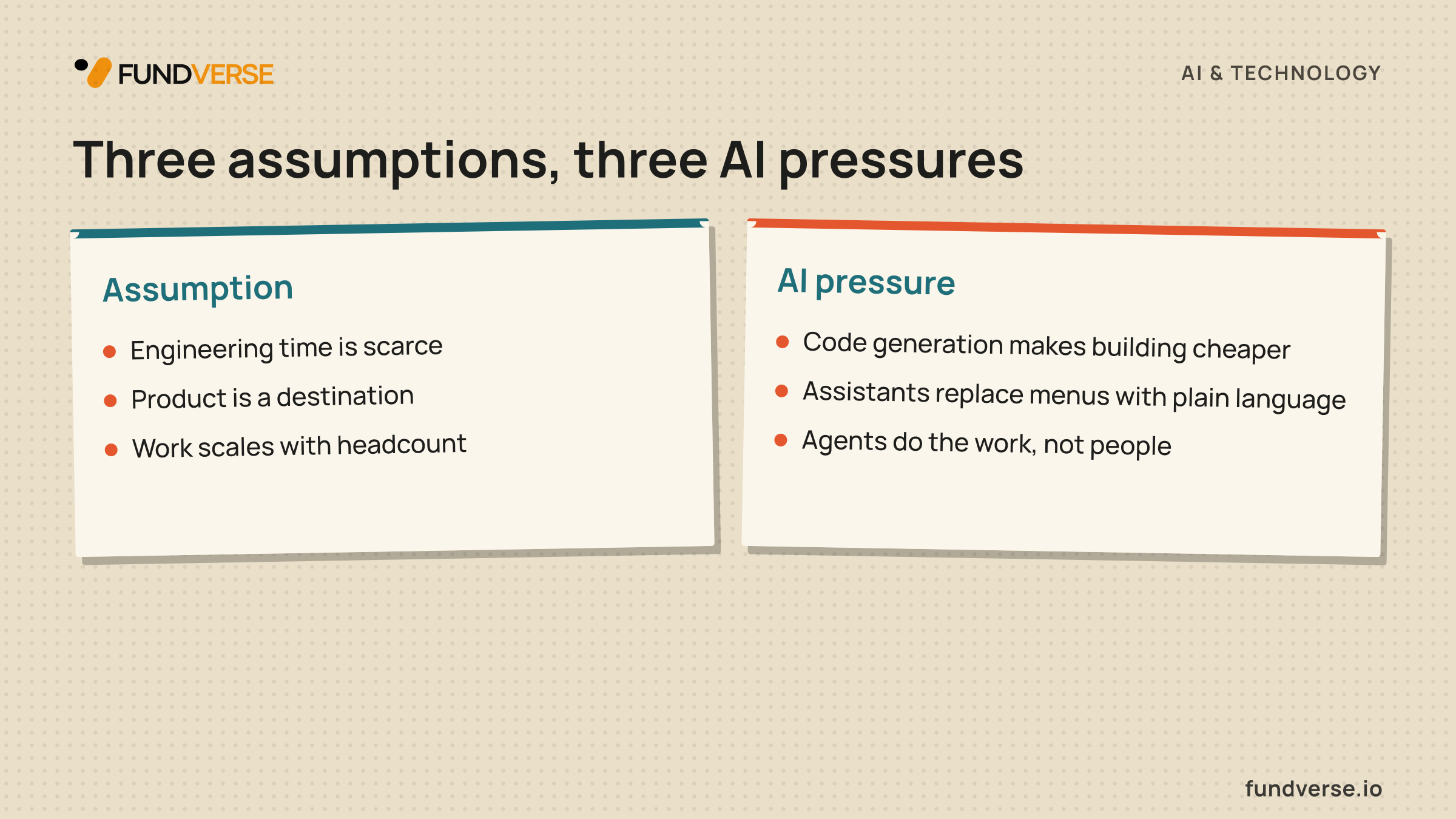
Each of those metrics quietly assumes three things. Competitors cannot replicate the product quickly, because engineering time is scarce. The product is a destination: people open it, click through screens and do their work inside it, so the interface is part of what customers buy. And the amount of work a customer does scales with the number of people it employs, so charging per seat tracks the value received. AI challenges all three assumptions, and not in the same way or at the same speed. Code generation attacks the first by making building cheaper. General-purpose assistants attack the second by letting users describe what they want in plain language instead of navigating menus. Agents, meaning software that carries out multi-step tasks on a user's behalf rather than just answering questions, attack the third, because once an agent does the work, the number of humans logged in no longer measures the value delivered. The next sections take them in that order.
Cheaper to build, harder to defend
Coding tools shrink the build moat
AI coding assistants and increasingly autonomous coding agents now draft, test and revise software at a speed that was not available a few years ago. Developers widely report this, so I treat it as observed. Economically it matters most for products whose value lay in assembling standard components (a database, a set of forms, some permissions, a dashboard) into a tidy application. When a small team, or a technically minded person inside the customer, can reproduce that assembly in days rather than quarters, the old argument that building it yourself is too expensive starts to fail.
It helps to be precise about what has become cheaper. Writing the first version of an application is dramatically easier. Operating it is not: security reviews, uptime, backups, regulatory requirements, upgrades, edge cases and the long tail of integrations that make a tool usable in a real organization all remain. Much of what a mature vendor sells is that operating burden, which is why a customer building an internal substitute often finds the prototype was the easy part. My interpretation is that the build-it-yourself threat is real for simple, low-stakes tools and overstated for anything holding sensitive data or tied into many systems. How long it stays overstated is the speculative part, because the tools keep improving.
The more certain effect falls on competition among vendors rather than between vendors and their customers. If a product can be built cheaply, so can its rivals, and so can a copy of any feature a rival ships. Feature differentiation, which used to buy a company a year or two of breathing room, now lasts a much shorter time. Entry gets cheaper for startups at the same moment that defending a lead gets more expensive, and that combination tends to compress pricing in crowded categories regardless of who wins any single contest.
When a product becomes a feature
The second pressure is subtler. A standalone product exists because a task was large enough, and different enough from other tasks, to justify its own interface, login and contract. A general AI platform that can read documents, write text, summarize meetings and act on connected systems erodes that boundary. Drafting a contract clause, transcribing a call, cleaning a spreadsheet or answering a routine support question can sit inside an assistant the customer already pays for. The product does not vanish; it is demoted to a capability.
There is evidence of this at both ends of the market. Large platform vendors such as Microsoft have embedded AI assistants into the productivity suites they already sell, which lets them bundle capabilities that smaller point products once charged for separately. At the other end, some businesses built on a single informational task have been hurt as free or cheap assistants began answering the same questions. The online homework help company Chegg is the commonly cited case, and it has attributed its decline in part to AI chatbots. Declines can have several causes, so I would not generalize from one company, but the direction for single-task products is clear enough.
The test I would apply is how much of the product's value lives outside the model's reach. If the value is a smart answer to a question the user can type, a platform can reproduce it. If it depends on proprietary records, on permission to act inside a company's systems, on regulatory sign-off or on a process that many parties must agree to follow, the platform has to do far more than be smart. That distinction runs through the rest of this analysis.
Pricing when the user is software
Why seats start to leak
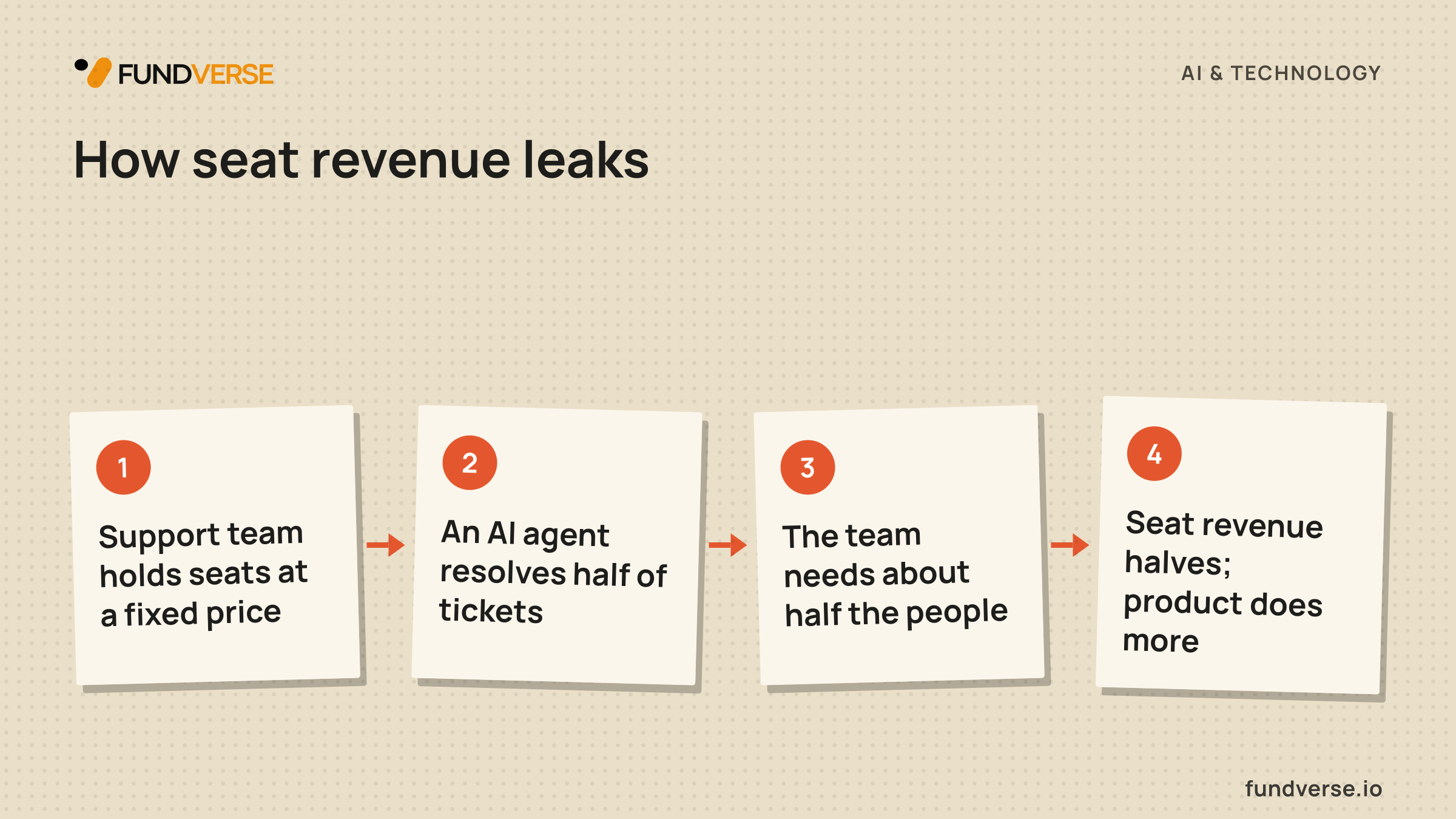
Per-seat pricing works because headcount and value are correlated: more people doing a task in the tool means more benefit, so a price per person is a fair and easily forecast proxy. An agent breaks that correlation. Take a labeled illustration, with round numbers chosen only to show the mechanism and not to represent any benchmark. A customer-support team of twenty people each holds a seat at a fixed monthly price, and an AI agent begins resolving half of incoming tickets without human involvement. The company now needs about ten people, so the vendor's seat revenue from that customer halves even though its product is doing more of the work than before. The customer is better off, the vendor is worse off, and the pricing model is the reason.
For incumbents this is the cannibalization problem. A vendor that sells seats and ships an agent that reduces the need for seats is discounting its own core revenue unless it changes how it charges. Customers will notice quickly, because a buyer who can cut headcount will ask why the software bill is not falling in step with the work, or why it should not share in the savings.
Usage and outcome pricing, and what they cost
The obvious response is to charge for what the software does rather than who logs in. Usage-based pricing charges per unit consumed, such as tasks run or documents analyzed. Outcome-based pricing charges when a defined result occurs; Intercom's support agent, Fin, is a widely discussed example because it is priced per resolved conversation rather than per seat. Large incumbents such as Salesforce have also been introducing consumption-style pricing for agent products alongside traditional licenses, which suggests even the biggest vendors are still experimenting. In our support example, a vendor paid per resolved ticket would earn more as the agent resolves more, instead of less.
These models solve one problem and create others. The first is predictability. A seat contract is a promise of a known monthly sum; a usage contract is a promise of a rate, and the total depends on how much work the customer sends through. That makes forecasting harder for the vendor and budgeting harder for the buyer, which is why many contracts blend a committed minimum with variable overage. The second is definition. Outcome pricing requires both sides to agree on what counts as a resolved ticket or a qualified lead, and the vendor is exposed to disputes whenever the answer is ambiguous.
The third is margins, and it gets less attention than it deserves. Traditional SaaS had a near-zero marginal cost per additional user. An AI feature does not: every request consumes model computation that the vendor pays for, whether on its own infrastructure or through a model provider. Heavy users can therefore become the least profitable customers, the reverse of the old pattern. The gross margin profile that made SaaS valuable is not guaranteed to survive in products whose core value comes from model inference. Costs per unit of AI work have tended to fall over time, which helps, but a company with a flat seat price and a customer with an unbounded appetite for computation can lose money on its best-engaged accounts.
What happens to recurring revenue
Recurring revenue does not disappear when fewer humans are needed, but its character changes. Seat revenue recurs because the seat exists as long as the employee does. Usage revenue recurs only as long as the work does, which for many business processes it will; invoices keep being processed and tickets keep arriving. The revenue stays repeatable, but it tracks the volume of the customer's business rather than the size of its payroll, so it can rise and fall with seasonality or the customer's own fortunes.
The more consequential change is in what net revenue retention means. In the seat model, expansion came from the customer hiring. In a work-based model, expansion comes from the vendor taking on more tasks or harder ones, which is a more product-driven form of growth. A company that cannot extend the range of work its software handles may see retention stall or reverse even if no customer cancels, because accounts quietly shrink as automation moves the same work onto fewer seats. Investors will need to read cohort charts carefully for the next few years: a falling seat count is no longer a reliable sign of dissatisfaction, nor a rising one of health.
Which advantages actually hold
If code, interface and clever features are all getting cheaper to copy, the question becomes what stays expensive to copy. Five candidates are usually named: proprietary data, integrations, distribution, customer relationships and workflow ownership. They are not equally strong, and they depend on each other, so each deserves a look under AI pressure.
Proprietary data is the most discussed and the most misunderstood. A vendor holding years of customer records, transactions or outcomes has something a model cannot invent: ground truth about how a particular industry behaves. But data is only a moat if it is hard to obtain elsewhere and improves the product in a way customers feel. Data that customers own, and can export to a competitor or feed to a general assistant, is a weaker advantage than it appears. Contracts and regulation decide this more than technology does, so investors should ask in diligence who actually owns the data and who may use it.
Integrations matter more than they used to, for an unglamorous reason. An agent that must act across a company's systems needs authorized, reliable and well-understood connections to them. Building and maintaining those connections, with the permission models, error handling and audit trails that enterprises demand, is slow work that does not become trivial because code is easier to write. A vendor sitting at the center of many connections is well placed to become the route through which agents act, though emerging standards for connecting models to tools may lower that barrier over time. That is a development to watch, not a settled fact.
Distribution and customer relationships are old advantages that gain value when products are easier to copy. If ten tools can do roughly the same thing, the one already in the customer's procurement system, trusted by its security team and known by its users has a head start that engineering cannot erase. This favors incumbents, and it is the strongest argument against the idea that new entrants will simply sweep them away. It also explains why bundling is so effective: distribution lets a good-enough feature beat a better standalone product. Relationships protect only a vendor that keeps delivering, though; a trusted supplier whose agent underperforms a rival's gets one chance to fix it.
Workflow ownership ties the others together. A product at the point where work begins, is approved or is recorded, such as the system of record for customers, payments, patients or compliance, has an advantage over one that merely assists with a step. An agent will usually need to read from and write to the system of record, which gives its owner leverage. The weaker position belongs to the tool that sits alongside the process and can be swapped without anyone changing how the business operates. The durable question is not whether a product has AI but whether the customer's operations would have to be reorganized to remove it.
Applying those five tests across categories gives a rough map of who is exposed and who may gain.
| Type of B2B software | Main exposure | What may strengthen it | Interpretation |
|---|---|---|---|
| Single-task point tools (summaries, drafting, simple analysis) | Absorbed into assistants and bundles | Little, unless tied to proprietary data | Most exposed |
| Horizontal seat-priced tools for routine knowledge work | Seats shrink as agents take tasks | Re-pricing around work done | Exposed but adaptable |
| Thin application layers over standard databases | Cheap to rebuild or replace | Operational depth, security, support | Exposed if shallow |
| Systems of record (finance, HR, CRM, ERP) | Pressure on seats and interface | Data gravity, integrations, trust | Likely to gain value if they open up to agents |
| Regulated or high-stakes vertical software | Slow adoption of unproven AI | Compliance, domain data, accountability | Often durable, and may gain |
| Infrastructure for agents (security, observability, identity) | Fast-moving and crowded standards | New demand created by agent use | Growing, but contested |
The pattern is not a rule. Software is most exposed when its value is generic, easily described in a prompt and not tied to anything the customer would find painful to move. It is most likely to become more valuable when it holds the records agents must consult, carries legal or regulatory responsibility, or supplies the controls that make autonomous action acceptable to a risk-averse buyer. The ranking says little about whether a company has an AI feature and a great deal about what it already owned before AI arrived.
Adapting, and what capital should ask
Beyond bolting on a chatbot
Adding an assistant to an existing product is the cheapest response and the least differentiated, because every competitor can do the same with the same underlying models. Adaptation that holds up tends to change the business rather than the interface. One change is repricing: moving from seats toward the unit of work, as Intercom did with resolutions, accepting short-term revenue uncertainty in exchange for aligning price with value. Another is reorienting the product from a tool people use to a system that does tasks, with human review where stakes are high. A third is opening the product to agents, through robust interfaces and permissions, so that it becomes the trusted place where automated work lands rather than something agents route around.
The record is mixed, and it is too early for confident verdicts. Big platform vendors have moved quickly to place AI inside existing products and to experiment with pricing, but how much revenue this generates, and at what cost to margins, is still being established, and companies' own claims should be read with that in mind. The clearest failures are less vendors that refused to adapt than businesses whose entire offering was one task a general assistant could do, the Chegg pattern again. The lesson from both is that incumbency helps only if a company converts its existing assets into something agents need, and that a late response can leave it defending a shrinking seat base while rivals reprice.
If you are preparing to raise, or assessing a software company, Fundverse can help you organize the metrics, data room materials and investor pipeline around a story that stands up to hard questions on pricing and defensibility.
Startups, investors and valuations
For startups, cheaper building cuts both ways. It lowers the capital needed to reach a working product, which in principle reduces how much a founder must raise and dilute; the same shift means a funded competitor can copy a feature set quickly. Early traction therefore proves less than it once did. Revenue that comes from a clever interface is the easiest kind to lose, whereas revenue from deep integration into a customer's operations is harder to displace. Founders raising now should expect investors to probe the source of retention, not just its level.
For venture investors the adjustments concern what to underwrite. Growth that depends on seat expansion deserves a haircut if automation could shrink those seats. Gross margins need to be examined net of inference costs, and at the level of heavy users rather than averages, since a healthy blended margin can hide unprofitable accounts. Defensibility can be tested by asking what a well-funded competitor with the same models and strong engineers could not replicate in a year. And valuations set when software multiples assumed stable seat-based retention need re-deriving from the new revenue model, not from analogies to the old one. Founders can pressure-test their own numbers against that logic with the startup valuation calculator, and the piece on defensible financial assumptions applies directly: an assumption that retention holds while the seat count falls is exactly what investors will challenge.
For lenders and other funders, the question is cash flow resilience. A business with contracted seat revenue has been an attractive credit; one whose revenue moves with usage has a different volatility profile and may deserve different covenants and more headroom. Debt providers should ask how much revenue is committed and how quickly a customer could reduce it. Investors using Fundverse can keep that diligence organized alongside the rest of their pipeline.
Sorting fact from forecast
Much commentary on this topic blurs how confident it is, so here is my own sorting. Already happening: coding tools are widely used and lower the effort of building software; large platforms are embedding AI into existing suites; some single-task products have been damaged by general assistants; and several vendors, including Intercom, now charge for work done instead of seats. Emerging: broader movement toward usage and outcome pricing across categories, agents acting across multiple systems on behalf of customers, and standards for connecting models to enterprise tools. The evidence here is partial and uneven, and results vary by company.
Speculation: that most enterprises will build their own software instead of buying it; that systems of record will dissolve into a layer of agents; that incumbents as a group will win or lose; and any specific timetable. These claims are often argued confidently by people with something to sell, whether a model, a platform or a short position, and deserve skepticism in both directions. A sensible reading is that the shift is real, its pace and distribution are uncertain, and the winners will be decided less by technology than by who controls data, distribution and the customer's day-to-day work.
Rebuild around the work, not the seat
Founders building B2B software should start by listing what a customer would lose if the product were switched off tomorrow, and be honest about how much of that is the interface, which is getting cheaper, and how much is records, connections, accountability and habit, which are not. Then look at pricing: if an agent could do the job with half the people, would your revenue fall or rise? If it would fall, the pricing model is a liability you can fix voluntarily now or have fixed for you by a customer later. Check what gross margin looks like at the heaviest usage level, not the average, and decide which unit of value you are prepared to be paid for.
The long-term question is whether you own something an agent has to come through. That might be a system of record, a regulated process, a network of counterparties or data no one else collects. If you do, AI can make the business more valuable, and the task is to open it up on your terms. If you do not, the task is to move toward something you do own before a bundle or a faster competitor makes the choice for you. Investors will increasingly ask the same thing, and the founders with a clear answer, backed by retention that survives automation, will be the ones who raise on good terms.
Frequently asked questions
Topics
B2B SaaS AI disruption
AI agents per-seat pricing
SaaS valuations AI
usage-based pricing
SaaS defensibility
AI coding tools
software moats
SaaS investors
Raising or investing?
Find the right people on the other side of the table, and run the round in one place.