
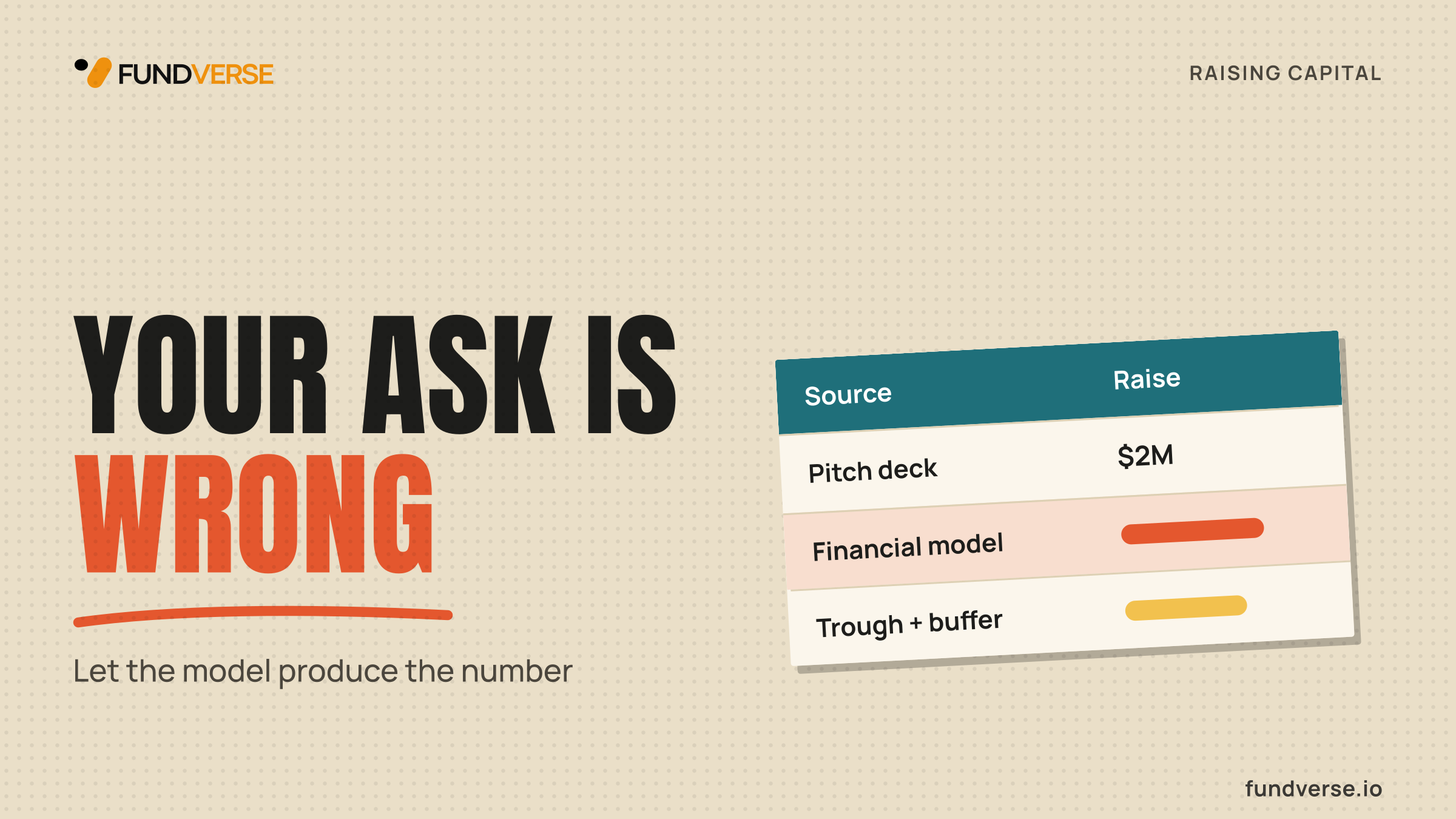

Your ask slide should be the output of your financial model, not a number chosen first. Learn how to derive the raise from your cash trough, test it, and reconcile deck and model before investors do.
A pitch deck and a financial model are two answers to the same question: how much money does this business need? The deck answers with a round figure on one slide, say $2 million. The model answers with a column of monthly cash movements that adds up to something else. Neither is obviously wrong, because nobody has ever made them agree.
Investors tend to find that gap quickly. They do not mind that forecasts are estimates, but an ask that does not match the founder's own spreadsheet suggests the number was chosen before anyone worked out how cash moves through the business. The fix is to reverse the order: let the model produce the number, then defend it.
The ask is a conclusion
The ask slide is the last line of a calculation. The business wants to reach a specific point: a launched product, a second market, a plant running at capacity. That point is the milestone, a concrete and checkable achievement the money is meant to buy. Getting there costs cash month by month before revenue covers the costs, and the round is the size of that shortfall plus a margin for error. Choosing the number first and justifying it afterward forces the model to bend to fit a figure it never produced.
Most of the damage comes from three habits. The first is sizing the round from comparable raises: a similar company raised about that much, so the deck says the same. Comparables show what the market has tolerated, not what your business consumes. The second is updating the model after the deck is finished. Hiring dates slip, a customer pays late, a supplier is renegotiated, and the spreadsheet records it while the slides keep the old story. The third is a use-of-funds chart built by percentage, perhaps 40 percent product, 30 percent sales and 30 percent everything else, because those proportions look conventional and not because the forecast produced them.
What investors actually check
Investors rarely rebuild a model, but they run three quick comparisons. They set the ask against the model's cumulative cash need. They compare the use-of-funds split with the cost lines in the forecast. And they check whether the milestones on the roadmap slide arrive at plausible dates in the model's timeline. A founder who has traced these links passes in minutes; one who has not usually finds out mid-meeting. Whether the revenue line carries two decimal places, or the formatting is polished, is mostly founder habit and seldom decides anything.
What cash flow shows that profit hides
To derive the ask you need the right statement. A profit and loss account records revenue when it is earned and costs when they are incurred. A monthly cash flow forecast records when money actually moves, and the two can diverge sharply. A customer invoiced in March may pay in May. Inventory is paid for before it is sold, so a product business can show a healthy margin while its cash sits on shelves. Payroll lands every month regardless of sales, and taxes such as VAT or payroll withholding fall due on fixed dates, sometimes before the related cash has arrived.
That is how a business can look close to break-even on the P&L and still need a substantial raise. The difference between earning and collecting, plus the cost of building stock or capacity ahead of demand, is working capital, and it only shows up in the cash forecast. A round sized from the P&L tends to understate the need, and an investor who reads both statements sees the shortfall at once.
Deriving the raise from the model
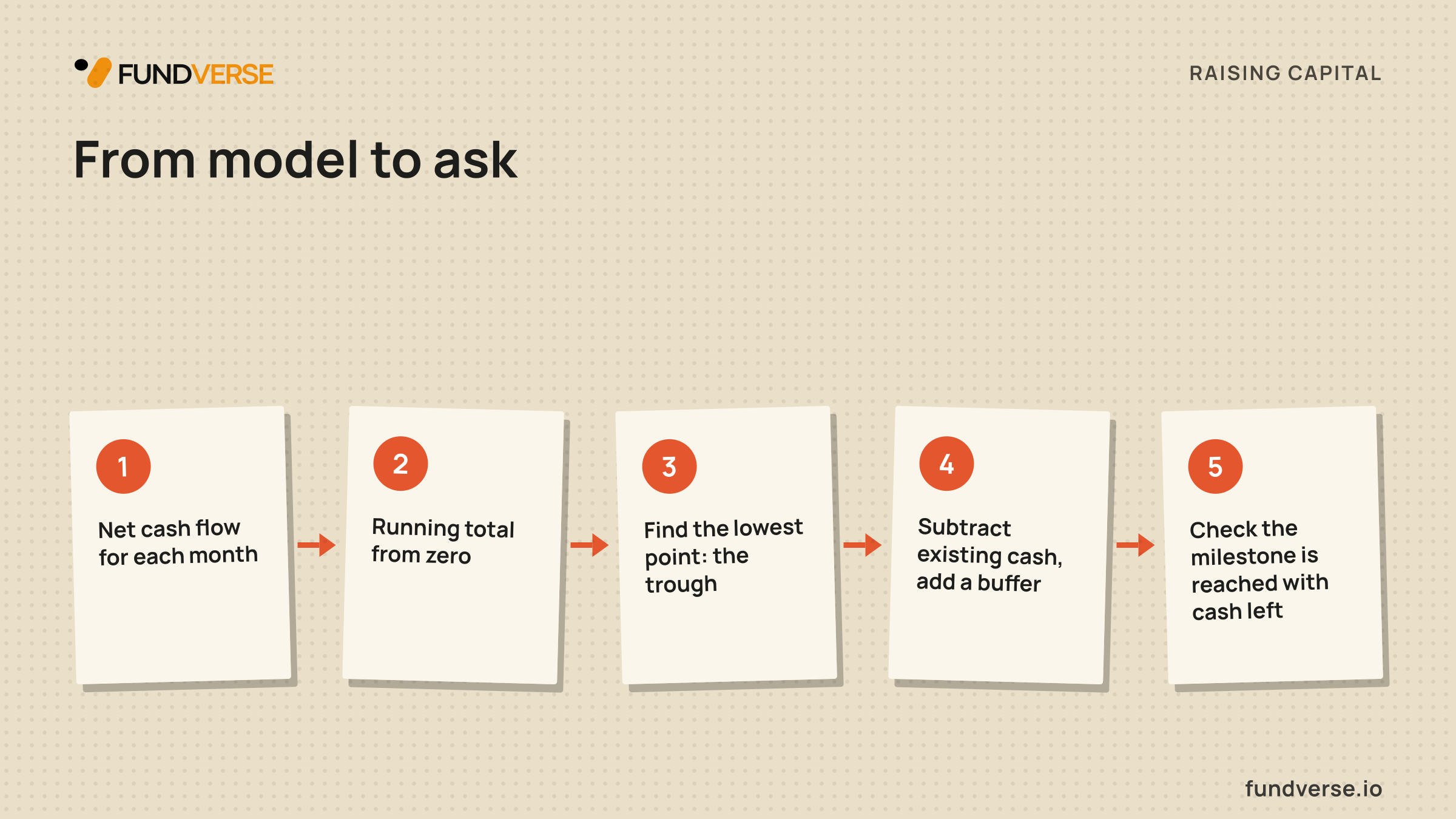
Start with net cash flow for each month: cash in minus cash out. Where that figure is negative, the business is burning cash, and burn is simply the size of that monthly loss. Now add the months up as a running total beginning at zero, and find the lowest value the total reaches. That cumulative cash trough is the funding gap before any buffer: the most cash the business will be short at any point if the forecast holds. Any cash already in the bank offsets it, so the gap is the trough less existing cash. Raise less than the gap and the money runs out before the model says the business turns around.
The trough means little without a milestone. A model can run for years and keep losing money, so the real question is what the money must achieve and by when. The model should show that milestone reached with cash still in the bank, because the next investor will judge the company on where it stands at that point, not on how long the money lasted. A milestone like a product in market with a set number of paying customers, or a facility commissioned and earning, also gives the round a clear purpose.
How much buffer to add
The buffer exists because forecasts are wrong in ways nobody can predict. Opinions differ on size: some advisers suggest three to six months of burn, others a percentage of the trough, and businesses with long lead times or heavy capital spending often want more. A fixed rule matters less than the reasoning. Fundraising itself takes months, so a company that reaches its milestone with only weeks of cash must raise again from weakness. Size the buffer so the next raise can begin while the business still has choices.
One illustration, two outcomes
The following is an illustration of the mechanism, not a benchmark and not a real company. A business has a deck asking for $2 million, with a milestone of a launched product earning steady monthly revenue by month 18. Suppose its cash forecast has net cash flows that, added up month by month, fall to a lowest point and then start climbing as revenue arrives. Assume monthly burn near the trough is about $150,000, so a three-month buffer is roughly $450,000. The only question is whether the trough plus that buffer lands near the $2 million on the slide.
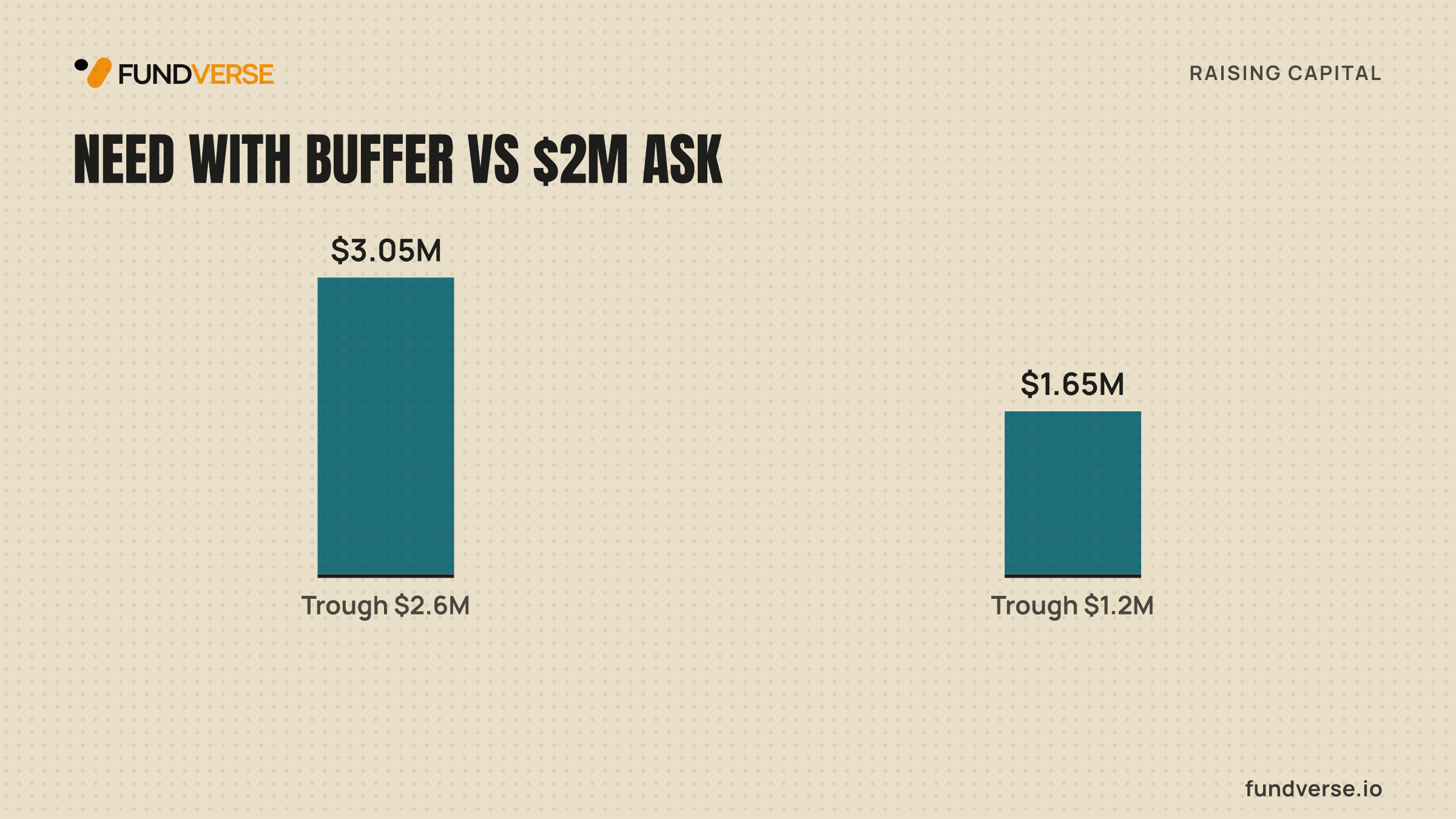
First outcome: the trough is $2.6 million. With the buffer, the real need is about $3.05 million. Raising $2 million means the cash ends many months before the milestone. The founder must find a bridge round, a small stopgap raise usually made on tight terms with little time to negotiate, or cut costs and slip the milestone. Either way the next investor meets a team that asked for too little and now negotiates with a shrinking runway, which is a weaker position than a properly sized first round would have given. Meanwhile any investor comparing today's deck with the model sees an ask that the founder's own forecast contradicts.
Second outcome: the trough is $1.2 million. With the same buffer the need is about $1.65 million, leaving roughly $350,000 of the $2 million unexplained. Surplus is not free. It costs dilution, because the founders sell a larger share of the company than the plan requires, and it prompts questions about discipline: what will this money be spent on, and will it be spent well? If there is a real reason, such as an extra hire or a larger inventory build, it should be in the model and tied to the milestone. If there is none, the ask should shrink to match.
Both outcomes send the same signal. The investor cares less about the size of the error than about evidence that the number came from somewhere other than the model.
Tracing use of funds and testing the base case
Once the ask is derived, use of funds, the breakdown of what the money will be spent on, should be a summary of the model's cost lines over the period the round covers: hiring plan, product development, marketing and sales, working capital and capital expenditure. Each slice should be a sum a reader can find in the spreadsheet. If the chart says 30 percent goes to marketing, the model's marketing line over the funded period should total about that. Proportions that differ from a typical pattern are fine, provided the model explains why.
Investors expect assumptions to be challenged, so challenge them first. Return to the illustration and delay first revenue by three months. The business now pays costs for three more months with no income, so at $150,000 of burn the trough deepens by roughly $450,000. Stretch customer collection from 30 to 60 days and the extra month of unpaid invoices ties up more working capital, which deepens it again. Doing this shows which assumptions the raise depends on most. Present the ask as a base case with a stated downside, for instance that a three-month revenue delay raises the need by a given amount. A defensible range is more credible than false precision, and a founder who shows the range has shown they understand the forecast is an estimate.
When currencies differ
Currency can change the arithmetic. A founder who raises in dollars but pays salaries, rent and suppliers in local currency is exposed to exchange movements. If the local currency weakens, the dollars buy more local costs, but imported inputs priced in dollars cost more local currency, and if customers pay in local currency while some costs are in dollars, the exposure turns against the founder instead. Local inflation can also push costs up faster than a flat model assumes. State the exchange rate the model uses, show the effect of a plausible move, and keep the trough in the currency of the round so deck and model stay comparable.
Same numbers, different readers
The same forecast is read differently depending on who holds it. A venture or equity investor looks at the trough, the milestone and what the business must look like for the next round. A lender asks whether operating cash flow covers interest and principal repayments, and whether the drawdown schedule, the timing of when loan money is released, matches when the cash is needed. A grant maker compares budget against deliverables, expecting each cost to tie to an activity and outcome, often within limits on what the grant may fund. An impact investor may add measures of social or environmental results alongside the cash.
So the model stays the same while the package changes. For a lender, add a repayment schedule and show coverage in a weak month. For a grant maker, rebuild the use of funds as a budget by deliverable. For an equity investor, keep the focus on the milestone and the cash left after reaching it.
Reconcile before you send
A short check before the deck leaves your hands catches most of the damage:
- Ask versus cash trough: the round size equals the lowest cumulative cash point, less existing cash, plus a stated buffer.
- Use of funds versus cost lines: every slice sums to a figure in the model.
- Milestones versus timeline: each milestone falls on a date the model supports, with cash remaining.
- Assumptions stated identically: growth rates, prices, hiring dates and exchange rates match in both documents.
If you want a second pair of eyes on how your deck and numbers fit together, Marcus, Fundverse's AI, can review a pitch deck, and Fundverse's financial analysis tools let you test the model alongside it. They help you check the two documents against each other; the judgment about what the business needs stays yours.
When the investor spots it live
Sometimes the mismatch surfaces in the meeting. The worst response is to defend a number you cannot trace. Acknowledge the gap plainly, say which document you believe is right and why, and explain how you will resolve it. For example: the model is current and the deck was built earlier, so the model's figure governs, and a corrected deck will follow within a day. Then send it. Investors tend to respect a founder who finds the source of an error quickly, because that is the same skill running a company requires.
A number you can defend
A good ask is rarely the round number that looks best on a slide. It is the figure the model produces, adjusted for a buffer you can explain, and it is allowed to be $2.3 million or $1.7 million if that is what the cash requires. A visible derivation survives scrutiny better than a number that merely sounds right.
So build the model first, find the trough, tie it to a milestone, and let the slide report the result. When someone asks where the number comes from, you can point to the line it came from. For more on how investors read the numbers behind a deck, see the financial model mistakes that make investors question a business.
Frequently asked questions
Topics
funding ask
financial model
pitch deck
cash flow forecast
how much to raise
runway
use of funds
round size
Raising or investing?
Find the right people on the other side of the table, and run the round in one place.