

How a deal travels through a venture firm, from sourcing and triage to partner meeting, diligence, committee and term sheet, and why most rejections reflect fit, fund math and time, not quality.
A partner can read a deck, find it compelling and still never reply, because the same afternoon holds a board meeting, a portfolio emergency and dozens of other unread submissions. A venture firm's interest in a company and its capacity to pursue it are different things, and most of what founders experience as mystery lives in the gap between them. From the outside the silence looks like a judgment. From the inside it is usually a queue.
The process a deal passes through exists to manage that queue. It is a series of filters, each built to answer one question as cheaply as possible before anyone spends more time. Knowing what each filter tests explains why most submissions end early, why many of those endings say nothing about the business, and how both sides can make better use of limited attention. Details differ by firm and by market, and the differences are covered below. The underlying logic is common.
Why the process has stages
The scarcest resource inside a venture firm is not capital. It is the attention of the few partners who can lead an investment, sit on a board and put their reputation behind a decision. A fund typically makes a limited number of investments over several years, yet it may see far more opportunities than that in a single quarter. If every opportunity received a partner's full attention, none would get a proper look.
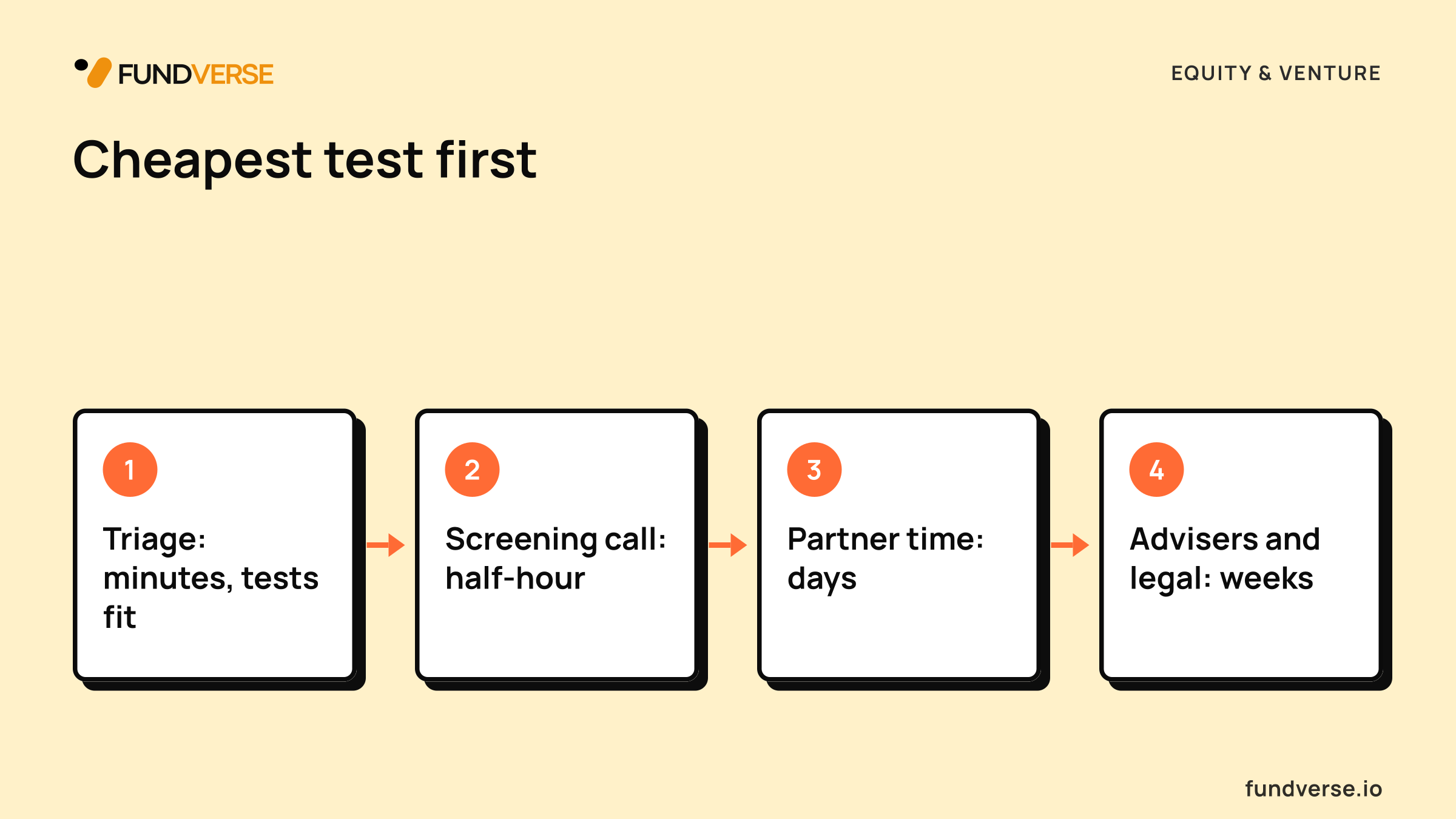
So the work is staged by cost. The first stage costs minutes and tests whether the deal belongs in the firm's world at all. The next costs a half-hour call and tests whether the team and opportunity deserve a deeper look. Later stages cost days of partner time, then weeks of outside advisers and legal fees. Each stage asks one question and releases only the survivors to the next. The cheapest test that can kill a deal comes first, and the most expensive work is reserved for deals that have passed everything else.
How deals reach the firm
Before any filter applies, a deal has to arrive, and the route it takes shapes how closely it is read. Firms usually receive deals through five channels. Inbound submissions come through a website form or a cold email; they are the highest in volume and the lowest in prior signal. Warm introductions come from people the firm trusts, such as portfolio founders, other investors or advisers, and carry an implied recommendation. Proactive sourcing means the firm goes looking: mapping a sector, following companies it has tracked, approaching founders it already admires. Co-investor referrals arrive when another fund wants a partner in a round or has passed on something outside its own mandate. Platforms, including accelerator demo days, investor networks and software that matches founders with investors, gather deal flow in one place.
The source matters because it sets the reader's starting assumption. A deal from a trusted co-investor has already passed someone else's filter, so it tends to be read with more care and moved faster. A cold form submission has passed nothing, so it gets the quickest possible read. That is the same cost logic, not snobbery. An introduction that is credible and specific saves the firm work; a merely forwarded email saves none, so a warm route helps only when the person making it knows both sides.
The first read decides fit, not quality
Triage is the first fast read of a deck or form, often by an associate, an analyst or a partner between meetings, sometimes with a template or software support. It takes minutes, and it tests fit before quality. The reader checks the deal against the firm's mandate: the stage of company it backs, the sectors it knows, the geographies it covers, the check size it writes and the ownership it needs to take. Ownership is the least visible of these to founders, and the next section explains why it matters so much to the firm.
Because fit is a yes-or-no test applied before anyone has formed a view on quality, a large share of declines happen here. A strong company outside a firm's sector or stage is declined as quickly as a weak one. A mandate is also usually fixed by commitments the firm made to its own investors, so a partner who personally likes a deal often cannot act on it. A check that is too large or too small for the round is a structural mismatch, not a comment on the company.
Founders can avoid much of this by researching mandate before sending anything. Read what the firm says about stage, sector and geography, look at its recent investments for typical round size and stage, and check whether it leads rounds or only follows. Then say in the first lines of the message why the company fits. A shorter, better targeted list almost always beats a long untargeted one, and our piece on sending the same deck to every investor covers that in more depth.
The screening call and the fund-returns question
A deal that fits earns a screening call, usually twenty to forty minutes with an associate, principal or partner. It tests four things at once. Can the team explain the business clearly? Is the problem painful enough that someone pays to solve it? Is there early evidence of demand, such as usage, pilots, paying customers or waiting lists, appropriate to the stage? And could the opportunity plausibly become large enough to matter to the fund?
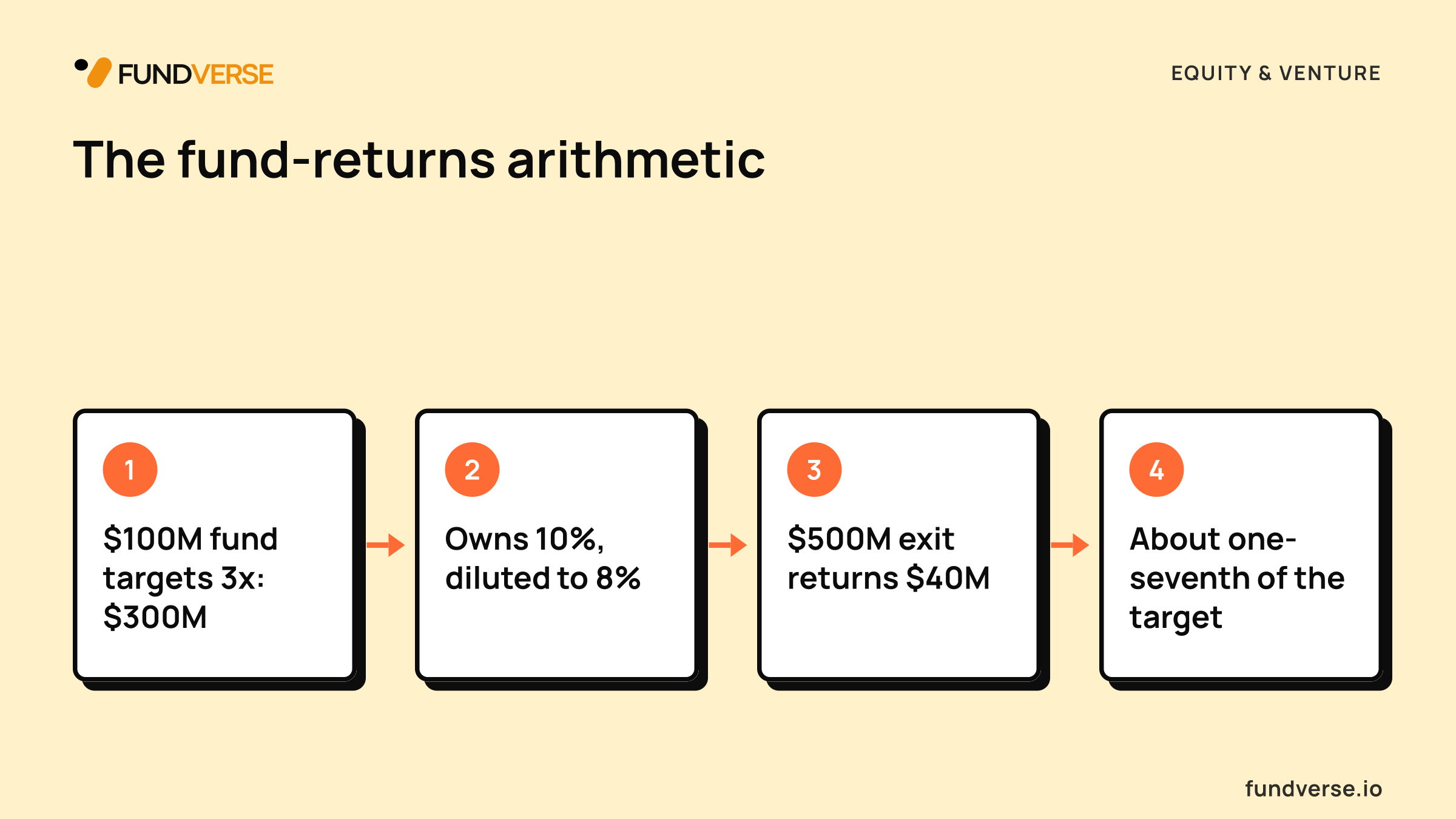
The last question is the one that surprises founders, so the logic is worth seeing. A venture fund is a portfolio in which many investments return little or nothing and a few return a great deal. The fund as a whole must return a multiple of what its investors committed, so the winners have to be big enough to pay for the rest. Here is a deliberately simple illustration, offered as arithmetic and not as a benchmark. Suppose a $100 million fund wants to return three times its capital, or $300 million. If it takes 10 percent of a company and that stake is diluted to 8 percent by later rounds, then an exit worth $500 million returns the fund $40 million, about one-seventh of the target. To make a single investment return the whole fund, the exit would need to be several billion dollars.
Two levers follow from this. Fund size sets how large an outcome must be: a $20 million fund needs far smaller exits to move its total than a $500 million one. Ownership sets how much of any exit the fund keeps, which is why firms hold target stakes and why a round that would only buy a sliver gets declined at triage. A good, profitable business can therefore be declined without being a bad business. The question is not whether it is worthwhile but whether the plausible upside is large enough for this particular fund. A founder who can describe the path to a large market honestly, with the evidence behind it, answers that better than one who simply asserts ambition.
Building the case inside the firm
After a promising call, the person who took it, often an associate or principal, begins building the case. They research the market, speak to the founders again, test the claims in the deck and write an internal note setting out what the company does, why it might work and what could go wrong. This is where a founder's material is translated into the firm's language of risk and return.
Someone senior must then carry the deal. A champion partner is the partner who believes in the opportunity, answers objections and puts their own credibility behind it. Without one, most deals stall quietly, however good the analysis. Junior team members can find and shape deals, but the champion is usually the person who gets one to a decision. For founders, the aim of early meetings is therefore not only to impress the person in the room but to give them what they need to argue for the company when the founder is absent: a clear story, specific evidence and honest answers about weaknesses.
The partner meeting
The partner meeting is the regular internal session, often weekly, where the investing team discusses live deals. Founders sometimes present at one, but more often the deal is discussed in their absence. The debate usually covers whether the team can execute, whether the market is large and reachable, what the key risks are, how the price compares with the possible return, and whether the deal fits the portfolio, for instance by conflicting with an existing investment.
How disagreement is handled depends on the firm. In some multi-partner firms a deal needs broad consensus, or at least no strong objection, which can slow decisions but surfaces concerns early. In others a single partner has authority over their own investments within agreed limits, which is faster but concentrates judgment in one person. A solo general partner, meaning the one person running the fund, decides alone, though many still consult trusted advisers. None of these models is inherently better. Consensus can dilute conviction and favor safe choices, while individual authority can miss blind spots.
Due diligence, in the right order
Due diligence is the structured checking of what the company has claimed. It usually begins once a champion is committed, sometimes before a term sheet and sometimes after, depending on the firm. It has several strands. Commercial work tests market size, competition, pricing and the sales evidence behind the growth story. Product and technical work asks whether the product does what is claimed and what the technical risks are. Financial work reviews historical accounts, the model, burn rate and runway, and whether the numbers reconcile. Legal work covers the cap table (who owns what, including options and convertible instruments), ownership of intellectual property and key contracts. Customer and reference calls test the story against people who have bought the product or worked with the founders, and background checks verify identity and claims about prior roles.
The strands are not run in parallel at full cost. Cheap checks that could end a deal come first: a look at the cap table for a structural problem, a few customer calls, a review of key metrics. Expensive work, such as outside legal review, technical audits or paid background checks, comes last, when the firm is nearly certain it wants to proceed. Founders help themselves by preparing a tidy data room in advance, with corporate documents, the cap table, financial statements, key contracts, and product and metrics information organized and current. Disorder at this stage does not just slow things down; it makes reviewers wonder what else is unstructured.
Committee, term sheet and what remains
When diligence is far enough along, the deal team writes an investment committee memo setting out the company, the thesis, the evidence, the risks, the proposed terms and the recommendation. The investment committee (IC) is the group that formally approves or declines the investment; in some firms it is all the partners, in others a defined subset, and in a solo fund the decision is the manager's own, sometimes with an advisory panel. Writing the memo forces the team to commit its reasoning to paper, which is as much a discipline as a report.
A conditional yes is common: approval subject to specific items, such as satisfactory confirmatory diligence, a particular co-investor joining, a key hire or the resolution of a legal issue. It is a real decision but not a final one, and the conditions deserve to be taken seriously.
The term sheet then sets out the main terms of the proposed investment: the amount, the valuation, the type of security and the key rights, such as board seats, information rights, investor protections and how proceeds are shared in an exit. It is generally non-binding on most terms, although confidentiality and exclusivity (a period when the company agrees not to negotiate with others) are typically binding. Signing it does not close the round. Confirmatory diligence, the final verification of facts the investor has relied on, and the full legal documentation still follow, and either can change or end the deal. Our article on verbal commitments explains why none of these steps equals cash in the account.
Why timelines stretch and what silence means
Timelines vary widely, and they usually stretch rather than shrink. Partner calendars are the first cause: travel, board meetings and portfolio problems take priority over a deal that is not yet urgent. Fund-cycle pressure is another, since a firm early in its investing period may move quickly while one close to fully invested, or waiting on a new fund, may slow down. And many deals wait on a lead, the investor who sets the terms and takes the largest role. Followers often will not commit until a lead does, and a lead may not appear for weeks.
Silence is therefore more often a low-priority signal than a rejection. A firm that wants to decline usually says so, because a clear decline costs little, while a deal that sits quietly is typically waiting for time, a partner or a lead. That is not a promise of interest and does not mean a yes is coming. It means little can be read into it either way, and the right response is a polite, specific follow-up and continued conversations with other investors. The dynamics are examined further in our piece on rounds that take too long.
Reading the signals along the way
Some behavior does carry information, and what it has in common is effort. A request for specific data, such as cohort retention or contract copies, suggests someone is building a case. An introduction to another partner means the champion is widening support. Reference calls and meetings with the wider team show the firm spending real time and money. Polite deferrals look different: warm words, offers to stay in touch and a request to update them next quarter, with no request for materials. The first set costs the investor something; the second costs nothing. For more on separating interest from intent, see investor interest versus genuine investment intent.
How the process changes by firm and market
Everything above describes common practice, not a universal rule. A solo-GP seed fund may move from first call to check in a couple of weeks, with the manager doing triage, diligence and decision alone. Diligence is usually lighter because the checks are small, and the risk is that one person's availability and judgment are the whole process. A multi-partner firm adds layers, such as an associate to screen, a champion to carry the deal, a partner meeting and a formal committee, which means more checks and more time. A corporate venture arm may weigh strategic fit with its parent, need approvals from outside the investing team and sometimes move more slowly. Evergreen vehicles, which invest on an ongoing basis rather than from a fixed-life fund, can face different pacing pressures than traditional funds.
Markets matter too. Where venture rounds are small and capital is thin, a lead investor often assembles the round from co-investors, angels and sometimes development finance institutions, which invest under their own mandates and have their own approval and compliance steps. A deal may then need several separate processes to converge, and the slowest sets the pace. Founders in those markets should ask early who else is expected in the round and what each party needs.
Making each stage easier to say yes to
For founders, the practical approach is to design each step around the filter in front of them. At triage, show fit in the opening lines. On the screening call, be clear about the problem, the evidence and the size of the opportunity. While the case is being built, equip the champion with specific answers. During diligence, keep the data room and cap table in order. Throughout, treat unexplained silence as a reason to keep other conversations alive, not as a verdict.
For investors, the aim is a pipeline in which the staging actually works. Record why each deal was declined, whether for fit, timing or quality, so a company that was early last year is easy to revisit. Keep a visible stage for every live deal so none stalls by neglect, and use a consistent screening template so triage is comparable across the team. Tools such as Fundverse's pipeline management and screening can keep that history in one place, and investor matching can help founders find firms whose mandate fits. Neither replaces judgment or guarantees an outcome.
If you run a pipeline, Fundverse can give your team a shared record of every deal, its stage and why it moved or stopped. If you are raising, it can help you find investors whose mandate fits before you spend time on a pitch.
Most deals end early, for reasons of mandate, ownership math or time, and a decline at the first stage usually says nothing about whether the company is good. The deals that progress do so because someone senior concluded that the evidence, the team and the potential return justified more of the firm's limited attention. Take the last firm that went quiet on you, or your last declined deal, and ask which stage it stopped at and what that stage was testing. The answer will show what to change in your list, your materials or your pipeline before the next round of conversations begins.
Frequently asked questions
Topics
venture capital process
deal flow
investment committee
due diligence
term sheet
partner meeting
investor screening
VC pipeline
Raising or investing?
Find the right people on the other side of the table, and run the round in one place.