
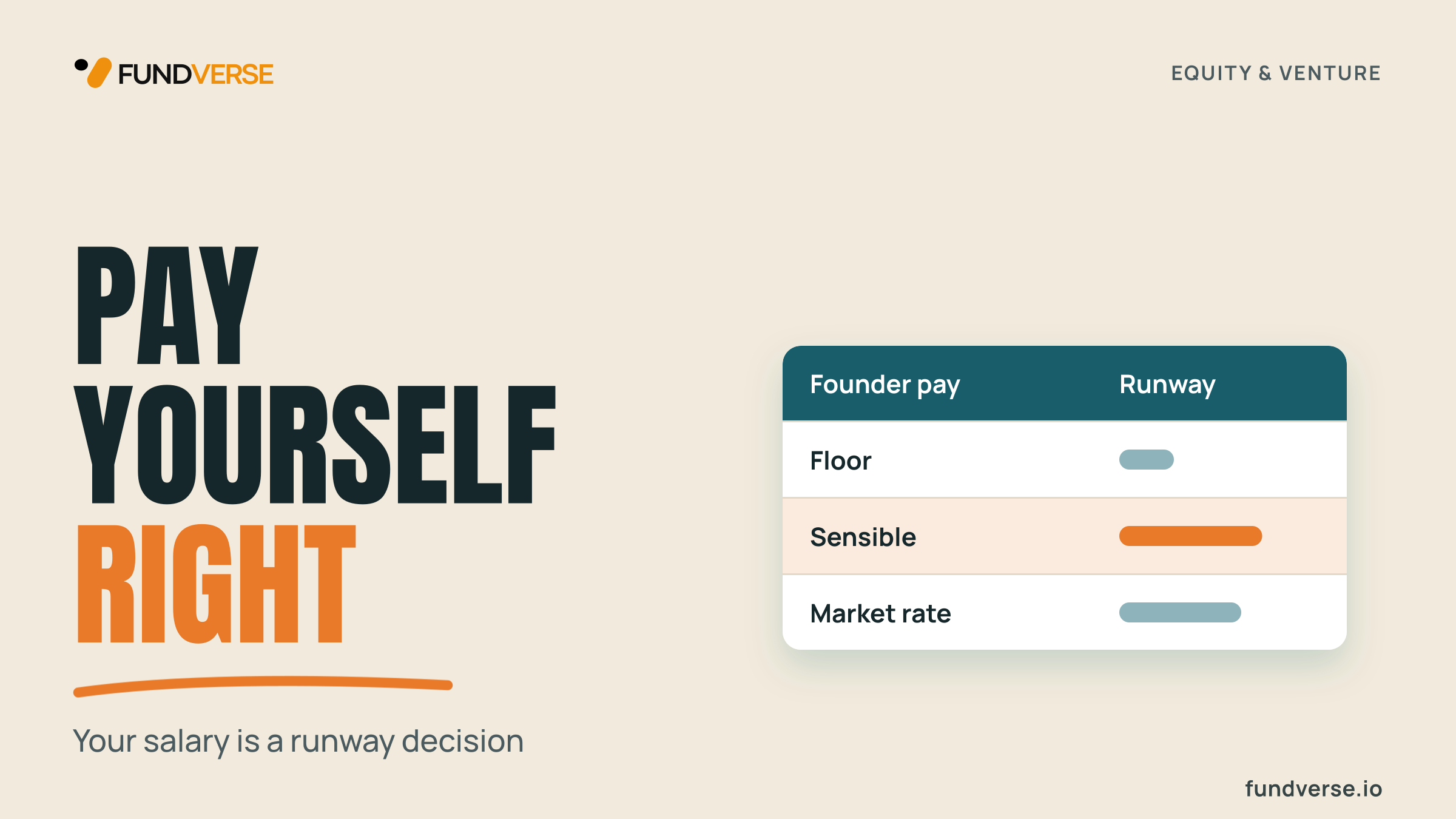

A founder's salary after a first VC round is a runway decision as much as a personal one. Here is how investors read it, how to set a figure, and how to agree it so it lasts.
Two founders can close the same round, in the same month, with the same lead investor, and sensibly pay themselves very different amounts. One lives in a city where a modest apartment takes half a salary. The other runs the company from a town where the same rent is a fraction of that, and has a partner whose income covers the household. Neither has made a mistake, because the right figure depends on things the round itself doesn't reveal.
A founder's salary after a first round is a runway and signaling decision, not a reward for raising. Once the money is in the bank, every pay choice buys or costs months of time, and investors read that choice as a sign of how the founder thinks. What follows covers how they read it, how to build a figure from your own costs and the funded runway, and how to agree it so it survives the next stage.
1. The round is a fixed pool
Before a round, founder pay is often small or nothing, and the question rarely comes up because there is hardly any money to argue about. After the round, the company holds a fixed pool of cash meant to reach a specific milestone, usually the evidence the next investors will want to see. Nothing is coming in to cover an overspend. Founder salaries come out of the same pool as engineering, hiring and customer acquisition, so each one lengthens or shortens the runway, the number of months the cash lasts at the current monthly burn.
That is why pay can't be judged without knowing the round size and the plan it has to carry. The same salary is trivial in a large round with a short plan and heavy in a small round with a long one. If you are unsure how the size of a round connects to the plan, the link between a pitch deck's ask and the financial model behind it is worth reading first.
What investors are really judging
Most investors don't carry a target figure in their heads. They care less about the exact number than about whether it is sensible, and they are usually reading three things. The first is whether you understand your burn: can you explain your pay as one line in the budget and say what it does to runway? The second is whether you are committed without being financially desperate. A founder worried about next month's rent ends up making decisions to cover the next paycheck instead of building the company.
The third is whether the level is neither extravagant nor self-sacrificing. A salary well above what the stage justifies suggests the round is seen as a prize. A salary near zero can suggest weak planning, or a show of discipline that won't last. A figure you can explain in two sentences is worth more than one that matches somebody else's benchmark.
2. Build the number from three inputs
Since investors want a reasoned figure, the reasoning needs an order: what you need, what the company can afford, and what the market pays for the role.
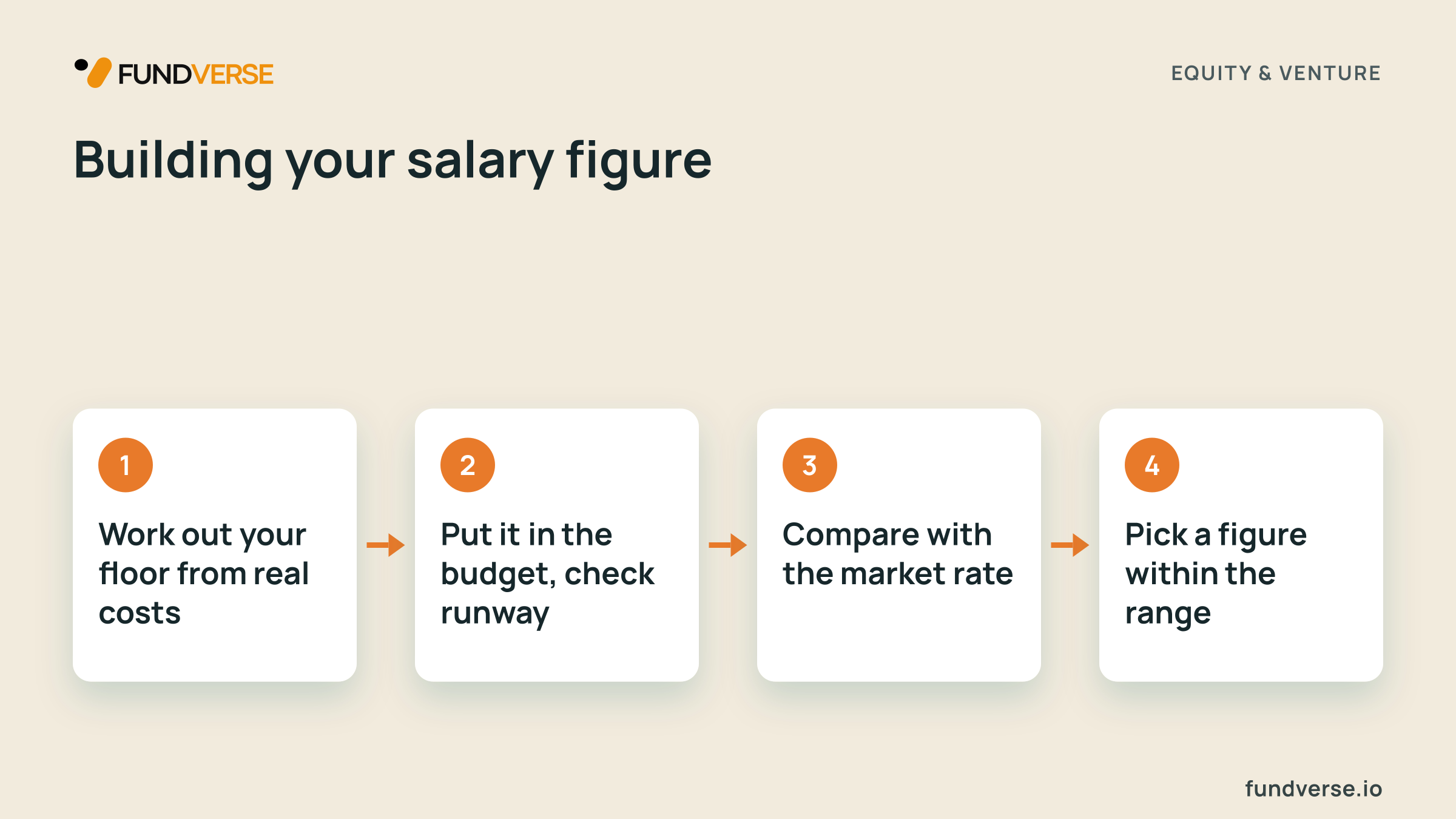
Start with what you actually need
List your real monthly costs: housing, food, transport, health cover, debt repayments, dependents and anything you send to family. Add the tax you will pay on the income. The total is a gross figure below which you would be anxious, and local living costs drive it. A number borrowed from founders in another city or country may be far too high or too low for you. Call this your floor.
Then test it against runway and the market
Put the floor into the budget and see what runway results. If the milestone needs 18 months and the plan now lasts 15, something has to give: the salary, the hiring plan or the scope of the milestone. Then ask what the company would have to pay a hired person to do your job at this stage. Most founders end up between their floor and that market rate, which gives a range to work in, not a fixed line.
3. What one salary change does to runway
Here is a hypothetical illustration; the figures are in any currency and are not benchmarks. A company raises 1,500,000. It has two founders, and its other monthly costs (a small team, tools, rent) come to 45,000. Employer costs such as payroll taxes and contributions are assumed to add 15% on top of gross pay. Compare two founder pay levels.
| Item | Lower pay | Higher pay |
|---|---|---|
| Gross salary per founder, per month | 4,000 | 8,000 |
| Employer cost per founder (gross plus 15%) | 4,600 | 9,200 |
| Both founders, per month | 9,200 | 18,400 |
| Other monthly costs | 45,000 | 45,000 |
| Total monthly burn | 54,200 | 63,400 |
| Runway on 1,500,000 | about 27.7 months | about 23.7 months |
Doubling gross pay adds 9,200 a month to burn, because the employer costs ride along, and takes about four months off the runway. The question then is whether those four months are worth it. If the milestone needs 24 months, the higher level fails and the lower one leaves a small cushion. If the milestone needs 20, both work, and the choice comes down to the founders' quality of life against a bigger buffer. Seen this way, an awkward personal topic becomes a budget discussion.
4. Why paying too little backfires
Looking at the table, the tempting move is to pay almost nothing and bank the extra months. Founders often under-pay themselves to look disciplined, and the runway model doesn't show what that costs. A founder under financial strain sleeps badly, takes side work, borrows privately and starts reading job offers. If a founder burns out or leaves, the company can lose far more than a few months of cash.
Deferring pay is a quieter version of the same problem. Unpaid salary builds up as a liability. Later it turns into a lump-sum back-payment that dents the next round's cash, or a sharp pay jump that surprises a board that thought burn was lower than it really was. Rules on unpaid wages and deferral also differ by country, so it isn't always even permitted. A modest, steady salary is easier to defend than a deferred one.
If you are weighing pay scenarios against a funded runway, Fundverse's financial analysis tools can help you test them next to the rest of your burn before you take a number to your board.
5. Agreeing it so it holds up
Set it with the board or lead investor
Founders usually propose a figure alongside the operating budget, and the lead investor or board reacts to it. Presenting it as part of the plan, with the runway effect shown, keeps the conversation practical. Increases are easiest to agree when tied to something visible, such as a product milestone, a revenue level or closing the next round. That gives everyone a reason to revisit the number without renegotiating from scratch.
With more than one founder, keep pay consistent and transparent. Differences can be justified by roles or personal costs, but they should be discussed openly and written down, since hidden gaps tend to surface later as resentment. Also keep two things apart: what investors tend to prefer is an expectation, while what your shareholders' agreement or articles require is a binding rule. Some documents require board or investor consent for executive pay or budget changes, so read yours rather than assuming.
When your situation differs
In a lower-cost market, a lower floor is genuine rather than a sacrifice, and a sensible salary may look small next to figures quoted elsewhere. In a costly city, the floor may be high enough that the runway only works with a smaller team or a narrower milestone. Savings or a working partner can lower the figure you need, but use that carefully: if one co-founder has that cover and another doesn't, equal pay may not mean equal security.
The cost of a salary also depends on where you are. Payroll taxes, social contributions, and pension and health levies can add little or a great deal to what the company actually pays, and how you are paid (employee salary, director fee, dividends) changes the tax picture. Employment, tax and payroll rules, and board approval requirements, vary by jurisdiction, so check the details with an accountant or lawyer in your country.
6. A sensible figure beats a symbolic one
A founder salary doesn't need to prove anything: not that you are frugal, and not that you have arrived. It needs to let you do the job without financial fear while leaving the company enough runway to reach its milestone. If you can explain your number in a short paragraph covering your costs, the runway effect and when you will revisit it, investors will rarely quarrel with it.
Before the next board conversation, put your costs into the runway model, try two or three pay levels, and decide what you would say if asked why you chose one of them.
Frequently asked questions
Topics
founder salary after funding
how much should a founder pay themselves
founder pay VC round
startup runway
founder salary seed round
startup burn rate
founder compensation
Raising or investing?
Find the right people on the other side of the table, and run the round in one place.