

When a founder-CEO is removed and brought back, the outcome rests on board seats, votes and leverage. Here is how those mechanics work and what founders should settle in their documents before raising.
A founder-CEO can only be brought back if the people who removed them can be overruled, persuaded or replaced, and who holds that power is settled long before anyone tests it. It sits in a shareholders' agreement, a board composition clause and a cap table, usually put together in the weeks when the founder is most focused on valuation and least interested in the paperwork. Headlines about a high-profile founder being pushed out and then reinstated tend to be read as boardroom drama. They are better read as a stress test of documents that every financed company has.
This piece does not depend on the details of any single episode, including the one in the headline; the company's own announcements are the place for those. What carries over to a seed-stage startup or a family-owned SME raising its first outside money are the mechanics: who can remove a chief executive, what makes a reversal possible, and what a founder trades away in each financing that moves that power around.
Who can actually remove a CEO
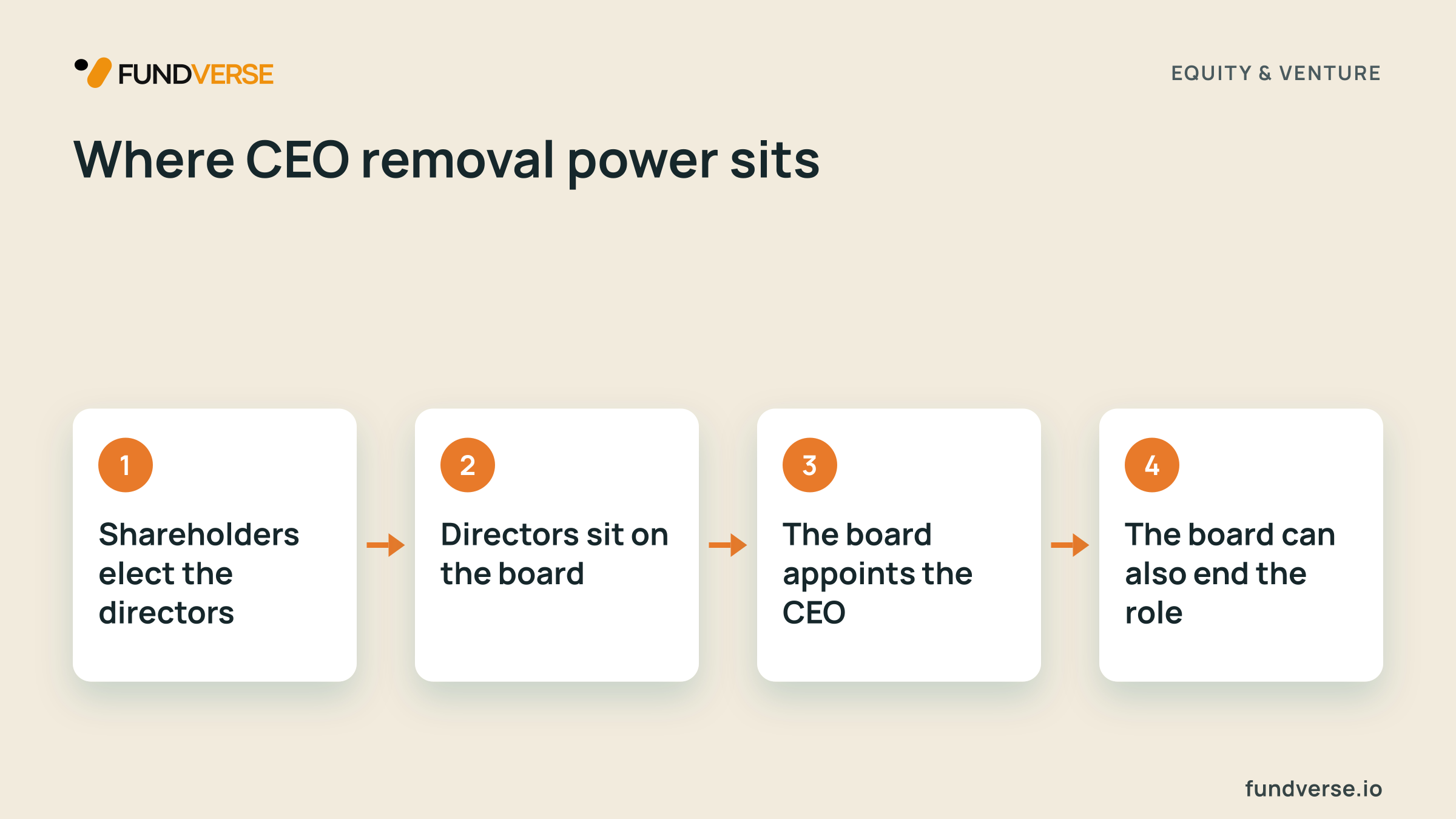
In most companies the CEO is an officer appointed by the board of directors, and what a board appoints it can generally end, subject to the employment contract and the company's governing documents. Shareholders sit one step further back. They elect the directors, and in many jurisdictions they can also vote directors out. Removing a chief executive therefore comes down to two questions: who controls the board, and who controls the shareholder vote that decides who sits on it. The answers differ by country and, in the US, by state, so what follows describes general mechanics rather than the rules of any one place.
The board is the first lever
Take a five-seat board with two founder seats, two investor seats and one independent director. On any contested vote the independent is the swing, so whoever the independent trusts effectively holds the CEO's job. Change one seat and the picture flips: with three investor seats the founders can be outvoted without anyone else's consent, and with three founder seats the investors can only object. Early rounds often leave founders with a board majority, and the arithmetic moves a seat at a time across later rounds.
Founders rarely notice the round in which they lost the board, because each concession looked reasonable on its own: a seat for the lead investor, an independent to keep things balanced, a second investor seat for the next lead. The cumulative effect only shows when the directors disagree with the founder.
Shareholder votes sit behind it
Behind the board sits the vote on who the directors are. A founder holding a majority of the voting power can usually replace directors who turn against them, which is why removing such a founder is hard. Once financing dilutes that holding below a majority, the outcome depends on how the other shareholders vote, and on whether a voting agreement commits holders to elect agreed designees to the board. Some companies, mostly larger or listed ones, also issue shares carrying unequal votes so that founders keep control with a smaller economic stake. Whether that is available depends on the jurisdiction, the investors and, for a listed company, the exchange.
Lenders have their own version. A loan agreement can include a key-person provision under which the departure of a named executive triggers a review or counts as a default, which is one more reason to read covenants and security terms as carefully as equity terms.
Why removals sometimes reverse
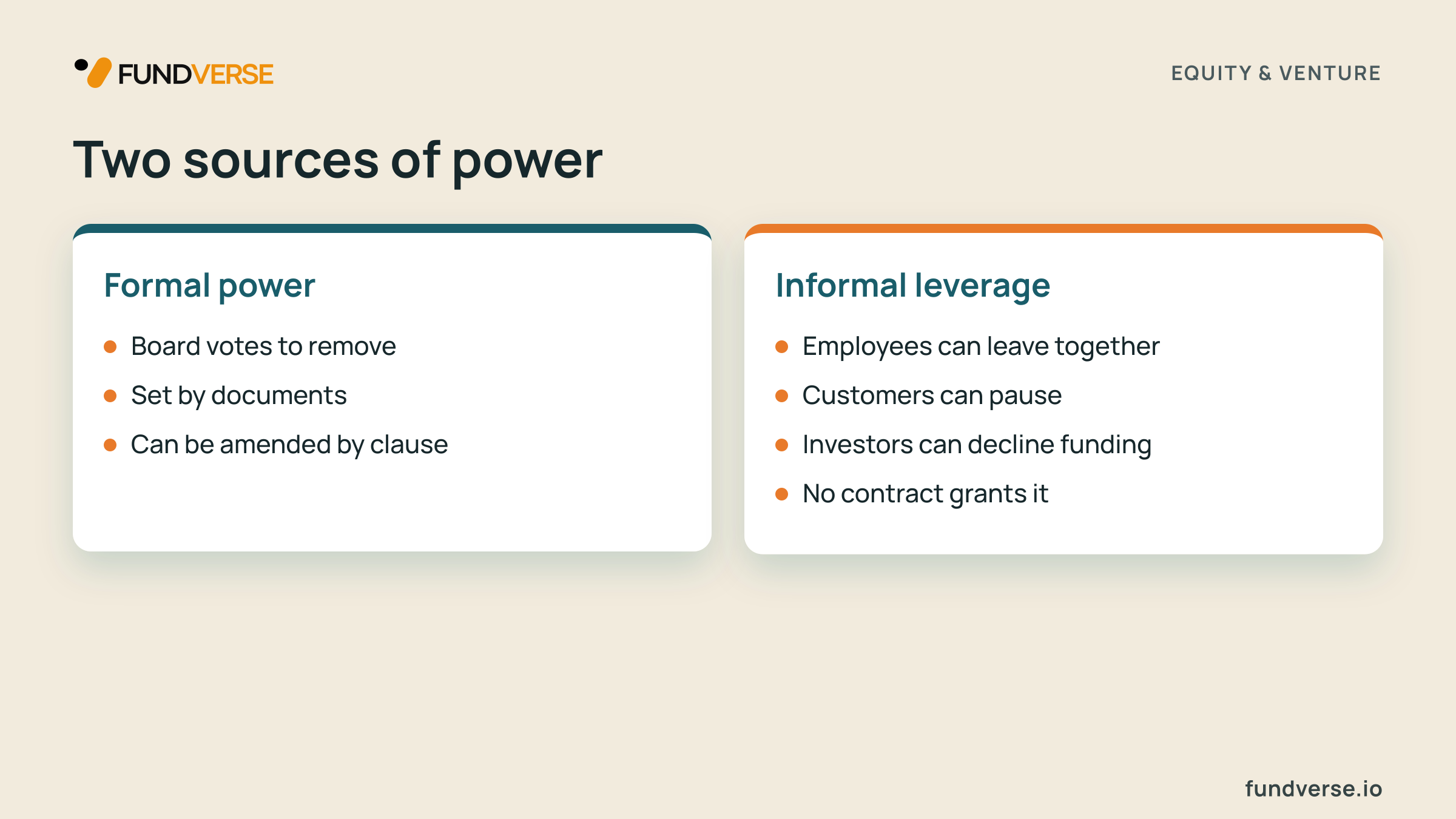
Formal power makes removal sound final. Reversals happen because a board's authority is not the only authority in a company. A board can vote, but the company still depends on employees turning up, customers renewing and investors honoring their commitments. If those groups signal that they will follow the founder out, the directors face a different question from the one they originally voted on: not whether they prefer someone else, but whether the company can survive that preference. Directors owe their duties to the company, so evidence that removal is destroying value gives them a reason to reconsider that has nothing to do with loyalty.
Leverage no contract grants
Three kinds of leverage do most of the work. Employees, whose loyalty and unvested equity often attach to the founder, can threaten to leave together. Customers who bought on the strength of a personal relationship can pause. Investors whose valuation rests on a founder's vision can decline to fund the next round. None of this is granted by a contract, which is both its strength and its weakness: no amended clause can take it away, but it exists only while people believe the founder is the reason the company works. A founder whose team thinks they are the problem has none of it.
Why indispensability cuts both ways
The same indispensability that creates leverage in a crisis is what funders price as key-person risk when raising. An investor who sees a company that would fall apart without one person will ask for vesting, insurance, succession plans or a board seat to protect themselves, and those are exactly the terms that reduce a founder's formal control. Leverage helps when things go wrong, but a company that depends entirely on one person gets worse terms before anything goes wrong. Founders manage both by building a leadership team and putting customer relationships and operating knowledge on record, so their influence rests on trust and not on being the only one who knows how things work.
What each round trades away
Each financing moves control through terms that rarely make the headline. Protective provisions, also called investor consent rights, require the investors' approval before the company does things like issue new shares, sell itself, change the size of the board or alter share rights. They give investors a veto rather than the ability to run the company, but a veto over board size can be as powerful as a board seat. Drag-along clauses let a majority force the remaining holders to join a sale, which matters most when the founders are no longer in that majority.
Vesting and leaver terms decide what removal costs. Under vesting, founders earn their shares over time, so if they leave early the company can usually buy back the unvested portion. Many European and UK documents add good leaver and bad leaver definitions that set the price at which a departing founder's remaining shares are bought: near fair value for a good leaver, often a steep discount for a bad one. Everything then turns on the definition. A narrow one, such as fraud or serious misconduct, makes removal expensive for the company. A broad one, such as breach of duty or underperformance, can make it cheap, and a board that wants a founder gone may find the terms have already priced the exit.
A cap table, a shareholders' agreement and board records only protect you if you know what they say. Fundverse's data room keeps them in one organized place, so you can check which rights are in play, and funders can review them, before a term sheet arrives.
Questions to settle before signing
None of this has to be negotiated in the middle of a crisis, and the best time to do it is the opposite moment: when more than one investor wants in. Before accepting a term sheet, go through the documents with a lawyer in the relevant jurisdiction and get clear answers to these.
- How many board seats does each side hold after this round, and what vote is needed to remove a director or the CEO?
- How is the independent director chosen: jointly, or by the investors alone?
- What does the definition of cause or bad leaver include, and who decides whether it has been met?
- Does unvested stock accelerate if you are removed without cause?
- Do investor consent rights reach board size, the issue of new share classes or the hiring and firing of the CEO?
- Does any loan or customer contract name you personally as a condition?
Then draw the voting map: for removing a director, removing the CEO, changing the board's size and approving a sale, write down who can do it alone and who needs whom. Any line that surprises you is the clause to renegotiate now, while a second investor is still waiting and your leverage is at its highest, because after the round closes, reopening those terms costs far more goodwill than raising them did.
Frequently asked questions
Topics
founder CEO reinstated
founder control
board control startup
CEO removal
bad leaver clause
key person risk
shareholders agreement
protective provisions
Raising or investing?
Find the right people on the other side of the table, and run the round in one place.