

How AI moves a venture firm's work from a recorded founder meeting to a draft memo: transcription, summaries, source checks, where it fails, and what the investor must still own.
The real output of a venture firm is a stream of written judgments: a note after a first call, a screening summary, a memo to the investment committee, a list of follow-up questions. Capital moves only after someone has turned a conversation and a pile of documents into a page that other people trust enough to act on.
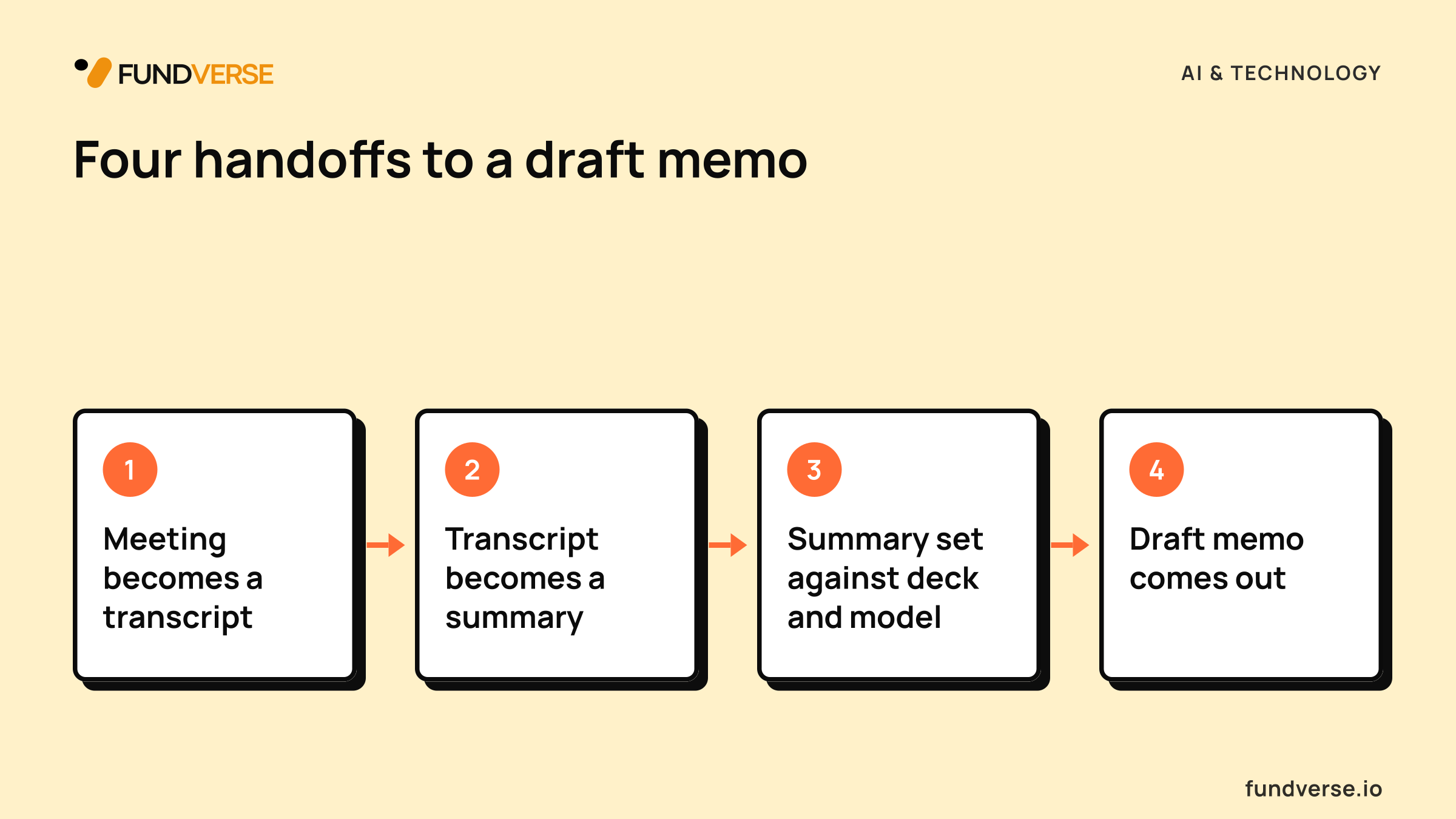
That conversion is slow, and it is where AI tools are now being tried. They help at four handoffs: a meeting becomes a transcript, the transcript becomes a summary, the summary is set against the deck and the model, and a draft memo comes out the other end. Each handoff works differently and fails differently, and a record that reads well is not necessarily a record that is right.
1. Where a firm's time actually goes
Ask an associate how a week is spent and the answer is rarely "analyzing companies" in the abstract. It is calls, then writing up the calls, then reading decks and models, then reconciling what the founder said with what the documents say, then drafting something a partner can read in ten minutes. The thinking happens inside that writing, because a memo is where an investor finds out what they actually believe.
Much of the time, though, goes on the mechanical part: typing up notes from memory, hunting through a forty-slide deck for the sentence that contradicts something said on a call, pulling figures from a spreadsheet into prose. These tasks are repetitive and text-heavy, which suits software. They are also tasks where a small error travels far, since a figure copied wrongly into a memo gets repeated by everyone who reads it. High volume and high consequence together are why the workflow deserves a careful look. The first place to look is where the information starts, on the call itself.
2. From a call to a record
Transcription and speaker labels
Transcription is turning recorded speech into text. The software listens to the audio and writes out the words it believes were spoken. It tends to do well with clear speech and ordinary vocabulary, and worse with unfamiliar accents, people talking over each other, poor connections, company names, product jargon and, most importantly for investors, numbers. "Fifteen" and "fifty" sound close, and so do "thirty percent" and "thirteen percent" on a bad line.
Speaker labeling assigns each stretch of text to a person: founder, co-founder, your partner. It matters more than it sounds. If a claim about customer concentration is attributed to your colleague instead of the founder, the record now says something the founder never said. Labels are usually reliable on a clean two-person call and shakier when three people talk at once, so any statement headed for a memo is worth a quick check against the recording.
A summary that pulls out the useful parts
Summarization condenses the transcript into a shorter text that keeps what matters. A generic summary of an hour-long call is often too vague to help. A more useful one is structured around four things: the claims the founder made, the numbers they cited, the commitments either side agreed to (send the cohort data, introduce a customer), and the questions raised but not answered. Anyone who has taken notes by hand will recognize those four as what they were trying to capture anyway.
Done well, this gives a firm something it often lacks: a searchable, consistent record. Six months later, someone can find what the founder said about churn without depending on whoever took the meeting. But the summary is built on the transcript, so a misheard figure upstream now sits in a clean bullet point downstream, looking authoritative. That matters as soon as the record starts feeding a larger document.
3. Drafting the memo from several sources
Three piles in a good draft
A first-draft memo draws on more than the call. The tool can read the pitch deck, the financial model and whatever sits in the data room, then arrange the material under the headings the firm normally uses: team, market, product, traction, financials, risks. That saves real time, because the blank page is the slowest part of writing a memo.
What separates a good draft from a merely fluent one is whether it keeps three things apart. What the founder said is a statement made on a call. What the documents show is something you can point to in a specific file. What is still unverified is everything else, including claims that appear only in the deck and figures nobody has traced to a source. A draft that blends the three into one confident voice leaves the reader unable to tell a checked fact from a repeated claim. A draft that labels each statement by where it came from lets a reviewer work through it quickly.
A single meeting, followed through
Take one ordinary founder call. Partway through, the founder says recurring revenue has been growing steadily month on month and that most customers renew. The transcript captures both statements. The summary lists them under claims and lists "share renewal data" under commitments. The deck shows a growth chart, and the financial model has a revenue line by month.
A good draft does three separate things with that one point. It records the growth claim as the founder's statement. It notes what the model's monthly revenue line actually shows and whether that matches what was said. And it puts "most customers renew" in the unverified pile, because nothing in the materials supports it yet and the cohort data promised on the call has not arrived. That is what a careful junior would do: line the claim up against the evidence and flag the gap. The draft has not decided whether the growth is good or whether the founder is credible, and the rest of this piece is about who does decide.
4. Where the draft goes wrong
The first failure is the simplest: a misheard name or figure. The transcript is the foundation, so a wrong number there flows into the summary and the memo with no visible sign. A memo that cites the wrong customer count in perfect grammar is more hazardous than a messy note the writer knew to double-check.
The second is what people call hallucination: the tool producing a statement that sounds right but is not supported by anything it was given. These systems generate likely-sounding text, and when the source is thin they can fill the gap instead of saying so. A draft might describe a company as having "strong net retention" when the founder only said customers usually stay, or supply a market-size figure that appears in no document. Asking the tool to quote the exact passage behind each claim helps, and any sentence it cannot trace back to a source deserves a closer look.
The third is subtler. A transcript holds words, not the pause before an answer, the change of subject when someone asks about a departed co-founder, or the confidence with which a number was stated. A summary flattens all of that. If a founder answered a question about customer concentration by talking about the pipeline, the summary may record the pipeline discussion neatly and never show that the question went unanswered. Hesitation and evasion are often the most informative moments in a meeting, and text-based tools lose them.
5. What stays with the investor
Given those failures, the investor's job in this workflow is specific. First, every number in the memo gets checked against its source: the model cell, the contract, the bank statement, or the recording at the relevant timestamp. A figure with no traceable source is removed or labeled as the founder's claim. It is the same discipline a firm should apply to hand-written notes.
Second, the investor adds what the tool cannot. The tool can say what was claimed. It cannot say whether this founder understands their customers, how they handled pressure, whether the market is as open as the deck suggests, or whether this is a company the firm should back at this price. That read comes from being in the room, from experience with similar companies and from reference calls, and it is the part of the memo that justifies the investor's seat at the table.
Third, a named person owns the recommendation. A committee should never have to wonder whether a conclusion came from a partner's conviction or from a draft nobody examined. The tool produces a record and a draft, while the decision and the accountability for it stay with people. Before any of this starts, though, the firm has to decide what it is willing to feed into the tool at all.
6. Settling confidentiality first
The first question is consent. Rules on recording calls differ across countries and, in some places, between states, and some require every participant to agree. A safe habit is to tell the founder at the start that the call is being recorded and transcribed, explain why, and let them decline. Founders share sensitive information in these conversations, and learning afterward that a third party processed it damages trust that took effort to build.
The second group of questions concerns the data itself. Where are the recordings, transcripts and uploaded documents stored, and in which country? Who at the provider can access them? How long are they kept, and can the firm delete them on request? Does the provider use customer content to train its own models? The firm's own obligations matter too: NDAs, term sheet confidentiality clauses and fund documents may limit what can be shared with outside processors, so they need to be read alongside the tool's terms. Each question has a definite answer in the provider's documentation or contract, and a firm should have it in writing rather than assume.
7. Introducing it without a big bang
Firms that adopt this well tend to start small. Pick one step, usually transcription and summary of first calls, because an error costs least there and the benefit is immediate. Leave memo drafting for later.
Then compare. For a few deals, have the analyst or associate write their usual notes and set them beside the tool's output. Look at what each caught that the other missed: the tool may capture more detail and the human more of the subtext. Count the factual errors in each. That small exercise tells the team where the tool can be trusted and where it needs a closer look, and it is more reliable than any vendor claim.
Finally, set a rule for what must be verified before a memo goes to committee. A workable version is short: every figure traced to a document or marked as a founder claim, every named person and company confirmed, and every sentence the tool could not source either supported or removed. Put the name of the person who did the check on the memo. The rule costs little, and it keeps the speed gained from drafting from being paid back as an error in front of the committee.
Marcus, Fundverse's AI, can help draft summaries from meeting notes, decks and data room files in one place, and everything it produces is a draft for you to review and own. Try it on a deal you already know well, so you can check its output against what you know.
8. A memo is only as good as its checking
These tools are best treated as a fast, tireless note-taker and first-draft writer that cannot tell when it is wrong. That is valuable if the firm handles the output the way it would a promising junior's first pass: read it, question it and fix it before anyone else relies on it.
The time saved is worth spending on what only an investor can do, which is to form a view of the founder, test it against the market and stand behind the decision. A memo that reads well is now easy to produce. A memo that is right still depends on someone checking the number.
Frequently asked questions
Topics
AI in venture capital
investment memo
meeting transcription
AI due diligence
deal workflow
VC workflow automation
AI hallucination
founder meeting notes
Raising or investing?
Find the right people on the other side of the table, and run the round in one place.