
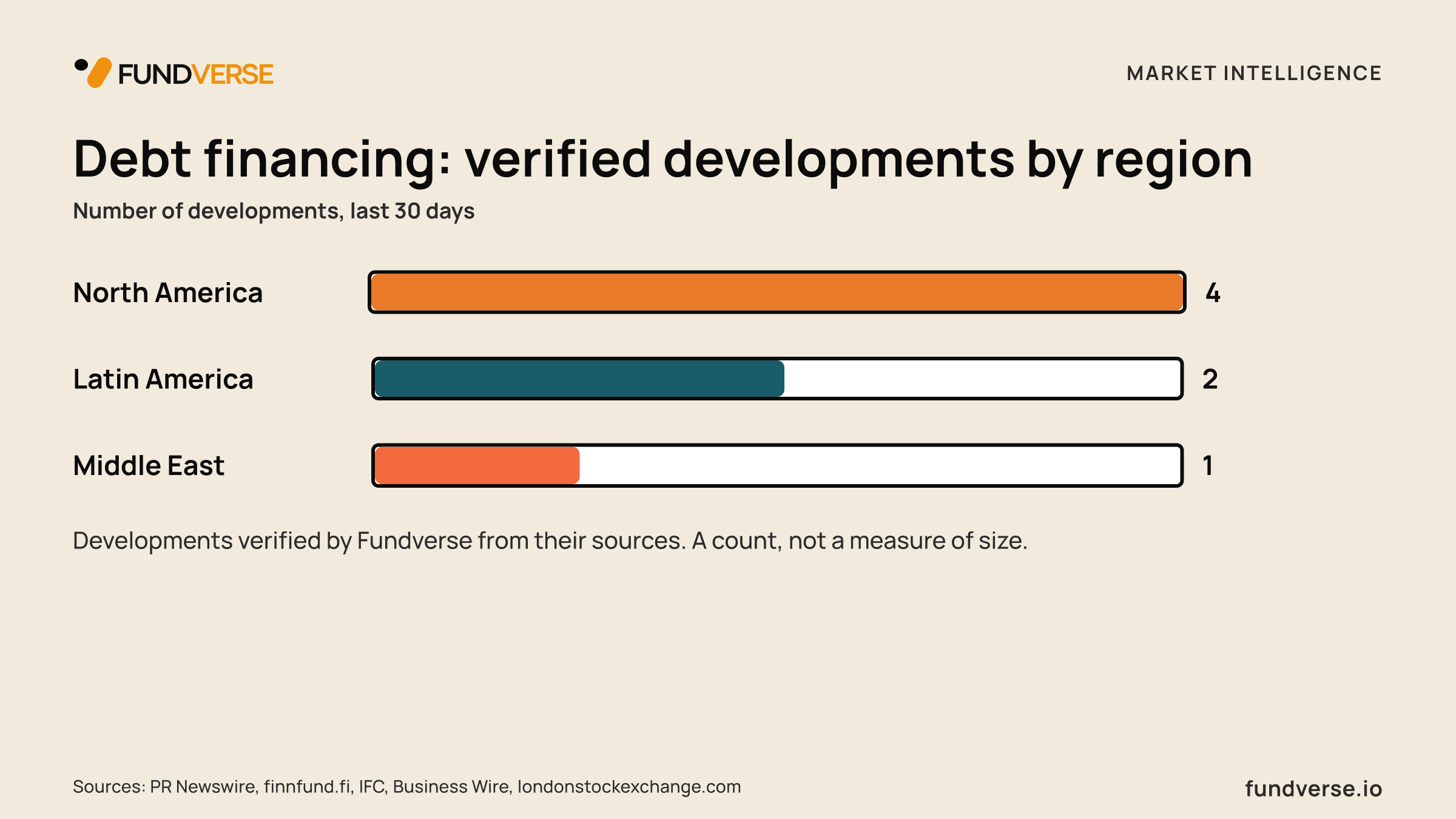

Seven debt financings announced between November 10 and 17, 2026 differ widely in borrower, lender and collateral. What they show about debt, and what they can't, matters for founders.
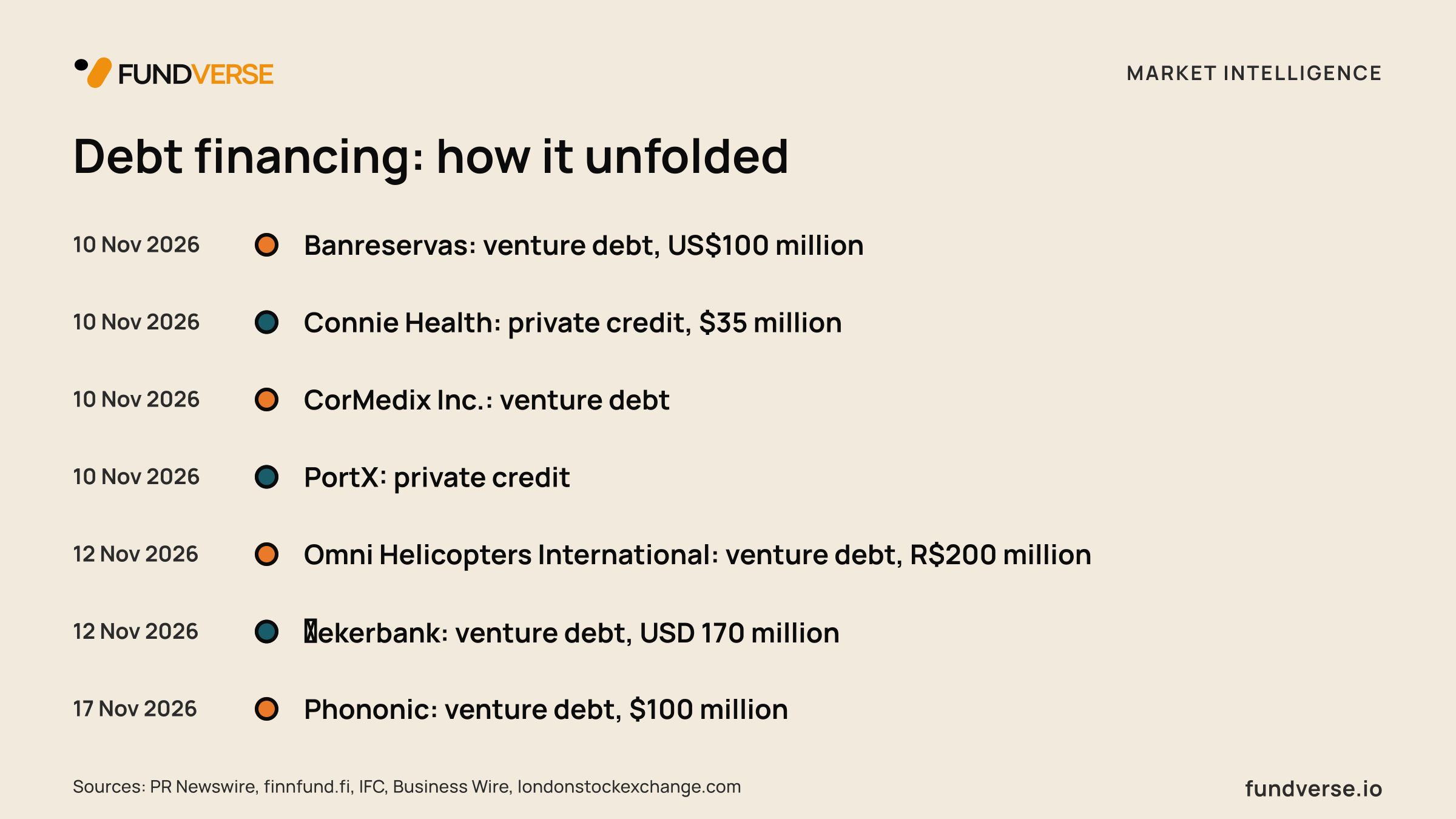
Seven debt financings were announced in the space of a week, between November 10 and November 17, 2026. One was Trinity Capital's $100 million commitment of debt financing for Phononic, a North Carolina company developing solid-state cooling for AI data centers. Another was a $35 million facility. Two amounts were not disclosed at all.
Read together, they show that debt is not one product. It was secured against contract cash flows, insurance receivables, a bank's trade portfolio and a pending acquisition. Each source describes its deal as announced, so none should be treated as a verified pattern of lending behavior, but the structures are instructive.
What the seven deals were
Operating companies borrowing for growth
Connie Health, a technology-enabled Medicare brokerage, announced a $35 million asset-backed revolving credit facility from Rivonia Road Capital. It can be expanded to $100 million and is meant to fund organic policy origination and M&A. CIBC Innovation Banking said it provided growth capital to PortX, a data integration platform for community banks and credit unions, described as non-dilutive. The amount was not disclosed.
Omni Helicopters International raised R$200 million through a Brazilian debenture and a bank credit note, with two- and four-year maturities, secured against Petrobras service contract cash flows. Trinity's financing for Phononic is, according to the announcement, meant to support growth and manufacturing capacity.
Banks borrowing to lend onward
Two deals were different in kind. Şekerbank received a five-year, USD 170 million syndicated loan from seven development finance institutions and impact investors, led by FMO, for lending to rural SMEs, women entrepreneurs and green transition investments. IFC agreed to provide Banreservas a credit line of up to US$100 million for its SME-oriented trade finance portfolio. Here the borrower is an intermediary, and smaller businesses are the end beneficiaries.
Debt around an acquisition
BioPharma Credit PLC and BioPharma Credit Investments V entered a senior secured loan agreement with CorMedix: a US$150 million facility in two tranches of US$75 million, following CorMedix's announced acquisition of Heron Therapeutics' assets. The filing says the BioPharma Credit PLC side will invest up to US$50 million and the other vehicle up to US$100 million. Those are commitments of up to a figure, not funds drawn.
What the pattern supports
The clearest point is that lenders in these deals priced against something specific: contracted cash flows at Omni, assets at Connie Health, a trade book at Banreservas. The sources do not disclose pricing, covenants or security terms for most deals, so we cannot say how much collateral drove the terms. But the descriptions fit a familiar logic, covered in why loans are priced on collateral quality rather than business quality.
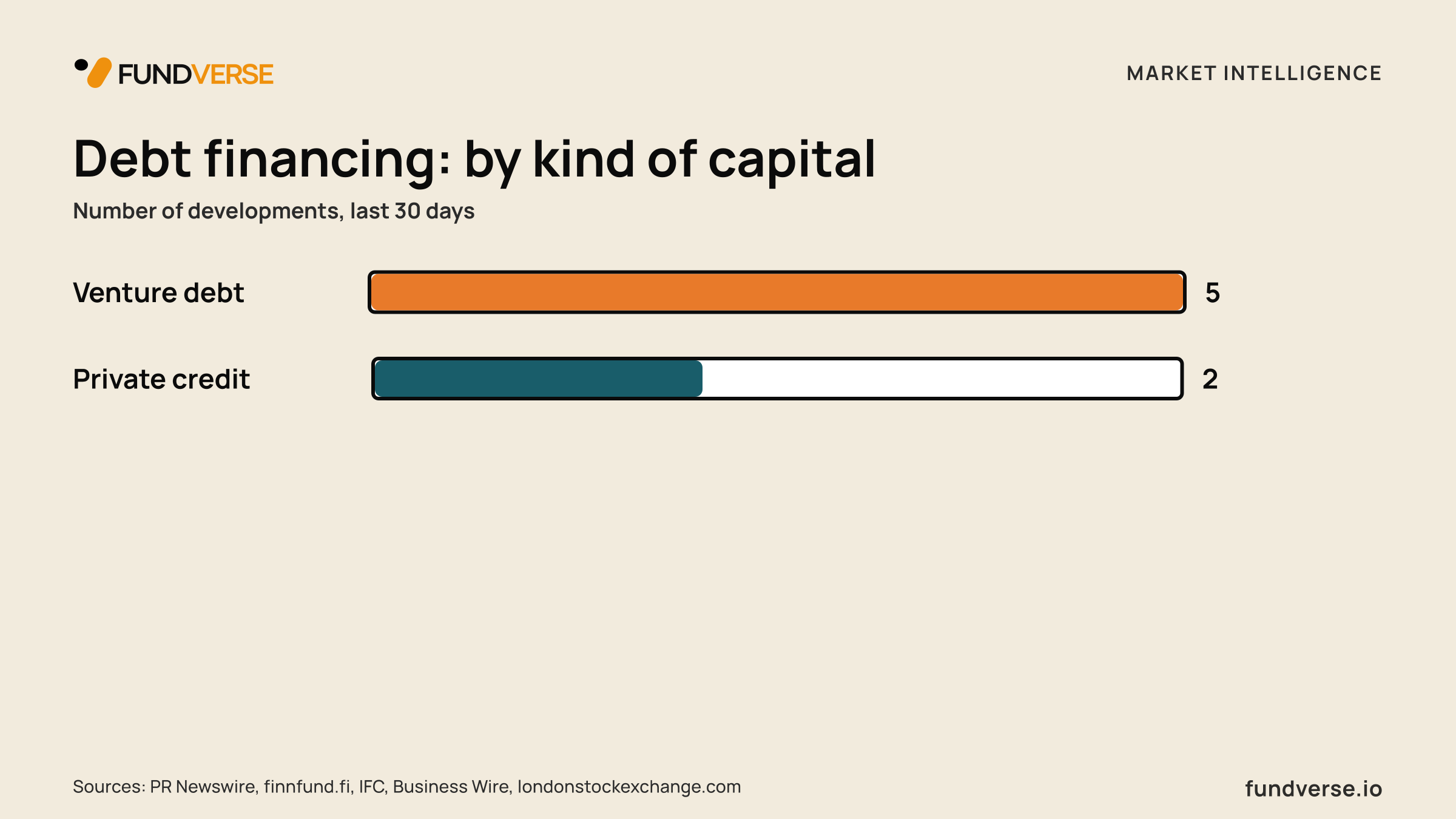
A second point is the range of lenders: a listed alternative asset manager, a specialty lending manager, a bank's innovation lending arm, development finance institutions and a life sciences credit fund. Founders looking at debt are choosing among very different counterparties with different appetites. The seven deals also spanned the US, Brazil, Türkiye and the Dominican Republic, so the capital was not confined to one market.
Third, the stated purposes were operational: manufacturing capacity, policy origination, M&A, product development, SME lending. That matches the idea that the cost of capital goes beyond equity dilution, since only PortX's release stressed the non-dilutive feature.
Debt and equity conversations need different preparation. Use Fundverse to find lenders and investors that fit your stage, and to organize the financial records either will ask for.
What the evidence does not show
Seven announcements in one week do not show that debt is growing, getting cheaper or getting easier to obtain. There is no comparison with earlier periods in the material, and the sample is whatever was published. Interest rates, repayment terms and drawdown schedules were not disclosed for any of them.
Nor do the deals say much about the borrowers' health. Lenders choose structures that protect them, and a facility can be large because collateral is strong rather than because the business is. Only two deals involved startup-style companies of the kind many founders will recognize, Phononic and PortX, and one of those has no disclosed amount. Phononic's $100 million is a commitment announced by the lender, and the release does not say how much has been drawn.
The development-finance deals are also a poor guide for early-stage founders. Şekerbank and Banreservas are banks, and the lenders there pursue mandates around SMEs, women entrepreneurs and trade. Their terms reflect that mandate and the borrowers' balance sheets, not anything a startup could replicate.
What founders and investors can watch
For founders, the practical question is what a lender can hold. Recurring revenue, receivables, contracts and assets can support debt in ways a product roadmap cannot. Knowing your runway and the purpose of the money, as in asking what the money would change, helps you decide whether borrowing fits.
For investors and capital providers, the useful signals will be in later disclosures: whether facilities such as Connie Health's get expanded, how much of CorMedix's tranches is drawn, and whether terms become public. Until those details appear, these seven announcements show what kinds of debt are being arranged, not how well it performs.
Frequently asked questions
Topics
debt financing
venture debt
private credit
Phononic
Trinity Capital
Şekerbank
Connie Health
non-dilutive capital
Raising or investing?
Find the right people on the other side of the table, and run the round in one place.