

Pre-seed is a small bet on next-round proof, not a checklist. Here are three realistic ways to supply that proof, what each looks like to a VC, and where each tends to stall.
A pre-seed round and the evidence behind it are two different things. The round is defined by its timing and size: usually a first institutional check, small by venture standards, written before the company has much to show. What the fund is paying for is a reason to believe, and that reason can take more than one form. Founders who treat pre-seed as a single checklist of a deck, a prototype and a few letters of interest often spend months talking to funds that were never going to write the check.
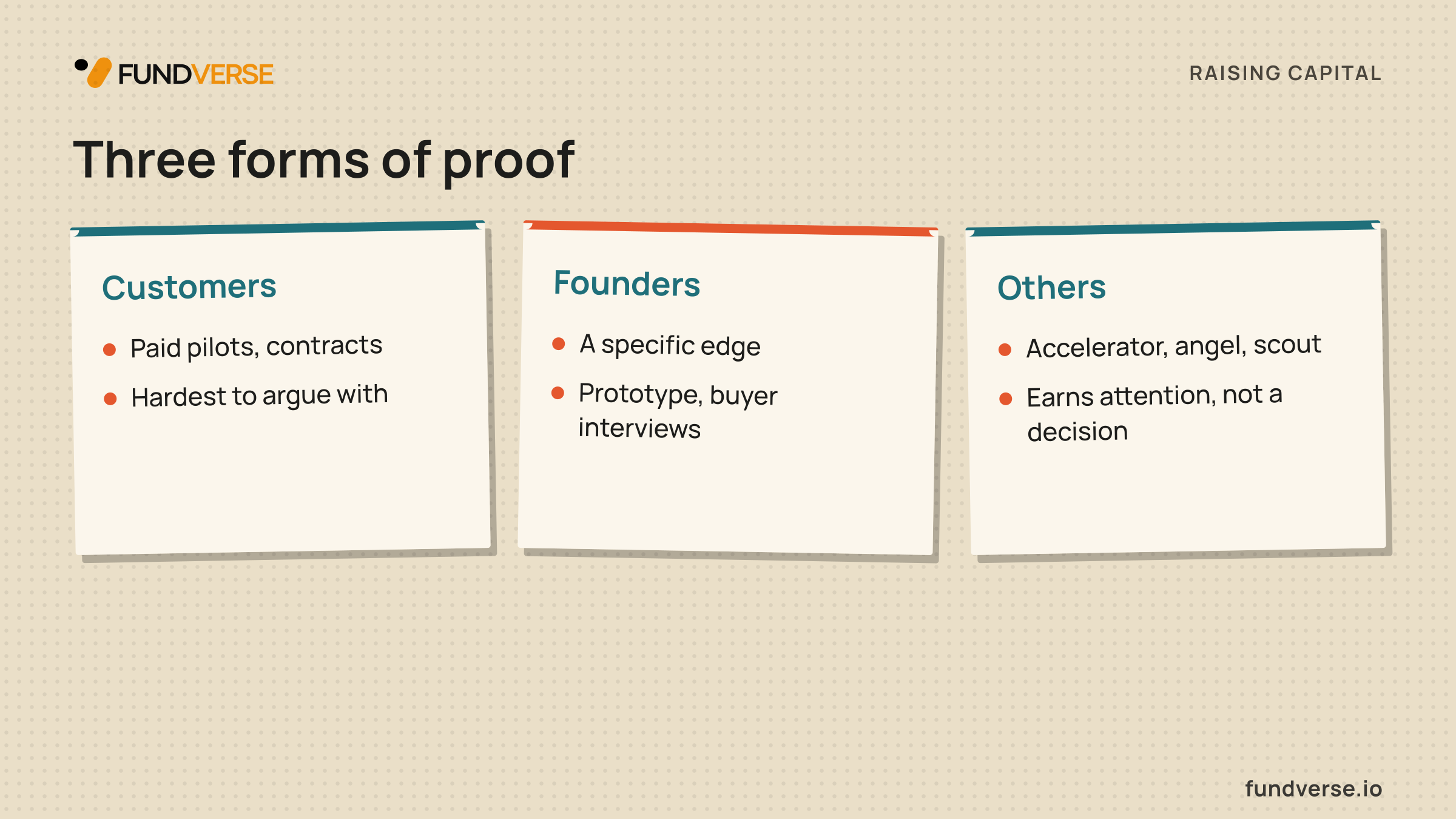
Three kinds of evidence work often enough to plan around: customers who have paid, founders with a real edge, and backing from people the fund already trusts. Each suits a different kind of fund and stalls in a different place. Knowing which one is yours before the first email goes out decides who you contact, what the deck leads with and how long the process is likely to take.
1. What pre-seed investors are really buying
A bet on the next round
A fund writing a pre-seed check is not valuing the business as it stands today. It is judging the chance that, by the time the money runs out, the company will have enough proof to raise a seed round from someone else. The check buys time, so the investor's real question is what will be true at the next raise that is not true now, and how likely that is.
To see how that works, take a company that raises enough for roughly eighteen months. Seed investors will want to see something at the end of that period: paying customers, a product people keep using, or a team that has clearly learned what the market wants. The pre-seed investor is betting that the money gets the company there. If the evidence you show today makes that outcome more believable, the check makes sense. If it doesn't, no deck design will fix it.
A second test sits behind the first. Venture funds rely on a small number of very large outcomes to return their capital, so even at this stage the investor has to see how the company could become a big one. A sound business that will stay modest in size can be a good business and still not fit a fund's return model. That is one reason some founders are better served by other capital, covered in this piece on investors who are not venture capitalists.
Why proof comes in different forms
At pre-seed there is little data, so investors accept substitutes that lower their uncertainty about the next round. Three recur: what customers have already done, what the founders have already done or can credibly do, and what other respected people have already committed to. They are not equally available to every company, and the first is the one investors find hardest to argue with, so it comes first.
2. Customers who already pay
The first path rests on behavior. A customer who has paid, or committed in a way that costs them something, tells an investor more than any projection, because the biggest early risk, that nobody wants the product, has been partly removed. Funds that like to work from data tend to respond to this route, and they are comfortable with a very thin dataset at this stage.
What counts as proof
Paid beats promised. A paid pilot, a first handful of contracts, a waitlist that turns into deposits, or usage that continues after the novelty fades all count. Size matters less than pattern: why those customers bought, how long each took to close, and whether the second customer looked like the first.
Where the first customers came from matters too. If the first three all came through the founder's own network, an investor will read that as proof the founder can sell to people who know them, not yet that the product attracts strangers. A founder who can explain how the fourth and fifth customers will be found, and has already started finding them, turns a weak signal into a much stronger one.
Where this path stalls
The most common problem is revenue that looks like consulting. If every customer needs custom work, the investor sees a services business, where growth means hiring more people rather than selling the same product again, and that does not scale the way a fund needs.
Size is a second problem. A few small contracts show demand, but they may not show a market large enough to matter, and the investor has to guess whether the customers who are easy to win are the whole market or just its edge. Some companies, such as hardware or biotech, or anything that needs heavy build-out, cannot show customer traction before they have money at all. For them, and for any team whose customers have not yet appeared, the question shifts from what customers did to who the founders are.
3. Founders with a real edge
Where the product takes time to build, investors look to the team, and the question becomes whether these particular people have an advantage on this particular problem. Years in an industry are not enough by themselves. The edge is something specific: having run the process being automated, having built an earlier version inside an employer, holding a technical skill few people have, or having built and sold a company in the same area before.
What turns that background into a check is evidence that the insight is real. A working prototype shows the founders can build. A set of in-depth conversations with potential buyers shows they understand how purchasing decisions are made and who signs. A clear statement of what would prove the idea wrong shows judgment, which investors weigh heavily when there is no revenue to examine.
This path stalls when the edge is claimed rather than shown. A strong résumé says who the founders are, not why this product or why now. Because less is proven, the founders also have less room to negotiate, since investors price uncertainty. And fewer funds will back a team before customers exist, often specialists in the founders' own sector or funds that say plainly they back people early. When neither customers nor résumé carries enough weight, founders often turn to a third source of proof: other people's judgment.
4. Credibility from others
The third path borrows trust. A fund screening a large number of decks has to decide where to spend its attention, and one of the best signals is a person or institution whose past recommendations proved good. That might be an accelerator that admits few companies, an angel with a record in the sector, a scout, an earlier funder willing to lead, or a recognizable customer who will act as a reference.
A warm introduction from someone the fund respects moves a deck up the queue, and a committed lead from an angel means the VC does not have to set terms alone. What it earns is attention, not a decision: the fund still does its own work, and the question about next-round proof remains. The signal also fades if the backer's involvement is thin, since a very small check from a well-known name says little.
Often this path runs as a sequence: a small angel or accelerator round first, then the VC check once that money has produced something. Its typical failure is a round assembled from many small commitments with no one willing to lead, which drags on and burns runway, as described in this piece on rounds that take too long.
5. Matching the path to the fund
The paths overlap, and most strong pre-seed raises combine two. One still has to lead, because it shapes how the story is told and what a fund hears first. A founder with ten paying customers and a modest background should open with the customers. A founder with a decade in the field and a working prototype should open with the insight and let a few buyer conversations support it.
Funds differ in which kind of evidence they weight, and they leave a trail. A fund's recent pre-seed investments, and what the public record shows those companies had at the time (revenue, a notable team, a named backer), reveal what it has actually been willing to fund, which can differ from what its website says. Reading a dozen funds this way turns a long list into a short one faster than any amount of generic outreach.
If you are building that target list, Fundverse can help you filter funds by stage, sector and check size and keep track of each conversation, so your effort goes to funds that could realistically write your check.
Before any outreach, write one sentence: what a fund has to believe for this check to make sense. Then list your evidence for it under three headings: customers, founders and others. Whichever column is fullest is your path. Build the first slide of the deck around it and cross out any fund whose recent pre-seed deals rested on a different kind of evidence. Then size the raise to the proof the next investor will want, and test the ownership math with the startup valuation calculator before you quote a number.
Frequently asked questions
Topics
pre-seed round
VC pre-seed
how to raise pre-seed
pre-seed funding
early-stage venture capital
pre-seed investors
startup fundraising
founder traction
Raising or investing?
Find the right people on the other side of the table, and run the round in one place.