
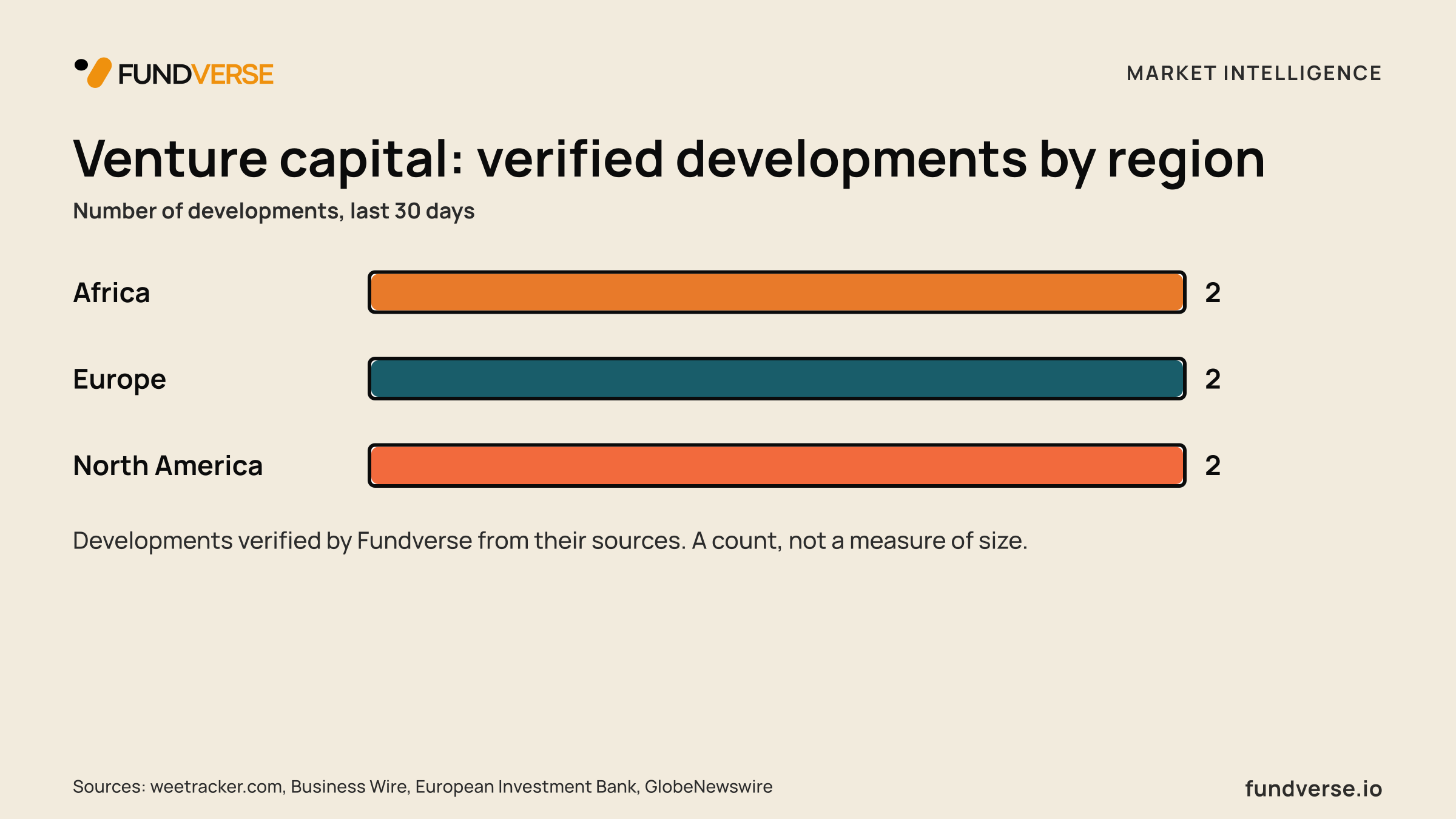

Six venture fund developments announced between November 10 and 19, 2026 span Europe, Africa and the US. They show established managers closing larger funds, DFIs backing African vehicles and a continued early-stage focus.
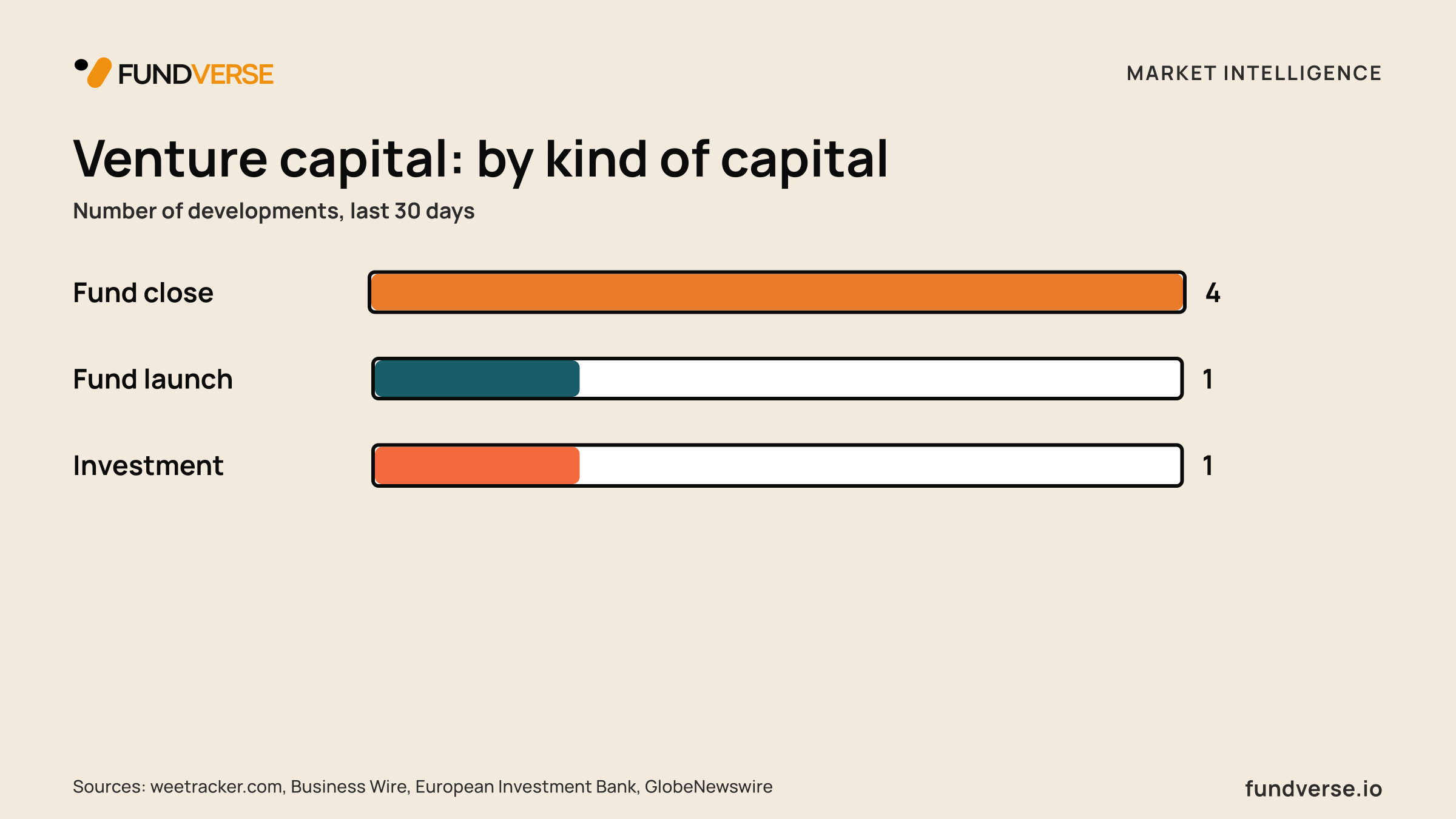
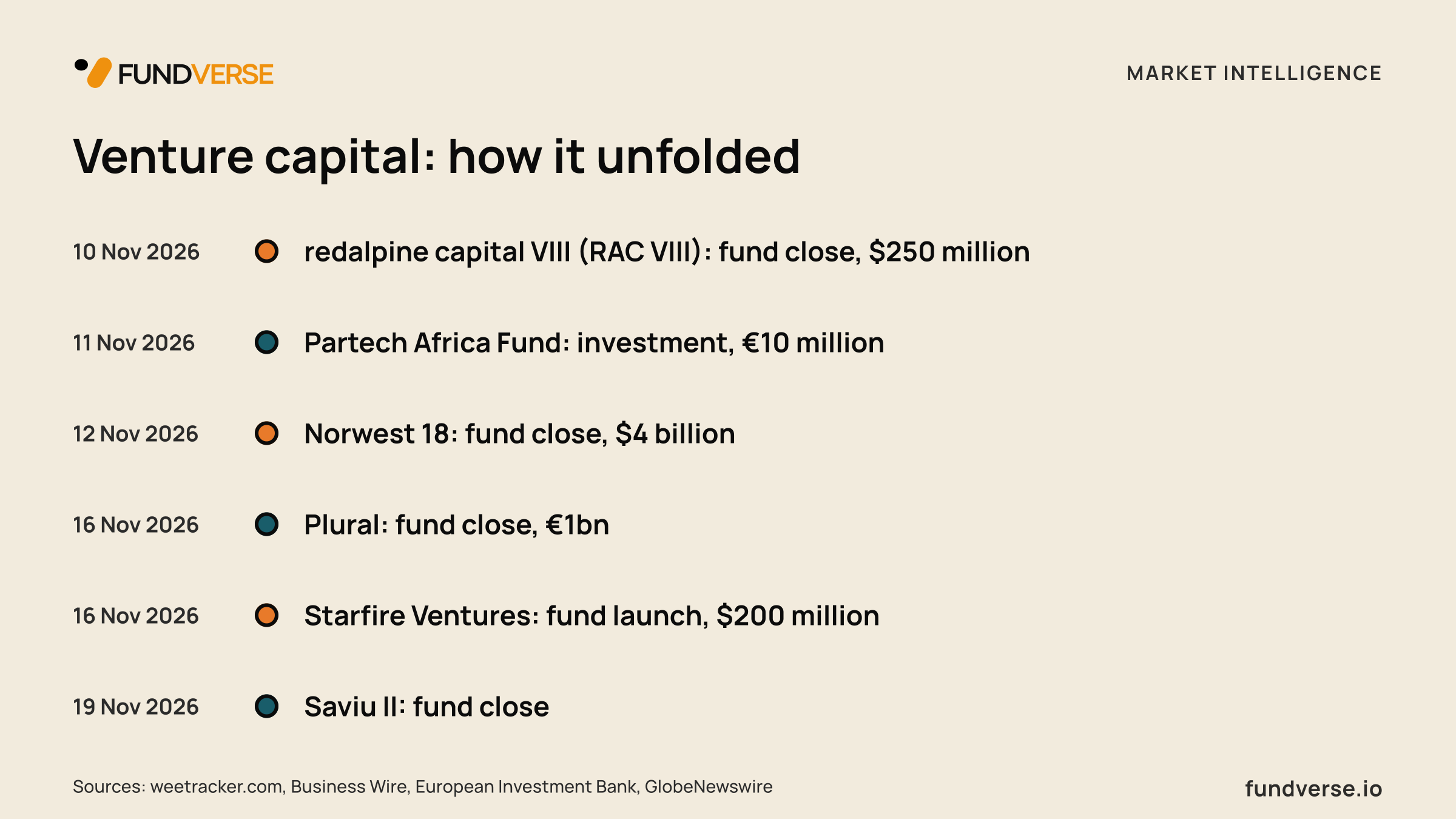
Six venture capital fund developments announced between November 10 and November 19, 2026 cover a $4 billion US multi-stage fund, a €1bn European early-stage fund, a $250 million Swiss fund, a roughly €40 million Francophone African fund, a planned $200 million US fund and a €10 million commitment to an African fund. Four involve funds that closed or were reported as closed; one is a commitment to an existing fund, and one, Starfire Ventures, is a launch that has not yet raised its target.
Taken together, they show capital concentrating in established managers and in early-stage strategies, with development finance institutions (DFIs) prominent where fund sizes are smaller. They do not show that venture fundraising as a whole is recovering, because six announcements are a selection, not a market measure.
What the six developments show
Norwest said in its announcement that it closed Norwest 18, a $4 billion global multi-stage fund and the largest in the firm's 65-year history, bringing total capital under management to $18 billion. The fund will support venture and growth equity investments in technology, healthcare and consumer sectors in the U.S., India and Israel. The announcement did not say how many limited partners committed or who they are.
Plural said in a statement that it has raised €1bn, nearly four times its €260m inaugural fund in 2022 and double its €500m second fund in 2024. The fund backs frontier founders in Europe in energy, AI infrastructure, defence, health and other frontier technologies, and will keep backing breakout companies as they scale. Our earlier coverage is in Plural Raises €1bn Fund to Back Early-Stage Frontier Founders in Europe.
redalpine announced the final close of redalpine capital VIII (RAC VIII) at $250 million, oversubscribed. Aviva Investors, Flexstone Partners and KfW are among the limited partners, and the fund plans to invest in around 20 early-stage companies, primarily at Seed and Series A. The firm describes itself as backing European technology companies from Seed to IPO.
Fund growth and the Africa contrast
Successor funds are larger
Three managers reported growth against earlier vehicles. Plural's new fund is nearly four times its first. Saviu Ventures, a firm focused on Francophone Africa, closed Saviu II at approximately EUR 40 M (USD 44 M), four times the size of its predecessor, WeeTracker reported. Norwest's fund is the largest in its 65-year history.
DFIs anchor African funds
Saviu II drew commitments from the African Development Bank, Bpifrance through its Averroès Africa programme, Proparco, the Dutch Good Growth Fund, Axian and more than 60 private investors. Individual commitment sizes were not disclosed. The fund backs early-stage startups and technology-enabled SMEs in Francophone West and Central Africa.
The European Investment Bank said it invested €10 million through its Boost Africa initiative in the Partech Africa Fund, which supports high-growth African technology companies. Partech subsequently invested in TradeDepot, which the EIB said expanded its network to 40,000 micro-retailers. That is one portfolio example, not evidence of fund performance, and the fund's total size was not given.
The pattern echoes recent DFI activity; see DFIs back SME lenders and projects across six deals. In these funds, public institutions appear as limited partners alongside private capital, which can matter for managers outside the largest markets. Whether DFI participation helps a fund's later fundraising is not something these announcements address.
Raising from institutional or development-finance LPs means preparing diligence materials early. Fundverse's data room helps founders and fund managers organize them before investors ask.
What the evidence does not show
Starfire Ventures, launched by Serena Williams and Beth Ferreira, plans to attract $200 million, according to its Business Wire announcement. It will invest primarily in Seed to Series A companies in areas including health, financial management and experiences, and describes its focus as tech-enabled and AI-native companies. A target is not a close, and the announcement does not say how much has been committed.
The sample is also uneven. Norwest and Plural are large managers; Saviu II and the Partech commitment are far smaller. Amounts are in different currencies and the Saviu figure is approximate. Nothing here supports a claim about overall fundraising volumes, valuations or returns, or that the sectors named are now more attractive to investors. Nor do the announcements say how long any of the raises took.
What founders and investors can watch
- Stage focus: redalpine, Plural and Starfire all emphasize early-stage entry, so Seed and Series A founders may see specialist capital from these managers, though check sizes were not disclosed.
- Geography and thesis: Norwest names the U.S., India and Israel; Plural names Europe; Saviu names Francophone West and Central Africa. Founders should match their market to each mandate.
- Deployment pace: redalpine expects around 20 companies; none of the others gave a pace.
- Starfire's close: whether the $200 million target is reached and who commits.
Founders can use investor matching to compare mandates, and our guide to the venture capital deal process explains what follows a first approach.
The clearest signal is that managers with prior funds and institutional backers are closing larger vehicles, while smaller regional funds rely on DFI participation. Whether that holds will depend on deployment and returns, which these announcements do not yet address.
Frequently asked questions
Topics
venture capital
fund close
Plural
Norwest 18
redalpine
Saviu II
Starfire Ventures
Partech Africa Fund
Raising or investing?
Find the right people on the other side of the table, and run the round in one place.