
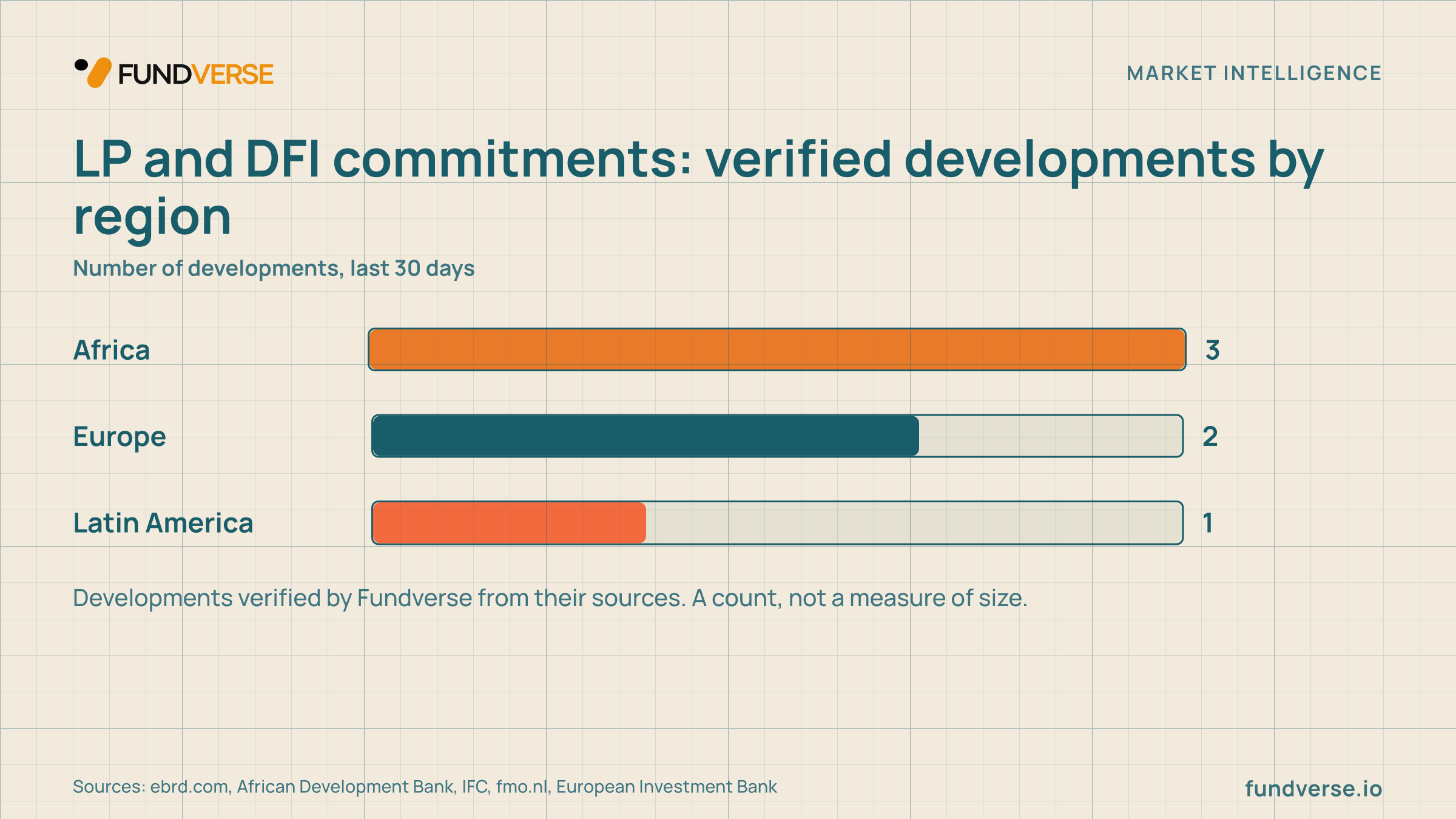

Six development finance deals announced November 13-18, 2026 show DFIs lending through banks and funds. Most are debt, and the details differ.
Six development finance institution (DFI) transactions announced between November 13 and November 18, 2026 share a feature: in five of them the capital goes to an intermediary, a bank, a fund or a national development lender, rather than directly to a small business. The sixth, from FMO, finances a single solar project. All six are described as announced, proposed or approved, and none is stated as completed.
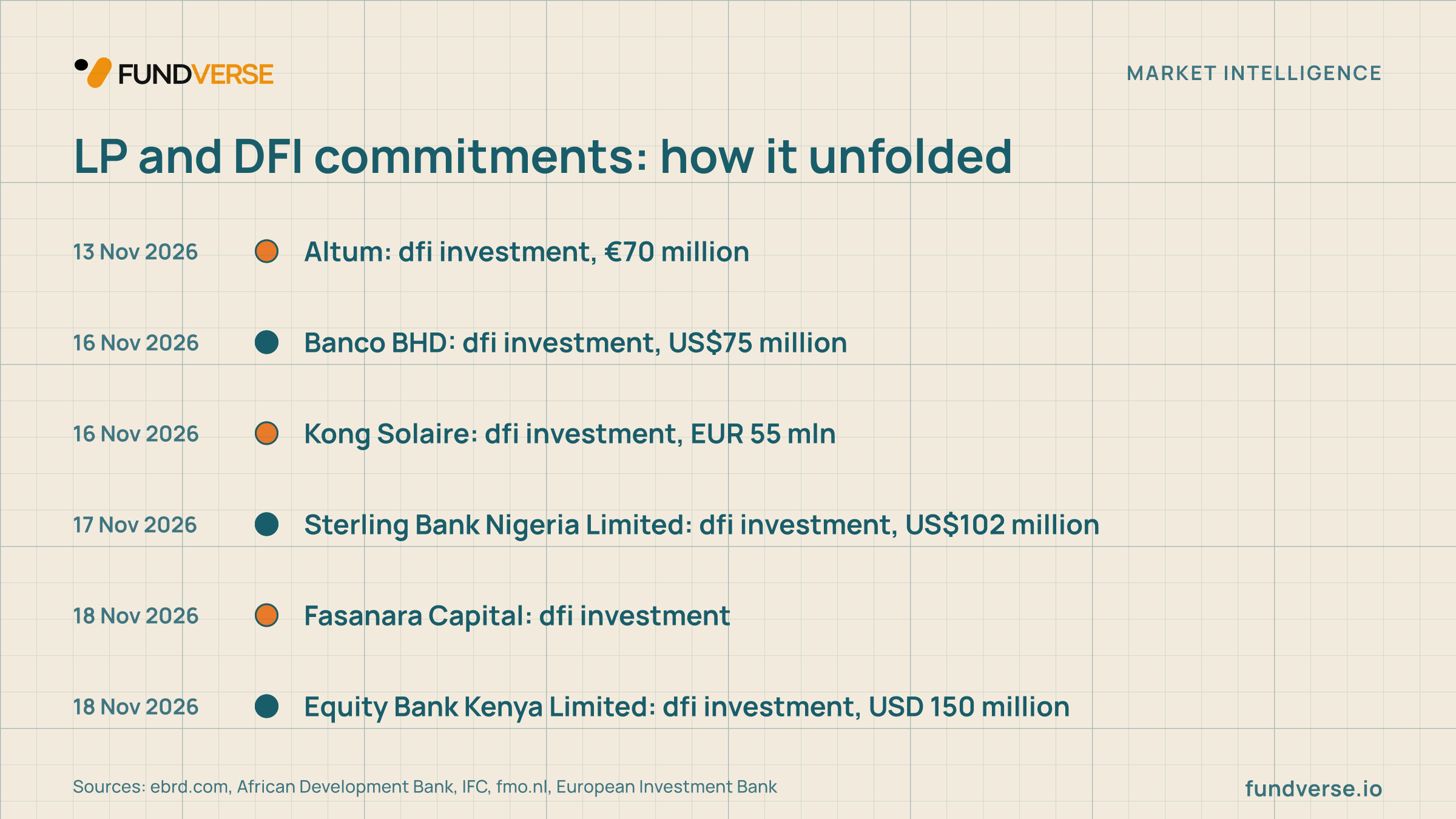
The deals are the EBRD's commitment to a Fasanara Capital fund, the African Development Bank's (AfDB) proposed subordinated debt for Equity Bank Kenya, the AfDB's package for Sterling Bank Nigeria, an IFC loan to Banco BHD in the Dominican Republic, FMO's financing of Kong Solaire in Côte d'Ivoire, and a European Investment Bank (EIB) loan to Latvia's Altum.
What each institution committed
Funds and subordinated capital
The EBRD said: "The EBRD will invest up to €25 million in the Global Diversified Alternative Debt Fund, managed by Fasanara." The fund provides institutional money to online lending platforms in Fasanara's network, and Fasanara aims to deploy around €425 million a year across EBRD economies to finance SMEs. This is the only fund-level commitment of the six, and the closest to a limited partner (LP) ticket in the traditional sense. The fund's total size was not disclosed.
The AfDB stated that the proposed project is "a USD 150 million subordinated debt facility to Equity Bank Kenya Limited (EBKL) which will qualify as Tier II capital under Basel III and Central Bank of Kenya (CBK) regulations (Subdebt/The Facility)." It is expected to unlock lending capacity mainly benefiting SMEs, and would be complemented by a USD 250,000 technical assistance grant from the AFAWA initiative and up to USD 900,000 in non-financial services under the SME Credit Catalyst Program. Tier II status means the money supports the bank's regulatory capital base, which is different from a plain loan.
Lines of credit and senior loans
The AfDB Group's Board approved a US$102 million package for Sterling Bank Nigeria Limited, the bank said in its announcement. It comprises a US$50 million line of credit, a $20 million sustainable loan, a US$2 million concessional loan and a US$30 million trade finance transaction guarantee. The package therefore mixes lending with a guarantee, and only part of it is cash on the bank's balance sheet.
IFC said a recent US$75 million loan to Banco BHD, half of it earmarked for women-owned small and medium enterprises, helped expand the bank's ability to support entrepreneurs. The EIB is providing a €70 million loan to Altum, which covers half of a €140 million project for homeowners' associations in Latvia for apartment energy-efficiency upgrades. FMO is committing EUR 55 million in senior financing to Kong Solaire, a 50 MWp solar project: a EUR 50.5 million 20-year loan and a EUR 4.5 million transmission facility.
The pattern across the deals
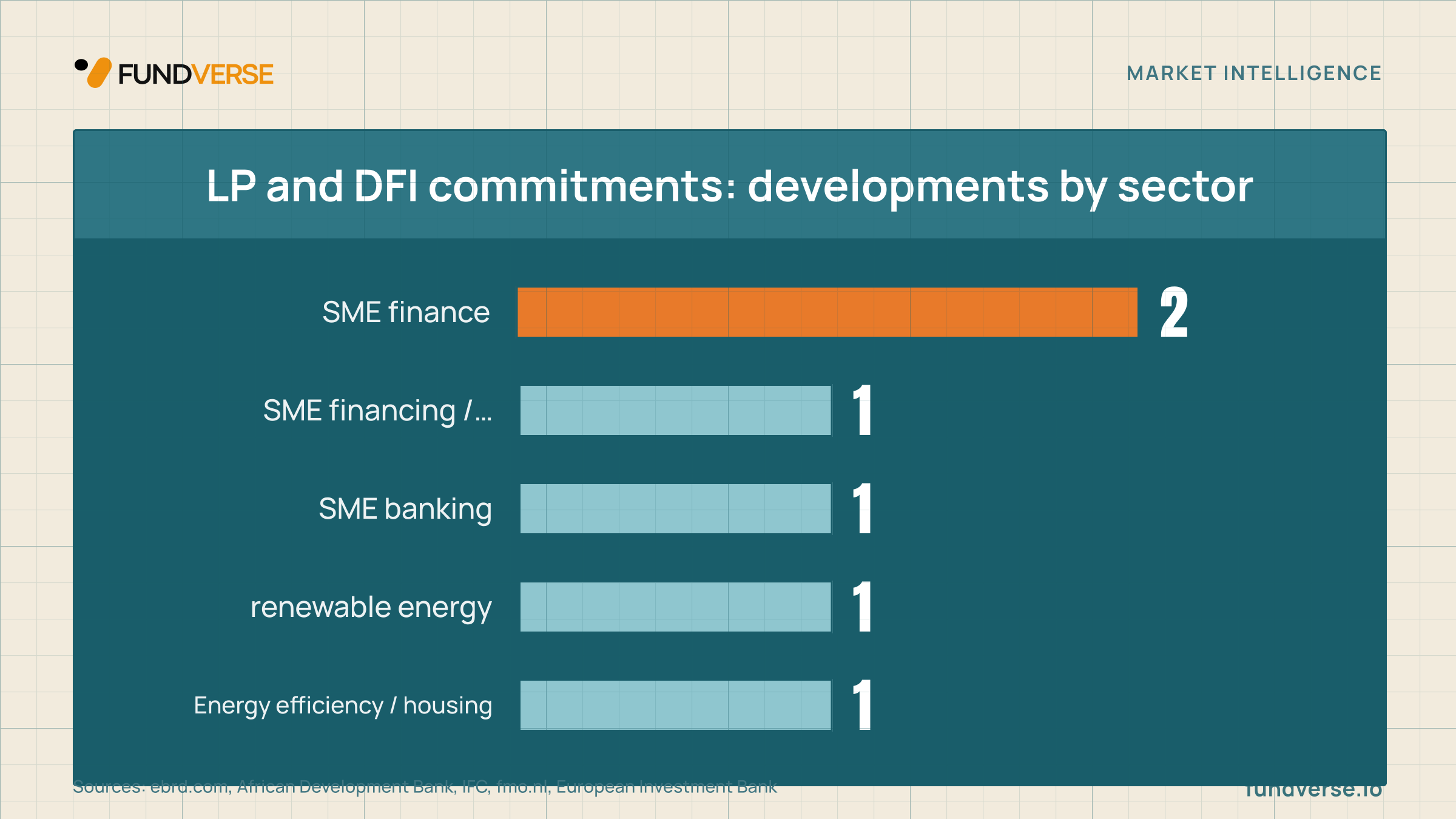
Five of the six commitments are debt or debt-like instruments routed through financial intermediaries. Only the EBRD's Fasanara commitment is an investment into a fund vehicle, and even that fund invests in debt. None of the six is an equity commitment. For founders, this means DFI money in these cases reaches smaller businesses as loans from local banks or lending platforms, not as venture capital.
The SME theme is also consistent. Fasanara, Equity Bank, Sterling Bank and Banco BHD are all described as financing SMEs, and three of the four name women, youth or women-owned businesses specifically. Equity Bank's model targets SMEs, including women and youth-led SMEs, and Sterling finances SMEs, women and youth-led businesses and farmers. Kong Solaire and Altum fall outside that theme, with project and housing finance respectively.
Geography is varied: Europe, Kenya, Nigeria, the Dominican Republic and Côte d'Ivoire. Africa accounts for three of the six. Three AfDB-related or FMO items were disclosed in the same week, but that is a small sample and shows timing, not a trend.
What the evidence does not show
Six announcements do not measure overall DFI activity, and they say nothing about volumes relative to earlier periods. The status of each also matters. The Equity Bank facility is proposed and pending. The Sterling package has Board approval. Other items are described as announced, and IFC's wording refers to a loan that has "helped expand" the bank's capacity. A reader should not treat every figure as money already disbursed.
The announcements also do not show outcomes. Expected lending capacity, earmarks and targets, such as Fasanara's €425 million a year, are stated intentions. Pricing, tenor for most deals, borrower covenants and security were not disclosed. Founders and investors comparing these facilities should read the terms, not only the headline amounts; the Fundverse piece on debt financing beyond interest rates sets out what to look for.
Raising from DFI-backed lenders or funds starts with knowing who actually holds the mandate. Use Fundverse investor matching to find capital providers whose focus fits your stage and sector.
What founders and investors can watch
- Pass-through to borrowers: whether banks such as Equity, Sterling and Banco BHD report SME lending against the stated earmarks.
- Completion and terms: whether the Equity Bank facility moves from proposal to approval and signing, and what terms are published.
- Fund scale: whether Fasanara discloses the size of its fund and how much reaches platforms in EBRD economies.
- Fund-level DFI participation: whether DFIs commit to more equity or fund vehicles, as in recent closes such as Proparco's investment in Lightrock's Africa Strategy.
For emerging fund managers and founders in these markets, the practical question is how DFI capital arrives: through banks, platforms or funds, on debt terms. The next disclosures on pricing, disbursement and borrower reach will show how far these commitments translate into financing for smaller businesses.
Frequently asked questions
Topics
DFI commitments
development finance institutions
SME finance
EBRD
African Development Bank
IFC
FMO
EIB
Raising or investing?
Find the right people on the other side of the table, and run the round in one place.