
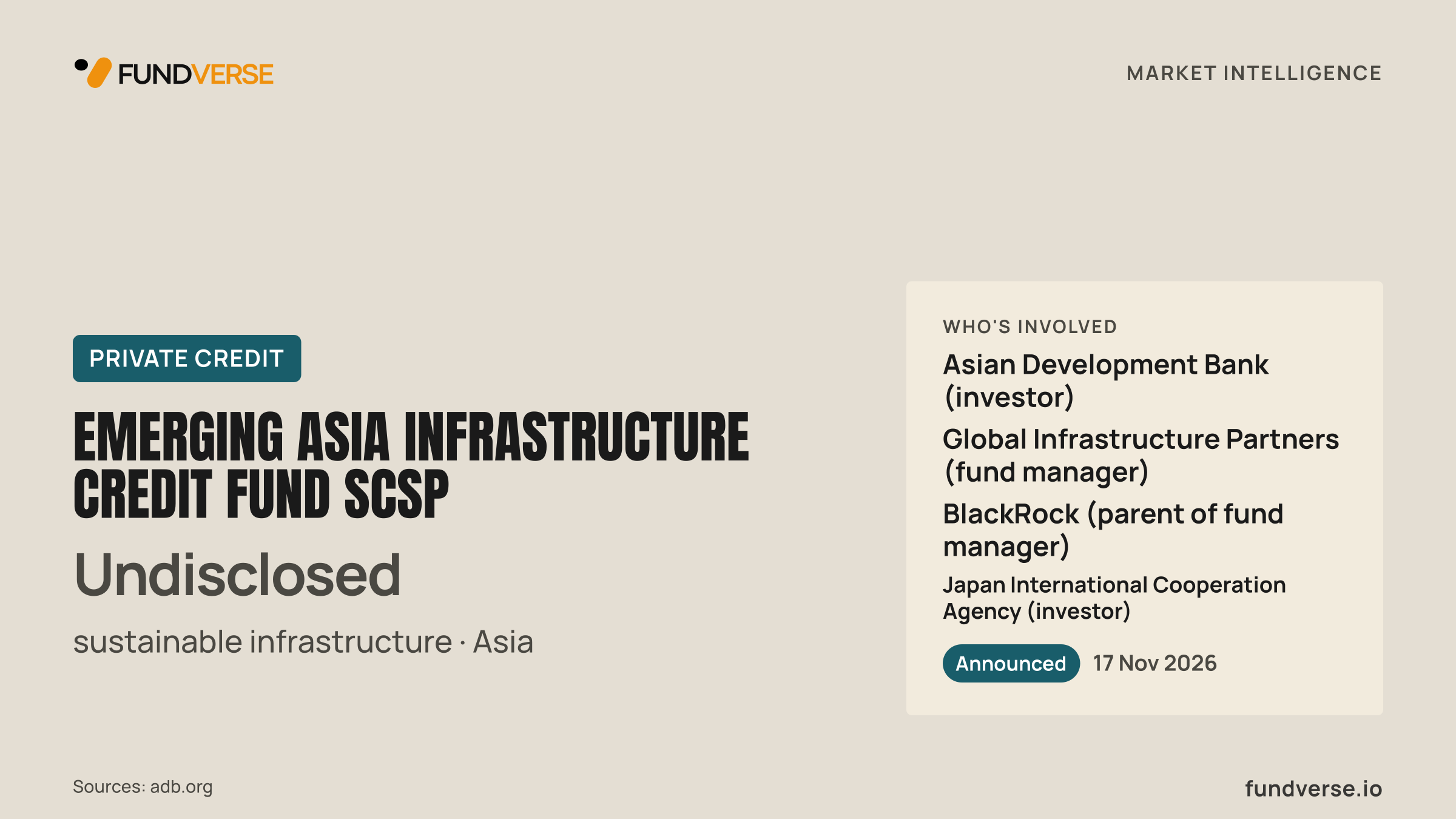

The Asian Development Bank has committed up to $30 million to a BlackRock-owned manager's infrastructure credit fund, and will administer up to $10 million and $17.5 million from two climate funds.
The Asian Development Bank (ADB) has committed up to $30 million to the Emerging Asia Infrastructure Credit Fund SCSP, a private credit fund managed by Global Infrastructure Partners (GIP), a part of BlackRock. ADB said in a statement on November 17, 2026 that the commitment is meant "to mobilize institutional capital for infrastructure and emerging technologies supporting industrial transformation across developing Asia."
The announcement describes a commitment, not a completed fund close. ADB did not disclose the fund's total size, its target, or the terms of the credit it will provide.
How the capital is structured
The fund commitment from ADB is up to $30 million. ADB will also administer up to $10 million from the Canadian Climate and Nature Fund for the Private Sector in Asia (CANPA) and up to $17.5 million from the Australian Climate Finance Partnership (ACFP). Those are separate figures, and the announcement as provided does not say how they combine in the fund.
The Japan International Cooperation Agency (JICA) is investing in the fund alongside ADB. JICA's amount was not disclosed.
Who is involved
- Asian Development Bank: investor, committing up to $30 million.
- Global Infrastructure Partners: fund manager, part of BlackRock.
- CANPA and ACFP: climate-focused funds whose money ADB will administer, up to $10 million and $17.5 million respectively.
- Japan International Cooperation Agency: investor alongside ADB.
The FAST-P framework
The fund is part of the Industrial Transformation Programme under FAST-P, a blended finance initiative launched by the Monetary Authority of Singapore. Blended finance generally means public or concessional capital sits alongside commercial investors in a single structure. The facts provided do not say how risk or returns are allocated between public and private participants here, and they do not name any private investors beyond the manager.
What the fund targets
The fund invests in infrastructure and emerging technologies that support industrial transformation across developing Asia, in the sustainable infrastructure sector. No specific countries, portfolio companies or investment sizes were disclosed.
Because it is a credit fund, its capital would typically arrive as debt rather than equity. That distinction matters for companies weighing financing routes; our piece on debt financing beyond interest rates covers the covenants and security terms that tend to accompany it.
Why it matters for capital seekers
Development institutions also back funds run by large asset managers, not only lend directly to companies. A recent direct example is FMO's senior loan facility with Banco Azul de El Salvador, a loan rather than a fund commitment.
For infrastructure and technology developers in developing Asia, the relevant point is that a credit vehicle with public backing and a BlackRock-owned manager exists for this segment. One commitment does not show how much capital the fund will deploy or on what terms, and the announcement gives no timetable for investments.
Raising debt or blended capital in Asia? Use Fundverse to match with capital providers that fit your stage, sector and structure, and keep diligence materials ready in a data room.
What to watch next
The open questions are the fund's total size, the amounts JICA and any private investors commit, and the first investments. Those details will show how far the FAST-P structure draws institutional money into infrastructure credit in the region.
Frequently asked questions
Topics
Asian Development Bank
Emerging Asia Infrastructure Credit Fund
Global Infrastructure Partners
BlackRock
FAST-P
infrastructure private credit
blended finance
Raising or investing?
Find the right people on the other side of the table, and run the round in one place.