
For investors
Venture Capital Software for Modern Funds
One place for a venture fund's sourcing, screening, pipeline, portfolio and LP reporting, so the work stops living in five tools and a shared inbox.

Shamba Credit
Seed · $750K

What a venture fund actually needs from software
Most venture firms run on a patchwork: a CRM someone set up years ago, a spreadsheet for the pipeline, a folder of decks, a separate tool for portfolio metrics, and quarterly LP letters assembled by hand. Each piece works on its own. The cost shows up between them, when a partner can't see why a company was passed on, or when an associate re-enters the same numbers into three places before an LP update.
Good venture capital software doesn't add another system to feed. It follows a deal from first contact to exit in one record, so the context from screening is still there at the investment committee and the metrics collected after the round flow into reporting. Fundverse is built around that single thread for funds that want fewer handoffs and a clearer view of their own process.
From first look to portfolio, in one record
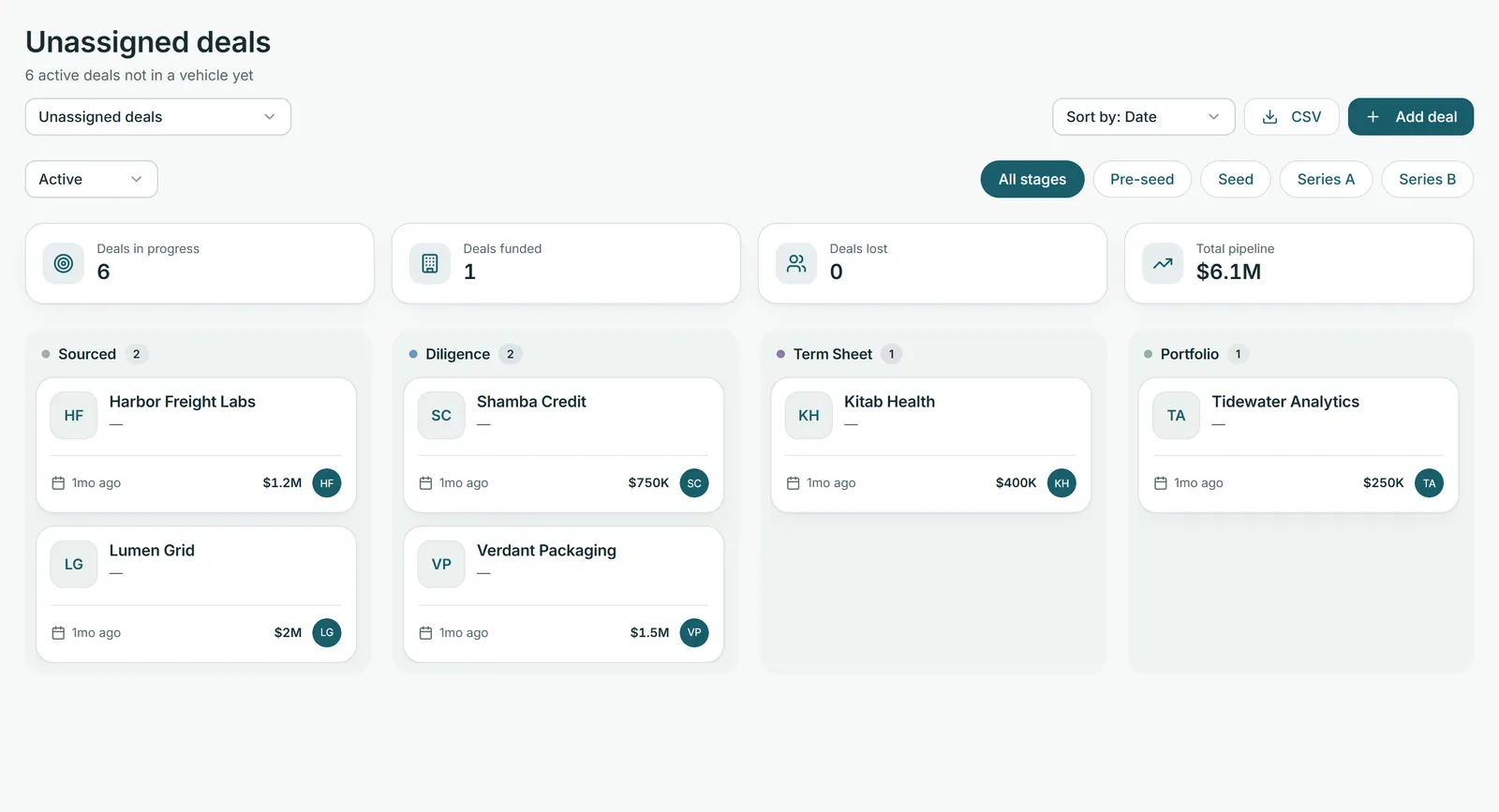
On Fundverse, companies arrive through discovery filtered by your mandate, through your own application forms, or through introductions you log yourself. Each one becomes a card on your pipeline board, and the analysis, documents and conversations attach to that card as the deal moves through your stages.
When a company closes, it doesn't leave the system. It becomes a portfolio company where you record valuation marks and KPIs, and those figures feed the MOIC and IRR you report.
- Companies matched to your mandate, with the reasons each one fits
- A pipeline board with your own stages
- Portfolio marks, KPIs, MOIC and IRR in the same place
- LP reports built from the data you already hold
Where AI helps, and where it doesn't
Marcus, Fundverse's AI analyst, reads a company's deck against your written thesis and returns fund, pass or needs more information, with its reasons. It's a first read that saves partner time on obvious mismatches, not a decision.
For LP reporting, Marcus drafts the executive summary and risk sections of a report from your portfolio data. Your team edits and approves every word before it's shared.