
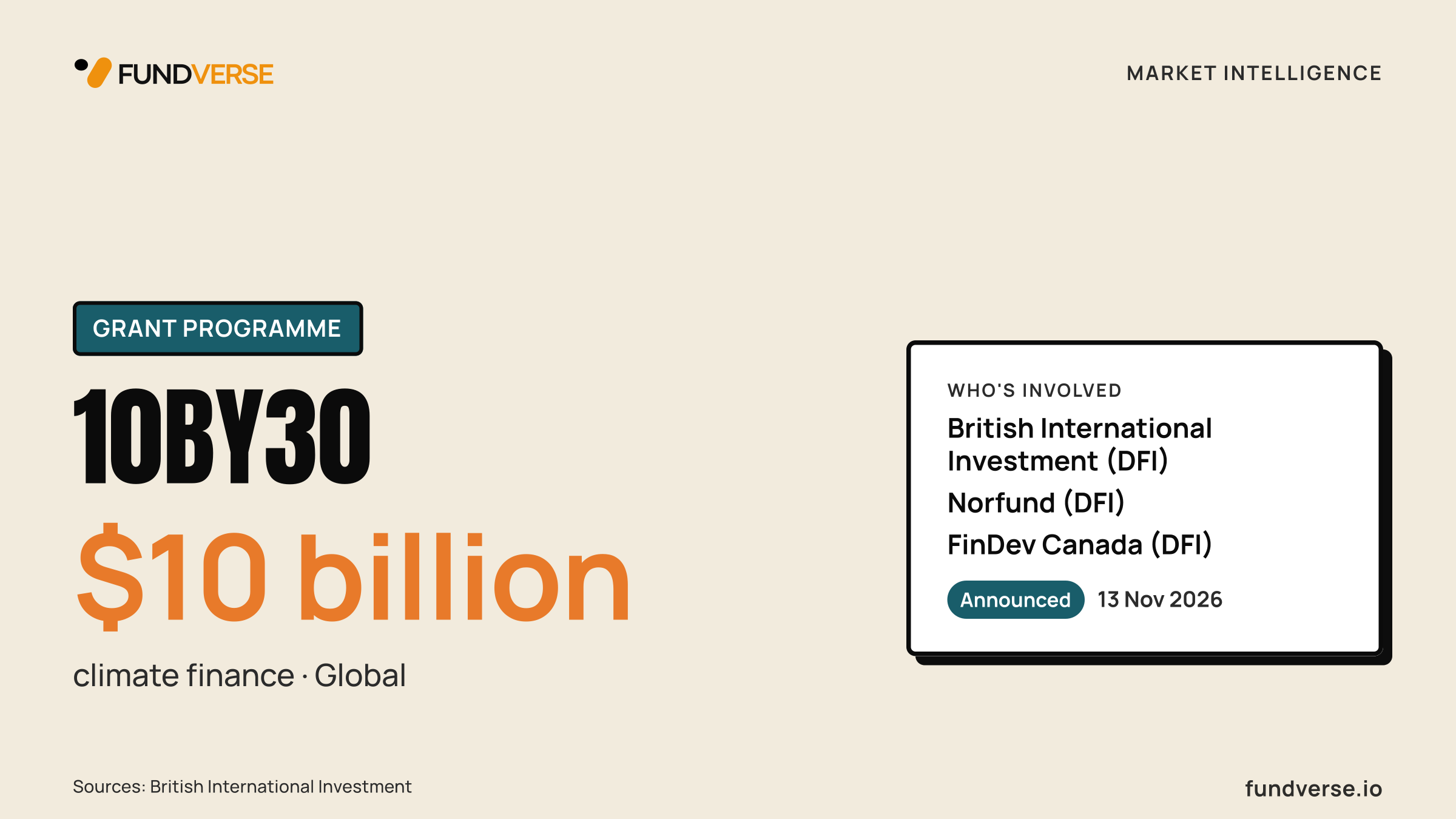

Three development finance institutions have announced 10by30, a collaboration aiming to deliver $10 billion in emerging-market climate finance by 2030 through shared pipelines and co-investment.
The development finance institutions of the UK, Norway and Canada have launched a collaboration called 10by30, announced on November 13, 2026. Its stated aim is to deliver $10 billion in climate finance in emerging markets by 2030.
The target is a goal, not money already committed or deployed. The announcement describes an intention to coordinate, and the source from British International Investment does not say how much of the $10 billion has been allocated so far.
Who is involved
Three institutions are behind the programme: British International Investment (BII), Norfund and FinDev Canada, which represent the UK, Norway and Canada respectively. Each is a development finance institution (DFI), meaning a public-mandate investor that puts capital into private businesses and projects in developing economies.
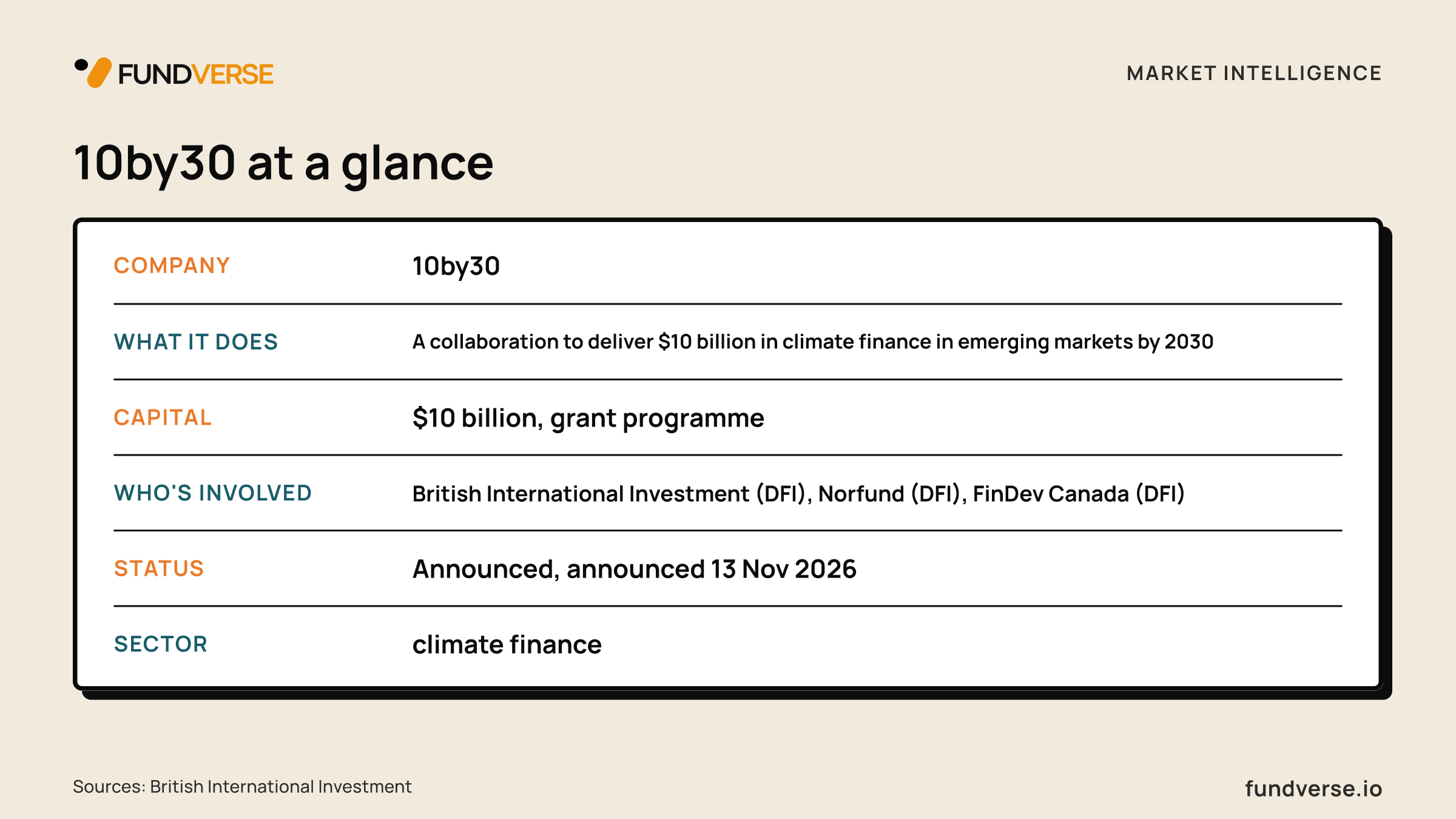
The announcement does not name other participants, and it does not say whether more institutions could join later. It also does not give a split of the $10 billion among the three.
How the collaboration will work
Under a memorandum of understanding, the institutions will share pipelines, coordinate due diligence and co-invest in flagship transactions. A memorandum of understanding sets out intent to cooperate; it is not the same as a binding fund or a pooled vehicle.
Shared pipelines and due diligence
Sharing pipelines means each institution can see deals the others are considering. Coordinating due diligence suggests that checks on a company or project may be run once, or in a joined-up way, instead of being repeated by each investor. The announcement does not describe the mechanics, so how this works in practice for a company in the process is not yet known.
Co-investment in flagship deals
The institutions also plan to co-invest in flagship transactions. The source does not define what qualifies as flagship, nor does it specify the instruments, such as equity, debt or guarantees, that will be used.
Why it matters to founders and funders
For companies seeking climate capital in emerging markets, three institutions coordinating their work could change how they are approached. A business that fits the mandates of more than one of them may find the process joined up. This is an inference from the stated design, not something the announcement promises, and the source gives no eligibility criteria or application route.
For other capital providers, co-investment among DFIs is often relevant because it can shape which deals reach a point where private investors are invited alongside. Whether 10by30 will invite outside co-investors was not disclosed. Founders preparing for this kind of capital can read why promising businesses struggle to access capital and look at how alternative funding routes in emerging markets work alongside venture funding.
Raising climate or impact capital in an emerging market? Use Fundverse to find investors whose mandates fit your business and to keep your due diligence materials organized in one place.
What the evidence does not show
A launch announcement is not proof that $10 billion will be delivered. The figure is a target for 2030, and the announcement gave no timeline for individual deals, no pipeline size and no first transactions. It would be a stretch to conclude from it alone that climate finance in emerging markets has become easier to access.
The useful signals to watch are concrete: the first co-investments the three institutions announce, whether the shared due diligence shortens timelines for investees, and whether the collaboration widens beyond its three founding members.
Frequently asked questions
Topics
10by30
climate finance
development finance institutions
British International Investment
Norfund
FinDev Canada
emerging markets
co-investment
Raising or investing?
Find the right people on the other side of the table, and run the round in one place.